|
| |
|
The below is
The CBSI
Executive Council approved version of Clan Buchanan’s history after which is
another section also from them about
"Why the issue of the Clan Buchanan Chief can not be challenged” After
that you will find the old history of the clan.
Clan Buchanan: History,
Genealogy, and Heritage
Clan Buchanan is one of the oldest and most historically significant
Highland clans of Scotland. For centuries the clan occupied lands along the
eastern shores of Loch Lomond in Stirlingshire, where the Buchanans
established themselves as one of the principal families of the Lennox
district. The ancient lands of Buchanan, from which the clan takes its name,
remained in Buchanan possession for nearly seven hundred years and became
inseparably connected with the clan’s identity, traditions, and influence in
Scottish history.
The name Buchanan is generally accepted to derive from the Gaelic Buth
Chanain, meaning “Canon’s House” or “House of the Canon,” suggesting an
early association with the Celtic Church and ancient ecclesiastical
settlements near Loch Lomond. The district itself eventually became known as
Buchanan, and the family who held those lands adopted the territorial
designation as their surname according to medieval Scottish custom.
One of the earliest and most important locations associated with the clan is
Clairinch, a small island in Loch Lomond traditionally regarded as the
ancient gathering place of the Buchanans. Clairinch later became the clan
slogan or war cry and remains one of the enduring symbols of Buchanan
identity. The island also possessed religious significance and may have
served as an early ecclesiastical center before the rise of the clan system
in Scotland.
Modern historical and genetic research has substantially reshaped
understanding of the origins of Clan Buchanan. Earlier traditions attempted
to connect the clan with external migration stories, but recent DNA evidence
gathered through the Clan Buchanan Y-DNA Project strongly indicates that the
Buchanans were established in the Loch Lomond region well before the year
1000 CE. The studies also demonstrate a close genetic relationship with Clan
Gregor, suggesting that both clans descend from a common ancestral
population within the ancient Kingdom of Alba.
Many Buchanan historians now believe the clan descended from ancient
P-Celtic or Brittonic peoples who migrated into Britain during the Bronze
Age. These early peoples eventually settled in western Scotland, especially
in Kintyre, Argyll, and the Lennox district, where over centuries they
developed into the territorial kindreds that later emerged as Highland
clans. The Buchanans became firmly established around Loch Lomond and
gradually emerged as hereditary lords of the district that came to bear
their name.
The genealogical traditions of Clan Buchanan trace the chiefly line through
a succession of lairds who held the Buchanan estate under the Earls of
Lennox. Historical records become increasingly reliable during the
thirteenth century, when individuals bearing the territorial designation “de
Buchkan” or “de Buchanan” begin appearing in surviving charters.
Around 1224, Dominus Absalon de Buchkan witnessed a charter granted by
Malcolm, Earl of Lennox, marking one of the earliest known documentary
references to the Buchanan name. During the reign of Alexander II, Maurice
Buchanan received confirmation of the Buchanan lands from the Earl of
Lennox, firmly establishing hereditary possession of the estate and
strengthening the family’s authority within the Lennox.
From Maurice descended a long succession of Buchanan chiefs who expanded the
clan’s influence through landholding, marriage alliances, military service,
and loyalty to the Scottish Crown. The genealogy of the chiefly line
traditionally proceeds through:
-
Maurice Buchanan of
Buchanan
-
Walter Buchanan
-
Patrick Buchanan
-
Walter Buchanan of that
Ilk
-
Patrick Buchanan
-
Walter Buchanan
-
John Buchanan
-
Sir Walter Buchanan
-
Patrick Buchanan
-
George Buchanan
-
Sir John Buchanan
-
Walter Buchanan
-
Patrick Buchanan
-
George Buchanan
-
John Buchanan, 22nd laird
of Buchanan
Though precise dates and
succession details vary among surviving historical records, the continuity
of the chiefly line reflects centuries of Buchanan leadership in the Lennox
district.
As the clan expanded, numerous cadet branches emerged from younger sons of
the chiefly line. Among the most important were the Buchanans of Leny,
Arnprior, Drumakill, Carbeth, Auchmar, Spittal, Craigend, Blairlusk, Garden,
and Ardoch. These branches became influential landowners and local leaders
throughout Scotland. The Buchanans of Leny later became especially
significant because they represented the senior surviving cadet branch after
the extinction of the direct chiefly line.
Clan Buchanan participated in many of Scotland’s major historical conflicts.
During the Wars of Scottish Independence the clan supported Robert the Bruce
in the struggle for Scottish sovereignty. Buchanan warriors later fought at
the Battles of Flodden in 1513 and Pinkie in 1547 alongside other Highland
and Lowland clans.
The clan also gained distinction abroad during the Hundred Years’ War.
Scottish forces were sent to France to support the French crown against
England, and Buchanan tradition records that Sir Alexander Buchanan achieved
lasting fame at the Battle of Bauge in 1421. According to historical
accounts, Sir Alexander slew Humphrey, Duke of Clarence — brother of King
Henry V of England — during fierce combat before being killed himself. The
exploit brought considerable honor to both the Buchanan name and the
Scottish forces serving in France.
The Buchanans maintained close historical ties with neighboring clans
throughout the Highlands, especially Clan Gregor. Geographic proximity,
intermarriage, shared traditions, and modern genetic evidence all point
toward a deep ancestral relationship between the two clans. During periods
when the MacGregors suffered persecution, some sought protection among
Buchanan families and occasionally adopted allied surnames.
Religion, scholarship, and public service also played major roles in
Buchanan history. The clan produced notable churchmen, educators, soldiers,
merchants, and statesmen over many centuries. Among the most distinguished
figures associated with the name was George Buchanan, the renowned
sixteenthcentury scholar, historian, poet, and political philosopher.
Educated in Paris and celebrated throughout Europe, George Buchanan became
tutor to the young James VI of Scotland and wrote influential works on
monarchy, liberty, history, and classical literature. He remains one of the
foremost intellectual figures of the Scottish Renaissance.
The principal seat of the clan for generations was Buchanan Auld House in
Stirlingshire. The estate served as the administrative and symbolic center
of the clan throughout the medieval and early modern periods. The chiefs
exercised considerable authority throughout the Lennox and maintained
alliances with neighboring clans and noble houses.
Despite long periods of prosperity, the chiefly line eventually encountered
financial and succession difficulties. John Buchanan, the 22nd laird of
Buchanan, died in 1681 without a direct male heir. Increasing debts and
legal complications forced the sale of the Buchanan estate in 1682 to James
Graham, Marquess of Montrose, chief of Clan Graham. This marked the end of
nearly seven centuries of Buchanan ownership of their ancestral lands around
Loch Lomond.
Following the loss of the estate, the direct chiefly line effectively ended.
The chiefship passed uncertainly among cadet branches, particularly the
Buchanans of Leny, but eventually the clan became officially armigerous —
existing without a formally recognized chief under Scottish heraldic law for
more than three centuries.
Even after the loss of their ancestral lands, the Buchanans remained
prominent in commerce, civic affairs, and military service. During the
eighteenth century several Buchanan families became deeply involved in
Glasgow’s expanding mercantile economy. George Buchanan of Auchintoshan,
Andrew Buchanan of Drumpellier, Archibald Buchanan of Auchintorlie, and Neil
Buchanan of Hillington emerged as influential merchants and civic leaders
who helped shape Glasgow into one of Britain’s leading commercial cities.
In 1725 these prominent Buchanans founded the Buchanan Society of Glasgow,
one of the oldest charitable societies in the city. The society provided
educational assistance, financial aid, and charitable support to members of
the Buchanan name and their descendants.
As Scots emigrated throughout the world, Clan Buchanan spread widely across
North America, the Caribbean, Australia, New Zealand, and South Africa.
Buchanan descendants became farmers, merchants, soldiers, clergy, educators,
politicians, and pioneers in many countries throughout the British Empire
and beyond.
The clan’s heraldry reflects its long and honorable history. The clan motto,
Clarior Hinc Honos, translates as “Brighter Hence the Honour.” The crest
badge traditionally depicts a hand holding a ducal cap, symbolizing dignity,
loyalty, and honorable service. Clan tartans associated with the Buchanans
became internationally recognized and remain widely worn by descendants
today.
A large number of surnames and sept names became historically associated
with Clan Buchanan through kinship, tenancy, alliance, and territorial
connection. Families connected with Buchanan lands or longstanding clan
relationships often identified themselves with the clan over many
generations, helping preserve Buchanan identity even during periods without
recognized chiefly leadership.
For more than three hundred years Clan Buchanan existed without an
officially recognized chief. Extensive genealogical and historical research
was undertaken in the modern era to identify the rightful representative of
the chiefly line. In 2018 the Lord Lyon King of Arms formally recognized
John Michael Baillie-Hamilton Buchanan as Chief of Clan Buchanan, restoring
official leadership to the clan for the first time since the death of the
22nd laird in 1681.
The new chief, whose formal title will be The Buchanan, said he was
"honoured and proud" to take up the role. The Lord Lyon King of Arms, who is
head of the Lyon Court which regulates Scottish heraldry, formally upheld a
petition for Mr Buchanan to assume the chiefship. It follows decades of
research conducted by renowned genealogist Hugh Peskett, who traced former
US President Ronald Reagan's Irish ancestry in the 1980s. Mr Buchanan, who
is the manager of Cambusmore Estate in Callander, Stirlingshire, the current
Clan seat, said it had been "a long journey" to prove his family's lineage.
The restoration of the chiefship marked a major moment in modern clan
history and was celebrated by Buchanan societies and descendants throughout
the world. Today Clan Buchanan remains active through international
organizations, genealogical projects, Highland games, historical societies,
and cultural gatherings dedicated to preserving Scottish heritage and
Buchanan traditions.
Though the ancestral lands passed from Buchanan ownership centuries ago,
Clan Buchanan remains forever linked with Loch Lomond, Clairinch, the
Lennox, and the historic district of Buchanan in Stirlingshire. The story of
the clan reflects the wider history of Scotland itself — ancient origins,
Highland traditions, warfare, scholarship, migration, resilience, and
enduring pride in family and heritage.
You can learn more on their
web site at:
www.theclanbuchanan.com/history-1
www.theclanbuchanan.com/history-2
The Clan Buchanan
Chieftainship Can Not be Challenged
1. The Lord Lyon, and the Court of the Lord Lyon operates under strict
rules, disregarding DNA evidence and relying solely on documented
genealogical trails for claims to Chiefship.
2. The Buchanan's claim to the Chiefship involved voluminous documentation,
including 302 supporting documents such as birth certificates and family
tree charts.
3. Public advertisements and notifications were made through various
channels, including the Buchanan Society, the Clan Buchanan Society
International and the Glasgow Herald, allowing potential challengers to come
forward.
4. One criterion for Chiefship is the use of the surname Buchanan, with
exceptions for temporary use by a lady heir.
5. The legal basis for challenging the Chiefship was addressed through a
two-part claim process initiated by Lord Lyon who chose to address The
Buchanan’s claim in two parts.
6. The first part required potential claimants to present evidence,
effectively ruling out future challenges by those who failed to come
forward.
7. The second part of the claim involved proving a real link to the Buchanan
of that Ilk line, supported by genealogist Hugh Peskett's analysis.
8. Peskett's research indicated the extinction of earlier lines, further
solidifying Michael Buchanan, The Buchanan's claim.
9. Hugh Peskett’s past experiences with similar cases suggest that those
unable to substantiate their lineage ultimately failed to make a formal
challenge. This occurred in The Buchanan’s path to our Clan’s Chieftainship.
10. Despite potential claims following public events, the BBC documentary,
the internet; the legal framework and validation process have preempted any
legitimate challenges to the Chiefship of Clan Buchanan. The Chieftainship
to Clan Buchanan can not be challenged, the matter is resolved
11. The Clan Buchanan Society International (CBSI) and the The Buchanan
Society had nothing to do with The Buchanan’s claim to become the Clan
Buchanan Chief. CBSI supports the process and The Buchanan in this matter.
Old
History
The Buchanans belong to a numerous clan in Stirlingshire, and
the country on the north side of Loch Lomond. The reputed founder of the
clan was Anselan, son of O'Kyan, king of Ulster, in Ireland, who is said to have been
compelled to leave his native country by the incursions of the Danes, and take refuge in
Scotland. he handed, with some attendants, on the northern coast of Argylshire, near the
Lennox, about the year 1016, and having according to the family tradition, in all such
cases made and provided, lent his assistance to King Malcolm the Second in repelling his
old enemies the Danes, on two different occasions of their arrival in Scotland, he
received from that king for his services a grant of land in the north of Scotland. The
improbable character of this genealogy is manifested by its farther stating that the
aforesaid Anselan married the heiress of the lands of Buchanan, a lady named Dennistoun;
for the Dennistouns deriving their name from lands given to a family of the name of
Danziel, who came into Scotland with Alan, the father of the founder of the Abbey of
Paisley, and the first dapifer, seneschal, or steward of Scotland, no heiress of that name
could have been in Scotland until long after the period here referred to. It is more
probable that a portion of what afterwards became the estate of Buchanan formed a part of
some royal grant as being connected with the estates of the Earls of Lennox, whom Skene
and Napier have established to have been remotely connected with the royal family of the
Canmore line, and to have been in the fist instance administrators, on the part of the
crown, of the lands which were afterwards bestowed upon them.
The name of Buchanan is territorial, and is now that of a parish in Stirlingshiure, which
was anciently called Inchcaileoch ("old woman's island"), from an island of that
name in Loch Lomond, on which in earlier ages there was a nunnery, and latterly the parish
church for a century after the Reformation. In 1621 a detached part of the parish of Luss,
which comprehends the lands of the family of Buchanan, was included in this parish, when
the chapel of Buchanan was used for the only place of worship, and gave the name to the
whole parish.
Anselan (in the family genealogies styled the third of that name) the seventh laird of
Buchanan, and the sixth descent from the above-named Irish prince, but not unlikely to be
the first of the name, which is Norman French, is dignified in the same records with the
magniloquent appellation of seneschal or chamberlain to Malcolm the first Earl of Levenax
(as Lennox was then called). In 1225, this Anselan obtained from the same earl a charter
of a small island in Lochlomond called Clareinch - witness Dougal, Gilchrist, and Amalyn,
the earl's three brothers - the name of which island afterwards became the rallying cry of
the Buchanans. He had three sons, viz, Methlen, said by Buchanan of Auchmar to have been
ancestor of the Macmillans; Colman, ancestor of the MacColmans; and his successor Gilbert.
His eldest son, Gilbert, or Gillebrid, appears to have borne the surname Buchanan.
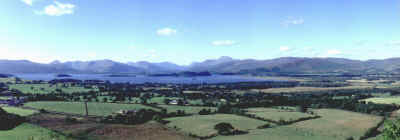
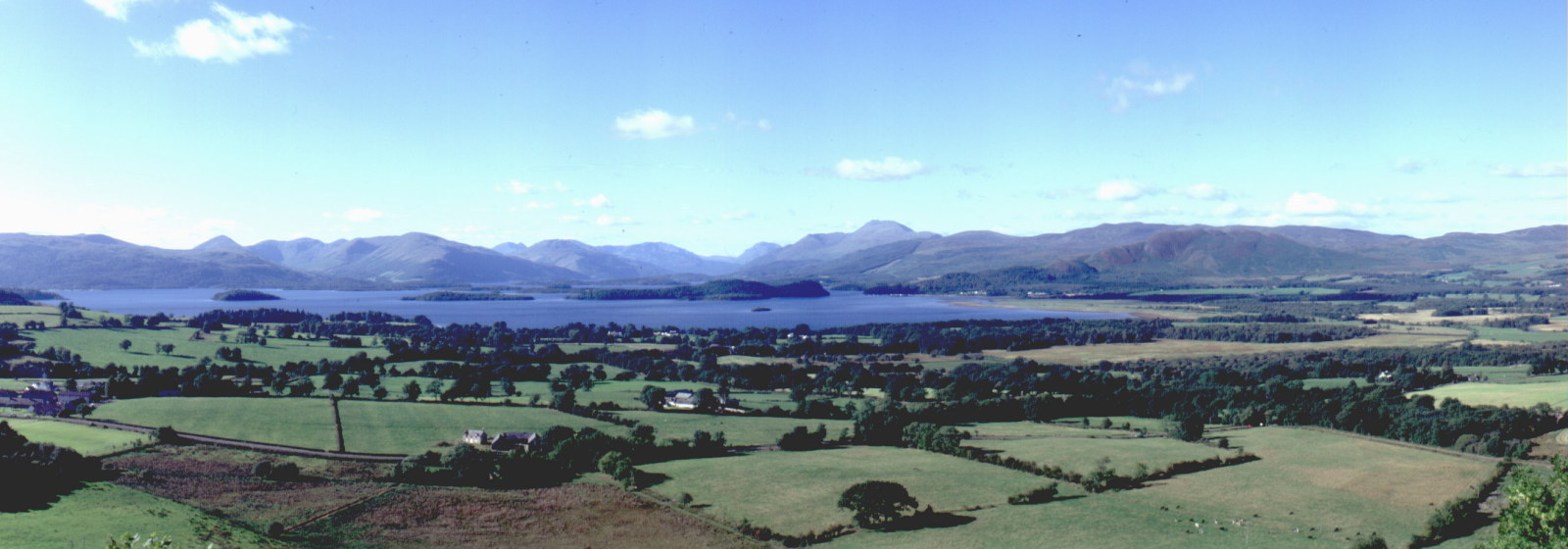
Loch Lomond looking north. The west bank home of Clan
Colquhoun
& Clan MacFarlane. The east bank the home of Clan Buchanan.
Thanks to Scottish Panoramic for this pictures
Sir Maurice Buchanan, grandson of Gilbert, and
son of a chief of the same name, received from Donald, Earl of Lennox, a charter of the
lands of Sallochy, with confirmation of the upper part of the carrucate of Buchanan. Sir
Maurice also obtained a charter of confirmation of the lands of Buchanan from King David
II in the beginning of his reign.
Sir Maurice de Buchanan the second, above mentioned, married a daughter of Menteith of
Rusky, and had a son, Walter de Buchanan, who had a charter of confirmation of some of his
lands of Buchanan from Robert the Second, in which he is designed the king's
"consanguineus", or cousin. His eldest son, John, married Janet, daughter and
sole heiress of John Buchanan of Leny, fourth in descent from Allan already noticed. John,
who died before his father, had three sons, viz, Sir Alexander, Walter, and John, who
inherited the lands of Leny, and carried on that family.
Sir Alexander died unmarried, and the second son, Sir Walter, succeeded to the estate of
Buchanan.
This Sir Walter de Buchanan married Isabel, daughter of Murdoch, Duke of Albany, governor
of Scotland, by Isabel, countess of Lennox, in her own right. With a daughter, married to
Gray of Foulis, ancestor of Lord Gray, he had three sons, viz, Patrick, his successor;
Maurice, treasurer to the Princess Margaret, the daughter of King James I, and Dauphiness
of France, with whom he left Scotland; and Thomas, founder of the Buchanans of Carbeth.
The eldest son, Patrick, acquired a part of Strathyre in 1455, and had a charter under the
great seal of his estate of Buchanan, dated in 1460. He had two sons and a daughter,
Anabella, married to her cousin, James Stewart of Baldorrans, grandson of Murdoch, Duke of
Albany. Their younger son, Thomas Buchanan, was, in 1482, founder of the house of
Drumakill, whence, in the third generation, came the celebrated George Buchanan. Patrick's
elder son, Walter Buchanan of that ilk, married a daughter of Lord Graham, and by her had
two sons, Patrick and John, and two daughters, one of them married to the laird of Lamond,
and the other to the laird of Ardinglass.
John Buchanan, the younger son, succeeded by testament to Menzies of Arnprior, and was the
facetious "King of Kippen", and faithful ally of James V. The way in which the
laird of Arnprior got the name of "King of Kippen" is thus related by a
tradition which Sir Walter Scott has introduced into his Tales of a Grandfather: -
"When James the Fifth travelled in disguise, he used a name which was known only to
some of his principle nobility and attendants. He was called the Goodman (the tenant, that
is) of Ballengeich. Ballengeich is a steep pass which leads down behind the castle of
Stirling. Once upon a time when the court was feasting in Stirling, the king sent for more
venison from the neighbouring hills. The deer was killed and put on horses' backs to be
transported to Stirling. Unluckily they had to pass the castle gates of Arnprior,
belonging to a chief of the Buchanans, who chanced to have a considerable number of guests
with him. It was late, and the company were rather short of victuals, though theyhad more
than enough liquor. The chief, seeing so much fat venison passing his very door, seized on
it, and to the expostulations of the keepers, who told him it belonged to King James, he
answered insolently, that if James was king of Scotland, he (Buchanan) was king in Kippen;
being the name of the district in which Arnprior lay. On hearing what had happened, the
king got on hoseback, and rode instantly from Stirling to Buchanan's house, where he found
a strong fierce-looking Highlander, with an axe on his shoulder, standing sentinel at the
door. This grim warder refused the king admittance, saying that the laird of Arnprior was
at dinner, and would not be disturbed. 'Yet go up to the company, my good friend' said the
king, 'and tell him that the Goodman of Ballengeich is come to feast with the King of
Kippen'. The porter went grumbling into the house, and told his master that there was a
fellow with a red beard at the gate, who called himself the Goodman of Ballengeich, who
said he was come to dine with the King of Kippen. As soon as Buchanan heard those words,
he knew that the king was come in person, and hastended down to kneel at James's feet, and
to ask forgiveness for his insolent behaviour. But the king, who only meant to give him a
fright, forgave him freely, and, going into the castle, feasted on his own vension which
Buchanan had intercepted. Buchanan of Arnprior was ever afterwards called the King of
Kippen". He was killed at the battle of Pinkie in 1547.
The elder son, Patrick, who fell on Flodden field, during his father's lifetime, had
married a daughter of the Earl of Argyll. She bore to him two sons and two daughters. The
younger son, Walter, in 1519, conveyed to his son Walter the lands of Spittal, and was
this the founder of that house. On the 14th December of that year, he had a charter from
his father of the temple-lands of Easter-Catter.
The elder son, George Buchanan of that ilk, succeeded his grandfather, and was sheriff of
Dumbartonshire at the critical epoch of 1561. By Margaret, daughter of Edonstone of
Duntreath, he had a son, John, who died before his father, leaving a son. By a second
lady, Janet, daughter of Cunninghams of Craigans, he had Willian, founder of the now
extinct house of Auchmar.
John Buchanan, above mentioned as dying before his father, George Buchanan of that ilk,
was twice married, first to the Lord Livingston's daughter, by whom he had one son,
George, who succeeded his grandfather. The son, Sir George Buchanan, married Mary Graham,
daughter of the Earl of Monteith, and had, with two daughters, a son, Sir John Buchanan of
that ilk. Sir John married Anabella Erskine, daughter of Adam, commendator of
Cambuskenneth, a son of the Master of Mar. He had a son, George, his successor, and a
daughter married to Campbell of Rahein.
Sir George Buchanan the son married Elizabeth Preston, daughter of the laird of
Craigmillar. Sir George was taken prisoner at Inverkeithing, in which state he died in the
end of 1651, leaving, with three daughters, one son, John, the last laird of Buchanan, who
was twice married, but had no male issue. By his second wife, Jean Pringle, daughter of Mr
Andrew Pringle, a minister, he had a daughter Janet, married to Henry Buchanan of Leny.
John, the last laird, died in December 1682. His estate was sold by his creditors, and
purchased by the ancestor of the Duke of Montrose.
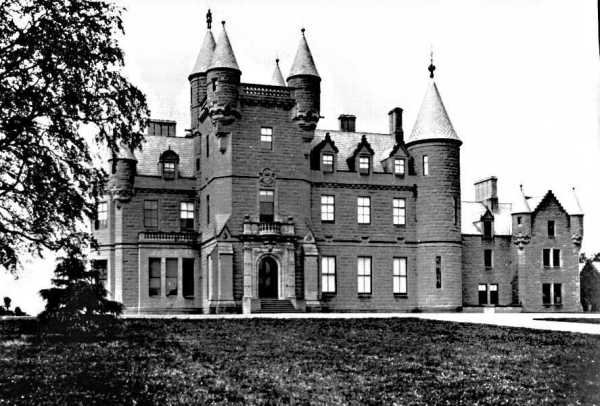
The barons or lairds of Buchanan built a caslte in Stirlingshire, where the present
Buchanan house stands, formerly called the Peel of Buchanan. Part of it exists, forming
the charter-room. A more modern house was built by these chiefs, adjoining the east side.
This mansion came into the possession of the first Duke of Montrose, who made several
additions to it, as did also subsequent dukes, and it is now the chief seat of that ducal
family in Scotland.
The principal line of the Buchanans becoming, as above shown, extinct in 1682, the
representation of the family devolved on Buchanan of Auchmar. This line became, in its
turn, exict in 1816, and, in the absence of other competitors, the late Dr Francis
Hamilton-Buchanan of Bardowie, Spittal, and Leny, as heir-male of Walter, first of the
family of Spittal, established in 1826 his claims as chief of the clan.
The last lineal male desendant of the Buchanans of Leny was Henry Buchanan, about 1723,
whose daughter and heiress, Catherine, married Thomas Buchanan of Spittal, an officer in
the Dutch srvice, who took for his second wife, Elizabeth, youngest daughter of John
Hamilton of Bardowie, the sole survivor of her family, and by her he had four sons and two
daughters. Their eldest son John, bron in 1758, succeeded to the estate of Bardowie, and
assumed the additional name of Hamilton, but dying without male issue, was succeeded by
his brother, the above named Dr Francis Hamilton-Buchanan.
There were at one time so many heritors of the name of Buchanan, that it is said the laird
of Buchanan could, in a summer's day, call fifty heritors of his own surname to his house,
upon any occasion, and all of them might with convenience return to their respective
residences before night, the most distant of their homes not being above ten miles from
Buchanan Castle.
|
Another Account of the Clan
BADGE: Dearcag monaidh (vaccineum
uliginosum) Bilberry.
SLOGAN: Clairinch!
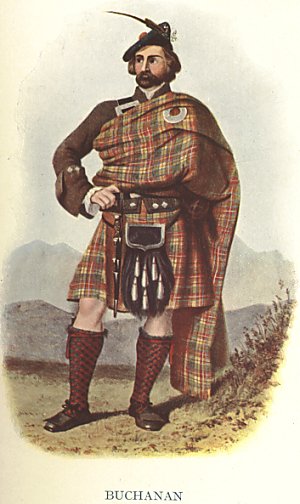 THE
name of the Clan Buchanan is almost alone among those of Highland families
in being derived, not from a personal ancestor, but from the lands on
which the Clan was settled. These lands extended of old along the east
shore of Loch Lomond, from the borders of Drymen parish northward for some
eighteen miles, and included, besides Ben Lomond itself, as fine a stretch
of country—strath and mountain—as any in the Highlands. Branches of
the Clan also owned lands in the neighbouring parish of Drymen, and on
both sides of the Water of Endrick, which here enters the Queen of
Scottish Lochs, as well as about Killearn and Balfron and further east at
Arnpryor, near Kippen; so that a good deal more than the actual parish of
Buchanan may be considered as the old Buchanan country. Strange to say,
however, this Buchanan country does not appear to have been the original
territory owned by the Chiefs of the race in Scotland. According to the
family historian, Buchanan of Auchmar, the founder of the race was a
certain Anselan O’Kyan, of royal race, like that of the O’Neils in
Ireland, who came over to escape troubles in the sister island about the
year 1016, and with his followers took service under Malcolm II., at that
time engaged in his great struggle against the invading Danes. For his
services in this struggle, Anselan was granted the lands of Buchanan in
Stirlingshire and of Pitquhonidy and Strathyre in Perthshire. Anselan
further secured his footing in the Buchanan country by marrying an heiress
of the Dennistoun family, the lands he got by her including Drumquhassle
on the Water of Endrick. THE
name of the Clan Buchanan is almost alone among those of Highland families
in being derived, not from a personal ancestor, but from the lands on
which the Clan was settled. These lands extended of old along the east
shore of Loch Lomond, from the borders of Drymen parish northward for some
eighteen miles, and included, besides Ben Lomond itself, as fine a stretch
of country—strath and mountain—as any in the Highlands. Branches of
the Clan also owned lands in the neighbouring parish of Drymen, and on
both sides of the Water of Endrick, which here enters the Queen of
Scottish Lochs, as well as about Killearn and Balfron and further east at
Arnpryor, near Kippen; so that a good deal more than the actual parish of
Buchanan may be considered as the old Buchanan country. Strange to say,
however, this Buchanan country does not appear to have been the original
territory owned by the Chiefs of the race in Scotland. According to the
family historian, Buchanan of Auchmar, the founder of the race was a
certain Anselan O’Kyan, of royal race, like that of the O’Neils in
Ireland, who came over to escape troubles in the sister island about the
year 1016, and with his followers took service under Malcolm II., at that
time engaged in his great struggle against the invading Danes. For his
services in this struggle, Anselan was granted the lands of Buchanan in
Stirlingshire and of Pitquhonidy and Strathyre in Perthshire. Anselan
further secured his footing in the Buchanan country by marrying an heiress
of the Dennistoun family, the lands he got by her including Drumquhassle
on the Water of Endrick.
MacAuslan remained
for two centuries and a half the name of the Chiefs of the family, and it
remains, of course, an independent surname to the present hour. The first
of the race to be styled "de Buchanan" was Gillebrid, who was
seneschal to the Earl of Lennox, and flourished in 1240. Meanwhile, in
1225 Macbeth, the father of Gillebrid de Buchanan, had obtained from
Maelduin, Earl of Lennox, a charter for the island of Clarinch, near Balmaha,
and the name of this island afterwards became the slogan or battle-cry of
the Clan. In 1282 Sir Maurice de Buchanan received from Donald, the sixth
Earl of Lennox, a charter of the lands of Buchanan themselves, in which
the Chief was granted the privilege of holding courts of life and limb
within his territory, on condition that everyone sentenced to death should
be executed on the Earl’s gallows at Catter. The charter is printed in
Irving’s History of Dunbartonshire, and the stone in which the
gallows tree was set is still to be seen beside the old judgment hill of
Catter, on Endrickside. At a later day Catter was itself for many
generations in possession of a family named Buchanan.
During the wars of
succession Maurice, the Chief, of Buchanan, had the distinction of being
one of the few notables of Scotland who would not sign the Ragman Roll, or
swear allegiance to Edward I. of England. Another of the name, Malcolm de
Buchanan, signed the bond, but the Chief stood firmly for the Independence
of Scotland and the cause of Robert the Bruce. Auchmar records a tradition
that, after the defeat at Dalrigh, Bruce was joyfully received in the
Buchanan country by its Chief, that the King’s Cave, near Inversnaid,
takes its name from this episode, and that Buchanan with the Earl of
Lennox afterwards conveyed the King to safety.
From an early date the
family of the Chiefs gave off branches, many of which remain of note to
the present hour. Thus Allan, second son of Maurice, the ninth laird,
married the heiress of Leny. His line ended in an heiress, Janet, who
married John, son of the eleventh Chief of Buchanan, and became mother of
the twelfth Chief. The eldest grandson of this pair distinguished himself
in the wars abroad. After the battle of Agincourt, when France, on the
strength of the "auld alliance," asked help from Scotland, and
7,000 men were sent over, Sir Alexander Buchanan went at the head of a
number of his clan, and at the battle of Beaugé is said to have
encountered the Duke of Clarence, and, escaping his thrust, to have
pierced him through the left eye, and on his fall to have carried off his
cap or coronet on his spear’s point. The usual account is that Clarence
was slain by the Earl of Buchan, Constable of France, but in telling the
story, Buchanan of Auchmar quotes the book of Pluscardine Abbey, and
declares that according to the family tradition it was for this service
that the French King granted the Buchanan Chief the double tressure flory
counterfiory, which forms part of the Buchanan arms to the present day,
and also for crest a hand holding a ducal cap. Sir Alexander Buchanan was
himself afterwards killed at the battle of Verneuil in 1424.
Sir Alexander’s next
brother, Sir Walter, became thirteenth Laird of Buchanan, while the third
brother, John, inherited his grandmother’s estate of Leny, and became
ancestor of the Buchanans of that branch.
From Thomas, third son of
Sir Walter, the thirteenth Laird, who is stated by Auchmar to have married
Isobel, a daughter of Murdoch Stewart, Duke of Albany, grandson of King
Robert II., came the Buchanans of Carbeth. And from Thomas, second son of
Patrick, the fourteenth Laird, came the Buchanans of Drumakil, with its
branches, the Buchanans of The Moss, and others.
An interesting story is
told of the founding of the house of Buchanan of Arnpryor by John, second
son of Walter, the fifteenth Chief, and a daughter of Lord Graham. In the
days of James IV., Arnpryor was in possession of a laird of the Menzies
family. This laird was childless, and as he began to be oppressed with
years, a neighbour, Forrester of Cardin, on pretence of a false debt,
threatened that, if he did not assign the estate and castle to him, he
would attack and capture them by force of arms. In his distress Menzies
appealed to the Chief of Buchanan, offering, in return for a guarantee of
protection during his life, to leave his lands and estate to one of the
Chief’s family. The offer was accepted, the obligation faithfully
carried out, and the estate duly left to the Chief’s second son.
Of the descendant of this
individual, the Laird of Ampryor in the days of King James V., an amusing
story is told. As the King’s forester was returning to Stirling on a
certain occasion with deer for the royal table, Arnpryor took the liberty
of appropriating the venison for his own use. He would listen to no
remonstrance, declaring with a laugh that if James was King of Scotland,
he, Buchanan, was King of Kippen. The forester proceeded to Stirling, and
laid his complaint before the King, and forthwith that monarch, so well
known for his exploits in disguise as the Guidman of Ballingeich, betook
himself in person to the gates of Arnpryor. There he was roughly refused
admittance by the porter, who informed him that the laird was at dinner,
and could not be disturbed. James thereupon ordered the man to inform his
master that the King of Scotland had come to dine with the King of Kippen.
On receipt of the message Buchanan flew to the gate, and proceeded to make
the most profuse and eager apologies.
At this, it is said, the
King only laughed. He forthwith joined the laird in partaking of his own
royal venison, and for ever after Buchanan of Arnpryor was known as the
King of Kippen. A signet ring, given by James, is still in possession of
the Chief of Buchanan.
Patrick, the sixteenth
Chief of Buchanan, married a daughter of the Earl of Argyll, while John
Buchanan of Leny married a daughter of the Earl of Menteith, and both fell
at the battle of Flodden in 1513. The clan also fought bravely for Queen
Mary at Pinkie in 1547 and at Langside in 1568.
The latter event brought
upon the stage of Scottish history a member of the clan who must always
remain famous as one of the greatest of Scottish scholars and men of
letters. George Buchanan was the third son of Thomas Buchanan of Mid
Leowen, now known as The Moss, on the water of Blane, some two or three
miles south of Killearn. Thomas Buchanan was the second son of Buchanan of
Drumakil, through whom he had the blood of a daughter of King Robert III.
in his veins. His wife was Agnes Heriot, of the family of Trabroun in
Haddingtonshire, and his son George first saw the light in February, 1506.
Thomas Buchanan of Mid Leowen died early, leaving his widow to struggle
valiantly for the upbringing of her eight children by the frugal
cultivation of the little estate. At the age of fourteen the future
historian was sent by James Heriot, his mother’s brother, to pursue his
studies at Paris University, but two years later his uncle died, and he
was forced to return home. He next joined the forces of the Duke of
Albany, to try a soldier’s career; but after the hardships of the winter
retreat from Wark Castle suffered a severe illness, and gave up sword and
buckler. He returned to his studies at St. Andrews and Paris, became
preceptor to the young Earl of Cassillis, and afterwards to a natural son
of James V. Attacking the corruptions of the Greyfriars in his poem
"The Franciscan," he was forced to flee to France in 1539. There
he became famous as the greatest of the Scottish scholars who occupied
chairs in the continental universities. Among those who boasted of being
his pupils was the celebrated Montaigne, while his friends were the
Scaligers, father and son.
Imprisoned in
Portugal by the Inquisition, he an his famous Latin paraphrase of the
Psalms, and he afterwards gained the notice of Mary Oueen of Scots by a
her marriage to the Dauphin. On her return to Scotland, the Queen chose
Buchanan as her Latin tutor, and conferred upon him the temporalities of
Crossraguel Abbey, worth £500 Scots a year. By Mary’s brother, the Earl
of Moray, he was made Principal of St. Leonard’s College at St. Andrews,
and from that time onward he remained a supporter of that personage. Upon
the fall of the Queen he drew up his notorious "Detection" of
her doings. Afterwards, under Moray, he was charged with the education of
James VI., and many amusing stories are told of his discipline of his
royal pupil. For a time he was Keeper of the Privy Seal, and for long he
took a large part in the public affairs of the kingdom; but he is chiefly
remembered now by his two great literary works, the treatise, De Jure
Regni apud Scotos and his Latin History of Scotland. He died on
28th September, 1582, and is esteemed as the last and greatest of the
Latinists, and one of the first apostles of modern democracy.
The scholarly tradition of
the great Latinist and historian was followed by the twentieth Chief, Sir
John Buchanan, who in 1618 mortified a sum of £6,000 Scots for the
maintenance of three students of theology in the University of Edinburgh,
and a like sum for the maintenance of three students in the University of
St. Andrews. In the records of the Burgh of Dunbarton also, this same Sir
John appears as the donor of various grants for the erection of a hospital
there in 1635 and 1636. His wife was a daughter of Lord Cambuskenneth,
grandson of the Earl of Mar. Sir George Buchanan, the twenty-first Chief,
commanded the Stirlingshire Regiment in the Civil Wars of Charles I.,
fought at the battle of Dunbar, and was taken prisoner at Inverkeithing.
The reign of John Buchanan,
the twenty-second Chief, proved disastrous to his house. Some of his
proceedings, as narrated by the family historian, possess not a little of
the character of conventional melodrama. On the death of his first wife,
Mary Erskine, daughter of Lord Cardross, he was left with a daughter,
Elizabeth, who appears to have possessed a will of her own. First he
attempted to make a match for himself with the daughter of Sir John
Colquhoun of Luss, but the young lady jilted him and married Stirling of
Keir, which threw Buchanan into a palsy that troubled him till his death.
He next arranged a match between his daughter and the son of Buchanan of
Arnpryor, and broke the entail of his estate in order to leave it to the
pair; but the plan was spoilt by the young lady refusing her consent. To
punish her, he made a disposition of his estate to Arnpryor, but, going to
Bath just then, fell in love with a Miss Jean Pringle, and married her. He
thereupon cancelled the disposition, and made an enemy of Arnpryor. He
next arranged a marriage for his daughter with his old friend, Major
Grant, Governor of Dunbarton Castle, to whom he made a disposition of his
estate; but again the girl indignantly refused. Grant and he thereupon
arranged to sell the Highland part of the estate to clear it of debt.
Arnpryor then, as Buchanan’s man of business, so manipulated matters
that at the death of the Chief in 1682, the whole estate had to be sold.
It was acquired by the third Marquess of Montrose, grandson of the great
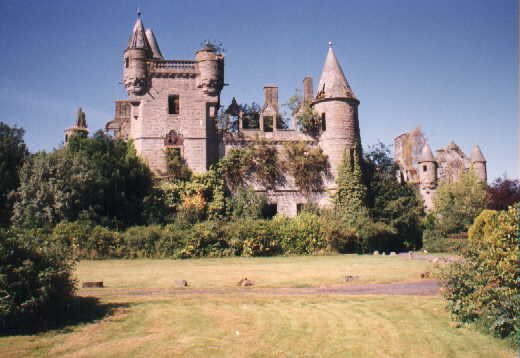
Scottish general of Charles the First’s time. Buchanan House, near the
mouth of the Endrick, the ancient seat of the Chiefs, then became the seat
of the Montrose family, and remained so till about 1870, when it was
destroyed by fire, and was replaced by the present Buchanan Castle. Parts
of the old mansion still remain, and possess considerable interest of
their own.
Elizabeth, daughter of the
last Laird of Buchanan, it is interesting to note, married James Stewart
of Ardvorlich, while her half-sister married Henry Buchanan of Leny.
It was probably owing to
the break in the direct line of the chiefship that the clan took no part
in the Jacobite rebellions of 1715 and 1745, which perhaps was not an
unfortunate circumstance for the bearers of the name.
On the failure of the
direct line, the representation of the ancient race fell to the nearest
heir-male of the family. There is reason to believe that Auchmar’s
account of the clan, published in 1723, had really for its purpose the
advocacy of its author’s own claim to the chiefship as head of the most
recent cadet branch of the family, and therefore nearest in blood to the
last of the main line. Nisbet in his Heraldry indicated a different
destination. It was not till a hundred years later, however, that an
authoritative claim was made. In that printed claim it was declared that
the Auchmar branch of the family had become extinct, and that the
chiefship had therefore fallen to the next nearest cadet branch, that of
Buchanan of Spital or Easter Catter, the old estate of the Knights Templar
in Drymen parish. This family had also come to possess the lands of an
earlier cadet branch, that of Leny. Thomas Buchanan, tenth laird of Spital,
had married, first, Katherine, ultimate heiress of Henry Buchanan of Leny,
and secondly, Elizabeth, heiress of John Hamilton of Bardowie. His son,
Colonel John Buchanan of Leny and Spital had, on inheriting the estate of
Bardowie, assumed the name of Hamilton. In 1818 he was succeeded by his
brother, Francis Buchanan, M.D., an author and man of science, who is said
to have known more about India and its civil and natural history than any
European of his time, and who also assumed the name Hamilton. On 9th July,
1828, Dr. Buchanan was served heir male to his great-gt.-gt.-gt.-gt.-gt.-gt.grandfather,
Walter Buchanan of Spital, and established his claim, the Arnpryor branch
being extinct, as Chief of the Clan Buchanan. The individual through whom
he counted descent was Walter, third son of Walter, the fifteenth Chief of
Buchanan, who became laird of the property of Spital in 1519, as well as
from John, third son of the twelfth Chief, already mentioned. According to
the tradition of the Leny family, it long held possession of these lands
by the preservation of a small sword with which its ancestor first
acquired them. Whoever had the custody of this weapon and a tooth of St.
Fillan was presumed to have a right to the estate. The sword was
abstracted from Leny in 1745.
The Buchanans of Leny have
had an even more turbulent history than the direct line of their original
house on Loch Lomondside. One incident of that history is recorded on a
tombstone still to be seen in the little kirkyard of Balquhidder, near
Strathyre, in what was at one time the MacLaurin country. At a certain
Fair in the Leny territory, it is said, a MacLaurin "innocent"
suffered the indignity of being struck across the face with the tail of a
new-caught salmon. The "innocent" could do little to avenge the
insult, but with a loose tongue he declared that his assailant dared not
try the same trick at the next fair in the MacLaurin country at
Baiquhidder. The episode was promptly forgotten by the
"innocent," but Balquhidder Fair had scarcely begun when a band
of Buchanans was seen coming, fully armed, up the road from Strathyre.
Forthwith the Fiery Cross was sent round, the MacLaurins mustered, and a
battle took place at Auchinleskine. The MacLaurins were getting the worst
of it when their Chief saw his son cut down. Claymore in hand, he shouted
his battle-cry, his clan were filled with the "miri-cath," or
madness of battle, and attacked so furiously that all the invading
Buchanans were slain. The last two, who tried to escape by swimming the
Balvaig, were shot with arrows, and the spot is still pointed out as the
Linn-nan-Seichachan, the "pool of flight."
The Buchanans of Loch
Lomondside were not, however, without their feuds and tragedies. Walter,
the first Laird of Spital, had an illegitimate brother, known as Mad
Robert of Ardwill. This individual got his sobriquet from a curious
incident. He had undertaken, under a heavy penalty, to secure a certain
malefactor for the Laird. The malefactor died, and Robert’s surety was
called upon to pay up. Mad Robert, however, dug up the corpse, carried it
to the court, and duly claimed to have performed his undertaking.
Of the various septs of the
Clan, MacAuslans, MacCalmans, and others, many interesting stories might
be told. Chief of these septs probably are the MacMillans, descended, it
is believed, from Methian, a brother of Gillebrid de Buchanan, the first
of the surname, in the time of King Alexander II. The MacMillans
originally lived around Loch Tay, with Lawers on the north shore for their
chief seat. From that region, however, they were driven out by the
Chalmerses in the reign of David II. The MacMillan Chief of that time had
ten sons, who settled in various parts of the country. The Chief was
MacMillan of Knapdale in Argyllshire, who, it is said, had a charter from
the Lord of the Isles engraved on the top of a rock; and at the chapel of
Kilmory, which was built by the family, is still to be seen the finely
carved MacMillan’s Cross. For the slaughter of an overbearing incomer,
Marallach Mor, a son of MacMillan of Knapdale, had to leave the country,
and settled beside Loch Arkaig in Lochaber, where, under the name of
MacGille Veol, he and his descendants performed many doughty deeds as
Supporters of Lochiel. They could raise no fewer than a hundred fighting
men to support that Chief’s cause, and proved themselves ever ready to
take part in the most desperate enterprises. The MacMillans are said to
have lost their Knapclale estate by taking part with their Superior,
MacDonald of the Isles, in the cause of the rebel Earl of Douglas against
King James II. in 1455.
The MacCalmans derive their
descent from a brother of Gillebrid and Methlan, who settled on Loch Etive
side in the time of Alexander III., and there is evidence that John
Ruskin, the famous writer, was one of the race.
Another interesting branch
of the Clan is that of Buchanan of Drumakil, now represented by Sir
Alexander Leith Buchanan of The Ross on Loch Lomondside. This property was
acquired in 1624 by Walter Buchanan of Drumakil, uncle or cousin of George
Buchanan the historian, and it was within the walls of the mansion that,
after the rebellion of 1745, the Marquis of Tullibardine, elder brother of
the second Duke of Athol, was taken prisoner. On being seized, he is said
to have uttered the prophecy, "There will be Murrays on the Braes of
Atholl when there is never a Buchanan at The Ross! " And, sure
enough, the male line of the Buchanans of The Ross presently came to an
end. The heiress, Jean Buchanan of The Ross, married Hector, son of Colin
MacDonald of Boisdale, who reunited by purchase different properties which
had been alienated from the family estate. At his seat of Ross Priory, he
frequently entertained his brother Clerk of Session, Sir Walter Scott, and
the present laird is the grandson of his second daughter.
Among more modern members
of the Clan who have attained distinction are Douglas Buchanan, the Gaelic
Cowper, who was a catechist at Kinloch Rannoch in 1755; Dr. Claudius
Buchanan, who died in 1815, famous among the first of those who induced
the British nation to send the blessings of education and religion to our
Indian empire; Sir George Buchanan, the famous physician and scientist,
whose reports are among the classics of sanitary literature; and Robert
Buchanan, the famous poet and novelist of our own time.
Still another chapter of
the Clan’s history may be said to have been begun by a holder of the
name who left his native strath at the end of the seventeenth century.
George Buchanan was the younger son of Andrew Buchanan, Laird of
Gartacharan, near Drymen. Migrating to Glasgow to push his fortune, he
took part with the Covenanters at the battle of Bothwell Bridge, and had a
reward set upon his head. After the Revolution, however, he appeared as a
prosperous maltster in the town, and was second Deacon-Convener of the
Trades’ House, in the time of William and Mary. The old maltster had
four sons, all of whom played a striking part in the foundation of Glasgow’s
prosperity. They were George Buchanan of Moss and Auchintoshan, Andrew
Buchanan of Drumpellier, Archibald Buchanan of Silver-banks or
Auchintorlie, and Neil Buchanan of Hillington. All four brothers became
great Glasgow merchants, and built splendid mansions in the city. George
was City Treasurer in 1726, Andrew became Dean of Guild and Lord Provost,
and in 1725 the four brothers founded the Buchanan Society, now the oldest
charitable institution in Glasgow, with the exception of Hutchesons’
Hospital. The Society has a handsome income from funds of its own. It has
supported many a promising youth of the Buchanan Clan or its septs through
college to a useful career in the world, and the amount of solid good that
it has done in the couple of centuries since it was founded must remain
beyond computation. At the present hour the Society is a large and
thriving brotherhood, and its annals, begun by the late Mr. Gray Buchanan,
and now on the eve of publication under the editorship of Dr. R. M.
Buchanan, are certain to excite wide interest, as they will form the
latest chapter in the long history of this ancient Clan.
Septs of Clan Buchanan:
Colman, Dove, Donlevy, Dowe, Dow, Gilson, Gibb, Harper, Gilbertson, Lennie,
Harperson, Macaldonich, Macandeoir, MacAuslan, MacCalman, MacCalmont,
MacCammond, MacChruiter, MacColman, MacCormack, Macdonaleavy, MacGibbon,
MacGilbert, Macgrensich, Macinally, Macindoer, Macindoe, MacMaster,
MacMaurice, MacMurchie, MacMurchy, Macnuyer, MacWattie, MacWhirter,
Masterson, Murchie, Murchison, Risk, Ruskin, Spittal, Spittel, Watson,
Watt, Yuill.
Another account of the clan
It is said that the Buchanans have the oldest
established clan society in Scotland. The clan's heartland lies on a small island,
measuring a mere half a mile in length, of Clar Innis or Clarinch on Loch Lomond. The
Buchanans have ecclesiastical origins, and are hereditary clerics of the Celtic church.
Some evne say that the Buchanans are descended from the son of a King of Ulster, Anselan
o'Kyan, who landed in Argyll at the beginning of the 11th century.
The Buchanan lands, lying to the east of Loch
Lomond, remained in the family for almost seven centuries. But after the John, the 22nd
laird died they were sold in 1682 to the
Marquess of Montrose. Despite the fact that
there were many cadet branches - Leny, Carbeth, Drumakill, Arnprior, Spittal and Auchmar -
the clan thereafter became dispersed.
The Buchanan clan presently has no chief.
The name Buchanan is of territorial origin from lands in
Stirlingshire bordering Loch Lomond, originally known by the Gaelic name "Buth
Chanain", meaning "Canon's House". Prior to the general adoption of the
name, the clan was known as MacAuslane claiming descent from Anselan O'Kyan, "son of
Kayn", King of Ulster. He was compelled to leave his native land by the Danes and
travel with some of his followers to Argyllshire around 1016 where he helped King Malcolm
II repel the Danes. For his services he received the lands of Buchanan by Loch Lomond.
These lands remained in the possession of the family for almost seven centuries.
The first record of the name appears in 1224 when Dominus
Absolone de Buchkan witnessed a charter by Malcolm, Earl of Lennox. King David II
officially recognised the family of Buchquhanane in the 14th century and the clan
prospered with a number of cadet branches; Arnprior, Auchamar, Carbeth, Drumakill, Leny
and Spittal. In the early period of the clan system they were active in various wars,
supporting Robert the Bruce and later fighting at Flodden and Pinkie. There were a number
of Buchanans amongst the seven thousand sent from Scotland who fought for the King of
France at Agincourt.
Towards the end of the 17th century the house and lands of
Buchanan were sold to the Marquess of Montrose, Chief of Clan Graham, after the death of
John Buchanan of that Ilk. His death meant the mainline of the chiefship passed to the
Auchamar branch, and upon its failing it passed to the Spittal family. The Buchanans of
Leny were the last to hold the chiefship which is now dormant. The clan has since
scattered worldwide over the centuries. However, Clairinch, an island in Loch Lomond from
where the clan took its war cry was purchased by a wealthy clansman who presented it to
the Clan Society and the island is now a nature reserve.
Watt
Dane Hahn tells
us... My grandmother Beatrice Fletcher Calvet (1878-1968) used to tell me that she
was related to James Watt, 1736-1819. Her contention was that Watt's 2nd wife was her
great aunt (or possibly great great aunt). Her father was George Fletcher who came to
Brooklyn New York (USA) probably about 1865 and died about 1930. Her mother was Sophie
Glasson, who may have been of the Stewart clan, but was recently from England. All the
pictures show George as a big powerful man and Sophie as quite the demure and attractive
woman.
There is some doubt about the latter Clan
Buchanan Chiefs cited in "History of the Scottish Highlands, Highland Clans
and Highland Regiments," edited by John S. Keltie, FSA Scot and which is
duplicated on Electric Scotland.
The last record in the Public Register of the
Scottish Heraldry Court (Court of the Lord Lyon) for undifferenced Arms of
Buchanan (ie, the Chief’s Arms) was recorded in 1675. So while there may
have been discussions and determinations within the Clan hierarchy regarding
the Clan Chief, these were not followed through with the Lyon Court and thus
have no legal standing.
It is true that Arms can be patrilineally
inherited and need not be matriculated; however, advice from the Lyon Court
is:
“It is normally the
case that Arms can be borne on apparency, that is without matriculating the
Arms, for three generations or 90 years and then should be matriculated in
name of the present heir in the Arms.”
In the case of the Arms of Buchanan and the
extinguishing of lines, in the absence of evidence of primary records
supporting the cited transfer of Chiefship, it would be necessary to
represent to the Lyon Court the whole argument back to 1675 for the transfer
of the Chief’s Arms.
Further confounding this matter is the issue of
principle names. Francis Buchanan-Hamilton who is cited as the last clan
chief had ‘Hamilton’ as his principle name. While this may not have been an
issue in his day, any of his descendants by the name ‘Buchanan-Hamilton’
would be ineligible to be the Chief because ‘Hamilton’ is the principle name
in their hyphenated name. The ruling on this is:
“The matter of
principal names was established when Lord Lyon Innes of Learney decided in
the case of Monro-Lucas-Tooth that he was a Tooth rather than a Monro or
Lucas. It is now clearly established that it is the last name which decides
the matter. See Reports of cases decide in the Court of the Lord Lyon, Scots
Law Times 1965.”
Clan Buchanan is currently seeking to establish
the preconditions to conduct a Family Convention (Derbhfine) under the
auspices of the Lord Lyon to identify a new Clan leader (either a Chief or a
Commander).
Stephen Buchanan, Sydney, Australia,
scabd_buchanan at hotmail.com.
Clan Buchanan appoints its first chief since
1681
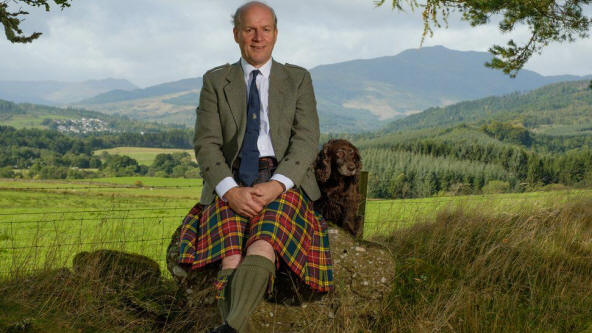
One of Scotland's largest and most ancient clans
has appointed its first clan chief in 337 years.
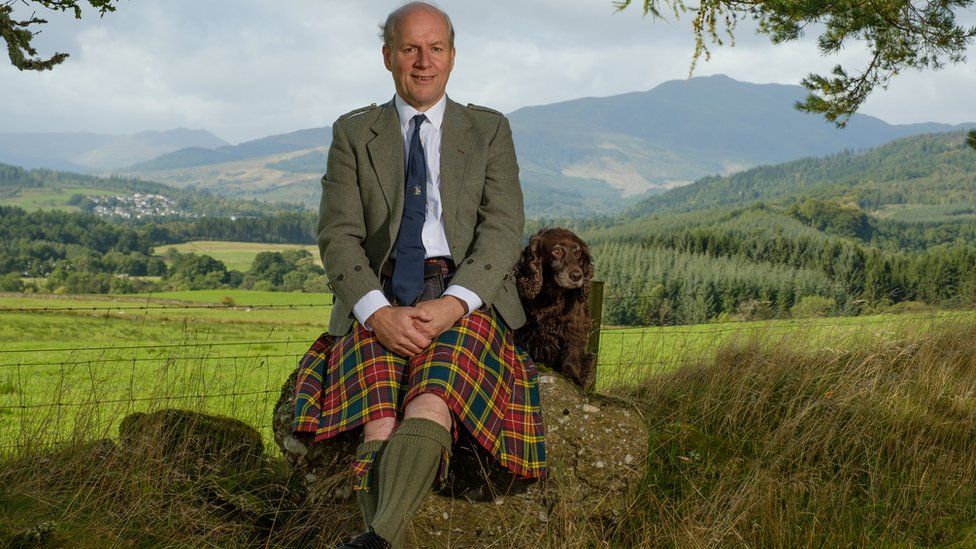
The Clan Buchanan will be led by John Michael Baillie-Hamilton Buchanan, who
first made his claim to the title more than 20 years ago.
The chiefship was last held by John Buchanan until his death without a male
heir in 1681.
The new chief, whose formal title will be The Buchanan, said he was "honoured
and proud" to take up the role.
The Lord Lyon King of Arms, who is head of the Lyon Court which regulates
Scottish heraldry, formally upheld a petition for Mr Buchanan to assume the
chiefship.
It follows decades of research conducted by
renowned genealogist Hugh Peskett, who traced former US President Ronald
Reagan's Irish ancestry in the 1980s.
Mr Buchanan, who is the manager of Cambusmore Estate in Callander,
Stirlingshire, said it had been "a long journey" to prove his family's
lineage.
He said: "There has not been a chief for a very long time - over 337 years -
but there is a thriving community of Buchanan clansmen, clanswomen and septs
around the world.
"I look forward to meeting members of the clan, committing myself to clan
matters in Scotland and attending some of the popular clan functions that
take place overseas."
He added: "My family has been acknowledged as leaders of one of the
principal clan septs, the Buchanans of Leny and Arnprior, for many years but
we have also believed that we had a good case for the overall chiefship.
"We first approached the Lyon Court informally over 20 years ago and it has
taken decades of genealogical research to back up our claim.
"I am indebted to Hugh Peskett, my fellow Buchanan clansman, for his
meticulous research and enduring tenacity."
George Lauder McAusland, commissioner for Scotland and the UK of the Clan
Buchanan International Society, congratulated Mr Buchanan on his
appointment.
He said: "Clan Buchanan has members worldwide and having a chief for the
first time in over 300 years will be an exciting time and a great
opportunity to promote our great clan to even greater heights."
The Clan Buchanan, whose historic seat was the now-ruined Buchanan Auld
House in Stirlingshire, can be traced back to 1010 in Scotland.
It has several million members in countries including the UK, the United
States of America, Canada, Australia, New Zealand, South Africa and Jamaica. |
Back |