From Stenhouse to the Digital Age — Remembering
an Edinburgh Childhood, Building STENHOUSE and Keeping the Future Open
By M. G. Judge, writing as
Bill Rectangle
I grew up in Stenhouse, Edinburgh,
during the 1980s and early 1990s — a period that now feels increasingly
important to preserve precisely because, at the time, most of it seemed
completely ordinary.
It was family life, school, friends,
football, skating, skateboarding, skiing, music, fashion, local
characters, shops, buses, streets and the gradual arrival of technology
into our homes.
We did not think of ourselves as
living through a transition between historical eras.
We were simply growing up.
Looking back, however, my generation
had one foot in an overwhelmingly analogue childhood and another moving
gradually into a digital future.
We taped music from the radio onto
cassettes. We copied tapes for friends. We watched VHS. We learned games
by sitting beside somebody else rather than watching an online tutorial.
Early home computers and games machines arrived almost like glimpses of
another world.
Then, over the decades that followed,
technology transformed almost every part of everyday life.
That transition became one of the
underlying themes of my first memoir:
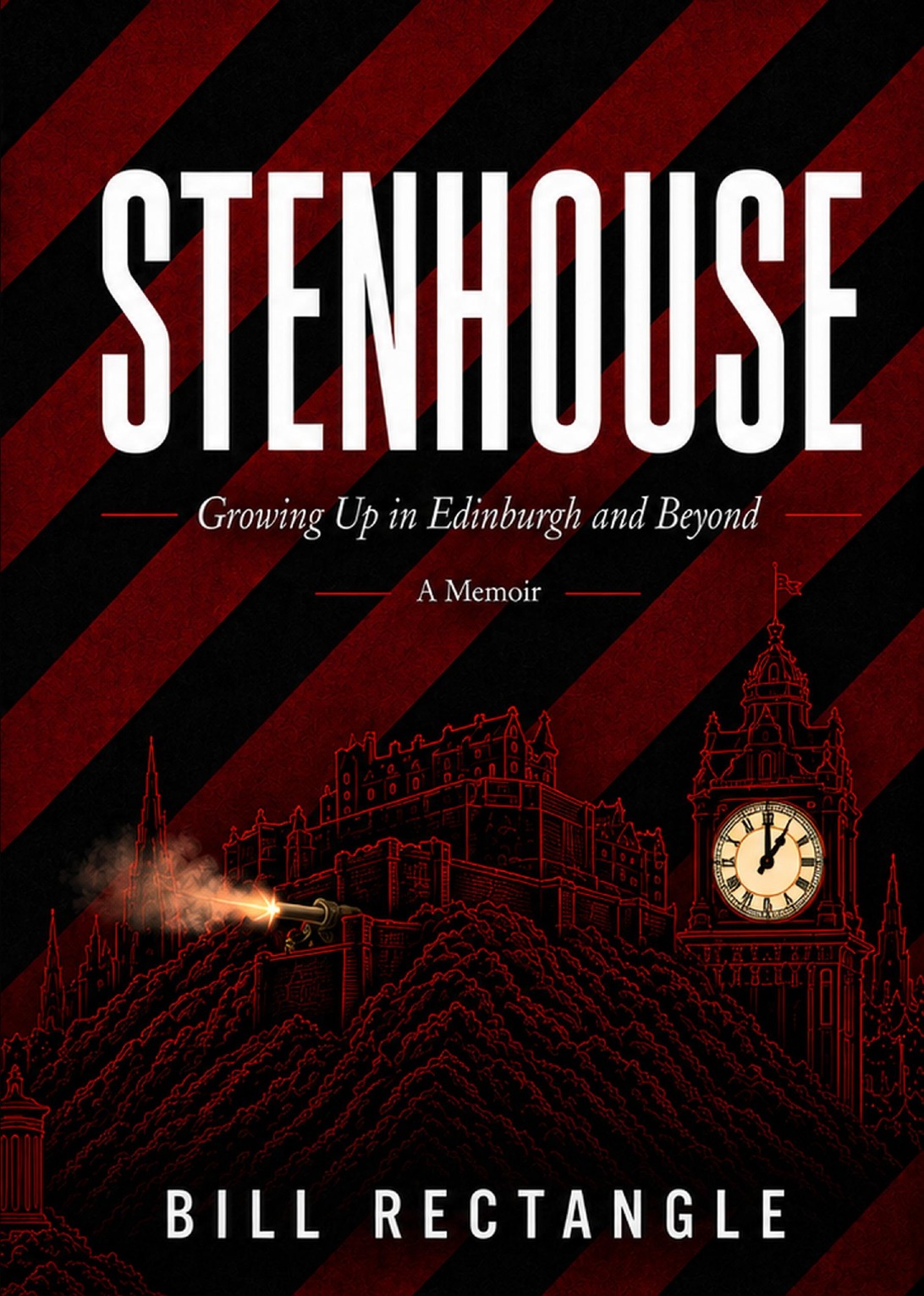
STENHOUSE: Growing Up in
Edinburgh and Beyond.
The book is my attempt to preserve
what an ordinary Edinburgh childhood actually felt like from inside it.
Not the Edinburgh of tourism
brochures.
Not a celebrity memoir.
Not an attempt to make childhood
appear more dramatic than it really was.
Just life as I remember it: funny,
difficult, exciting, sometimes sad, occasionally ridiculous and full of
people and details that mattered.
Why preserve ordinary memories?
One thing I have increasingly come to
believe is that ordinary lives form part of history too.
History is not solely politicians,
wars, institutions and famous people.
It is also the shop that disappeared
from the high street.
The neighbour everybody knew.
The school teacher whose mannerisms
remained in your memory for forty years.
The football games played on ground
that has since changed completely.
The music coming from somebody’s
bedroom.
The first computer sitting in the
corner of a family home.
The clothes people wore.
The buses they caught.
The jokes families repeated.
The local characters whose names might
never appear in an archive but who were once instantly recognisable to
an entire neighbourhood.
When those memories disappear with the
people who experienced them, a small piece of social history disappears
too.
That was one of the reasons I finally
decided to write STENHOUSE.
I had actually wanted to write a book
for many years.
Growing up in Edinburgh, there was
something powerful about seeing writers such as Irvine Welsh
emerge from my own wider neck of the woods and demonstrate that very
specific Edinburgh voices, places and lives could become literature.
You did not necessarily need to come
from somewhere distant or glamorous.
The streets around you could contain
stories too.
It took me until my late forties to
finally turn that long-held ambition into a completed book.
Keeping it real
My preference as a reader and writer
tends towards memoir, autobiography, non-fiction and social or cultural
history.
I like reality.
Real people and real lives can already
be extraordinary without needing to manufacture anything.
There is also an attitude towards
creativity that has always appealed to me in people such as John
Lennon and Liam Gallagher.
I am certainly not comparing myself
with either of them artistically.
What I mean is something much simpler:
a willingness to remain direct, grounded and recognisably yourself.
Keep it real.
Say what you mean.
Do not polish away every rough edge
until the person or place you started with becomes unrecognisable.
That approach suited STENHOUSE.
I did not want to manufacture a
dramatic childhood simply because I thought memoir required one.
The ordinary funny bits, difficult
bits, family life, friendships, football, music, fashion, technology and
neighbourhood experiences were enough.
That does not mean I dislike fiction.
Far from it.
There is a time and place for fiction,
and it can sometimes reveal truths that straightforward factual
description cannot.
Sometimes life imitates art, and
sometimes art imitates life.
That idea may become increasingly
relevant if I eventually write Book Two.
Bill Rectangle existed before the
author
Even my pen name has a slightly
unusual history.
The name Bill Rectangle
did not begin with STENHOUSE.
It goes back roughly nineteen years to
an automation project I created around an internet radio station being
run by one of my nephews while he was still around his school years.
When the station was live, he could
present it normally.
When he was not broadcasting live, his
mixes could continue playing automatically.
I designed an automated avatar for the
station and called him Bill Rectangle.
We then pushed the automation a little
further.
Listeners could email the station, and
the system could take the incoming text and convert it automatically
into speech so that Bill Rectangle could read the listener’s message
during the broadcast.
Today, when artificial intelligence,
conversational agents and automated systems are common subjects, that
may not sound especially remarkable.
At the time it felt wonderfully
experimental.
It was simply us playing with
technology and discovering what could be made to happen.
Long before Bill Rectangle became an
author name, he was therefore already a digital character.
And then the name went somewhere
considerably further away.
Bill Rectangle goes into space
NASA/JPL ran its free Dawn
“Send Your Name to the Asteroid Belt” programme, allowing
members of the public to submit names for inclusion on a microchip
carried by the Dawn spacecraft.
The programme even allowed noms de
plume.
I submitted:
Bill Rectangle.
So, long before that name appeared on
the cover of my memoir, Bill Rectangle had been submitted as part of the
public name collection carried on the Dawn spacecraft into space.
There is something wonderfully strange
about the sequence when I look back at it now:
automated radio avatar → NASA
microchip → author pen name.
None of this was planned as a grand
strategy.
It was simply one little idea leading
to another over the years.
That is probably true of much of my
life with technology.
From childhood computers to a
professional IT career
Technology had fascinated me from an
early age.
Home computers and games machines were
not simply entertainment.
They felt like doorways.
Machines such as the Commodore 16,
Commodore 64 and ZX Spectrum were part of a world in which ordinary
children could suddenly interact with something that felt futuristic.
Gaming then moved through the NES and
Sega 8-bit years into the Super Nintendo and Mega Drive era.
For children growing up during that
transition, every generation of hardware seemed to arrive carrying a
little piece of the future.
I eventually followed that interest
into further and higher education, studying computing and Computer
Support/IT through NC, HNC and HND-level study.
That led into professional IT work and
ultimately a technology career that has now stretched across more than
thirty years.
I still work full-time in IT.
That distinction matters when
discussing STENHOUSE.
Writing has not
replaced my professional career.
STENHOUSE was developed in my own
personal time, outside my Monday–Friday, 9–5 professional IT
role, with my professional responsibilities and my personal and
family commitments taking priority.
I am proud of how much the project has
grown, but I am equally clear about where it sits in the overall order
of my life.
Turning the usual AI argument on its
head
There was another layer to STENHOUSE
from the beginning.
Because of my technology background, I
became interested in using the project as a real-world test of what the
latest publicly available frontier AI and increasingly agentic
technology could enable one individual to accomplish.
There is something about this testing
concept that particularly appeals to me because, in one sense, it
turns a familiar criticism of generative AI on its head.
A large part of the public debate
around AI understandably concerns synthetic material, hallucinations,
invented information, artificial images and the ability of generative
systems to produce something that can look convincing even when it is
not true.
Those are genuine concerns.
But my STENHOUSE experiment
deliberately went in almost the opposite direction.
I started with something that was
real.
My own childhood.
My family.
My friends.
My streets.
My schools.
My memories.
My lived experiences.
The purpose of the technology was not
to take me away from those things and manufacture a new reality.
It was to see whether modern AI could
help me recover, organise, explore, verify where appropriate,
structure and communicate an authentic human story more effectively
while never becoming the authority over that story.
That inversion fascinates me.
AI is commonly associated with the
ability to generate something artificial.
My experiment asked whether the same
technology could instead help one person preserve something deeply
authentic.
The constraint was deliberate.
If a model produced a plausible detail
that I did not remember, that did not suddenly make the detail true.
If I was uncertain about something, an
eloquent AI answer could not decide the memory for me.
It could ask a question.
It could suggest something worth
investigating.
It could help search for public
context.
It could help organise information.
But it could not tell me what happened
in my own life.
My lived experience remained the
single source of truth for the personal narrative.
That is one of the reasons I like the
STENHOUSE test concept so much.
Rather than:
AI → synthetic material →
further away from the original human source
I wanted to explore:
human memory → AI-assisted
exploration → clearer preservation of the original human source.
The technology becomes a lens rather
than the subject.
And the human remains behind the lens.
A fuller account of that methodology
is set out in my independently published STENHOUSE project paper / white
paper:
STENHOUSE — A Real-World
Benchmark of Publicly Available Frontier AI and Agentic Technology
https://stenhouse-frontier-ai-project-paper.michael-judge-mcp.chatgpt.site
AI as an enabling tool, not the
controlling mind
This principle also reflects views I
have already expressed publicly.
In my published interview with
The Book Hook Online, I described AI as:
“an enabler rather than a
hindrance”
and:
“another tool in the creative
and professional toolbox.”
I also agreed strongly with the
principle that:
“Humans must remain the
controlling mind and retain design authority.”
For me, that is fundamental.
A responsible AI system does not
remove human accountability.
People must still define the purpose.
People must establish boundaries.
People must assess risk.
People must verify the result.
And people must remain accountable for
what they ultimately choose to do with it.
That is as relevant to creative work
as it is to professional technology.
In STENHOUSE, I remained the author,
verifier and final creative decision-maker.
AI could assist the process.
It could not assume authorship of my
life.
Source — The Book Hook Online,
Bill Rectangle / M. G. Judge author interview:
https://thebookhook.online/author-interviews/bill-rectangle/
The future of AI also needs
responsible policy
I am optimistic about the future of
AI.
I have spent more than thirty years
working with technology, and I have seen technologies move from being
unusual or specialist into becoming completely normal parts of working
and personal life.
AI may ultimately represent another
major change of that kind.
But optimism should not mean
abandoning safeguards.
In the same Book Hook interview I
argued that:
“responsible governance must
keep pace with development.”
I believe clear policies are needed
around accountability, privacy, security, accuracy, bias, transparency,
data quality and ownership, intellectual-property rights, consent,
attribution and appropriate human oversight.
These are not reasons to stop
developing AI.
They are reasons to develop and use it
properly.
Governance and organisational policy
should ideally be considered before technology is
deployed at scale rather than being invented afterwards when problems
appear.
Sensitive decisions involving areas
such as health, employment, security, privacy, individual rights and
creative ownership require meaningful human responsibility.
The same applies artistically.
I am strongly opposed to plagiarism.
I do not support copying or exploiting
the established work, voice, likeness or identity of writers, actors,
musicians, artists or other creators without appropriate consent,
licensing, recognition and fair treatment.
AI can be an extraordinary enabling
technology without requiring us to discard those principles.
In fact, building those principles
into its development could help the technology mature.
Published source:
The Book Hook Online — Bill Rectangle / M. G. Judge interview
https://thebookhook.online/author-interviews/bill-rectangle/
Expanded methodology and
project evidence:
STENHOUSE — A Real-World Benchmark of Publicly Available Frontier AI and
Agentic Technology
https://stenhouse-frontier-ai-project-paper.michael-judge-mcp.chatgpt.site
Avoiding both AI hype and AI fear
I also think the debate works best
when it avoids the two extremes.
Blind enthusiasm is not useful.
Neither is automatic fear.
AI systems make mistakes.
Their output must be tested,
questioned and challenged by people with the appropriate knowledge.
But individual failures should not
automatically be presented as though they define the entire field.
Likewise, impressive demonstrations
should not be treated as proof that every AI system is reliable or that
human expertise is no longer necessary.
I described this in The Book Hook
Online interview as the need to avoid:
“both blind enthusiasm and
exaggerated fear.”
That remains my position.
The debate should be informed,
evidence-based and capable of recognising both genuine risks and genuine
opportunity.
Source:
https://thebookhook.online/author-interviews/bill-rectangle/
Why I remain optimistic about AI
There are areas where the potential is
particularly exciting.
Healthcare is one obvious example.
AI and machine-learning techniques
have already played roles in medical imaging, analysis, research,
disease monitoring and drug development.
Future systems may help specialists
find patterns earlier, process complex information more effectively and
support research that would otherwise take much longer.
But again, the principle is the same.
The technology should augment
human capability rather than casually remove human judgement and
responsibility.
That is essentially the same model I
tested on a much smaller and more personal scale with STENHOUSE.
The life belonged to me.
The judgement remained mine.
The technology expanded what I could
practically do with it.
From AI-assisted book to AI-assisted
ecosystem
The experiment did not stop once the
manuscript was finished.
AI-assisted tools also supported
bounded parts of the wider project: organisation and continuity;
contextual research; language refinement; publishing preparation;
paperback and Kindle production workflows; parts of the audiobook-production
workflow; website material; promotional copy; advertising concepts;
scripts and storyboards; visual concepts; audience research; outreach
planning; structured project archives; and increasingly agentic
multi-step workflows.
I personally narrated the complete
audiobook.
I remained responsible for the
publishing decisions.
I remained responsible for public
claims.
I remained responsible for judging
whether an audience or opportunity genuinely suited the book.
That wider experiment eventually
became substantial enough that I documented it in the separate
independently published project paper / white paper cited above.
The central question became much
broader than:
“Can AI help write a book?”
Instead I asked:
“How far can one individual
take publicly available frontier AI and agentic technology when
authentic human source material remains authoritative and the human
remains the author, verifier, controlling mind and final
decision-maker?”
That is a much more interesting
question to me.
Building a STENHOUSE ecosystem
One of the more unexpected
developments has been that STENHOUSE has gradually become much more than
a single paperback sitting on a shelf.
An ecosystem has developed around it.
There is the printed book.
There is the Kindle edition.
There is the complete audiobook which
I personally narrated.
There is the White Hat Media website
and its supporting material.
There are interviews, articles, media
conversations, book-discovery pages and discussions with people
interested in memoir, social history, Edinburgh, Scotland, nostalgia,
technology and the analogue-to-digital transition.
There is the separate frontier-AI
project paper.
There are archive materials and
photographs.
There are conversations about future
writing.
There is now even early research into
whether some of the world behind STENHOUSE could eventually become
interactive.
What interests me about this ecosystem
is that each part provides a slightly different way of discovering
who actually connects with the material and why.
That is particularly important because
STENHOUSE is my first book.
Book One as a way of testing the
waters
The first book is naturally about the
book itself.
I wanted to write it properly, publish
it properly and give the memories the attention I thought they deserved.
But Book One has also allowed me to
test the waters.
Instead of deciding in advance that I
already know exactly who the audience is, I have been able to put the
work into the world and observe which people, communities and interests
genuinely respond to it.
That has been enormously useful.
Some people connect strongly with the
Edinburgh and Scottish aspects.
Others recognise the experience of
growing up during the 1970s, 1980s and early 1990s.
Some respond to the transition from an
analogue childhood into digital adulthood.
Some are interested in the music.
Others in football, skating,
skateboarding, skiing, early computers or games.
Some connect with family and community
memory.
Some are interested in the journey
from early difficulty with written language to eventually publishing a
first book later in life.
Technology audiences can find another
route into the project altogether, particularly through early home
computing, my later professional IT career and the use of modern AI.
That means the first book is helping
me understand the real market rather than trying to guess it from the
beginning.
Learning who the audience really is
For any future book or adaptation,
that knowledge could be enormously valuable.
If I eventually produce Book Two,
develop My Bit / Ma Bit, create another form of
adaptation, or even undertake another completely different project, I
will not necessarily be beginning with a blank sheet of paper.
Book One is helping establish a much
more clearly defined audience.
I can see which subjects generate
genuine conversation.
I can see which communities
immediately recognise something of themselves in the material.
I can see which interviewers want to
talk about particular parts of the story.
I can see which cultural, historical
and technological themes repeatedly resonate.
And I can also learn what does
not connect.
That matters just as much.
It means future projects can
potentially start with a much stronger understanding of the people most
likely to care about them.
Rather than building something first
and only afterwards trying to work out who might want it, the STENHOUSE
ecosystem allows audience understanding to grow alongside the project.
For somebody with a technology
background, I find that process fascinating.
It is almost a form of practical
iterative development.
Create something genuine.
Put it into the world.
Listen carefully.
See what people respond to.
Learn from the response.
Then allow those findings to inform
the next stage without allowing them to dictate the creative truth of
the original work.
The response to Book One
Perhaps the most rewarding part of the
whole experience has been the human response.
The book has connected particularly
strongly with local friends and family, many of whom
remember the places, people, atmosphere or period first-hand.
But the response has also extended
well beyond that immediate circle.
Readers who did not grow up in
Stenhouse have still recognised something familiar in the family life,
friendships, humour, music, technology and ordinary experiences of
growing up.
That wider connection has been
extremely encouraging.
The reaction from other authors,
readers, publishers, interviewers and people working around books and
cultural memory has also been remarkably welcoming.
People have generally approached the
project with curiosity, support and genuine enthusiasm.
Even where a particular publishing or
professional opportunity has not progressed, the conversations
themselves have often been constructive and encouraging.
That matters to me.
When you independently write and
publish your first book in your late forties, you do not really know how
the wider world will respond.
You hope people will understand what
you were trying to do.
In the case of STENHOUSE, I have been
genuinely pleased by how warmly people have received it.
The support from friends, family and
people who have discovered the book independently has been tremendous.
Readers have engaged with it.
Authors and interviewers have wanted
to discuss it.
Publishers and people within the wider
book world have been supportive and encouraging about the work and the
professionalism of the project.
People interested in social and
cultural history have understood why preserving ordinary memories
matters.
Technology audiences have recognised
the analogue-to-digital dimension.
Others have simply enjoyed the
stories.
The whole experience has been far more
welcoming than I could reasonably have expected when I began.
I am genuinely grateful for that.
Success is not only a sales number
For a first independent book, I think
it would be easy to judge everything by one number.
How many copies?
How many rankings?
How many clicks?
Those things are useful, particularly
when you are learning about a market.
But they are only one part of the
outcome.
For me, another measure of success is
whether the project creates genuine human connection.
Did somebody recognise their own
childhood?
Did a family start talking about
something they had forgotten?
Did somebody who grew up somewhere
completely different still recognise the atmosphere?
Did an interviewer find enough
substance in the project to want an hour-long conversation?
Did somebody interested in Scottish
history see value in preserving an ordinary Edinburgh life?
Did another first-time writer look at
it and think they might be able to do something themselves?
Those are meaningful outcomes too.
And they give me much better
information about where future projects might go.
Technology does not stand still — and
neither does professional learning
All of this sits alongside my
continuing professional IT life rather than replacing it.
Technology is moving rapidly,
particularly in artificial intelligence, automation and cyber security.
I am continuing my own structured
professional development and expect the next approximately eighteen
months to include substantial part-time cyber-security study and
training alongside my normal professional responsibilities.
That matters when I think about future
STENHOUSE projects.
I deliberately do not want to create a
rigid public roadmap which says that Book Two must arrive on a
particular date, that a game must be built by another date, or that an
article must appear every week.
I prefer to keep those possibilities
open.
My professional IT commitments come
first during my working week.
My personal and family commitments
come first in my personal life.
STENHOUSE is something I pursue
enthusiastically outside those priorities, when the
available personal time makes it sensible to do so.
For me, that makes the project more
sustainable.
It remains something I enjoy rather
than something I have unnecessarily turned into another full-time
obligation.
Life beyond computers and writing
I am certainly not somebody whose
interests stop at a computer screen.
Football and music have always been
important to me.
So have physical activities and sports
including skating, skateboarding, skiing, snowboarding and
surfing.
Different interests tend to overlap in
unexpected ways.
Music leads into memories of friends.
Sport leads into memories of place.
Technology leads into memories of
shops, games and particular Christmases.
A snowboard, skateboard, cassette tape
or games console can unlock just as much memory as an old photograph.
That is one of the reasons memoir
interests me.
Memory rarely arrives neatly organised
into chapters.
It comes back through objects, sounds,
movements, places and people.
Could STENHOUSE become a game?
One future idea that particularly
interests me is the possibility of turning some of the STENHOUSE world
into an interactive experience.
At this point, however, I want to be
very clear about its status:
it is only an idea.
There is no game currently in
production, no development timetable and no promised release.
At present I would describe it as
being at the research and concept stage.
One part of that research is looking
at the rapidly developing range of AI-assisted creative and development
tools now becoming publicly available and asking what combination of
them might realistically help one individual prototype or explore an
idea like this.
That could potentially involve
AI-assisted tools for areas such as concept development, coding, world
building, dialogue, character creation, graphics, audio, prototyping and
testing.
But, just as with the STENHOUSE book
project, I would want the technology to function as an enabling layer
rather than allowing the tools to determine the creative direction.
I have already reached one part of the
concept that I particularly like:
the possible title.
At present I am considering either:
MY BIT
or, in a more Scots-styled form:
MA BIT
The title has a deliberate double
meaning.
Growing up in Scotland, “my bit”
or “ma bit” could simply mean my place, my house or my
local area.
If friends were deciding where to go,
somebody might say something along the lines of:
“Want to go down to my bit?”
meaning:
Do you want to come down to my
place or my area?
Or someone might suggest:
“We’ll go up to her bit.”
meaning that we were heading up to her
house, her street or the part of town where she lived.
The precise direction — up to,
down to, or simply over to somebody’s bit — depended
on where everyone was and where they were going.
The important meaning was:
their place. Their patch.
Their part of the world.
That makes My Bit
particularly appropriate for a game based around childhood memory and
place.
The player’s world would, quite
literally, begin with:
my bit — Stenhouse.
But there is another meaning.
In computing, a bit
is one of the fundamental units of digital information.
Bits build bytes.
Bytes build upwards into the digital
systems, computers and games machines that became such an important part
of my childhood and later my professional life.
So the title can work in several
directions simultaneously:
My Bit — my place.
My Bit — my part of the story.
My Bit — my little part of
Edinburgh.
And:
bit — the fundamental building
block of computing.
That crossover feels particularly
appropriate for a project beginning in an analogue Edinburgh childhood
and eventually moving towards a professional life immersed in
technology.
The game idea itself would begin with
Stenhouse forming the map.
Rather than only reading about the
neighbourhood, the player might eventually be able to move through an
interpretation of it.
Friends, family, football, school,
skateboarding, skating, skiing, music, fashion and ordinary childhood
adventures could provide activities, stories or small missions.
As the character grew older, the
environment and the technology around them could evolve.
The gaming side might progress from
Commodore 16, Commodore 64 and ZX Spectrum culture through the NES and
Sega 8-bit period and later into the Super Nintendo and Mega Drive era.
The physical world could evolve
alongside it.
A trip into Edinburgh might involve
shops such as Dixons, John Menzies or Virgin.
One genuine memory that still makes me
smile involves spending far too long with friends using the shop-floor
NES demonstration systems before we eventually received our own consoles
for Christmas.
Once we worked out how the
demonstration timer operated, we became rather good at extending our
time on the machine.
That sort of harmless childhood
ingenuity could potentially translate naturally into an interactive
story.
What interests me most about the idea
is not simply creating a game about STENHOUSE.
It is the possibility of allowing
somebody who never lived in 1980s Edinburgh to explore a
remembered environment rather than only read about it.
The audience knowledge being gathered
through Book One could also become extremely useful here.
If the project ever develops beyond
research, I would already have a far clearer understanding of which
elements of STENHOUSE resonate most strongly — local history, nostalgia,
Scottish identity, youth culture, early technology, gaming, music, sport
or the analogue-to-digital transition.
For now, however, My Bit / Ma
Bit remains a working concept and research project only.
I am exploring what might be
technically possible, what current and future AI tools might
realistically enable, what audience it could ultimately serve, and
whether the idea deserves to progress beyond the research stage.
There is deliberately no deadline
attached to it.
What might Book Two become?
The same flexibility applies to the
continuation of the written story.
STENHOUSE ends as I move out of
childhood and towards leaving school.
The years that followed were
particularly heady for me, my friends and the wider social and cultural
networks stretching outward through Scotland, the wider UK and Europe.
Britpop.
Cool Britannia.
The cultural impact of
Trainspotting.
College.
Early employment.
Music.
Social life.
Relationships.
Family.
Technology.
And the gradual movement from being
somebody interested in computers to somebody beginning a professional IT
career.
I initially tested the world of work
and then increasingly recognised that I wanted to pursue something I was
genuinely interested in.
That led through computing education
and eventually into an early professional IT position with a local
Microsoft solutions/provider business which was also involved in
technology training.
There is a considerable amount of
material there.
I am also considering whether Book Two
might use a slightly different literary form.
The actual period and lived
experiences would remain its foundation, but I may eventually allow
myself more freedom to fictionalise or combine elements in order to
represent the atmosphere and intensity of those years more effectively.
If I do that, I would make the
distinction clear.
I would not present fictionalised
material to readers as literal memoir.
It could become a hybrid space between
memoir and fiction.
Again, nothing is rigid.
The idea can develop naturally.
And unlike Book One, any future book
would begin with a considerable advantage:
I now know much more about the
audience.
Book One has helped identify
communities, subjects and themes that actually connect with people.
That evidence can inform future
writing from the very beginning rather than being discovered only after
publication.
The value of keeping plans open
One of the lessons STENHOUSE has
taught me is that a personal project can become far larger than you
originally imagine.
A collection of memories became a
manuscript.
The manuscript became a paperback and
Kindle book.
I personally narrated the full
audiobook.
The book then led to interviews,
articles, conversations about cultural memory and discussions about
technology, AI and independent publishing.
It eventually led to a separate
project paper about frontier AI.
It has developed into an ecosystem
which is simultaneously preserving memories, reaching audiences and
teaching me much more about how different groups engage with the
material.
Now there are possibilities ranging
from Book Two to interactive ideas such as My Bit / Ma Bit.
But possibilities do not all have to
become deadlines.
I think we sometimes make personal
creative projects unnecessarily stressful by immediately converting
every new idea into an obligation.
I would rather remain curious.
My professional IT career continues.
My cyber-security training and wider
professional development continue.
Technology will continue changing.
My family and personal life continue.
STENHOUSE can develop alongside those
things rather than compete with them.
That is the model that has worked for
me so far.
Returning to where it started
For all the technology, publishing
infrastructure and audience analysis surrounding the project now,
STENHOUSE ultimately remains something very simple.
It is about remembering.
A house.
A street.
Parents.
Family.
Friends.
School.
Football.
Music.
Computers.
Shops.
Laughter.
Difficult moments.
The people who were there.
The things we did without realising
that one day they would belong to history.
The world changed around us.
We changed with it.
Some of the physical places
disappeared.
Some of the people are no longer here.
But the memories remain.
And once those memories are written
down, recorded and shared, perhaps a little piece of that ordinary
Edinburgh world remains too.
The incredibly supportive response to
Book One has shown me that those memories can also travel much further
than I originally expected.
People who were there can recognise
them.
People who grew up elsewhere can
relate them to their own lives.
And entirely new audiences can
discover a small part of Edinburgh through them.
That, more than anything else, is what
STENHOUSE is for.
|