|
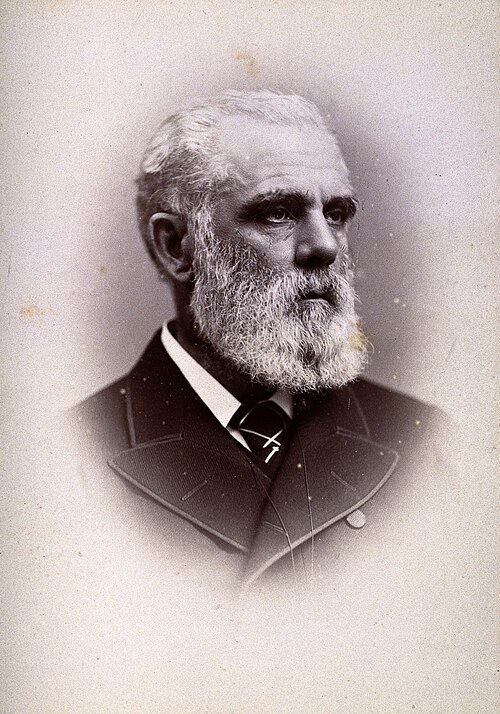
Charles Alexander Lockhart
Robertson (4 April 1825 – 18 May 1897), best known as C. Lockhart Robertson,
was a Scottish asylum doctor and spiritualist. He was born in Edinburgh, the
son of John Argyll Robertson, president of the Royal College of Surgeons of
Edinburgh.
Our Society, Society for Psychical Research, has suffered a serious loss
through the death, on the 18th ult., 1897, of the distinguished
medico-psychological physician, Dr. Lockhart Robertson, who has for many
years been a member of its Council. He studied medicine first at Edinburgh
and St. Andrews; and then, after five years spent in the Army Medical
Service, he entered on a fresh course of medical study at Cambridge, where
he took the degree of M.D. After this he commenced practice in London,
devoting — with characteristic energy — the time that he could spare from
his profession to the work of the Medico-psychological Association; of which
he was for some years Honorary Secretary, afterwards becoming joint Editor
with Dr. Maudsley of its journal — the Journal of Mental Science. After
filling most successfully the post of Medical Superintendent of the Haywards
Heath Lunatic Asylum, he was appointed, in 1870, Chancery Visitor in Lunacy
; which appointment he only resigned in January of last year, at the age of
70. He was a man of very active mind, who wrote much on subjects connected
with the treatment of the insane, and showed an ever-fresh interest in new
ideas and facts, and improvements of method. He was thoroughly fearless in
the expression of his convictions; and long before the foundation of the
S.P.R., having turned his attention to the phenomena of Spiritualism, he had
publicly declared his opinion that the evidence for those phenomena was too
strong to be rejected. He accordingly welcomed the formation of our Society,
of which he was one of the original members, being also on the Council from
the beginning; and he never ceased to take a keen interest in our work. No
member of our Council was a more assiduous reader of the proofs forwarded to
him of articles in the Proceedings; and I have received from him many
letters relative to these articles, sometimes simply approving, sometimes
containing criticisms or warnings, but all testifying to his eager sympathy
with our inquiries and his resolute independence of judgment. The loss of so
distinguished an alienist makes a gap in our ranks that it will be difficult
to fill: and no one who knew him in private life can fail to miss him as a
friend, since he was one of those rare beings who seem privileged to
maintain, in spite of the advance of years, a perennial youthfulness of
heart and mind. |



