|
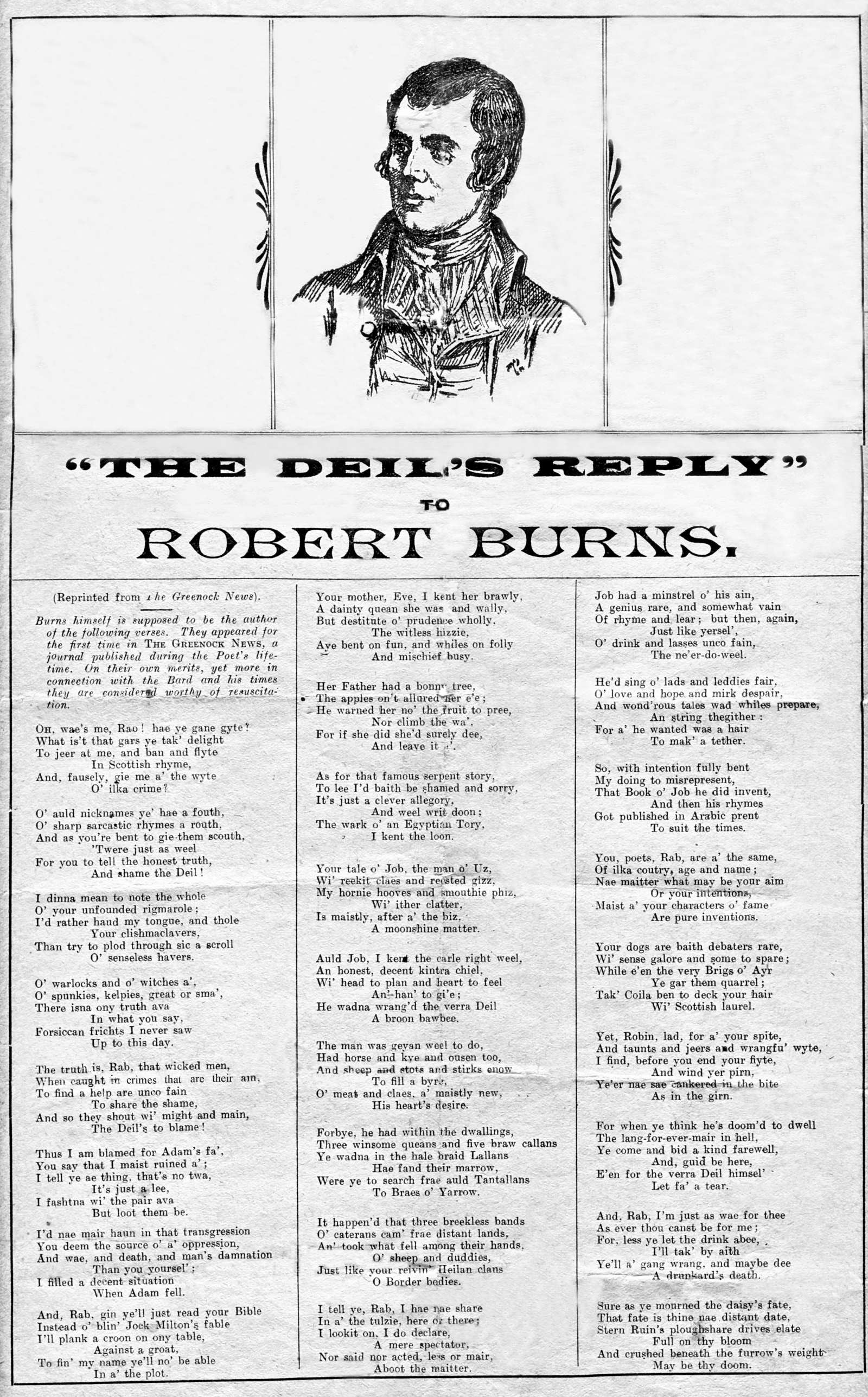
I was sent in this poem by Ian Fergusson in
which he said... I
found it in a book of Burns works given to me after my grandfather died.
The paper is very yellow with age and is suffering from the folding. We
have tried various methods of preparing the page for transmission,
finally photographically repairing the ''fold'' damage which made
reading difficult. It would be a discussion point with the "Robert
Burns" supporters as to whether he did or did not write this poem.
I later learned that....
The Deil's reply to
Robert Burns - a Poem. Written on 6th Sept 1793, A Parody of Burns, by
James Ditchburn, Ushaw Moor, Kircaldy; John Davidson and Son.
I also got in an email
which claims another author and here is what Koral Lavorgna told me...
“I have for some time
past been amusing myself occasionally at a whimsical composition which I
call ‘The Deil’s Response to Robert Burns,’ purporting to be an answer
from Satan himself to the Poet’s far famed ‘address.’”
This diary entry, written with devilish delight, reveals the decidedly
playful side of prominent public figure, James Brown. He asked that the
poem be published anonymously, and though a few knew its true
authorship, Brown must have relished in the reaction to its publication
in the Scottish American Journal in September 1859. A long lost poem
written by the bard himself, many declared. Robert Burns was immortal
indeed! Tongue firmly in cheek, Brown took great pleasure in showing his
son John, during a government sponsored tour of Scotland in 1861, the
Deil’s chair where Satan composed his reply to Robert Burns. The joke
long continued to tickle James Brown’s funny bone, perhaps because of
his own connection to the bard. James Brown was related to Robert Burns
through his maternal line. He revered the bard and had a writing style
which evidently matched that of Burns.
Diarist James Brown emigrated from Glamis near Dundee, Scotland when he
was 20 years old. When he arrived at the port of St. Andrews, Charlotte
County, in May 1810, he described himself as “a friendless boy”. That
friendless boy rose not only to local but provincial prominence. He
became politically active, serving as a member of the Legislature. He
was appointed to the Board of Works and travelled throughout the
province surveying roads and bridges for the Crown Land Office. Brown
was also appointed School Inspector in 1844, and helped prepare a
critical provincial report on the state of education.
Brown began keeping a diary shortly after he settled in St. David, and
in short entries, recorded life on his farm. He faithfully kept his
diary during particular pockets of time: from 1813-1816; 1838-1844; and
from 1857-1870. He wrote the last entry in January 1870, and he died in
April of that year. Brown often wrote retrospectively, documenting his
daily activities at the end of the week. He later reviewed his diary
entries, and would correct inaccuracies or amend date discrepancies.
Over time his entries became more detailed, painting a picture of New
Brunswick society and most especially the hospitality of Scottish
immigrants across the province.
His travels brought Brown into frequent contact with fellow countrymen,
whether colleagues, friends, or strangers. Once he knocked at the door
and broke bread with them, they did not remain strangers for long.
Memories of the home country forged fast friendships, and nights were
livened by songs, stories, music, dance, and laughter. Once an
acquaintance was made, Brown never forgot a friend. James Brown’s diary
contains 90 different encounters with people from Scotland over the
course of a 30 year period, from 1838 to 1868.
The diary is a lively and entertaining read, making references to the
“downfall of Bonapart”, to grand Balls at Government House, the arrival
of dignitaries, public scandals, holiday merriment, and to entertainers
such as Anderson, the Wizard of the North. Brown documents such pivotal
events as the laying of telegraph cable in 1858, the Tour of the Prince
of Wales in 1860, the Fenian scare in 1866, and a meeting favouring the
“union of the Colonies” that same year, but curiously no mention was
made of Confederation in 1867, perhaps reflecting his opposition to it.
James Brown worked long days and logged considerable mileage on foot
daily. He was rarely sick, but a mysterious condition plagued him from
1866 to 1868. It was in fact the return of a most dreadful affliction,
which he had suffered many years earlier: Hypochondria. This “old
complaint”, as he called it, referred not to imagined illnesses but to a
stress-related disorder which came with very real physical symptoms.
Brown suffered terribly with medicinal cures which were worse than the
disease. Sleep was often in short supply and when he managed to nap, he
would awaken in a “fit of horrors”. Though his “mental disease” caused
him grave concern, Brown did his best to keep pace with work and
familial obligations. He consulted many doctors and even a few friends
who suffered from the same condition during those dark days. Finally in
September 1868, James Brown declared himself in excellent health. He was
not only thankful for the improved state of his health, but for the
comfort and satisfaction he had taken in “pushing along through the
journey of life.”
The above came from the
New Brunswick Scottish History web siite
The Deil's Reply to Robert Burns
Burns himself is supposed to be the author of the
following verses. They appeared for the first time in The Greenock News,
a journal published during the Poet's lifetime. On their own merits, yet
more in connection with the Bard and his times they are considered
worthy of resuscitation.
Oh, wae's me, Rab! hae ye gane gyte?
What is't that gars ye tak' delight
To jeer at me. and ban and flyte
In Scottish rhyme,
And, fausely, gie me a' the wyte
O' ilka crime?
O' auld nicknames ye' hae a fouth,
O' sharp sarcastic rhymes a routh.
And as you're bent to gie them scouth,
'Twere just as weel
For you to tell the honest truth,
And shame the Deil!
I dinna mean to note the whole
O' your unfounded rigmarole;
I'd rather haud my tongue, and thole
Your clishmaclavers,
Than try to plod through sic a scroll
O' senseless havers.
O' warlocks and o' witches a',
O' spunkies, kelpies, great or sma',
There isna ony truth ava
In what you say,
Forsiccan frichts I never saw
Up to this day.
The truth is, Rab, that wicked men,
When caught in crimes that are their am.
To find a help are unco fain
To share the shame,
And so they shout wi' might and main,
The Deil's to blame!
Thus I am blamed for Adam's fa'.
You say that I maist ruined a';
I tell ye ae thing, that's no twa,
It's just a lee,
I fashtna wi' the pair ava
But loot them be.
I'd nae mair haun in that transgression
You deem the source o' a' oppression,
And wae, and death, and man's damnation
Than you yoursel':
I filled a decent situation
When Adam fell.
And, Rab, gin ye'll just read your Bible
Instead o' blin' Jock Milton's fable
I'll plank a croon on ony table,
Against a groat,
To fin' my name ye'll no' be able
In a' the plot.
Your mother, Eve, I kent her brawly,
A dainty quean she was and wally,
But destitute o' prudence wholly.
The witless hizzie,
Aye bent on fun, and whiles on folly
And mischief busy.
Her Father had a bonny
tree,
The apples on't allured her
e'e;
He warned her no' the .fruit to pree,
Nor climb the wa'.
For if she did she'd surely dee,
And leave it a'.
As for that famous serpent story,
To lee I'd baith be shamed and sorry,
It's just a clever allegory,
And weel writ doon;
The wark o' an Egyptian Tory,
I kent the loon.
Your tale o' Job. the man o' Uz,
Wi' reekit claes and rented gizz,
My hornie hooves and smouthie phiz,
Wi' ither clatter,
Is maistly, after a' the biz,
A moonshine matter.
Auld Job. I kent the carle right weel,
An honest, decent kintra chiel,
Wi' head to plan and heart to feel
An'-han' to gi'e;
He wadna wrang'd the verra Deil
A broon bawbee.
The man was geyan weel to do,
Had horse and kye and ousen too,
And sheep and stots and stirks enow
To fill a byre,
O' meat and claes, a' maistly new,
His heart's desire.
Forbye, he had within the dwallings,
Three winsome queans and five braw callans
Ye wadna in the hale braid Lallans
Hae fand their marrow,
Were ye to search frae auld Tantallans
To Braes o' Yarrow.
It happen'd that three breekless bands
O' caterans cam' frae distant lands,
An' took what fell among their hands.
O' sheep and duddies,
Just like your reivin' Heilan clans
O Border bodies.
I tell ye, Rab, I hae nae share
In a' the tulzie. here or there;
I lookit on. I do declare.
A mere spectator,
Nor said nor acted, less or mair,
Aboot the maitter.
Job had a minstrel o' his ain,
A genius rare, and somewhat vain
Of rhyme and lear; but then, again,
Just like yersel',
O' drink and lasses unco fain,
The ne'er-do-weel.
He'd sing o' lads and leddies fair,
O' love and hope and mirk despair.
And wond'rous tales wad whiles prepare,
An string thegither:
For a' he wanted was a hair
To mak' a tether.
So, with intention fully bent
My doing to misrepresent,
That Book o' Job he did invent,
And then his rhymes
Got published in Arabic prent
To suit the times.
You, poets, Rab, are a' the same,
Of ilka coutry, age and name;
Nae maitter what may be your aim
Or your intentions,
Maist a' your characters o' fame
Are pure invention's.
Your dogs are baith debaters rare,
Wi' sense galore and some to spare;
While e'en the very Brigs o' Ayr
Ye gar them quarrel;
Tak' Coila ben to deck your hair
Wi' Scottish laurel.
Yet, Robin, lad, for a' your spite,
And taunts and jeers and wrangfu' wyte,
I find, before you end your fiyte,
And wind yer pirn.
Ye'er nae sae cankered in
the bite
As in the girn.
For when ye think he's doom'd to dwell
The lang-for-ever-mair in hell.
Ye come and bid a kind farewell,
And, guid be here,
E'en for the verra Deil himsel'
Let fa' a tear.
And, Rab, I'm just as wae for thee
As ever thou canst be for me;
For less ye let the drink abee,
I'll tak' by aith
Ye'll a' gang wrang. and maybe dee
A drunkard's death.
Sure as ye mourned the daisy's fate,
That fate is thine nae distant date,
Stern Ruin's ploughshare drives elate
Full on thy bloom
And crushed beneath the furrow's weight
May be thy doom. Note: We've pretty much figured that
this is not a Burns poem. |