|
Part 1: The Signal and the Noise
Oct 18, 2026 It is a
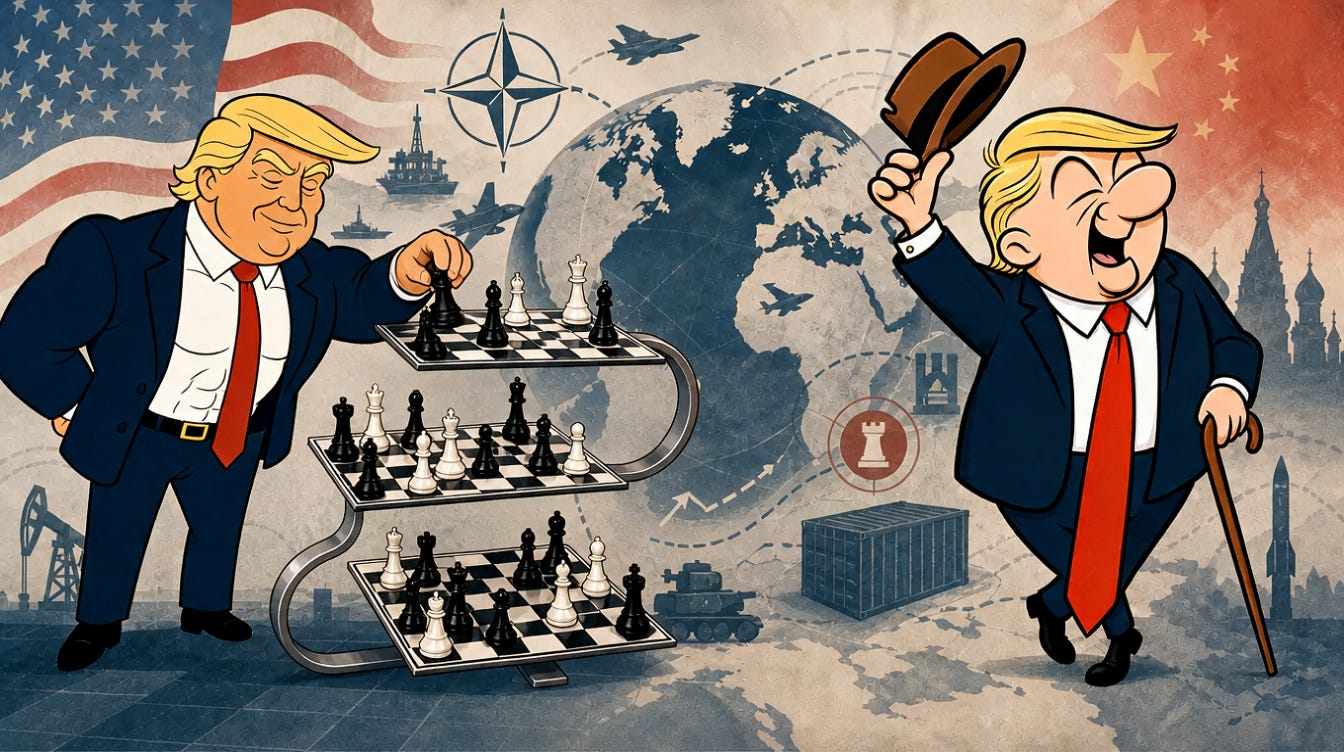
popular, if vapid, refrain among President Trump’s critics that he has no
coherent foreign policy. The harshest of them are unable to bring themselves
to acknowledge any foreign policy successes. While the more rational critics
acknowledge achievements like the Abraham Accords, the Armenia–Azerbaijan
peace deal, U.S.-assisted resolutions to the Cambodia-Thai border dispute,
North Kosovo crisis, and the 2025 India-Pakistan conflict, they give no
credit to the president for these and other developments. Rather, they
characterize him as a geopolitical Mr. Magoo, the cartoon character from the
1950s who fumbles and stumbles his way into a series of precarious
situations because of his extreme near-sightedness, yet through pure chance
the situations all seem to work out. In the analogy, all of Trump’s
accomplishments are downplayed, dismissed as incidental, or described as
having been achieved despite, rather than because of his leadership. On the
other side, the president’s staunchest supporters insist that his instincts
are brilliant, that even his supposed blunders are part of an elaborate game
of 3D chess, and that his critics are simply not calculating a sufficient
number of moves in advance to recognize the genius in them.
The purpose of this series is not to persuade anyone of the merits of
Trump’s foreign policy, but to dispense with the idea that he doesn’t have
one, to outline it objectively, and to enable a fair assessment.
By focusing on the signal and ignoring the noise, it is possible to trace a
coherent thread through all of the administration’s policy decisions. The
consistent elements are transactionalism, leverage, sovereignty,
burden-sharing, and personalized (Trumpian) diplomacy, focused on negotiated
deals rather than deference to the “rules-based order” or to what Trump
regards as ineffectual and corrupt institutions like the United Nations. To
parse the signal and the noise, one must accept two obvious facts. First,
there is a large contingent of foreign policy experts who are incapable of
reimagining how diplomacy is done and who regard a departure from the
orthodoxy as a personal threat. And second, approximately 85% of the
mainstream news media is executing the business model of amplifying
criticism of Trump to its audience of Trump-haters, while most of the
remaining 15% whitewash the president for their true-believer MAGA
audiences. On balance, what can be observed plainly is that we, the people,
are being misled. And any positive outcomes, if achieved through Trump’s
unconventional means, are routinely dismissed or reframed negatively.
Far from being erratic or inconsistent, Donald Trump has been voicing many
of the primary elements of his foreign policy, in his distinctly brusque and
combative style, since the 1980s, long before he ever ran for office. He has
been outspoken for decades about allies not paying their fair share for
their own defense, nuclear non-proliferation, trade imbalances and the costs
of foreign entanglements. He first assembled and articulated these positions
as a platform in his April 27, 2016 foreign policy speech, delivered at the
Mayflower Hotel in Washington, D.C. The speech laid out an “America First”
strategy hinging on peace through strength. In it, Trump proposed rebuilding
a depleted military to deter adversaries, aggressively demanding
burden-sharing by NATO and Asian allies, taking a hard line on Iranian and
North Korean nuclear ambitions, and using economic leverage to correct the
vast trade deficits with China and other trading partners. Within one hour
of the speech’s conclusion, Politico published a piece titled “Trump fails
to impress foreign-policy experts,” a coterie of whom were apparently on
standby, eagerly awaiting the opportunity to be quoted denouncing the
strategy.
In the spirit of full disclosure, then-candidate Trump asked me to offer
suggestions on that speech, and truthfully, I found the outline of the
strategy he presented refreshing. It was a pragmatic set of positions that
occupied the huge, unattended middle ground between the nation-building
hubris of George W. Bush’s second inaugural, which promised the end of
tyranny on earth, and the Obama-Clinton-Kerry concept of a controlled,
apologetic American retreat, punctuated by the occasional drone strike,
vanishing “red line” and an invitation to America’s traditional allies and
enemies to trade roles and places.
Fareed Zakaria, on CNN that night and again in The Washington Post the
following morning, dismissed the speech as an incoherent, contradictory and
meandering collection of slogans. Readers can judge the speech for
themselves, but I submit that Fareed’s verdict is evidence of the foreign
policy establishment’s attitude of “my way or the highway,” despite the way
in question not having accurately defined, much less advanced, the American
national interest in over thirty years.
Fareed is an old friend. We were both members of the Council on Foreign
Relations, and I was an occasional guest on his CNN program, GPS, until,
during one appearance, I made a faintly supportive remark about Donald
Trump, which I learned was in contravention of the show’s editorial
guidelines, which strictly forbade any such utterances. He is one of many
highly intelligent individuals who were so traumatized by the elevation of
someone as brutish and crass as Donald Trump to the highest office in the
land that they have lost all capacity for critical thinking (at least as it
relates to Trump) and have never been the same since. He is one of many
denizens of the bipartisan foreign policy elite whose positions seem to
evolve into the precise antithesis of whatever stance the Trump
administration advances. To wit, their collective voice is a large part of
the noise that needs to be ignored to arrive at the signal.
Before we assess the signal itself in subsequent instalments of this series,
it will be helpful to outline one of the most concrete examples of the
noise. This phenomenon was never more evident than in the coverage of
Trump’s highly unorthodox dealings with North Korea’s Kim Jong-un.
On August 8, 2017, Trump set forth his North Korea deterrence strategy in
remarks in New Jersey, where he infamously promised “fire and fury” if Kim
continued on the path he was on:
“North Korea best not make
any more threats to the United States. They will be met with fire and fury
like the world has never seen. He has been very threatening beyond a normal
state. They will be met with fire, fury and frankly power the likes of which
this world has never seen before.”
All of the experts, including
those who had been calling for a harder line on the Kim regime for years, in
perfect unison, publicly accused the president of dangerous escalation that
would assuredly lead to nuclear apocalypse. And sure enough, Kim called what
he considered to be Trump’s bluff, and on September 3, 2017, North Korea
conducted its largest ever nuclear weapon test. The old playbook was to
respond with stern warnings and more diligent enforcement of existing
sanctions, never mind that it was that strategy which had led to the crisis
at hand. Two weeks later, Trump took a different approach. Addressing the
United Nations General Assembly, the president announced that, if necessary,
he would “totally destroy North Korea,” and that “Rocket Man” (Kim Jong-un)
was “on a suicide mission for himself and for his regime.”
“The United States has great
strength and patience, but if it is forced to defend itself or its allies,
we will have no choice but to totally destroy North Korea. Rocket Man is on
a suicide mission for himself and for his regime. The United States is
ready, willing and able, but hopefully this will not be necessary.”
This prompted critics,
including Republican Senator Bob Corker, then-Chair of the Senate Foreign
Relations Committee, to accuse Trump of treating the presidency like a
reality show and of making reckless threats that could put the country on a
path to World War III. However, what ensued was a series of unprecedented
and (at least temporarily) successful negotiations, culminating in Trump
calmly waltzing through the demilitarized zone into North Korea to shake
Kim’s hand and pat him on the back. Trump had jokingly claimed that he and
Kim had fallen in love, describing correspondence he had received from the
North Korean despot as “beautiful letters.”
“I was really being tough,
and so was he, and we would go back and forth. And then we fell in love, OK?
No, really. He wrote me beautiful letters. And they’re great letters. We
fell in love.”
The exact same critics
(including Sen. Corker) who had derided the president for his “fire and
fury” tone now accused him of fawning over an evil dictator. That is the
noise. The signal is that Trump’s tactics ushered in one of the most
peaceful periods of bilateral relations with North Korea in decades. This
episode was revelatory because, while the foreign policy establishment was
feverishly oscillating between criticizing Trump for being too harsh and
then too soft on Kim, none of them bothered to acknowledge any of the
diplomatic successes. Once the opportunity to slag the president off had
passed, they simply moved on.
Trump’s policy was a combination of credible military deterrence through
major joint exercises with the South Koreans (with a splash of unhinged
rhetoric), maximum economic pressure, importantly including pressure on
China to enforce sanctions, and a willingness to engage personally with Kim
Jong-un. This marked a sharp departure from the bipartisan policy of
“strategic patience.” For years, previous administrations had isolated and
delegitimized the Kim regime while applying largely symbolic pressure. Under
the old framework, strict direct sanctions were undercut by effectively
giving China a free pass to prop up North Korea. This allowed Beijing to use
Pyongyang as a geopolitical proxy, fostering regional instability to
distract from and run cover for China’s own expansionist ambitions. Trump
upended the old model and got results.
There is an important caveat. During the Biden years, North Korea
strengthened its alignment with China and Russia, reverted to a belligerent
stance, sent more than 10,000 troops to Russia in support of its war against
Ukraine, and ramped up missile testing. It will be interesting to see how
Trump 2.0 handles this delicate relationship, and whether the administration
will once again find success in dealing with Kim. However, one thing is
certain in advance: regardless of what Trump does, the foreign policy elites
will present it negatively.
Throughout the rest of this series, we will examine Trump’s NATO hustle, the
China threat, trade policy, Venezuela, Iran, Greenland, and I will stretch
my practical knowledge to its limits (and perhaps beyond) to discuss the
geopolitical relevance of AI advancement and how all these topics fit into
the broader Trump Doctrine. Next up: while it may cost me some friends, I
will systematically debunk the Iran “quagmire hoax” and explain why the
bipartisan foreign policy experts have got it wrong again. Despite some
strategic failures in its execution, the Iran conflict has been one of the
most successful military campaigns against a formidable enemy in the history
of modern warfare. If I am detecting a slight note of incredulity, stay
tuned for the analysis.
Part 2: A Necessary War
Oct 24, 2026 Last week
I wrote about noise drowning out signal. This week the noise came from the
Oval Office. From the Resolute Desk, Trump went on a series of five-minute,
slightly rambling, highly entertaining, but entirely undignified rants
endorsing various Republican midterm candidates. One of the most memorable
(for dubious reasons) was his endorsement of Texas Senatorial candidate Ken
Paxton. It was more of a takedown of Paxton’s opponent James Talarico, or as
the president nicknamed him, “Tala-freako.” While the president’s assessment
of Paxton’s opponent was largely factual, albeit formulated more acerbically
than necessary, and frequently interspersed with self-aggrandizing reminders
of how well he did in Texas during the previous presidential election, it
was entirely ineffective. In another attack ad the president cautioned
Michigan voters against electing Abdul el-Sayed, who he refers to by his
middle name, Mohamad, to the Senate. Again, allowing for Trump’s looseness
with the particulars under his umbrella of “truthful hyperbole,” the facts
were generally accurate, but the style and delivery pitched raw meat to a
base that is already voting Republican, provided fodder to the president’s
critics to discredit him as brash and classless, and I suspect were net
negative on swaying moderates or independents who tend not to be persuaded
by the MAGA-rally style of rhetoric and oratory. It is enough to make one
wince when considering from the same desk, Kennedy drew the line in the sand
over Cuba, Nixon announced his resignation in order to “put the interests of
America first,” Reagan told the nation the Challenger crew had ‘slipped the
surly bonds of earth to touch the face of God,’ and Bush addressed the
country on September 11. Against that, the Trumpian takedowns of “Mohamad”
El-Sayed and James “Tala-freako” are quite the jarring comedown. When all is
said and done, as I wrote in my column in the New York Sun this week, Trump
is like a brilliant circus performer regarded with derision as he clowns and
performs tricks but as he departs the arena, he will be seen to have
reoriented America to the tangible benefit of the great majority of its
people.
With that preamble out of the way, let’s refocus on the task at hand.
The 2026 U.S.-Israeli operations against Iran were the most successful
military conflict in the history of modern warfare. Given how negative the
coverage of the Iran conflict has been, that may sound like an extraordinary
claim. And while Carl Sagan’s aphorism that extraordinary claims require
extraordinary evidence is true, in this case, ordinary evidence will
suffice. All the metrics that matter support the claim, and we will cover
them all throughout this series.
There are three primary questions which must be asked and answered:
(1) When is war necessary, and did the
situation in Iran meet the threshold?
(2) What is the cost?
The answer must factor in lost American lives and spent public money, as
well as the inflationary impact of the ensuing energy-shock on Americans
facing an affordability crisis at home.
(3) How successful has it been at achieving its objectives?
Short-term success being defined as the elimination of the enemy’s
war-fighting capacity (including via support of terrorist proxies), and
long-term success defined by the permanent prevention of a nuclear-armed
Iran and the potential for long-term regional stability.
This post will seek to address the first question, but before that let’s
start with an examination of why this analysis is even necessary, given how
obvious a success this conflict has been.
Pervasive claims that this Iran conflict has been a failure hinge on a few
concurrent and overlapping phenomena. Firstly, we are in the middle of a
midterm election campaign, and the Democratic Party has spent a fortune on
targeted attack ads specifically framing Iran as a failure. Simultaneously,
they have deployed an army of candidates and their spokespeople armed with a
set of talking points amplifying this message. It is politically useful to
portray this conflict as a failure and in politics the truth often takes a
backseat to political expedience. Secondly, according to the most recent
data, press coverage of the president among the major news networks remains
more than 90% negative. Thirdly, a sizable minority, representing
approximately 30% of MAGA voters, have emerged as pure isolationists, a
viewpoint championed by prominent right-wing commentators who have lost
their way and have turned rabidly against Israel, like Tucker Carlson, Megyn
Kelly, and Candace Owens. And finally, among the avowed Trump-haters, there
is, for lack of a better term, a pervasive form of “wishful schadenfreude”;
the warping of reality such that one becomes convinced of the failure of
another so that they may mock, deride, and take pleasure in that failure,
when the failure has yet to take place. With all the noise echoing around
the public square, there is little wonder that there are so many people who,
despite earnestly trying to stay well-informed, have been misled on Iran.
To those of you who fall in the isolationist camp, and feel the United
States has no role to play on the geopolitical stage, you may find little
value in the following analysis. While you’re welcome to stay and follow
along, this is written for those who acknowledge the importance of the
United States as the champion of Western Civilization, and the tremendous
good that nation has done in that role over the past half century or more.
It may be useful to zoom out to 10,000 feet and take a sober look at the
geopolitical landscape without Trump in the frame. Not because the president
does not deserve the credit (or blame) for engaging in Iran, but because
Trump is such a divisive figure and gets under some people’s skin so deeply
that his presence in any discussion can often muddy the waters in an
irrational way.
The first question we must answer, and can do so quite straightforwardly,
is: when is war necessary?
Iran’s extremist regime is a geopolitical adversary whose motto is “Death to
America,” who had the blood of roughly 1,000 Americans on their hands prior
to this conflict, and who has been actively pursuing nuclear armament, for
the express purpose of being able to terrorize the World with impunity
through deterrence and to exterminate the Jews of Israel.
“The situation between
America and Iran is this: When you chant ‘Death to America!’ it is not just
a slogan – it is a policy.” — Ayatollah Ali Khamenei, Supreme Leader of
Iran, address aired November 1, 2023, on Channel 1 (Iran), translated by the
Middle East Media Research Institute (MEMRI).
While I haven’t heard it from
any commentators who I would consider serious or well-informed on the
subject, there is a groundswell of online sentiment that Iranian nuclear
ambitions are exaggerated or overblown. The three most common formulations
of that claim are: the WMD sequel, the Netanyahu montage, and the Operation
Midnight Hammer goalpost shuffle. The WMD 2.0 claim holds that since the
Iraq invasion was predicated on the “weapons of mass destruction” lie, all
future justification of military interventions predicated on supposed
nuclear ambitions are invalid. This is obvious bunk. The Netanyahu montage
generally comes in the form of a video depicting dozens of times over the
years where the Israeli prime minister, and others, have warned of imminent
Iranian nuclear capability. The claim holds that since, despite these
decades of warnings, Iran does not currently have nuclear capabilities, the
warnings are tantamount to the Boy Who Cried Wolf. The fallacy here lies in
the failure to acknowledge the long history of past Israeli and US
interventions (involving the full gamut of diplomacy, international
sanctions, covert operations, targeted killings of nuclear scientists,
cyberattacks, and multiple military interventions) which have, so far, been
effective in delaying Iran (and Saddam Hussein’s Iraq) from developing
nuclear weapons. However, the very fact that this sequence of extreme
preventative measures has been necessary proves that Iran, like Wile E.
Coyote chasing the Road Runner, keeps trying over and over again to pick up
where it left off, plainly telegraphing their likelihood to continue to do
so. The third objection holds that even if Iran’s nuclear ambitions were
real, the June 2025 strikes ended the threat, so Operation Epic Fury,
launched on the last day of February 2026, was unnecessary.
The simplest way to debunk these theories in one fell swoop is through three
observations. Anyone analyzing this situation rationally will be able to
conclude from them that Iran has always and will always be seeking nuclear
armament, so long as the Khomeinist regime remains in power.
Firstly, nuclear weapons in the hands of psychopathic regimes, by creating
an implicit, credible threat of catastrophic nuclear retaliation in response
to any major attack, gives that regime a virtually unassailable deterrence
mechanism with which they can pursue their psychopathic designs with
impunity. Secondly, 20 years ago, Iran started constructing its Fordow
uranium enrichment facility deep inside a mountain underneath an IRGC
military base. In case anyone misses the implication, an internationally
designated terrorist organization (in the same category as Al-Qaeda) buried
a facility designed to produce weapons grade uranium in a location selected
specifically to prevent that facility from being destroyed by foreign powers
who might take issue with said terrorist organization acquiring nuclear
weapons. Lastly, a leopard does not change its spots, and the greatest
predictor of future actions are past actions—while come-to-Jesus moments
sometimes do happen, I would not place any bets on the power of conversion
as related to the mullahs in Iran.
Iran was stockpiling thousands of conventional ballistic missiles and Shahed
drones as a stop-gap form of deterrence while its nuclear program advanced.
Immediately following the June 2025 strikes on their nuclear facilities,
Iran sharply accelerated production and underground storage in what are
colloquially referred to as subterranean “missile cities”— a network of
large, hardened underground complexes. This acceleration in the mass
production of high volumes of conventional weapons signaled a strategic
pivot to double down on their conventional deterrence strategy, and buy time
to get their nuclear ambitions back on track.
The regime’s nihilistic willingness to plunge the whole region into chaos
was put on full display when Iran and its proxies launched a flurry of
missile and drone strikes on largely neutral Gulf states, including energy
infrastructure and airports in Saudi Arabia, the UAE, Kuwait, and Bahrain.
Additionally, Iran’s attempted ballistic-missile strike on the U.S. base at
Diego Garcia both exposed its push to develop true long-range capabilities
and its intent to use them as an offensive deterrent against American forces
far beyond the Gulf. Fortunately, the effort failed when one of the Iranian
missiles was intercepted by a U.S. Navy surface-to-air missile and the
second broke up in flight short of its target, revealing that the Iranians
had not yet perfected the craft of extended-range system. These failed
launches, when interpreted correctly, are an endorsement of the timing of
Operation Epic Fury. The existence of these long-range missiles clearly
demonstrates Iran’s attempts to develop the capability to threaten and
terrorize its enemies within a vastly expanded radius. But while they had
the technology and willingness to use it, fortunately, they had not advanced
it enough to be effective. Had there been no US-Israel intervention, that
capacity would have only improved over time.
These immediate, indiscriminate retaliatory attacks revealed a propensity
for scorching the earth, treating neighbouring infrastructure and economies
as legitimate targets solely to wreak global chaos as a coercive tactic.
Iran acted like a bank robber who indiscriminately shoots several hostages
just to demonstrate they mean business. What prevented this strategy from
succeeding was the combination of U.S. and Israeli precision strikes that
destroyed launchers and production sites, layered missile and drone
intercepts that thinned the salvos, and the timing of Operation Epic Fury
itself—which arrived before Iran could fully exploit the massive post-June
2025 ramp-up in munitions production and stockpiling it had set in motion.
By early 2026, Iran’s precision-guided missile output had reached between
300-500 per month, and production of Shahed-class suicide drones reached
rates as high as 400 units per day. Iran’s ambitions were to have, within
two years, a stockpiled arsenal exceeding 10,000 precision-guided missiles
and hundreds of thousands of suicide drones. This volume of ordnance would
have overwhelmed US, Israeli and Gulf allies’ missile interception
capabilities. A similar counter-offensive to the one Iran launched in March
of 2026, at this massively enhanced scale, would have been so devastating to
civilian and infrastructure targets in the region that Iran would have
effectively secured sufficient deterrence to develop nuclear weapons and
long-range missile capabilities, unabated.
In conclusion, anyone who attributes an appropriate value to preventing Iran
from being able to achieve these aims, which ought to include everyone who
values human life and sides with good over evil in the world, should now be
able to answer the two-part question we started with as follows: When is war
necessary? Now. And did the situation in Iran meet the threshold? Yes.
We will continue with our analysis and answer the next important questions
in the following instalment. As the president often concludes his posts on
Truth social, “thank you for your attention to this matter!”
Part 3: The Cost of War
Oct 30,2026 First, a
mea culpa. I have been negligent in allowing a backlog of correspondence to
pile up, and I will endeavor to do better at keeping up with subscribers. I
appreciate your support. Many thanks to you all.
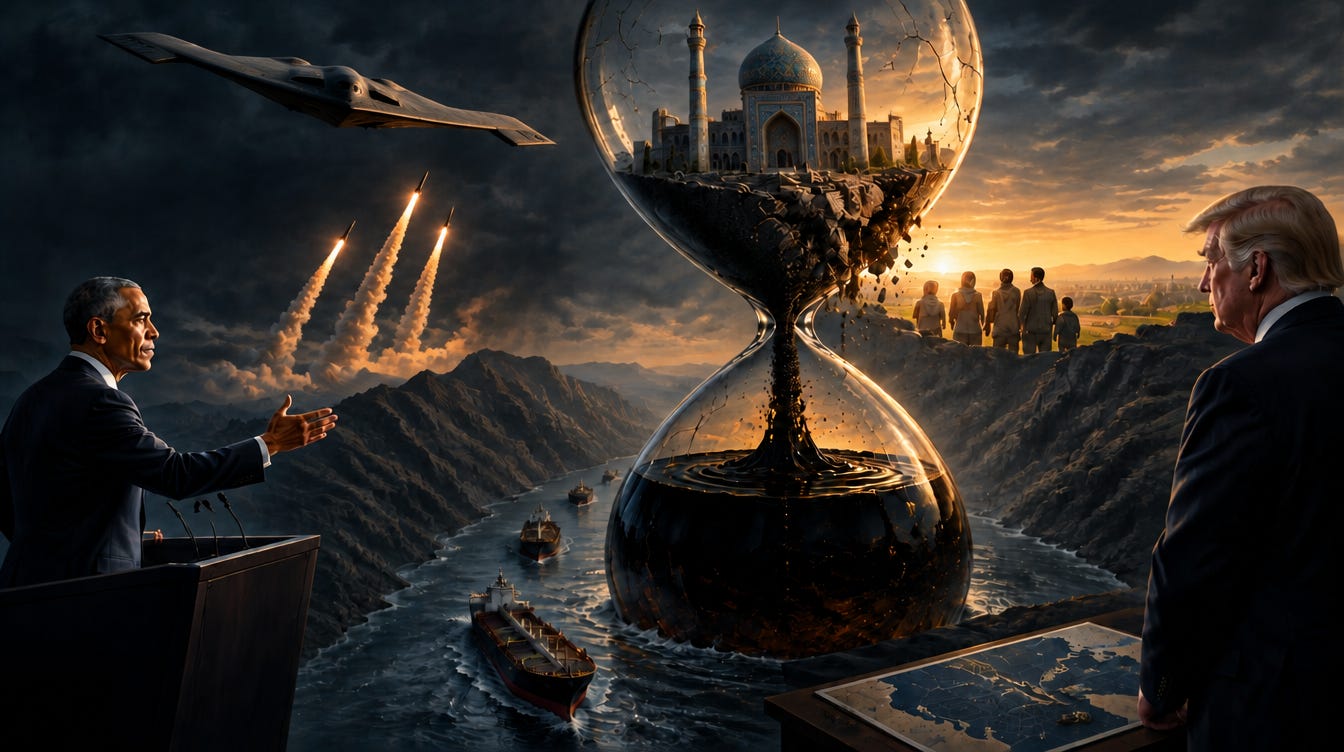
A few days ago, former President Barack Obama, stumping for Amy Acton and
Sherrod Brown in Cleveland, Ohio, provided a perfect illustration of the
spread of misinformation about the Iran conflict. Despite an unsuccessful
presidency, Obama remains a well-liked public figure and is considered
trustworthy by a majority of Americans, especially Democratic voters. In his
speech, he dismissed the Iran conflict as unnecessary and criticized its
cost, before stretching credulity past its limits with the assertion that
recent U.S.-Israeli actions had strengthened Iran’s geopolitical position.
The Political and Strategic History of the World is a reader-supported
publication. To receive new posts and support my work, consider becoming a
free or paid subscriber.
The speech borrowed its structure, if not its style, from the standard Trump
rally template: a series of statements based on how politically beneficial
they would be if true, rather than any excessive preoccupation with their
veracity, generously interspersed with self-congratulatory revisionist
history. Where Trump is the used-car salesman trying to sell you a beloved
classic American muscle car, glossing over some of the issues under the
hood, Obama is peddling a hybrid station wagon with the horsepower of a golf
cart, insisting that if you don’t like it, you’re a dunce or a rube standing
in the way of progress. The distinction is that Trump is trying to upsell
Americans on the gimcrack mythos of the great U.S. of A., while Obama is
hawking the “Great Liberal Deathwish” on an instalment plan.
“Iran didn’t have nuclear
weapons because I had put a deal in place that everybody acknowledges kept
them from getting nukes. And I didn’t have to fire a missile to do it. I
just had to engage in diplomacy.”
— President Barack Obama, 24 October 2026
Obama’s Diplomacy
In reality, Obama released between $100 billion
in previously frozen Iranian assets, roughly half of which were liquid and
convertible to cash, and through sanctions relief, enabled the regime to
expand oil production and exports to add an additional $20 billion in annual
revenue. In exchange, Iran was not required to dismantle its uranium
enrichment infrastructure or play nice. They merely had to agree to a
temporary pause on their nuclear ambitions. Under the JCPOA’s sunset
clauses, after the waiting periods had elapsed, Iran would have been free to
pick up where it left off, and start amassing weapons-grade uranium while
remaining technically compliant with its non-proliferation treaty
obligations. In effect, Obama paid the terrorists’ ransom upfront and
reserved the right to be held hostage later.
To no one’s surprise, except perhaps President Obama’s, Iran’s conduct
throughout the negotiating process and after the deal was finalized made
clear that it was not a good-faith actor. During negotiations, Foreign
Minister Javad Zarif established a working group of prominent Iranian
lawyers and legal scholars to help draft the agreement. Among them were
experts in exploiting ambiguity in international regulations. They fought to
insert ambiguous language throughout the agreement, only later to cite that
same ambiguity as an impediment to compliance. While the JCPOA was in
effect, Iran routinely pushed the envelope with the IAEA. Whenever it was
caught breaching conditions or exceeding clearly defined stockpile limits,
it feigned innocence and insisted it was an honest mistake. In truth, Iran
was like a baseball player leading off in preparation to steal a base,
constantly testing the limits.
One might have expected that Obama’s largesse would have earned some
goodwill with the regime. But four days after the deal was finalized,
Ayatollah Khamenei addressed the country on national television, praising
large crowds that had assembled to chant “Death to America” the week prior.
“At Al-Quds Day rallies last
week, you heard ‘Death to Israel,’ ‘Death to America.’ You could hear it.
The whole nation was shaken by these slogans. It wasn’t only confined to
Tehran. The whole of the nation, you could hear, that was covered by this
great movement. So we ask Almighty God to accept these prayers by the people
of Iran.”
— Ayatollah Ali Khamenei, 18 July 2015
And the Supreme Leader’s
belligerence was not just talk. Throughout the JCPOA’s term, Iran continued
testing ballistic missiles, advancing centrifuge technology, expanding its
military footprint in the region, and financing and arming proxies like
Hamas, Palestinian Islamic Jihad, Iraqi Shia militias, Hezbollah and the
Houthis. The regime captured American sailors, harassed U.S. warships,
threatened American forces throughout the region, conducted cyberattacks and
espionage, and pursued a coordinated strategy to undermine American and
allied interests. To make matters worse, these efforts were funded in part
by cash and assets made available through Obama’s sanctions relief. While
the Iranians pocketed the cash and patiently waited for their permission
slip to continue their nuclear ambitions, they only escalated their
confrontational stance toward the United States. President Obama’s
diplomatic efforts, for which he heaped praise upon himself in Cleveland,
were a farce.
The cost Later
in the stump speech, Obama went on to opine about the present conflict:
“Our allies and our bases
have been attacked. Americans have been killed. Hundreds of Americans have
been wounded. We have run down our stock of missiles, and Iran now has veto
power over the Strait of Hormuz, where oil goes through to get to the world
market. So they’re in a stronger strategic position now than before the war
started.”
Since February 28, 23
American lives have been lost, and each of those deaths is a tragedy.
However, only 11 were killed by Iran. The majority were due to medical
conditions, a tragic mid-air collision and one suicide, all unrelated to
Iranian strikes. By contrast, the Iraq quagmire that critics of this
conflict are comparing it to saw an average of that many Americans killed
every week for almost nine years. The comparisons to Vietnam are even more
preposterous, as that conflict saw an average of 11 dead Americans per day
for 14 years, with entire years where 200–500 flag-draped caskets were
shipped home every week.
In this conflict, approximately 93% of all Iranian offensive strikes have
been intercepted by U.S. and allied missile-defence systems. Since the start
of the war, Iran’s missile and drone launch capacity has been reduced by
over 95%. Its conventional navy has been sunk, its air force grounded, and
its ground troops have been deployed to Iranian cities to terrorize and
oppress its own citizens rather than engage U.S. or allied forces. With no
American boots on the ground and the most vulnerable regional bases
evacuated and operations relocated to safety, further U.S. casualties will
be limited.
The other cost consideration is financial. This conflict has cost an
estimated $47.1 billion so far, with ongoing operations projected at around
$2.5 billion per month. While that may sound like a lot of money, so far,
those costs have been absorbed through existing defence resources and
appropriations. To date, Congress has not yet needed to increase military
spending by one cent. The administration has proposed a massive, one-time
$1.5 trillion defence budget for 2027 (the increase substantially earmarked
for preparing for the future of warfare through major investments in AI,
robotics, and space-based missile defence, rather than Iran specifically),
but even if Congress rejects the increase and holds defence spending roughly
flat at 2026 levels, the U.S. will have adequate funding to adequately
replenish its missile stocks, sustain the blockade and continue necessary
precision strikes against Iranian targets for a prolonged period. By
comparison, monthly U.S. spending during the War in Iraq averaged $10
billion and peaked at $25 billion (inflation adjusted). Once gas prices
normalize, the financial impact of continuing this engagement will be
effectively imperceptible to the American public.
The Hormuz “Veto”
As of today, Iran’s primary method of waging
this war is by mining the Strait of Hormuz with a small armada of IRGC
dinghies, in the hope of wreaking havoc on the global economy. Its desperate
strategy is to cause so much pain at the gas pump that American consumers
deliver Trump such a “shellacking,” to borrow Obama’s description of the
Democrats’ 2010 midterm results, that he is impeached or otherwise forced to
abandon the mission. This strategy has five obvious flaws:
To keep driving up gas prices, Iran must shut down the trade route upon
which 90% of its exports and a major part of its entire economy depend.
Saudi Arabia, the UAE, and Oman are all currently expanding their ports and
establishing new pipeline corridors, and by 2028 will have the
infrastructure to bypass 60% of Hormuz oil flow.
In recent weeks, total Middle Eastern oil exports have reached peaks above
pre-war levels, even as Iran’s share has been reduced practically to zero,
as producers find ways to bypass the Strait.
Since the conflict began in February 2026, the United States and other
friendly oil producers unaffected by the Middle East conflict—which, thanks
to Trump’s recent actions in another theatre, now include Venezuela—have
increased production by 1.5 million barrels per day, with the ability to
more than double that increase over the next twelve months.
While Democrats look likely to win the House and will almost certainly
plunge the nation into another impeachment sideshow, no reasonable scenario
will result in a Senate conviction. In the meantime, the president can
invoke his constitutional authority to largely disregard a hostile, partisan
Congress and get the job done.
In other words, as time goes by, Iran loses more and more of its leverage.
The war of attrition
While Iran waits for November’s election
results, Trump is waiting for December. According to energy intelligence
firm Kpler, Iran’s floating crude inventory that set sail before the U.S.
blockade was established dried up earlier this month. Iran has not been able
to ship any new oil since August. Iran’s Chinese buyers typically pay on a
one- to two-month lag, so the regime’s oil revenues will go to zero by
mid-December.
With Iran facing a deep recession and inflation nearing 70%, things only get
worse. As conditions deteriorate, more force will be required to pacify a
populace that already despises the regime, creating a vicious cycle. The
regime must increasingly cut civilian expenditures and divert funds to meet
the IRGC and Basij payroll, but offloading more of the economic pain onto
ordinary Iranians foments even greater unrest, necessitating more force to
stay in power, and so on. Quickly, the situation becomes a pressure cooker.
The U.S. midterms are days away, and the mullahs have put all their eggs in
a basket with a false bottom and will soon discover the hems of their
dresses stained with yolk.
The energy shock has been an effective campaign tool and will surely do some
real damage to the Republicans at the polls. But consider the context. The
average gas price during Joe Biden’s four years in office was $3.471 per
gallon, compared with $3.472 for Trump 2.0. Even at the May 2026 peak,
prices at the pump remained $1.10 per gallon lower in real terms than the
peak under the previous administration in 2022. Far from unprecedented, real
average gas prices were higher than the 2026 year-to-date average in 22 (or
more than 1 in 5) of the last 100 years. The point is not to diminish the
strain on Americans struggling to make ends meet, but those painting a
picture of a major crisis are catastrophizing for political reasons.
The endgame The
United States is not mired in another intractable Middle East quagmire, the
Iranian regime cannot win a war of attrition, and the midterm results will
not change that equation. My prediction is that regardless of the results on
November 3, the mission will continue. In any scenario, the president has
nothing to lose and will be more motivated than ever to secure what he now
regards as a key part of his legacy. This conflict will be recognized by
history as a crucial turning point in establishing relative stability in the
Middle East.
The regime does not have time on its side. More than 70% of Iranians reject
the Islamic Republic, and the regime earns greater contempt as it clings to
power with a progressively tighter and more oppressive grip. Once its
machinery of repression falters, the revolutionary spirit of the great
Persian people will have the opportunity to slip the yoke of Islamofascism
once and for all. The post-midterm Trump will be unencumbered by public
opinion and will be largely free to prosecute this conflict in the most
effective way to achieve that objective. There are already signs the U.S. is
preparing to resume major military operations after the midterms, and it
seems more likely than ever that Trump will finish the job he started.
Our last question
How successful has this conflict been at
achieving its objectives?
It is hazardous to attempt to predict what the future holds, and there is
certainly plenty of precedent for America’s foreign interventions going
sideways. But the scorecard so far is decidedly positive. The U.S. and its
allies, through strikes on Iranian launch sites, stockpiles and munitions
factories combined with their missile defence systems, have been able to
reduce the lethality of Iranian strikes by 99%. By all accounts, Iran’s
capacity to wage conventional war has been reduced to virtually nothing. It
is unable to hold the region hostage. As far as the regime’s nuclear
ambitions are concerned, its enrichment facilities were heavily damaged by
U.S.-Israeli strikes, and there is no sign that it has tried, or has the
capacity, to rebuild its enrichment capacity any time soon.
It is left with only two options. First, the unconventional and
self-defeating tactic of cutting traffic through the Strait of Hormuz. It
has had very mixed success at achieving that objective, and perversely, the
Strait is a trade route that Iran is vastly more dependent on than those it
seeks to harm by closing it. Second is to wage war by proxy. In pursuit of
this strategy, Iran is effectively sending its remaining allies on suicide
missions to preserve its regional leverage. Meanwhile, Hamas and Hezbollah
have been severely hobbled by Israel. The Houthis have managed to mount an
effective campaign in recent months, but face an imminent Saudi-backed
counter-offensive supported by the U.S., Turkey and Pakistan. Iraqi militias
remain a threat, but Baghdad is aligned with the U.S. in its attempts to
pacify them, a process which should become easier as Iran’s ability to
finance and supply them becomes progressively strained. Over the coming
year, we can expect the steady erosion of these proxies’ military capacity
and usefulness to Tehran.
In summary, so far, so good.
A chance for peace
I challenge anyone to present an example of a
more successful military engagement between sophisticated combatants in the
history of modern warfare. The only serious contenders would be the Six-Day
War or Desert Storm, and both carried a much higher death toll, financial
burden, or both.
While generally averse to putting too much stock in wishful thinking as it
relates to geopolitics, particularly in the Middle East, I invite readers to
consider what it could look like if Trump succeeds. There is a real path
emerging for the people of Iran to deliver the regime a coup de grâce and to
install a moderate government of their own choosing. This sequence of events
would usher in an era of unprecedented Iranian prosperity and cooperation.
Iran could gradually become a valued ally in suppressing violent extremism
across the region, rather than serving as its chief architect.
The first domino in a chain that could see Iran rescued from the Dark Ages,
the Houthis smashed, Hamas rooted out, Hezbollah sidelined, Iraq pacified,
and the Abraham Accords expanded to include Saudi Arabia, Egypt and other
major Muslim-majority nations is teetering. If, over the next two years,
Trump manages to coax even a few of those dominoes to fall, he will have
left behind an astounding foreign-policy legacy, one far greater than that
of Barack Obama, who oversaw the prequel to Russia’s invasion of Ukraine,
North Korean brazenly conducted four nuclear weapons tests, Libya’s descent
into chaos, large swathes of Iraq and Syria falling under ISIS control, and
a refugee crisis that has in subsequent years nearly overwhelmed dozens of
Europe’s great historic cities.
There’s no guarantee Donald Trump will pull it off. But he might—and whether
you like him or not, there’s no good reason not to hope he does. |




