|
The MacInnes's are of
ancient Celtic origin, with the name MacAoghuis being Gaelic for "son of Angus".
The ancestors were probably amoung the earliest settlers of Dalriada and were said to have
formed a branch of the Siol Gillebride, believed to be the original inhabitants of Morven
and Ardnamurchan. Old tradition has it that the MacInnes were promised favour by the Lord
of the Isles. A later chief of the Clan MacInnes was appointed Constable of the Castle of
Kinlochaline and was still held by a MacInnes when it was burnt by Coll Kitto in 1648. The
clan suffered severly early in the 13th century during the conquest of Argyll by Alexander
II and at about this time the clan moved under the protection of the Campbells. They
supported the Covenantors against Charles I and later supported the Hanoverians against
the Jacobites under the Campbells, although there also seems to have been a MacInnes
appointed as Hereditary Bowmen to the chiefs of clan MacKinnon. Another group of MacInnes
were also to be found as followers of the Stewarts of Ardshiel and as such supported the
Jacobite struggle. Of those MacInnes who emigrated, Donald MacInnes became a merchant and
later Senator in Canada and Renn MacInnes became Bishop of Jerusalem in 1914.
Another account of the Clan
BADGE: Cuileaun (hex
aquifolium) Holly.
 NOT
a great deal appears to be known about this West Highland clan. The common
derivation of the name is from Angus, one of the most ancient of Christian
names among the Gael. In the genitive the "g" of this word is
aspirated, and the name is left with the sound MacAon’es or Maclnnes.
Who the original Angus was, however, appears to be unknown, and as the
name Maclnnes also means "Son of the Islet," many of the bearers
of it are no doubt descendants of individuals who dwelt in such a spot,
and in the usual way took their name from their location. The ancient
family of Innes of Innes in Moray, of which the Duke of Roxburghe is head,
no doubt derives its name from such a circumstance. NOT
a great deal appears to be known about this West Highland clan. The common
derivation of the name is from Angus, one of the most ancient of Christian
names among the Gael. In the genitive the "g" of this word is
aspirated, and the name is left with the sound MacAon’es or Maclnnes.
Who the original Angus was, however, appears to be unknown, and as the
name Maclnnes also means "Son of the Islet," many of the bearers
of it are no doubt descendants of individuals who dwelt in such a spot,
and in the usual way took their name from their location. The ancient
family of Innes of Innes in Moray, of which the Duke of Roxburghe is head,
no doubt derives its name from such a circumstance.
Skene, in his Highlanders
of Scotland, says, "The oldest inhabitants of Morven, Ardgour,
and Lochaber consisted of two clans, the MacGillivrays and the Maclnneses,
who were of the same race. The statement is confirmed by an old MS.
History of the MacDonalds written in the reign of Charles II. in the
Gregory collection. Before the defeat of the Lord of the Isles and the
dispersion of the clans by Alexander II. a single confederacy, the Siol
Gillivray, appears to have included the MacGillivrays, Maclnneses,
MacEacherns, and MacMasters.
Clan Maclnnes had its headquarters in the
heart of Morven, and at the head of Loch Aline, which winds away into the
hills from the Sound of Mull, the ruin of an old square tower is still
pointed out as the ancient seat of the chiefs.
Tradition avers that this old tower of
Kinlochaline was built by a lady of the name of Dougall. This tradition is
corroborated by an old saying—MacAonghais an Dun’s MacDhughil an
Laorn, "Maclnnes of the Fort of MacDougall of Lorn." The
stones of which the stronghold is erected are remarkable for their size,
even to the top of the wall, and it is said that the cost of the building
was equal to that of a mass of butter of the same extent. Whatever the
cost, the builder chose a site for the fortalice that was both picturesque
and of great natural strength. From the summit of a bold rock overhanging
the loch the ruin still romantically lords the scene. Kinlochaline was
within a short distance of Ardtornish, on the Sound of Mull itself, one of
the principal seats of the all powerful Lords of the Isles, and the
Macinneses were probably, therefore, closely allied with and dominated by
these potentates. The seat of the Maclnnes chiefs, however, was still a
place of strength in the middle of the seventeenth century. In 1645,
during the wars of Montrose, Kinlochaline was besieged by the Irish
auxiliaries of that leader. The siege was pressed with much vigour, but
Clan Maclnnes held out with great bravery till a breach was made in the
wall and defence became hopeless. The castle was then taken and garrisoned
for King Charles I.
The Maclnnes chiefs sleep
their last sleep in the little burial-ground of Kilcolumkil, a short
distance away. Several of their monuments are there to be seen, slab
stones beautifully sculptured with intricate designs of foliage and
tracery. No inscriptions, however, remain to tell the names of the
sleepers or the deeds which they performed.
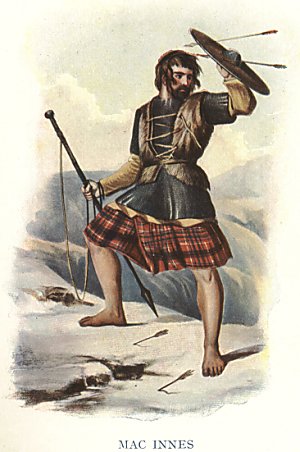
In early times the Maclnnes
clansmen were famous for their skill in archery, and one of their families
held the office of hereditary bowman to the Chiefs of MacKinnon. This
official had the duty of instructing the MacKinnon clansmen in the use of
the weapon, and for its services the family enjoyed a hereditary farm, Dal
na Saighdear--"the Field of the Archer." Many characteristic
anecdotes are related regarding these hereditary bowmen.
Septs of the Clan MacInnes:
Angus, MacAngus, MacCainsh, MacCansh, MacMaster. MacNeish
|



