|
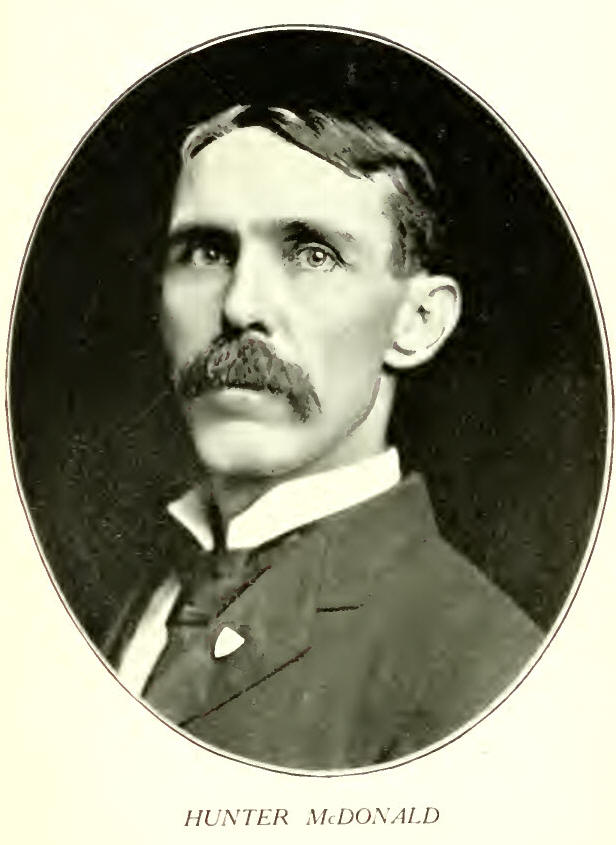
Hunter McDonald, the seventh son of Angus
%V. McDonald and Cornelia Peake (his wife) , was born at Winchester,
Virginia, June 12th, 1860, and was named after a favorite cousin of his
father's, Dr. Hunter McGuire, who afterwards became Medical Director of
Jackson's Division of the Army of Northern Virginia.
He was at quite a tender age when the
family were forced to leave their home at Winchester and take refuge in
Lexington, Virginia, and among his earliest recollections is the
bombardment of the place by the guns under command of General Hunter,
and the burning of the Virginia Military Institute, with all the
buildings connected with it. The family remained in Lexington for
sometime after the close of the war, and Hunter's youth was passed in
constant association with the students of Washington and Lee University
and the cadets of the Virginia Military Institute. Some of his older
brothers attended each of these institutions and he was often a
spectator and sometimes a participant in their engineering field
practice. He attended a private school taught by his mother until 1871
and after that, other schools in Lexington, until the summer of 1873.
Several of his older brothers having
settled in Louisville, Kentucky, it was decided at this time that Mrs.
McDonald and her younger children should also remove to that city.
Accordingly, one of the brothers, Allan, came on from Louisville for the
purpose of taking the family back with him, bringing the necessary funds
and tickets, but before leaving Virginia he decided to visit the Natural
Bridge, taking with him young Hunter, who was then about thirteen years
old. In leaning down and looking over the precipice, near the famous
Cedar Stump, the pocket-book, containing the transportation and funds
needed for emigration, dropped from Allan's pocket and lodged on a ledge
of rock about one hundred and twenty feet below. This created
considerable consternation, for even if the book could be dislodged from
its resting place, the swollen creek below threatened destruction to its
contents. A consultation ensued and Hunter consented to be lowered with
a rope and make an effort to secure the lost treasure.
Accordingly, he was seated on a stick tied to the end of a rope and
lowered over the precipice, but the rope unfortunately proved to be
inadequate, and he, with remarkable fortitude, agreed to remain
suspended until more rope could be procured. An hour probably was spent
in this hazardous position, when the arrival of additional rope enabled
him to reach the pocket-book, after crawling along the ledge for a
distance of about sixty feet.
On his arrival at Louisville, Hunter was
entered in the Louisville Rugby School, taught by two of his older
brothers, where he graduated in 1878. He then returned to Virginia to
study engineering at Washington and Lee University.
He came again to Louisville in 1879 and
being compelled to find employment, he applied to the Louisville and
Nashville R. R., and more to try his mettle than anything else (for it
was not at that time considered an important matter) , he was sent to
re-locate the mile-posts on the road. The work consisted in measuring
the distance of each milepost from the initial point at Louisville, and
also, that of all stations, switches, State and county lines and
bridges, and it soon developed that the work was highly important.
Measurements of record, at that time, were inaccurate on account of
having been secured from original surveys of short sections of the road,
the L. and N. Co. having absorbed and consolidated a number of shorter
lines, so their correct measurements from a given point were very
necessary.
Hunter started out with two of his young
companions and a negro cook to help him, walking and carrying his
camping outfit on a hand-car and camping wherever night overtook him.
The weather was hot and the work became exceedingly disagreeable, and
one of his assistants dropped out, his place was soon filled, however,
and the work went steadily forward, lasting through a very hot summer,
and extending over one thousand miles of road. Their only means of
baggage transportation was a hand-car, which had to be lifted hastily
from the track whenever a train was heard approaching, but one unlucky
day this was not done quickly enough and the hand-car was smashed beyond
repair.
With no way now of transporting the tent,
it had to be abandoned and the rest of the trip was made sleeping on the
ground wherever the day's work ended and procuring food as best they
could. The work was finally completed at Memphis while the yellow fever
was at its height, on November 1st, 1879, and was well and faithfully
performed. On December 1st, 1879, Hunter was made Assistant Engineer of
the Nashville, Chattanooga and St. Louis Railway under Col. R. C.
Morris, M. Am. Chief Engineer, being the only assistant on the system at
that time, and his service with the railway has been continuous since
then. He has also filled various positions in the Maintenance of Way and
Construction Departments, having had direct charge, or responsible
supervision of the surveys and construction of all new Iines, and the
re-construction of those lines acquired by purchase or lease; the
mileage having been increased from 453 in 1880 to 1,230 miles in 1911,
and the train mileage from 1,500,000 to more than 7.000,000 in the same
period.
In 1884, Hunter had charge of the
rebuilding of the Running Water Viaduct and in 1887-1888 he was engineer
in charge of the construction of the Huntsville Branch and changing the
gauge of the Duck River Valley, narrow gauge branch. On the completion
of this work, he was appointed Division Superintendent of the Huntsville
Division, and at the same time had charge of the surveys and
construction of the Tennessee and Coosa Railroad and the extension of
the Sequatchie Valley Branch to Pikeville. In 1891, he was appointed
Resident Engineer of the Western and Atlantic P. R., which his company
had leased from the State of Georgia. He was stationed in Atlanta at the
time, and had charge of the complete re-construction of the track,
bridges and most of the other structures.
On the death of Col. Morris, in November,
1892, Hunter was appointed Chief Engineer, and still occupies that
position.
His first work after being promoted to
the office of Chief Engineer, was the re-construction of the drawbridge
over the Tennessee River at Johnsonville, Tenn., which required the
sinking of pneumatic foundations to a depth of fort'-four feet below low
water. Shortly after its completion he presented a paper to the American
Society of Civil Engineers, with a detailed description of this work.
In 1882, he was elected a junior, and in
1887, a full member of the American Society of Civil Engineers. In 1889,
he assisted in the organization of the Engineering Association of the
South, and became its President in 1895.
He was the eleventh member enrolled in
the American Railways Engineering and Maintenance of Way Association,
and was made a director upon its organization, and President in 1904,
serving two years. In 1900, he was employed by the Southern Railway to
examine into and report on the cause of the disaster at Camp Creek,
south of Atlanta, by which thirty-four persons lost their lives, due to
the washing out of a large culvert. His report was made the basis of
defense by the attorneys, and the first damage suit resulted in favor of
the defendant, while the others were compromised.
In 1903, he was elected director for
District No. 6 in the American Society of Civil Engineers, and in 1910,
Vice-President. He is also a member of the National Geographic Society.
The above details of Hunter's activities
in the pursuit of his chosen work, have been largely gathered from the
pages of the Railway Age and Engineering News. And in view of the fact
that his health has never been very robust, it seems wonderful that he
should have accomplished so much.
In addition to all this, he is also
responsible for the handsome structure known as Cummin's Station in
Nashville, which cost half a million dollars, and is General Manager of
the corporation which owns and operates it.
In 1893, he was married to Miss Mary
Eloise Gordon, of Columbia. Tenn., a great granddaughter of Colonel John
Gordon. one of Andrew Jackson's most trusted scouts. They have one son,
Hunter, named for his father.
Two children of Angus W. McDonald and
Cornelia Peake (his wife) died in infancy. Humphrey, the third son, born
December 31st, 1850, died July 30th, 1851, and Elizabeth, born 29th
October, 1861, died August 23rd, 1862. |