by Gregory Lauder-Frost,
F.S.A. Scot.
member of the Council of the Scottish Genealogy Society;
member of The Heraldry Society of Scotland.
(Note:
clicking on the arms below will bring up a full-screen picture of them but a
little patience is required while they load)
According to all the sources I have
consulted, the ancient family of Lauder bore arms long before any
established heraldic authority existed in Scotland. It is probable that, as
Normans, they brought their arms – a griffin – with them when first entering
Scotland in 1056. From about the year 1000, Normans were decorating their
shields, especially with wavy crosses and with beasts. Alexander Nisbet,
writing in his famous Systems of Heraldry in 1722, seems to
think that the Lauders may originally have been Flemish or German and
suggests this is where they acquired the griffin from, as in the 11th
century only the Germans were known to be using this mythical figure.
Amongst the best authorities for early
arms and crests are seals. Ancient Scottish Seals by Henry Laing
(Edinburgh 1866) mentions five Lauder seals and illustrates one from the
Melrose Charters – that of William Lauder, (died 1425) Bishop of Glasgow
and Lord Chancellor of Scotland. The Bishop’s arms, identical to the seal,
are to be found in stone in Glasgow Cathedral, large parts of which were
constructed at his behest.
Scottish Armorial Seals
by W.R.MacDonald (Edinburgh 1904) went further than Mr.Laing, listing some
twenty four Lauder seals. Again, the earliest seal he has listed was one
from 1417, again of William Lauder Bishop of Glasgow. All the seals
mentioned herein show a shield with a griffin
segreant.
Following the death of Alan Lauder of that
Ilk circa 1407 the family split into two distinct branches: Lauder of
The Bass, and Lauder of Haltoun.
 ANCIENT
LAUDER
ANCIENT
LAUDER
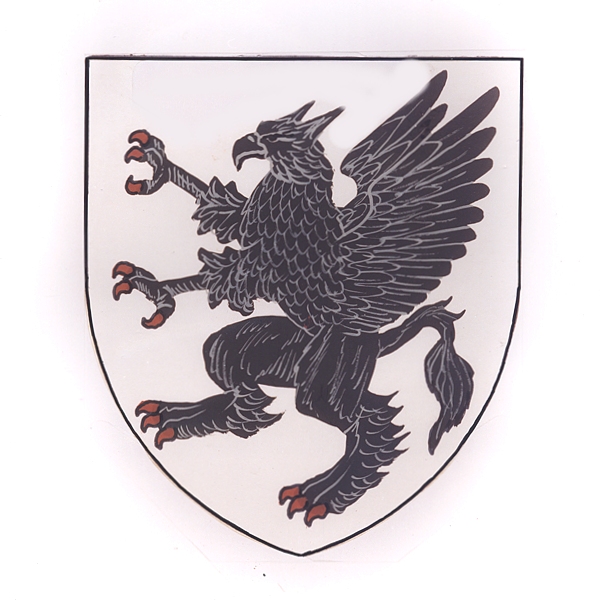
Nisbet states that the original family of
Lauder of that Ilk or Lauder Tower carried a griffin for their armorial
figure, and it appears that the original Lauder arms were, (Burke
[1842] lists erroneously as Lauder of Haltoun), Ar. a griffin segreant sa,
with a tower as crest with motto Vivit post funera virtus
(‘Virtue lives on after death’). The family based at Lauder descended from
an Alan Lauder of that Ilk, a younger son of Sir
Robert Lauder of The Bass (d.1425), who sat on a Retour
Inquest in the Royal Burgh of Lauder on 30th April 1461, and
whose seal is attached, showing the original arms only. His younger son,
Robert Lauder of Murecleuch, who later became Robert Lauder of that Ilk
(upon the demise without male heirs of his elder brother Oliver) used the
same seal on 23rd May 1503 and this can be found on p.197 of
MacDonald.
 HALTOUN
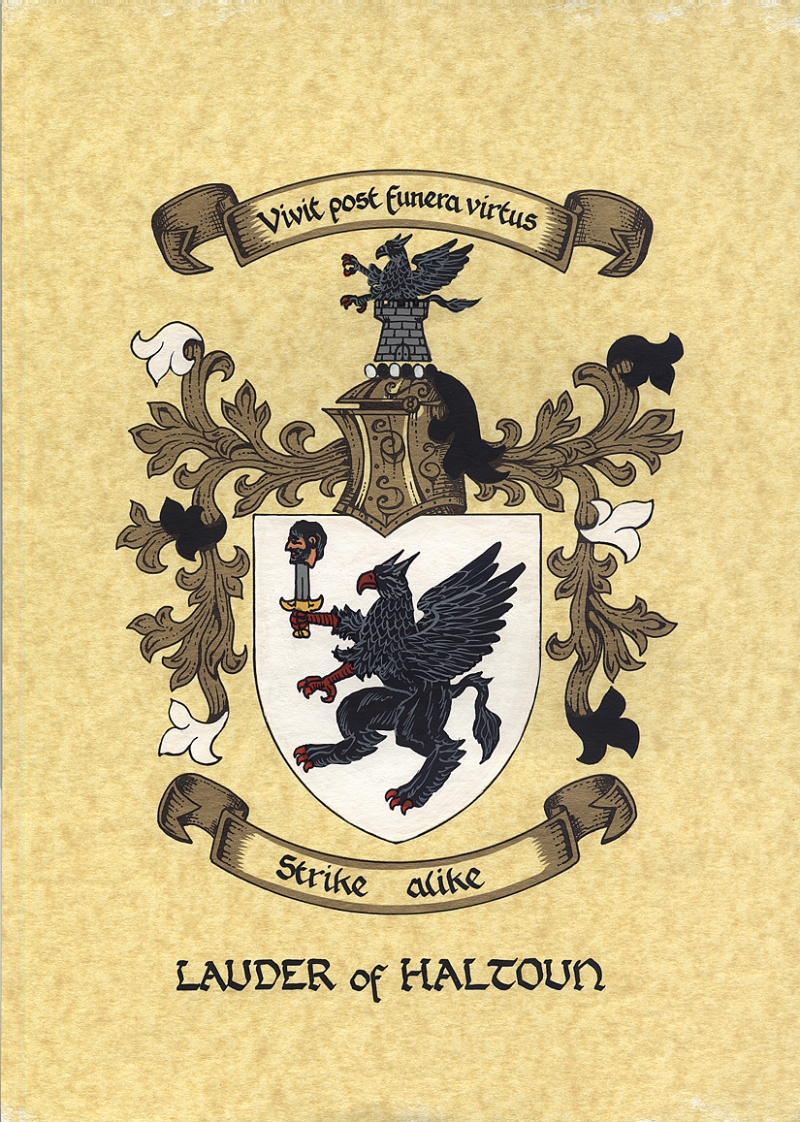
In Sir David Lindsay’s Heraldic
Manuscript of 1542, he displays plates of Lauder of Bass, and Lauder of
Haltoun, both with the griffin sergeant (Bass with a double
tressure). The present Lord Lyon of Scotland also relies upon the
Workman’s Manuscript for an authority. This manuscript is a little
misleading as to Lauder pedigrees, however what it does tell us is that
Lauder of Haltoun had a griffin in the arms but that "afterwards
it was borne holding a sword in its for-paw, supporting a
saracen’s head proper". The arms motto was Strike alike. (Nisbet
and Stodart agree with this plate).
The original crest to the Lauder
arms appears to have been a tower. However, after the addition to the
arms for Haltoun which Workman’s mentions, above, a demi-griffin
issued from the tower, which had a motto Vivit post
funera virtus.
Alan Lauder of that Ilk (d.c1407), who was confirmed in
the Haltoun estates in 1371, had fought the Moors in Spain, and his
direct ancestor had been in the Third Crusade fighting the Saracens.
Exactly when the shield was altered, therefore, we cannot say, but it
may be safe to assume that George Lauder (d.c 1430), who established
the separate House of Lauder of Haltoun after his father’s death,
altered the arms to add the saracen’s head on a sword, as above.
 BASS
BASS
The next arms of this family which concern
us are those of Lauder of Bass, a branch which became a separate entity at
about the same time as Haltoun.
Henry Laing tells us that a seal of Sir
Robert Lauder of Bass, Lord Justice of Scotland etc etc, appended to an
Instrument dated 16th July 1425, has the griffin surrounded by a
royal tressure. (Tytler states that this Sir Robert Lauder was "a firm
friend of the King" [James 1st] and possibly the double-tressure
dates from this time. Alternatively, his father "a renowned hero" [Froissart]
had been at the battle of Otterburn). Mr.MacDonald also describes this seal
the same way but adds that there was for a crest: on a helmet front
face, a griffin head. This crest may have been personal to this Sir Robert
as it does not appear after this time. Messrs Laing, MacDonald and also
Workman’s state that these arms had supporters: two lions rampant
guardant.
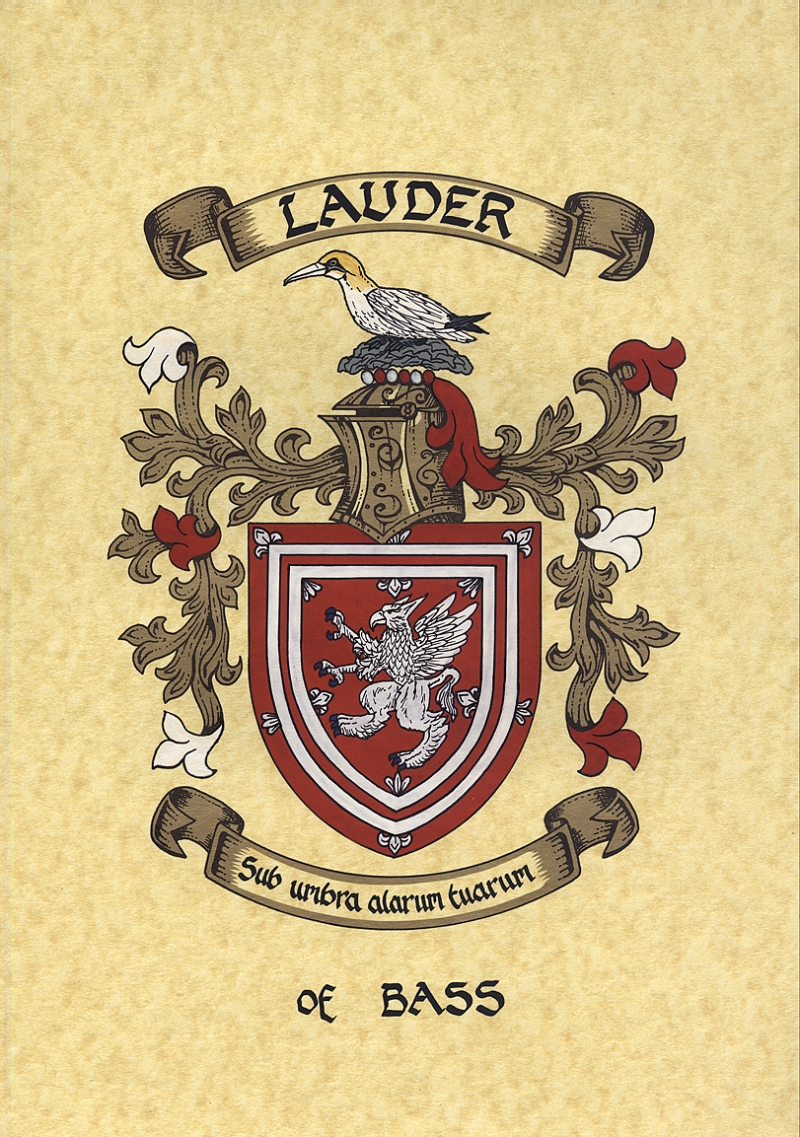
Since that time it would also appear that
the background colour of the shield was changed by this branch of the family
from white to red. All authorities (Stodart, Nisbet, Burke etc) now agree
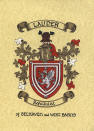
that the arms of Lauder of Bass are: gules, a griffin
segreant, within a double tressure flowered and counter-flowered argent;
motto (possibly added at the same time as the crest): sub umbra alarum
taurum (the motto is taken from Psalm LXIII verse 8 – "because thou hast
been my helper, therefore, ‘under the shadow of thy wings’ will I
rejoice").
Alexander Nisbet, states that an old
gravestone in North Berwick had two angels as supporters but he does not say
that he himself actually saw it and does not quote the authority. Given what
has already been said, above, such supporters may be disputed. It is also
universally acknowledged that the crest of this family was, by the 16th
century,: a solan-goose [gannet] sitting on a rock proper.
 BELHAVEN
or BEILMOUTH
BELHAVEN
or BEILMOUTH
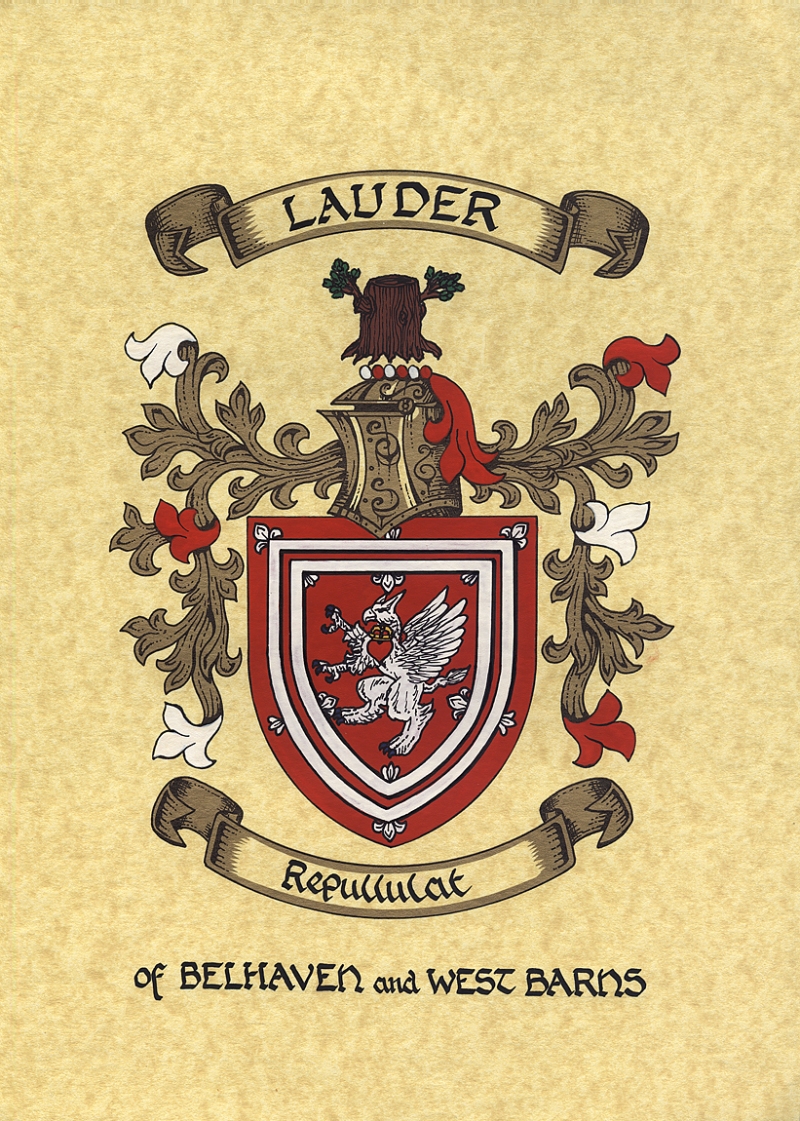
Sometime after 1650 Robert Lauder of
Belhaven & West Barns (later ‘of Beilmouth’), whose line
commenced with a younger son of Bass c1500, registered arms based upon that
descent: gules, a griffin segreant, within a double tressure flowered
and counter-flowered argent, the same with Bass; and charges the breast
of the griffin with a heart ensigned with an imperial crown, all proper, for
his difference, his wife being daughter of Douglas of Standingstone;
crest: the trunk of an old tree budding, proper. Motto: Repullulat
(It sprouts forth again). This branch of the family were later Jacobites.
FOUNTAINHALL
Next we come to Sir John Lauder of
Newington (not displayed) [Edinburgh], and later Fountainhall [East Lothian], 1st
baronet, who registered arms about 1672 as a descendant of a second son of
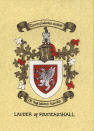
Lauder of that Ilk: gules, a griffin segreant argent in dexter
canton a tower, or. Crest: a balance equilibriated, or. Motto:
Mediocria firma .
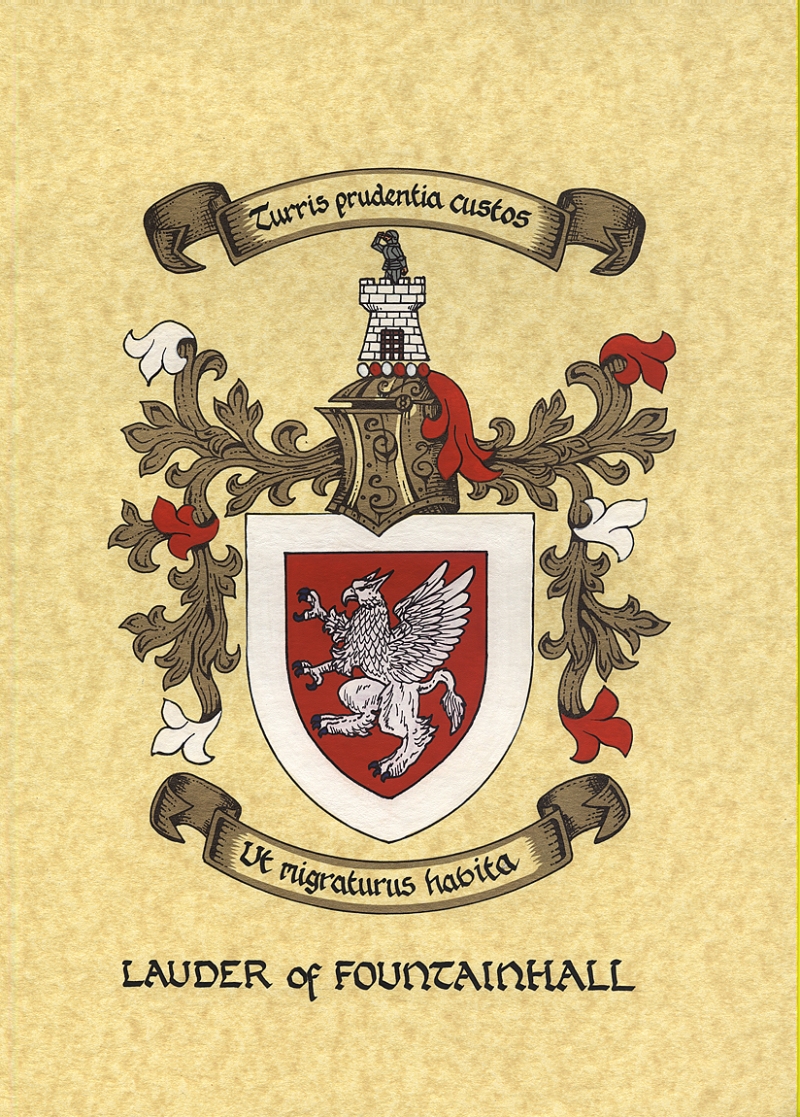
 His son, Sir John Lauder, Lord
Fountainhall, 2nd baronet, registered arms on 15th
June 1699: gules, a griffin segreant within a bordure argent.
Supporters: two lions rampant argent, standing on a compartment
on which is this motto: Ut migraturus habita (‘Live, but be
ready to leave’). Crest: a tower embattled argent, masoned sable,
with the porticullis down, on the top of the embattlement a man in a
watching posture; Motto: Turris prudentia custos (‘careful watch over
the tower’).
His son, Sir John Lauder, Lord
Fountainhall, 2nd baronet, registered arms on 15th
June 1699: gules, a griffin segreant within a bordure argent.
Supporters: two lions rampant argent, standing on a compartment
on which is this motto: Ut migraturus habita (‘Live, but be
ready to leave’). Crest: a tower embattled argent, masoned sable,
with the porticullis down, on the top of the embattlement a man in a
watching posture; Motto: Turris prudentia custos (‘careful watch over
the tower’).
The Lauders of Fountainhall (today this
family have the additional surname of Dick, therefore Dick Lauder
with a quartered coat of arms) claimed descent through the lairds of
Lauder who were, they said, of the Bass family. Thus their Lauder coats of
arms’ colours are based on that of Bass (but see above, under Ancient
Lauder.
 WINEPARK
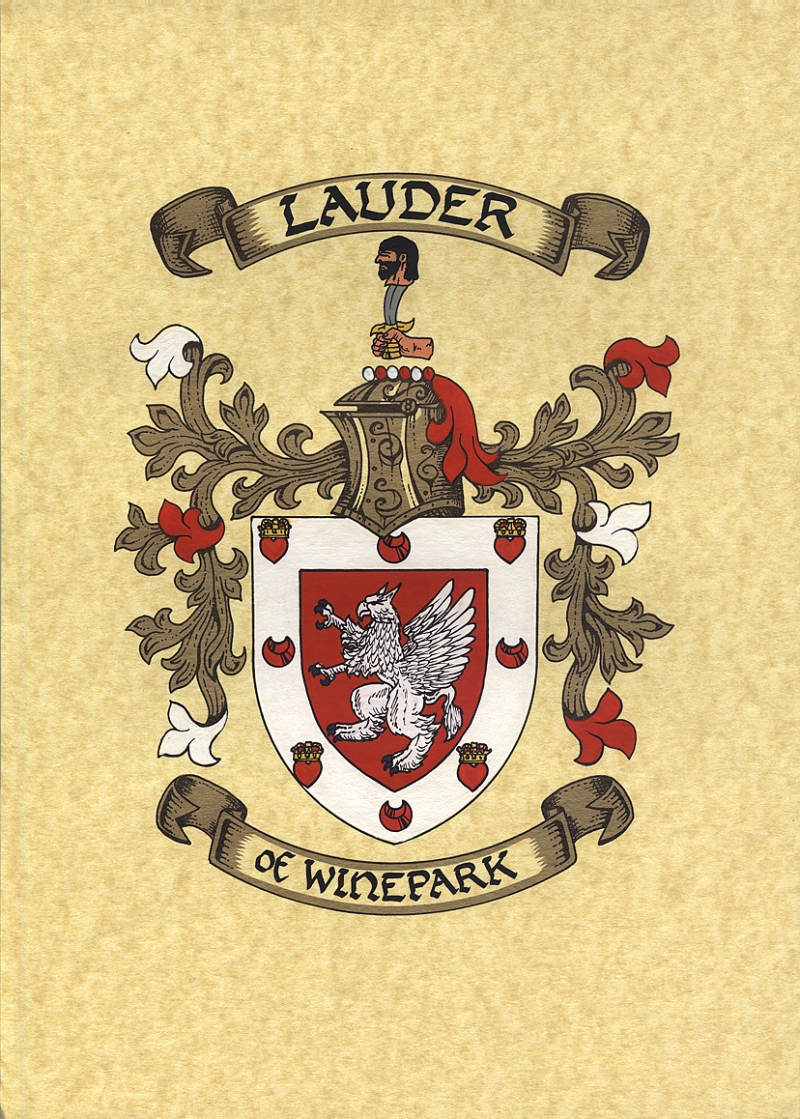
John Lauder of Winepark, (an estate
with a Pele Tower above the Mains of Lauder in Berwickshire, originally part
of the Maitland of Thirlestane lands, then Lauder of Haltoun, reverting to
the Maitlands as superiors but feud to the Lauders of Bass from a very early
date, at least 15th century), registered arms in 1745 clearly
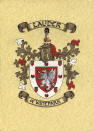
claiming his descent from Bass: gules, a griffin segreant argent
within a bordure of the last, charged with four hearts, ensigned with
imperial crowns, proper, and as many crescents gules.
Crest: a dexter
hand holding a scimitar, and on the point thereof a Saracen’s head, all
proper.
The issuing authority, the Lord Lyon’s
Office in Edinburgh, has the Winepark shield griffin as salient, clearly an
error as all the ancient Lauder arms bore the griffin segreant. Also, the
crest indicates a connexion with the House of Haltoun. Unless, that is, John
Lauder is using the crest to indicate he too is a descendant of the Lauder
ancestor who went on the Third Crusade.
In the above achievements
of Haltoun, Bass and Fountainhall there
is an error common to them all: their crests sit upon a helmet facing
sideways. This is incorrect. It should be a full-faced steel helmet, with
the visor thrown back, and without bars.
One last point. There are strict legal
rules on sporting a coat of arms or crest. You should not "adopt" either
until you have consulted the Office of the Lord Lyon and New Register House,
Edinburgh, who can confirm whether or not you are a descendant of the the
person to whom the arms/crest(s) were issued.
Some additional references: