|
We are pleased to announce the
formation of a new organization in North America consisting of individuals
with Arms registered in the Public Register of All Arms and Bearings in
Scotland at the Court of the Lord Lyon King of Arms in Edinburgh,
Scotland – The Society of Scottish Armigers, Inc.
The Society has been given the very
great honor of having The Right Honorable Robin Orr Blair, LVO, WS, Lord
Lyon King of Arms, agree to act as its patron. We are also most pleased to
note that the former Lord Lyon, Sir Malcolm Innes of Edingight, KCVO, WS,
Orkney Herald of Arms Extraordinary, has graciously consented to serve as
chairman of the advisory committee.
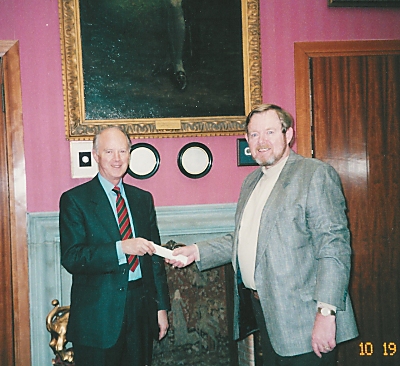
Lord Lyon and Major Randal Massey of Dunham
when he agreed to serve as our Patron
The Society was formed with the goal
of assisting and helping to educate the Scottish American community and
the public at large about Scottish Heraldry and Armory, and Clan
Tradition. To this end, the Society as well as the Lord Lyon, encourages
those Scottish that may have the right to bear arms to do so and join the
Society.
Many Scottish Americans, male and
female, may have the right to bear arms. If you can prove that you descend
from an ancestor who has arms and bear the same surname, you may petition
the Lord Lyon to matriculate your ancestor’s arms. The Lord Lyon may, at
his prerogative, grant arms to well deserving individuals. Thus, if you
cannot identify an ancestor who had arms, you can petition the Lord Lyon
to grant arms to you, or to grant retrospective arms in memory of your
Scottish ancestor and then matriculate those arms if you bear the same
surname.
There are a number of privileges
that come with having your own coat of arms, such as wearing your own
crest badge consisting of your crest within a circlet (not
strap-and-buckle as clansmen do) inscribed with your motto and one eagle’s
feather in silver behind the circlet on your bonnet; flying your own
personal flag bearing your arms; and your wife wearing your crest by
itself, to name but a few. (Clan chiefs are entitled to wear three
feathers while chieftains two.)
More importantly, just as the arms
of the chief descend to his heir, so do the arms of other Armigers. Their
arms become part of their own family's history and heirlooms, building a
link across the generations with the symbols of heraldry and the genealogy
of the bearers of those arms. We Scots take our traditions seriously,
spending great effort in maintaining and celebrating them. The Society
hopes to aid in both understanding and building upon that tradition.
Members of the Society are available
to speak to groups, appear at Highland Games and other appropriate events,
or to author short articles for publication in clan and society
newsletters. For further information contact:
Major Randal Massey of Dunham.
PO Box 361924
Birmingham, AL 35236
masseyofdunham@scotarmigers.net
www.scotarmigers.net
What
is an Armiger?
Captain Robert Jeffrey
Urquhart, FSA Scot.
An Armiger is a member of the Armorial Noblesse of Scotland, an embodiment
of the living survival of the old medieval realm. Armigers perpetuate the
organization, traditions and concepts of the old clan or family
organization of the kingdom. As such they are of immense interest and
value to those of Scottish descent in America, especially at all Scottish
games, gatherings and social events, where their use of heraldry maintains
tradition - pride in, and loyalty to the family, and to the chief, who
represents the family.
Every Fellow and member of the Society of Scottish Armigers has been
recognized by Lyon Court in Scotland and has been granted “Ensigns Amorial”,
their individual “monomark” or coat of arms. The Scottish system of
armorial differencing distinguish chief, chieftains, and cadets of each
such noble and organized name on scientific lines in order to give
practical identification to the various lines of the family and to prevent
cadets from assuming arms inconsistent with their actual position in the
family tree. This splendid scientific system of individual differencing
has been carried on in Scotland from the Middle Ages to the present time.
The basic or undifferenced arms and crest, are the property, not of the
"family" but of the "Chief".
A
coat of arms is the outward indication of nobility (Edmondson, Complete
Body of Heraldry, p. 154), and arms are officially described as "Ensigns
of Nobility". (Nisbet's Heraldry, iii, ii, 65) A patent of arms is a
Diploma of Nobility. (Sir Thomas Innes of Learney, Scots Heraldry, p. 20)
Despite the popularity of recent merchandising campaigns, there is no such
thing as a Scots "Family" coat of arms or crest. Since a coat of arms is a
monomark (mono = one) ownership of an arms pertains to one individual and
is the individual mark identifying that individual, it is strictly not
open to anyone else of the same surname. If you use the arms of someone
else you are usurping arms. If you make up your own arms you are using
assumed arms. In Scotland, in both cases you are committing an offence and
may be charged and tried in the Lord Lyons Court which is a court of law.
Scots Heraldry is one of the most tightly controlled in the world, one of
the few countries where heraldry is protected by law. That law is still
strictly enforced in Scotland. Prosecution of offenders is conducted
entirely at the expense of the Crown, and the owners of arms invoke it
very freely and at no cost to themselves.
Legitimate Arms for citizens of the monarchies of the (British)
Commonwealth are heraldic devices which have been granted or registered by
the Kings of Arms in England, the Lord Lyon King of Arms in Scotland or
the Chief Herald of Canada, and to which an individual has a right of use.
Assumed Arms are heraldic devices which have been adopted by the
user as an identifying symbol without the warrant of a legitimate heraldic
authority but which are not the property of another. Usurped Arms are
heraldic devices which are not the property of the user nor to which he
has a recognized right but are the property of some other individual or
institution. Assumed or usurped Arms have no place at Scottish events and
indeed debase the splendid traditions of the old medieval realm and
subject the user to scorn and ridicule.
Heraldry is the machinery for operating The Family - the most important
community-organization in the world; and Scottish heraldry is the most
scientifically perfected heraldic system for that purpose, because it came
under statutory-control and administration. Heraldry appeared in the 12th
century as a form of identification. It appeared when visors were added
to helmets making it difficult or impossible to recognize individuals. A
design was placed on the shield as a means of identification. This system
would only work if the design was unique to that individual. If two
persons could have the same design there would be a confusion similar to
that which would occur if two or more hockey players had the same number
on their sweaters. This principal has been maintained in the heraldry of
Scotland and of Canada. European and English heraldry is not so pure."
To be strong the family must use heraldry. Chiefs, lairds, and chieftains
- and the duaine-uasal gentlemen of the family, should also assiduously
and carefully use heraldry. It maintains tradition - pride in, and loyalty
to the family, and to the chief, who represents the family. The chief,
chieftains and duine-uasal, use their arms on notepaper, invitation cards,
marriage and other invitations, and on Christmas cards. Thus is "The
Family" made a living and functioning entity, whose existence, embodied in
the chief, is ever before its members with the inspiration of tradition,
heraldic color, and sense of unity and strength, and so kept steadfastly
before its children. Heraldry should therefore be used lavishly, as color
with a purpose, the symbol of the noble patriarchate, and the glory and
strength of a well-knit house and clan.
To preserve our ancient and noble heritage Scottish Armigers should be
invited to attend all Scottish gatherings and events, and as part of the
Noblesse of Scotland are eager, willing and qualified to speak at such
events on a variety of topics such as heraldry, Scottish customs and
traditions, clan history, etc. The authority and authenticity they bring
to these gatherings, as well as their use and display of heraldry enhances
the prestige of such events and provides Americans of Scottish descent an
opportunity to obtain factual information on their heritage. Armigers can
easily be spotted at Scottish events by the long feather(s) worn in their
bonnets, or the silver feathers worn above their crest-badges. A clan
chief wears three, a chieftain two and the gentlemen of the clan wear one.
Their crest badges are round circles, rather than the belt and buckle
style worn by the clansmen. The wearing of long feathers (as opposed to
the bandsman’s hackle) by clansmen is not appropriate and indeed reveals
the ignorance of tradition and custom by those wearing them. The colourful
heraldic flags, banners, standards, guidons, pinsels, and gonfanons which
are the personal property of the Armiger add to the glory of the event and
instill pride in one’s Scottish heritage.
More information about armigers living in your area and how to arrange for
their attendance at your event can be obtained by contacting this
organization.
See the Society
of Scottish Armigers web site |



