|
 NASMYTH,
PETER, was the son of Alexander Nasmyth, the subject of the
preceding notice, and was born in Edinburgh in 1786. In his earliest
boyhood Peter showed that love for painting by which his family, of whom
he was the eldest son, were distinguished. So wholly, indeed, were his
affections devoted to this pursuit, that he made no progress in the
ordinary branches of a schoolboy’s education, and neither the allurements
of duxship, nor the compulsion of the tawse, could suffice
to make him even a tolerable scholar. The school-room itself was abandoned
whenever a bright sunshine announced that nature could be seen at its
best; and on these occasions the truant boy was to be found in the fields
or among the hedges, pencil in hand, taking sketches of the flowers and
trees. Another proof of his enthusiastic devotedness to the art is yet
more remarkable. While still very young, he was engaged to accompany his
father on a sketching excursion; but in his preparations for the journey
on the previous evening, an accident lamed his right hand, so that he was
to be laid aside as unfit for service. But his left hand was still
untouched, and with this he handled his pencil so effectually that the
difference was scarcely perceptible. This fact will remind some readers of
the bold Spartan, who seized and held the Persian galley first with his
right hand, and then with his left, and when these were successively
lopped off, secured his prize with his teeth until he was decapitated. The
undertaking of the young artist was equally resolute, and fully more
difficult. Many of these left-handed sketches are now sought by
collectors, and prized for their remarkable neatness and fidelity. As
Scotland, with all its beautiful scenery, has one of the most fickle of
climates, so that its landscape sketchers are often wetted to the skin,
Peter Nasmyth endeavoured to counteract these interruptions, so as to
continue his labours in storm as well as sunshine. One of his devices for
this purpose was a travelling tent, which he sometimes carried about with
him into the country; and though it was more like a little clumsy booth
for the exhibition of Punch at a fair, than the shrine of an artist,
having been formed by his own hands, which had no skill whatever in
carpentry, he consoled himself for the jeers of his companions by the good
service which it yielded him. As may be guessed, this booth was never
pitched upon the mountain tops when the storm was at the wildest. NASMYTH,
PETER, was the son of Alexander Nasmyth, the subject of the
preceding notice, and was born in Edinburgh in 1786. In his earliest
boyhood Peter showed that love for painting by which his family, of whom
he was the eldest son, were distinguished. So wholly, indeed, were his
affections devoted to this pursuit, that he made no progress in the
ordinary branches of a schoolboy’s education, and neither the allurements
of duxship, nor the compulsion of the tawse, could suffice
to make him even a tolerable scholar. The school-room itself was abandoned
whenever a bright sunshine announced that nature could be seen at its
best; and on these occasions the truant boy was to be found in the fields
or among the hedges, pencil in hand, taking sketches of the flowers and
trees. Another proof of his enthusiastic devotedness to the art is yet
more remarkable. While still very young, he was engaged to accompany his
father on a sketching excursion; but in his preparations for the journey
on the previous evening, an accident lamed his right hand, so that he was
to be laid aside as unfit for service. But his left hand was still
untouched, and with this he handled his pencil so effectually that the
difference was scarcely perceptible. This fact will remind some readers of
the bold Spartan, who seized and held the Persian galley first with his
right hand, and then with his left, and when these were successively
lopped off, secured his prize with his teeth until he was decapitated. The
undertaking of the young artist was equally resolute, and fully more
difficult. Many of these left-handed sketches are now sought by
collectors, and prized for their remarkable neatness and fidelity. As
Scotland, with all its beautiful scenery, has one of the most fickle of
climates, so that its landscape sketchers are often wetted to the skin,
Peter Nasmyth endeavoured to counteract these interruptions, so as to
continue his labours in storm as well as sunshine. One of his devices for
this purpose was a travelling tent, which he sometimes carried about with
him into the country; and though it was more like a little clumsy booth
for the exhibition of Punch at a fair, than the shrine of an artist,
having been formed by his own hands, which had no skill whatever in
carpentry, he consoled himself for the jeers of his companions by the good
service which it yielded him. As may be guessed, this booth was never
pitched upon the mountain tops when the storm was at the wildest.
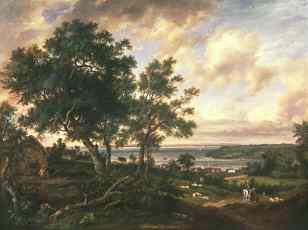
At the age of twenty, Peter
Nasmyth went to London, and commenced in earnest the profession of a
landscape painter, in which he acquired such distinction that he was
called the English Hobbima. It was rather, however, from the minuteness of
his touch and finish that he resembled the great Flemish painter, for he
could not pretend to Hobbima’s boldness and vigour. Still his scenes, and
especially his English ones, abounding in objects of minute beauty, and
reposing tranquilly beneath an untroubled sky, secured him a reputation as
a landscape painter superior to that of his father. His Scottish scenery,
however, was inferior; as its wild grandeur and massiveness were not so
congenial to the particular bent of his artistic excellence. As a scholar,
Hobbima and Ruysdael were his favourite guides; but while he endeavoured
to acquire their spirit, he was far from being a copyist: on the contrary,
he had a delicacy that was all his own, and gave him the foremost place in
that distinguished family which has obtained the name of the "Nasmyth
School."
The success with which his
excellencies were rewarded was such as to animate him in his labours, and
his productions were so highly prized as to be in universal request among
the genuine lovers of art, so that every choice collection of England
contains the works of his pencil, while every scrap and relic of his
studio still continues to be sought after. But while patronage was at the
height, and orders flowing in upon him in greatest profusion, he was dying
before his day—not a martyr, however, to the pure and ennobling art which
he loved so well, and which would have cherished him so affectionately,
but to a vice which degrades the highest intellect and most refined tastes
to the level of the meanest. At the early age of seventeen, Peter Nasmyth,
in consequence of sleeping in a damp bed, was seized with deafness, which
continued with him to the last; and being thus in a great measure shut out
from the healthful excitement of conversation, he endeavoured to console
himself by the stimulus of the bottle—and that, too, in the retirement of
his study, where the usual checks were not likely to enter. Of course, the
habit grew rapidly upon him, so that he became old and feeble while still
young in years. At last, being attacked by influenza, he ventured, before
he had recovered, to go to Norwood, to make a sketch of a scene which he
had particularly admired; but he paid dear for his enthusiasm, by a return
of the disease, against which his enfeebled constitution had no power to
rally. Even then, his dying gaze was still in quest of the beauty and
grandeur which he had so loved to delineate; and in a thunder-storm which
occurred while he was dying, he besought his sisters to raise him up in
bed, that he might see its passing splendour and its effects before he had
himself departed. Thus he passed away, on the 17th of August, 1831, at his
lodgings, in South Lambeth, at the age of forty-five. |



