|
SMOLLETT, the
surname, evidently originally territorial, of a Dumbartonshire family,
one of those members, Dr. Tobias Smollett, by his genius and writings,
has rendered it illustrious in the annals of literature. His
grandfather, Sir James Smollett of Bonhill, parish of Cardross, from
whom the family derived its first eminence, was a native of the burgh of
Dumbarton, and was bred to the law in the office of a writer in
Edinburgh. He represented Dumbarton in the convention of estates in
1688, as well as in several subsequent parliaments. He warmly supported
the Revolution, and by King William III. was knighted, and made a judge
in the commissary court of Edinburgh. He was a zealous advocate of the
union with England, and in 1707, was appointed one of the commissioners
for framing the articles of union. He was the first member who
represented the Dumbarton district of burghs in the British parliament.
By his wife, Jane, daughter of Sir Aulay M’Aulay of Ardincaple, he had
several sons and daughters. His fourth son, Archibald, married, without
his father’s knowledge, Barbara, daughter of Cunningham of Gilbertfield,
Lanarkshire. She had no fortune, and Sir James, though displeased at
first with the match, gave his son a liferent of his farm of Dalquhurn,
which, with an annuity, made his income about £300 a-year.
Archibald had three
children, and Dr. Smollett, the novelist, poet and historian, of whom a
memoir follows, was the youngest. Jean Smollett, the doctor’s sister,
married Alexander Telfer, Esq. of Symington, Lanarkshire, and on the
death of her cousin-german, Mr. Commissary Smollett, she succeeded to
Bonhill, when she resumed her maiden name of Smollett. Her son and
successor, Alexander Telfer Smollett of Bonhill, married Cecilia,
daughter of John Renton, Esq. of Lamberton, Berwickshire, and with one
daughter had four sons. 1. Alexander, lieutenant-colonel, Coldstream
guards, and M.P. for Dumbartonshire, killed at the battle of Alkmaar in
1799. 2. John Rouett, a naval officer, who succeeded to the estate. 3.
Tobias George, captain 78th regiment, Ross-shire Highlanders. 4. James,
accidentally killed at sea.
The 2d son, Rear-admiral
John Rouett Smollett, succeeded to Bonhill. He married, 1st, Louisa,
daughter of William Rouett, Esq. of Auchindennan, Dumbartonshire, and
had an only daughter, who died in infancy; 2dly, in 1800, Elizabeth, 2d
daughter of Hon. Patrick Boyle of Shewalton, Ayrshire, 2d son of 2d earl
of Glasgow; issue, 4 daughters and 2 sons, Alexander, and Patrick Boyle.
Elizabeth, the eldest daughter, married, in 1830, Charles Villiers
Stuart, Esq., youngest brother of Lord Stuart de Decies.
Alexander Smollett, Esq.
of Bonhill, the admiral’s elder son, born Nov. 29, 1801, passed advocate
in 1824, M.P. for Dumbartonshire from 1841 to 1859.
Patrick Boyle, the
younger son, born in 1805, was in the East India Company’s civil service
at Madras, from which he retired in 1858. Elected 1859 M.P. for
Dumbartonshire in room of his brother.
SMOLLETT, DR. TOBIAS GEORGE, a distinguished novelist and
historian, was born in 1721, at the old house of Dalquhurn, in
Dumbartonshire. He was the youngest of three children of Archibald
Smollett and Barbara Cunningham, daughter of Dunningham of Gilbertfield
near Glasgow. His father dying while he was very young, his education
was undertaken by Sir James Smollett, his grandfather. He received his
first lessons in classical learning in the school of Dumbarton. When the
usual school routine was completed he was sent to the university of
Glasgow, where he studied medicine, being at the same time articled as
apprentice to a Mr. John Gordon, a surgeon there. At the early age of
eighteen, his capabilities for poetry began to manifest themselves; and,
besides writing several keen and skilful satires, he composed ‘The
Regicide,’ a tragedy, founded on the assassination of King James I. In
1740 his grandfather died, without leaving any provision either for the
mother of Smollett or the family, and thus thrown upon his own
resources, Smollett resolved to visit London after the expiry of his
apprenticeship, and endeavour to obtain employment in the army or navy.
On his arrival there he presented his tragedy to the managers of the
theatres, but meeting with no success in his endeavours to bring it on
the stage, he published it, in 1749, with an angry preface. In 1741 he
obtained the appointment of surgeon’s-mate on the board a man-of-war,
and sailed in the unfortunate expedition to Carthagena. While the ship
was in the West Indies he quitted the service, and, during his residence
in Jamaica, he became attached to a Miss Anne Lascelles, whom he
afterwards married.
On his return to London
in 1746, his feelings of patriotism led him to write the beautiful and
spirited poem of ‘The Tears of Scotland.’ The same year he published
‘Advice, a Satire;’ and about the same time composed the opera of ‘Alceste,’
which, however, was never acted, in consequence of some ill-timed
satires on Rich the manager. He had expected £3,000 with his wife, but
of this sum he obtained only a small part, and that after a very
expensive lawsuit regarding it. He was therefore obliged to have
recourse to his pen for support, and in 1748 he published ‘The
Adventures of Roderick Random,’ in two volumes, which soon became the
most popular novel of the age.
In 1750 Smollett visited
Paris, and on his return in 1751 he produced ‘The Adventures of
Peregrine Pickle,’ in four volumes 12mo, which had a rapid sale, and was
soon translated into French. Having obtained the degree of M.D., he
settled at Bath, with the view of entering upon medical practice; but,
being disappointed in his design, he returned to London, and fixing his
residence at Chelsea, became an author by profession. In 1753 he
published the ‘Adventures of Count Fathom,’ and in 1755 his translation
of ‘Don Quixote.’ About this time he visited his relations in Scotland,
and on his return to London he undertook the editorship of ‘The Critical
Review.’ In 1757 his farce of ‘The Reprisal, or the Tars of Old
England,’ was performed at Drury Lane theatre. Being convicted of a
libel on Admiral Knowles, inserted in ‘The Critical Review,’ he was
sentenced to pay a fine of £100, and to be imprisoned in the King’s
Bench for three months. During his confinement, he composed the
‘Adventures of Sir Lancelot Greaves,’ a sort of English Quixote, in
which the character of Theodore king of Corsica, his fellow-prisoner, is
beautifully delineated. His ‘Complete History of England, from the
earliest times to the Treaty of Aix-la-Chapelle,’ in four quarto
volumes, appeared in 1758, and is said to have been written in the short
space of fourteen months. The success of this work encouraged him to
write a continuation of it to 1764. By this work, the most important of
his productions, he is said to have realized the sum of £2,000.
In June 1763 he had
visited the Continent, in the hope of dissipating the melancholy which
preyed upon his mind in consequence of the death of his only daughter
this year. On his return he published his ‘Travels through France and
Italy,’ in two vols. Soon after, on account of declining health, he
again went to Scotland, and on his return to London he made an
unsuccessful attempt to obtain from government an appointment as consul
at some port in the Mediterranean. His novel entitled ‘Adventures of an
Atom’ was published in 1769. His health becoming again impaired, he set
out early in 1770 for Italy, whence he never returned. During the
journey he wrote his ‘Expedition of Humphrey Clinker,’ which, in the
opinion of many, is his best novel.
Dr. Smollett died October
21, 1774, at a village called Monte Nuovo, near Leghorn, where he had
taken up his abode. His widow, the Narcissa of ‘Roderick Random,’ was
left nearly destitute in a foreign land; and March 3, 1784, a benefit
was procured for her in the Theatre-Royal, Edinburgh, the proceeds,
amounting, with private donations, to £366, being remitted to her in
Italy.
The only work he
published connected with his profession was a treatise ‘On the External
Use of Cold Water,’ a subject which many years afterwards began to
occupy considerable attention in Germany, as well as in Great Britain,
where several establishments for the “Cold water cure” of diseases were,
in course of time, set on foot.
Smollett’s ‘Ode to Leven
Water,’ and his ‘Ode to Independence,’ with ‘The Tears of Scotland,[
written on hearing of the barbarities inflicted by the army of the duke
of Cumberland in the north of Scotland in 1746, contain much of the
feeling and inspiration of real genius, and cause regret that he did not
cultivate his talents for poetry. Three years after his death a lofty
Trajan column, with a Latin inscription, was erected to his memory, by
his cousin, Smollett of Bonhill, on the banks of the Leven, near the
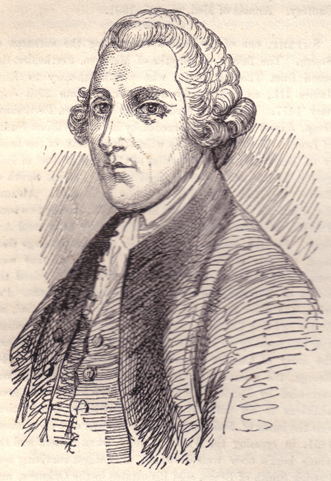
house in which he was born. His portrait is subjoined:
[portrait of Dr. Smollett]
Dr. Smollett’s works are:
Advice; a Satire. 1746.
Reproof; a Satire; being the second part of Advice. 1747.
The Adventures of Roderick Random. Lond. 1748, 2 vols. 12mo. Lond. 1750,
2 vols, 12mo. The 10th edition. Lond. 1778, 2 vols. 12mo. Edinb. 1784, 2
vols, 8vo. Innumerable editions. In German, Berlin, 1790, 2 vols, 8vo.
And also in most of the other European Languages.
The Regicide; a Tragedy. Lond. 1749, 4to.
The Adventures of Peregrine Pickle, in which are included, Memoirs of a
Lady of Quality. Lond. 1751, 4 vols. 12mo. Second edition, same year.
Reprinted. Lond. 1781, 4 vols. 8vo. Lond. 1784, 3 vols. 12mo. Numerous
impressions.
An Essay on the external use of water; with particular Remarks on the
present Method of using the Mineral Walters of Bath. Lond. 1752, 4to.
The Adventures of Ferdinand Count Fathom. Lond. 1753, 2 vols. 12mo. Lond.
1782, 2 vols, 8vo.
Don Quixote; translated into English. Lond. 1755, 2 vols. 4to. This is
reckoned the best translation of Cervantes.
Compendium of Voyages. 1757, 7 vols. 12mo.
The Reprisals; or the Tars of Old England; a Comedy. 1757.
A Complete History of England, deduced from the descent of Julius
Caesar, to the Treaty of Aix-la-Chapelle, 1748; containing the
Transactions of one thousand eight hundred and three years. Lond.
1757-8, 4 vols. 4to. Reprinted. Lond. 1757-60, 11 vols. 8vo.
Continuation, printed, Lond. 1763, 4 vols. 8vo. Vol. v. 1765, 8vo.
The Adventures of Sir Launcelot Greaves. Lond. 1762, 2 vols, 12mo. 1782,
2 vols. 8vo.
The Works of M. de Voltaire; translated from the French; with Notes,
Historical and Critical. Lond. 1763, &c. 27 vols. 12mo. Written in
conjunction with T. Francklin and others.
The Present State of all Nations. Lond. 1764, 8 vols. 8vo.
Travels through France and Italy; containing Observations on Character,
customs, Religion, Government, Police, Commerce, Manufactures, Arts, and
Antiquities; with a particular Description of the Town, Territory, and
Climate of Nice, and a register of the weather for eighteen months in
that city. Lond. 1766, 2 vols. 8vo. The same. Dubl. 1766, 2 vols. 8vo.
The Adventures of an Atom. Lond. 1769, 2 vols, 12mo. Lond. 1786, 2 vols.
8vo. This is a satire upon the conductors and measures of government
from the year 1754.
Ode to Independence. Glasg. 1773, 4to.
The Adventures of Telemachus, the son of Ulysses; translated from the
French of Mons. F. Salignac de la Mothe Fenelon. Lond. 1776, 2 vols.
12mo.
The Adventures of Gil Blas of Santillane, translated. Lond. 1797, 4 vols,
12mo.
Plays and Poems, with Memoirs of the Life and Writings of the author.
Lond. 1777, 8vo.
Miscellaneous Works, with Memoirs of his Life and Writings; by Robert
Anderson, M.D. Edin. 1790, 6 vols, 8vo. The same, with Memoirs of his
Life; to which is prefixed, a View of the Commencement and Progress of
Romance; by J. Moore, M.D. Lond. 1797, 8 vols. 8vo.
Smollett wrote many
articles in the British Magazine, and opposed Wilkes in a weekly paper
called ‘The Briton.’ He was also, as is well known, the founder of ‘The
Critical Review,’ which he conducted for several years with a spirit
then new in the annals of criticism. |



