BUCHANAN,
a surname belonging to a numerous clan in Stirlingshire, and the country
on the north side of Loch Lomond. The reputed founder of the Buchanans
was Anselan, son of O’Kyan, king of Ulster in Ireland, who is said to
have been compelled to leave his native country, by the incursions of
the Danes, and take refuge in Scotland. He landed, with some attendants,
on the northern coast of Argyleshire, near the Lennox, about the year
1016, and having according to the family tradition, in all such cases
made and provided, lent his assistance to King Malcolm the Second in
repelling his old enemies the Danes, on two different occasions of their
arrival in Scotland, he received from that king for his services, a
grant of land in the north of Scotland. The improbable character of this
genealogy is manifested by its farther stating that the aforesaid
Anselan married the heiress of the lands of Buchanan, a lady named
Dennistoun; for the Dennistouns deriving their name from lads given to a
family of the name of Danziel, [see DENNISTOUN, surname of,] who came
into Scotland with Alan the father of the founder of the abbey of
Paisley, and the first dapifer, seneschal, or steward of
Scotland, no heiress of that name could have been in Scotland until long
after the period here referred to. It is more probable that a portion of
what afterwards became the estate of Buchanan formed a part of some
royal grant as being connected with the estates of the earls of Lennox,
whom Skene and Napier have established to have been remotely connected
with the royal family of the Canmore line, and to have been in the first
instance administrators, on the part of the crown, of the lands which
were afterwards bestowed upon them.
The name of
Buchanan is territorial, and is now that of a parish in Stirlingshire,
which was anciently called Inchcaileoch, (‘old woman’s island,’) from an
island of that name in Loch Lomond, on which in earlier ages there was a
nunnery, and latterly the parish church for a century after the
Reformation. In 1621 a detached part of the parish of Luss, which
comprehends the lands of the family of Buchanan, was included in this
parish, when the chapel of Buchanan was used for the only place of
worship, and gave the name to the whole parish.
Regarding the
etymology of Buchanan (or, as it was formerly spelled, Bouchannane) the
following curious passage occurs in Bleau’s Atlas, published in Holland
in 1653; “Buchanan qui ont de belles Signeuries sur la riviere d’Aneric
du coste du Midi, et sur le lac de Leimond du coste du l’occident, l’une
desquelles appartient an chef de la famille, qui s’uppelle volgairment
Buchanan, laquelle a donne le nom a toute l maison; le mot, qui signifie
une possession, est compose, et vent dire un terrior bas et proche des
eaux, car Much on Buch signifie un lieu bas, et Annan de l’eau; et en
effect il est ainsi,” &c. [Tome vi. pp. 96, 97.] We have not a doubt
that the name Buchanan has the same origin as the word Buchan, being its
diminutive of Buchanan or Buquhanino, the little Buquhan or
cattle-growing district.
Anselan (in
the family genealogies styled the third of that name) the seventh laird
of Buchanan, and the sixth in descent from the above-named Irish prince,
but not unlikely to be the first of the name, which in Norman French, is
dignified in the same records with the magniloquent appellation of
seneschal or chamberlain to Malcolm the first earl of Levenax (as Lennox
was then called). He and two of his sons, Gilbert and Methlen, are
witnesses to a charter granted by the same earl to Gilmore son of
Maoldonich, of the lands of Luss, in the reign of King Alexander the
Second, a nobleman of no great influence or power, descended from
administrators of one of the abthaneships of Dull, or royal lands
reverting to the crown by demise of younger branches, in which charter
they are more correctly designed the earl’s clients or vassals. In 1225,
this Anselan obtained from the same earl a charter of a small island in
Lochlomond called Clareinch, witnesses Dougal, Gilchrist, and Amalyn,
the earl’s three brothers, the name of which island afterwards became
the rallying cry of the Buchanans. The same Anselan is also mentioned as
a witness in a charter granted by the earl of Lennox of the lands of
Dalmanoch in mortification to the old church of Kilpatrick, by the
designation of Absalon de Buchanan, Absalon being the name as Ansalon.
He had three sons, viz. Methlen, ancestor of the MacMillans; Colman,
ancestor of the MacColmans; and his successor Gilbert.
His eldest
son, Gilbert, or Gillebrid, appears to have borne the surname of
Buchanan. There is a charter of confirmation of that of Clairinch, and
some other lands of Buchanan, granted in favour of this Gilbert by King
Alexander the Second in the seventeenth year of his reign, and of our
Lord 1231. The same Gilbert is also witness to a charter, by Malcolm
earl of Lennox, to the abbot and monks of Paisley, dated at Renfrew in
1274. [Chartulary of Dumbartonshire.]
Sir Maurice
Buchanan, grandson of Gilbert, and son of a chief of the same name,
received from Donald earl of Lennox, a charter of the lands of Sallochy,
with confirmation of the upper part of the carrucate of Buchanan. As his
name does not appear on the roll of parties who swore fealty to Edward
the First, his descendants claim the merit of his having refused to do
so. To the bond of fealty, however, a Malcolm de Buchanan attached his
name. Sir Maurice also obtained a charter of confirmation of the lands
of Buchanan from King David the Second in the beginning of his reign.
Allan, the
second son of the first Sir Maurice, married the heiress of Leny of that
ilk, descended from Gillespic Moir de Lany, supposed to have lived about
the beginning of the tenth century. According to a family manuscript
pedigree, quoted in Buchanan of Auchmar’s account of the Leny branch,
the early proprietors of the estate of Leny had no charters, but
carefully preserved a large sword, and one of the teeth of St. Fillian,
the possession of which was held to be a sufficient title to the lands.
John, the third son, was always reputed the ancestor of the Buchanans of
Auchneiven.
Sir Maurice de
Buchanan the second, above mentioned, married a daughter of Menteith of
Rusky, and had a son, Walter de Buchanan, who had a charter of
confirmation of some of his lands of Buchanan from Robert the Second, in
which he is designed the king’s “consanguineus,” or cousin. His eldest
son, John, married Janet, daughter and sole heiress of John Buchanan of
Leny, fourth in descent from Allan already noticed. John, who died
before his father, had three sons, viz. Sir Alexander, of whom next
paragraph; Walter, who succeeded his father; and John, who inherited the
lands of Leny, and carried on that family
Sir Alexander
Buchanan, the eldest son, accompanied the earl of Buchan to France, when
he went to assist the French king Charles against Henry the Fifth of
England, and distinguished himself at the battle of Beauge in Normandy,
in March 1421. The victory was principally owing to the valour of the
Scots auxiliaries. it is stated in Buchanan of Auchmar’s account of the
martial achievements of the family of Buchanan that it was Sir Alexander
Buchanan who, in this battle, slew the duke of Clarence, a feat commonly
attributed to the earl of Buchan. He is said to have pierced the duke
through the left eye and brain, on which the latter fell, when seizing
his coronet, Buchanan bore it off on his spearpoint. He is also said to
have sold the coronet, which was set round with jewels, to Stewart of
Darnley for one thousand angels of gold, and that the latter pawned the
same to Sir Robert Houston for five thousand angels. Sir Alexander
Buchanan was killed at the battle of Verneuil, on the 17th of
August of the same year.
The armorial
bearings of the Buchanans lend countenance to the assertion that Sir
Alexander Buchanan assisted in slaying the duke of Clarence. The crest
is a hand holding a ducal crown. The double tressure with fleurs de
lis was granted to him by the king of France. The mottoes “Audaces
Juvo” and “Clarior Hine Hones,” are correspondent to each other and to
the devices.
Sir Alexander
died unmarried, and the second son, Sir Walter, succeeded to the estate
of Buchanan.
This Sir
Walter de Buchanan married Isabel, daughter of Murdoch, duke of Albany,
governor of Scotland, by Isabel, countess of Lennox in her own right.
With a daughter, married to Gray of Foulis, ancestor of Lord Gray, he
had three sons, viz. Patrick, his successor; Maurice, treasurer to the
princes Margaret, the daughter of King James the First, and dauphiness
of France, with whom he left Scotland; and Thomas, founder of the
Buchanans of Carbeth.
The eldest
son, Patrick, acquired a part of Strathyre in 1455, and had a charter
under the great seal of his estate of Buchanan dated in 1460. He and
Andrew Buchanan of Leny made in 1455 mutual tailzies of their estates in
favour of one another, and the heirs of their own bodies, passing some
of their brethren of either side. He married Galbraith, heiress of
Killearn, Bamore, and Auchenreoch. He had two sons and a daughter,
Anabella, married to her cousin, James Stewart of Baldorrans, grandson
of Murdoch, duke of Albany.
Their younger
son, Thomas Buchanan, was, in 1482, founder of the house of Drumakill,
whence, in the third generation, came the celebrated George Buchanan.
One of Sir Walter Scott’s colleagues of the clerk’s table of the court
of session was Hector Macdonald Buchanan, Esq. of Drumakill, “a
frankhearted and generous gentleman,” says Lockhart, “not the less
acceptable to Scott for the Highland prejudices which he inherited with
the high blood of Clanranald; at whose beautiful seat of Ross priory, on
the shores of Lochlomond, he was almost annually a visitor; a
circumstance which has left many traces in the Waverley novels.”
Patrick’s
elder son, Walter Buchanan of that ilk, married a daughter of Lord
Graham, and by her had two sons, Patrick and John, and two daughters,
one of them married to the laird of Lamond, and the other to the laird
of Ardkinglass.
John Buchanan,
the younger son, succeeded by testament to Menzies of Arnprior, and was
the facetious “King of Kippen,” and faithful ally of James the Fifth.
The local proverb, “Out of the world, and into Kippen,” was meant to
show the seclusion and singularity of this district of Stirlingshire, of
which the feudal lord was formerly styled King. The name is supposed to
be derived from the Gaelic word Ceap-beimn, ‘foot of the mountain,’ and
the parish is partly in Perthshire. An insulated portion of the latter
county, about two miles long and half-a-mile broad, embraces the village
of Kippen. The minister’s manse stands on the eastern boundary, so that
his dinner is cooked in Perthshire and eaten in Stirlingshire. The way
in which the laird of Arnprior got the name of “King of Kippen”: is thus
related by a tradition which Sir Walter Scott has introduced into his
Tales of a Grandfather. [History of Scotland.] – “When James the
Fifth travelled in disguise, he used a name which was known only to some
of his principal nobility and attendants. He was called the Goodman (the
tenant, that is) of Ballengeich. Ballengeich is a steep pass which leads
down behind the castle of Stirling. Once upon a time when the court was
feasting in Stirling, the king sent for some venison frm the
neighbouring hills. The deer was killed and put on horses’ backs to be
transported to Stirling. Unluckily they had to pass the castle gates of
Arnprior, belonging to a chief of the Buchanans, who chanced to have a
considerable num er of guests with him. It was late, and the company
were rather short of victuals, though they had more than enough of
liquor. The chief, seeing so much fat venison passing his very door,
seized on it, and to the expostulations of the keepers, who told him it
belonged to King James, he answered insolently, that if James was king
in Scotland, he (Buchanan) was king in Kippen; being the name of the
district in which Arnprior lay. On hearing what had happened the king
got on horseback, and rode instantly from Stirling to Buchanan’s house,
where he found a strong fierce-looking Highlander, with an axe on his
shoulder, standing sentinel at the door. This grim warder refused the
ding admittance, saying that the laird of Arnprior was at dinner, and
would not be disturbed. ‘Yet fo up to the company, my good friend,’ said
the king, ‘and tell him that the Goodman of Ballengeich is come to feast
with the King of Kippen.’ The porter went grumbling into the house, and
told his master that there was a fellow with a red beard at the gate,
who called himself the Goodman of Ballengeich, who said he was come to
dine with the King of Kippen. As soon as Buchanan heard these words, he
knew that the king was come in person, and hastened down to kneel at
James’s feet, and to ask forgiveness for his insolent behavior. But the
king, who only meant to give him a fright, forgave him freely, and,
going into the castle, feasted on his own venison, which Buchanan had
intercepted. Buchanan of Arnprior was ever afterwards called the king of
Kippen.” He was killed at the battle of Pinkie in 1547.
The elder son,
Patrick, who fell on Flodden field, during his father’s lifetime, had
married a daughter of the earl of Argyle. she bore to him two sons and
two daughters.
The younger
son, Walter, in 1519 conveyed to his son Walter, the lands of Spittal,
and was thus the founder of that house. On the 14th December
of that year, he had a charter from his father of the temple-lands of
Easter Catter. In 1531, he had a remission from James the Fifth, for
seizing and detaining in the castle of Glasgow, John duke of Albany,
then governor of Scotland. In this deed he is styled “Salter Buchanan in
Spittel,” the property of which was then in the hands of his brother
George Buchanan of that ilk, who resigned his lands of Spittel of
Easter-Catter to Edward, son of the said Walter Buchanan, as appears by
the confirmation in favour of this Edward, by Gavin, archbishop of
Glasgow, dated 18th September 1531.
The elder son,
George Buchanan of that ilk, succeeded his grandfather and was sheriff
of Dumbartonshire at the critical epoch of 1561. He must have succeeded
to the estate when very young, as in the register of the privy seal of
Scotland, quoted in the appendix to Pitcairn’s Collection of Criminal
Trials, under date July 11, 1526, there is a respite to George Buchanan
of that ilk, and twenty-two others, “extract furth of the respitt of
Johne erle of Levinax, for his tressonabill asseging, taking and
withhalding of our sourane lordis castle and fortalice of Dumbertene fra
his seruandis keparis thairof.” He was at the battle of Pinkie, on the
queen’s side, in 1547, in which, besides Buchanan of Arnprior, many
others of the name of Buchanan were slain. He was also at the battle of
Langside fighting for Queen Mary, in 1568. On January 26, 1593-4, Robert
Buchanan of Spittel, Mungo Buchanan in Tullichewne, and eight other
Buchanans, were ordained to be denounced rebels, for not relieving
George Buchanan of that ilk, of a decreet-artibral, pronounced by
Ludovick duke of Lennox, upon a submission entered into by the laird of
Buchanan, taking burden on him for his friends, on the one part, and
Allan or Awlay M’Caula of Ardincaple and his friends, on the other part,
“be the quhilk decrete, the said George has been decernit to mak payment
to the said Allane, and vtheris his friendis, of a certaine sowme of
money, for sum violence done, and attemptit aganis thame be the said
George friendis.” [Pitcairn’s Trials. vol. i. part ii. p. 306.]
By Margaret, daughter of Edmonstone of Duntreath, George Buchanan had a
son, John, who died before his father, leaving a son. By a second lady,
Janet, daughter of Cunninghame of Craigans, he had William, founder of
the now extinct house of Auchmar. A descendant of this house, William
Buchanan of Auchmar, published at Glasgow, in 1723, a quarto volume
entitled an ‘Historical and Genealogical essay upon the family and
surname of Buchanan, with an Enquiry into the Genealogy and present
state of ancient Scottish surnames, and more particularly of the
Highland Clans.’ An octavo edition of the same appeared at Edingurgh in
1775. In drawing up this account of the Buchanans, Auchmar’s work has of
course been consulted, but in the early portion especially of the
genealogies, we should not be disposed to rely implicitly on its
statements, either in respect of the name of Buchanan or any other of
the “ancient Scottish surnames” which it contains.
John Buchanan,
above mentioned as dying before his father, George Buchanan of that ilk,
was twice married, first to the Lord Livingston’s daughter, by whom he
had one son, George, who succeeded his grandfather, and secondly to a
niece of Chisholm, bishop of Dunblane, and had by her a daughter married
to Mr. Thomas Buchanan of Ibert, lord privy seal.
The son, Sir
George Buchanan, married Mary Graham, daughter of the earl of Monteith,
and had, with two daughers, a son, Sir John Buchanan of that ilk, who in
1618, mortified (or bequeathed) six thousand pounds Scots to the
university of Edinburgh, for maintaining three bursars at the study of
theology there; and an equal sum to the university of St Andrews, for
maintaining upon the interest thereof, three bursas at the study of
philosophy there, and constituted the magistrates of Edinburgh managers
or patrons of both mortifications. This on the authority of Buchanan of
Auchmar, although Bower in his History of the University of Edinburgh
does not mention any such bequest. Sir John married Anabella Erskine,
daughter of Adam, commendator of Cambuskenneth, a son of the Master of
Mar. He had a son, George, his successor, and a daughter married to
Campbell of Rahein.
Sir George
Buchanan the son married Elizabeth Preston, daughter of the laird of
Craigmillar. He was colonel of the Stirlingshire regiment during the
whole of the civil wars in the reign of King Charles the First, and was,
with his regiment, at the battle of Dunbar in 1650. He was also at the
fatal conflict of Inverkeithing in the following year, and with
Major-general Sir John Brown of Fordel, colonel of the Mid Lothian
regiment, at the head of their regiments, stopped the passage of
Cromwell’s troops over the Forth, for some days. The Scots were,
however, eventually defeated with great loss, and Sir George Buchanan,
with Sir John Brown and other officers, taken prisoner, in which state
he died in the end of 1652, leaving, with three daughters, one son,
John, the last laird of Buchanan, who was twice married, but had no male
issue. By his second wife, Jean Pringle, daughter of Mr. Andrew Pringle,
a minister, he had a daughter Janet, married to Henry Buchanan of Leny.
John, the last laird, died in December 1682. His estate was sold by his
creditors, and purchased by the ancestor of the duke of Montrose.
The barons or
lairds of Buchanan built a castle in Stirlingshire, where the present
Buchanan house stands, formerly called the Peel of Buchanan. Part of it
exists, forming the charter-room. A more modern house was built by these
chiefs, adjoining the east side. This mansion came into the possession
of the first duke of Montrose, who made several additions to it, as did
also subsequent dukes, and it is now the chief seat of that ducal family
in Scotland.
The principal
line of the Buchanans becoming, as above shown, extinct in 1682, the
representation of the family devolved on Buchanan of Auchmar. This line
became, in its turn, extinct in 1816, and in the absence of other
competitors, the late Dr. Francis Hamilton-Buchanan of Bardowie, Spittal,
and Leny, as heir-male of Walter, first of the family of Spittal,
established in 1826 his claims as chief of the clan. Of this gentleman,
the author of an account of Nepaul, and other works on India, a separate
notice is given. See BUCHANAN, HAMILTON FRANCIS.
The last
lineal male descendant of the Buchanans of Leny was Henry Buchanan about
1723, whose daughter and heiress, Catherine, married Thomas Buchanan of
Spittal, an officer in the Dutch service, who took for his second wife,
Elizabeth, youngest daughter of John Hamilton of Bardowie, the sole
survivor of her family, and by her he had four sons and two daughters.
their eldest son John, born in 1758, succeeded to the estate of Bardowie,
and assumed the additional name of Hamilton, but dying without male
issue, was succeeded by his brother, the above named Dr. Francis
Hamilton-Buchanan.
_____
The first of
the Buchanans of Ardoch was William Buchanan who, in 1693, acquired that
estate in the parish of Kilmarnock, Dumbartonshire. He was descended
from John Buchanan, eldest son of the second marriage of Thomas Buchanan
of Carbeth, grandson of Thomas Buchanan, third son of Sir Walter
Buchanan, thirteenth laird of Buchanan.
_____
The Buchanans
of Ardinconnal and Auchintorlie, in the same county, are also a branch
of the ancient house of Buchanan of that ilk and of Leny. Of this family
was George Buchanan, a merchant in Glasgow, and his three brothers,
Andrew of Drumpellier, in Lanarkshire; Niel, of Hillington, county of
Renfrew, M.P. for the Glasgow district of Burghs, whose male line is now
extinct; and Archibald of Auchintorlie. These four brothers were the
original promoters, in 1725, of the Buchanan Society of Glasgow, one of
the most flourishing benevolent institutions in the west of Scotland.
Mary, their sister, married George Buchanan of Auchintoshen in
Dumbartonshire. The Drumpellier branch of the Buchanan family is
represented by the descendant of Andrew’s second son, Robert Carrick
Buchanan, Esq. of Drumpellier.
_____
The name of
Buchanan was at one time so numerous in heritors that it is said that
the laird of Buchanan could, in a summer’s day, call fifty heritors of
his own surname to his house upon any occasion, and all of them might
with convenience return to their respective residences before night, the
most distant of their homes not being above ten miles from Buchanan
castle.
In Pitcairn’s
Criminal Trials, vol, ii. pp. 544-557, it given, under date of May 31,
1608, the trial of one Margaret Hertsyde, wife of John, afterwards Sir
John Buchanan, a female servant of her majesty, Anne, queen of James the
Sixth, for stealing the queen’s jewels. The uncommon nature of the
crime, and the interest of the pleadings induced him to insert the
entire arguments. He remarks that the real cause of the criminal
prosecution of this servant of the queen is understood to have
originated in Mrs. (afterwards Lady) Buchanan’s being too deeply versed
in certain court intrigues, and it was deemed necessary to get rid of
her, even in the face of the most strenuous remonstrances on the part of
her majesty. She was in the following August found guilty, and banished
to Orkney. On this case, Balfour has the following entry in his Annals,
(vol. ii. p. 26,) “John Buchanan and his wyffe, Margaret Hartesyde, that
had laynn longe in prisson heire, for the allegeit stealling some of the
queins jewells (bot the courtiers talked, that it was for revelling some
of the queins secretts to the king, wich a wysse chalmbermaide wold not
have done), was, by ane sentence, condemned to perpetualle exyle, in the
iylands of Orkney, and declared to be ane infamous persone.” The
sentence was, however, recalled in the following November.
Volume third
of the same Collection contains the indictment of several persons of the
name of Buchanan, and among them Patrick the son of George Buchanan of
Auchmar, under date June 6, 1623, for the slaughter of one Duncan
M’Farlane, in the preceding April. The accused gave in a supplication
which revealed incidents of a most horrible nature. It appears from it
that the M’Farlanes had seized one William Buchanan, while hunting, and
after torturing him for ten hours had barbarously murdered him. His
tongue and entrails they cut out, and having slain his dogs, they took
out the tongue and entrails of one of them and transferred them to each
other, and so left him and the dogs lying on the earth, where they were
not discovered for eight days; the offence of Buchanan being that he had
inquired after some goods said to have been stolen by the said Duncan
M’Farlane; and the latter having afterwards stolen an ox from one of the
party, he was pursued, and firing his gun at them was slain in self-defence.
The M’Farlanes on their part also gave in a supplication giving a
different complexion to the case, and the laird of Buchanan came forward
and offered to submit the matter, as it arose out of the murder of one
of his clan, to the earls of Mar, Menteith, Wigtoun, and Linlithgow, but
no records remain as to the result of this extraordinary case.
BUCHANAN, GEORGE,
a distinguished reformer and Latin poet, is perhaps the only man but one
whom Scotland had ever produced who was acknowledged by the acclamations
of Europe to be the princeps – “Poetarum sui seculi facile
princeps” – the decidedly first in the art he cultivated, not only of
his country but his age. This applies, however, only to poets writing in
Latin or Greek. He was born at Killearn in Stirlingshire, on the western
bank of the rivulet of Blane, in February 1506. – As Richardson writes,
“Triumphant even the yellow Blane,
Though by a fen defaced,
Boasts that Buchanan’s early strain]
Consoled her troubled breast.”
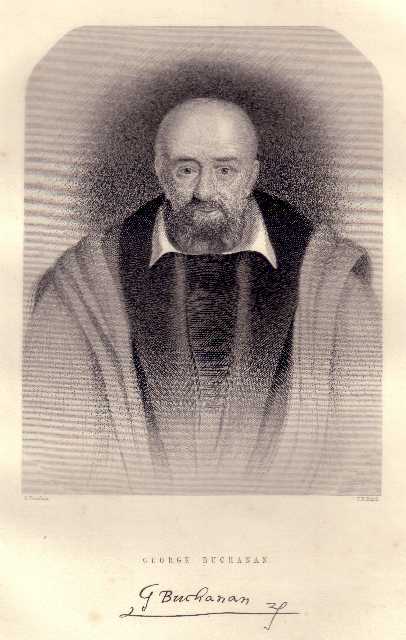
portrait of
George Buchanan later in life
He
belonged to a family which was rather ancient than rich. He was the
third son of Thomas, second son of Thomas Buchanan of Drumakill, who,
having received the farm of Moss, otherwise called Mid-Leowen, from his
father, was called Thomas Buchanan of Moss. George’s father died of the
stone in the flower of his age, and owing to the insolvency of his
grandfather about the same time, his mother, Agnes, daughter of James
Hariet of Trabrown, was left in extreme poverty, with five sins and
three daughters. Her brother, James Hariet, is said to have sent him,
(after he had, according to a doubtful tradition, received the rudiments
of his education at a school supposed to have been then established at
Killearn,) about 1520, to Paris, where he improved his knowledge of
Latin, acquired the Greek language without the aid of a tutor, and began
to cultivate his poetical talents. He seems to have possessed a
knowledge of the Gaelic, (which Dr. Irving incorrectly conjectures to
have been the current speech of his native district at that period,
there being evidence that the Macfarlanes, who occupied the wild region
of the Dumbarton Highlands in the vicinity, spoke English before his
time, although they also use the Celtic to this day,) for it is related
that when in France, having met with a woman who was said to be
possessed with the devil, and who professed to speak all languages, he
accosted her in Gaelic, and as neither she nor her familiar returned any
answer, he entered a protest that the devil was ignorant of that tongue,
– a trait of humour in entire accordance with the gravity of his after
character. The death of his uncle, two years afterwards, having deprived
him of his resources, he returned to Scotland in 1522. It is stated that
at this time his poverty was so great that in order to get back to his
native country, he joined the corps then in course of being raised in
France as auxiliaries to the duke of Albany in Scotland. In 1523, after
a twelve-month spent at home for the recovery of his health, being then
only seventeen years of age, he served as a common soldier with the
French auxiliaries, and proceeded with them when, under the command of
the regent Albany in person, they marched across the borders, and about
the end of October of that year laid siege to the castle of Werk, from
which they were compelled to retreat. After one campaign he became tired
of a military life, and the fatigue and hardships he had endured on this
occasion so much affected his health, which in his youth seems not to
have been robust, that he was confined to his bed for the remainder of
the winter. The brief notice he gives of this in his short biography of
himself, would seem to imply that he considered this service a useful
part of education. His words are “studio rei militaris cognoscendae
in castra est perfectus.” “The exercise which I commend first,”
says Milton, “is the exact use of their weapon, to guard and to strike
safely with edge or point; this will keep them healthy, nimble, strong
and well in breath, is also the likeliest means to make them grow large
and tall, and to inspire them with a gallant and fearless courage,
which, being tempered with seasonable lectures and precepts to them of
true fortitude and patience, will turn into a native and heroic valour,
and make them hate the cowardice of doing wrong.” Milton wrote these
words about the year 1650, a time when recent events had given him good
cause to appreciate the effect of such a character upon a nation’s
welfare, and to comprehend the distinction between the logic of the
schoolmen, and the logic of Oliver Cromwell, and of
.................................... brands,
Well wielded in some hardy hands,
And wounds by Galileans given.
In the ensuing spring Buchanan and his brother, Patrick, entered
students at the university of St. Andrews, and he took the degree of
bachelor of arts, October 3, 1525, at which time he was a pauper or
exhibitioner. In the following summer he accompanied John Mair, or
Major, then professor of logic in St. Salvador’s college, St. Andrews,
to Paris, and became a student in the Scottish college there. In March
1528 he took the degree of M.A., and in June 1530, after being the
previous year defeated as a candidate, he was chosen procurator of the
German Nation, which comprehended the students from Scotland. The
principles of Luther having, about this time, made considerable progress
on the Continent, Buchanan, whose mind was more imbued with the spirit
of classical antiquity than with the trammels of the Catholic church,
readily adopted them, and became a steady friend to the Reformation. He
had in 1529 received the appointment of professor in the college of St.
Barbe, where he taught grammar for three years, without deriving much
remuneration from his labours. In an elegy, apparently composed about
this period, he paints in forcible and gloomy colours the miseries to
which the professors of humanity in Paris were then exposed.
In 1532, whilst at this college, he became tutor to Gilbert Kennedy,
earl of Cassillis, “A youth of the most promising talents, and of an
excellent disposition,” then residing near the college of St. Barbe, and
to his lordship he inscribed his first work, being a translation of the
famous Thomas Linacre’s Rudiments of Latin Grammar; which was published
in 1533. He resided with the earl in France for about five years, and in
May 1537 he returned with him to Scotland.
“While he was residing at the earl’s seat in the country,” says his
biographer, Dr. Irving, “he composed a little poem which rendered him
extremely obnoxious to the ecclesiastics, an order of men whom it i
generally hazardous to provoke. In this poem, which bears the title of
‘Somnium,’ and is a happy imitation of Dunbar, he expresses his own
abhorrence of a monastic life, and stigmatizes the impudence and
hypocrisy of the Franciscan friars. The holy fathers, when they became
acquainted with this specimen of his sarcastic wit, speedily forgot
their professions of meekness, and resolved to convince him of his
heterodox presumption in disparaging the sacred institutions of the
church. It has repeatedly been alleged that Buchanan had himself
belonged to a religious order which he has so frequently exposed with
the most admirable powers of ridicule; but this seems to have been a
tale fabricated by the impotent malice of his theological enemies. That
he had actually assumed the cowl, has never been affirmed by any early
writer sufficiently acquainted with his history; it is not, however,
improbable, that during the convenient season of his youthful
misfortunes, the friars were anxious to allure so promising a novice;
and this suggestion is even countenanced by a passage in one of his
poetical productions.”
Buchanan had determined to resume his former occupation in France; but
King James the Fifth retained him in Scotland in the employment of tutor
to his eldest natural son, (by Elizabeth Shaw, of the family of Sauchie,)
James Stewart, afterwards the abbot of Kelso, who died in 1548, and not
his half brother, the famous earl of Murray, as erroneously stated in
several of his memoirs. We learn from the lord high treasurer’s
accounts, quoted in the Appendix to the first volume of Pitcairn’s
‘Criminal Trials,[ that August 21, 1537, Buchanan was paid, by order of
the king, twenty pounds; and the same sum in July 1538, when he also
received a rich gown of Paris black, with a cassock, on occasion of Mary
of Guise’s public entry into Edinburgh. At the request of the king, to
whom the incensed priests had found means of representing him as a man
of depraved morals and dubious faith, he wrote his ‘Palinodia’ and ‘Franciscanus,’
the latter a powerful and bitter satire against the Franciscan friars.
“This production,” says
Dr.
Irving, “as it now appears in its finished state, may without hazard be
pronounced the most skillful and pungent satire which any nation or
language can exhibit. He has not servilely adhered to the model of any
ancient poet, but is himself original and unequalled. To a masterly
command of classical phraseology, he unites uncommon felicity of
versification; and his diction often rises with his increasing
indignation to majesty and splendour. The combinations of his wit are
variegated and original; and he evinces himself a most sagacious
observer of human life. No class of men was ever more completely exposed
to ridicule and infamy; nor is it astonishing that the Popish clergy
afterwards regarded the author with implacable hatred. The impurities
and the absurdities which he rendered so notorious, were not the
spontaneous production of a prolific brain; their ignorance and
irreligion presented an ample and inviting harvest. Of the validity of
his poetical accusations, many historical documents still remain.
Buchanan has himself related in plain prose, that about this period,
some of the Scottish ecclesiastics were so deplorably ignorant, as to
suppose Martin Luther to be the author of a dangerous book, called the
New Testament.”
The following account and (in part) only translation yet attempted of
this admirable satire is from the pen of an able but anonymous critic,
and will not be unacceptable to our readers.
After asking his friend –
“Unde novus rigor in vultu? tristisque severi
Frons caperata minis, tardique modestia gressus?
Illaque frenatae constans custodia linguae? &c”
He makes him thus reply –
“Oft musing on the ills of human life,
Its buoyant hopes, wild fears, and idle strife,
And joys of hue – how changeful! Tho’ serene,
That flit ere you can tell where they have been –
(Even as the bark, when ocean’s surges sweep,
Rais’d by the warring winds, along the deep,
Is headlong by the howling tempest driven,
While the staid pilot, to whose charge is given
Her guidance, skilfully the helm applies,
And in the tempest’s face she fairly forward flies,)
I have resolved, my earthly wanderings past,
In rest’s safe haven to secure at last
Whate’er of fleeting life, by Fate’s decree,
Ere end my pilgrimage, remains to me, –
To give to heaven the remnant of my days –
And wash away in penitence and praise,
Far from this wild world’s revelry uncouth,
The sins and follies of my heedless youth.
O, blest and hallowed day! With cincture bound,
My shaven head the grey hood veiling round,
St. Francis, under thine auspicious name,
I will prescribe unto this fleshly frame
A life aetherial, that shall upward rise,
My heavenward soul commencing with the skies.
This is my goal – to this my actions tend –
My resting-place – original and end.”
To
this explanation of his friend’s object, the poet thus replies –
“If ‘tis thine aim to reach the goal of life
Thro’ virtue’s path, and, leaving childish strife,
To free thy darken’d mind from error’s force,
To trace the laws of virtue to their source,
And raise to heavenly things thy purged sight,
I view thy noble purpose with delight;
But if a shadowy good doth cross thy way,
And lure thee, phantom-like – but to betray –
Oh! While ‘tis time, restrain thy mad career,
And a true friend’s yet timely warning hear;
Nor let old error with bewildered eye,
Nor let the blind and senseless rabble’s cry,
More move thee than stern reason’s simple sway,
That points to Truth the undiscovered way: –
But deem not, that high heaven I dare defy,
Or raise again vain war against the sky,
For, from my earliest youth I have revered
The priests and holy fathers, who appeared,
By virtue’s and religion’s holy flame,
Worthy a bright eternity of fame.
But seldom underneath the dusky cowl,
That shades the shaven head and monkish scowl,
I picture a St. Paul; the priestly stole
Oft covers the remorseless tyrant’s soul,
The glutton’s and the adulterer’s grovelling lust,
Like soulless brute each wallowing in the dust,
And the smooth hypocrite’s still smiling brow,
That tells not of the villany below.”
After some preliminary remarks, the poet goes on to enumerate the
various classes of men who compose this respectable body –
“Principio hue omnes tanquam ad vivaria currunt,
Queis res nulla domi est, quibus est irata noverca,
Quos durus pater, aut plagosi dextra magistri,
Territat, aut legum timor, aut quos dedita somno
Excercit nullis Lethoea ignavia curis;
Deinde quibus gelidus arcum praecordia sanguis
Obstitit ingenio, quos sacre a fonte Camoence,
Quos Pallas Phoebusque fugat, quos sidere torvo
Aspicit infausto volucrer Tegeaticus ortu.
* * * *
Adde his, quos febris, quos vexat dira phrenesis, &c.
* * * *
Adjice praeterea quos praeceps alea nudat,
Quos Venus enervat, &c.”
He
rapidly sums up his sketch of the order, as of a set of men
“Whom fear, wrath, frenzy, dulness, sloth, and crime,
Ambition, ruin, weariness of time,
Unhappy love, home changed or hostile found,
And dark hypocrisy together bound.”
In
allusion to this precious collection, he then makes the following
caustic remarks –
“Still deathful is the drug envenomed draught,
Tho’ golden be the bowl from which ‘tis quaff’d:
The ass, in Tyrian purple tho’ array’d,
Is as much ass, as asslike whom he bray’d;
Still fierce will be the lioness – the fox
Still crafty – and still mild the mighty ox –
The vulture still will whet the thirsty beak –
The twittering swallow still will chirp and squeak:
Thus tho’ the vesture shine like drifted snow,
The heart’s dark passions lurk unchang’d below.
Nor when the viper lays aside his skin
Less baleful does the venom work within,
The tiger frets against his cage’s side
As wild as when he roam’d in chainless pride:
Thus neither crossing mountains nor the main,
Nor flying human haunts and follies vain,
Nor the black robe nor white, nor cowl-clad head,
Nor munching ever black and mouldy bread,
Will lull the darkly-working soul to rest,
And calm the tumults of the troubled breast.
For always, in whatever spot you be,
Even to the confines of the frozen sea,
Or near the sun, beneath a scorching clime,
Still, still will follow the fierce lust of crime –
Deceit, and the dark working of the mind,
Where’er you roam will not be left behind.”
The king appears to have been either unable or unwilling to protect the
author of this poem against the powerful and vindictive body of men whom
he had attacked. He was accordingly comprehended in the general arrest
of persons suspected of Lutherism, “and to the eternal infamy of the
nation,” says Dr. Irving, “his invaluable life might have been
sacrificed to the rancour of an unholy priesthood. After he was
committed to custody, Cardinal Beaton endeavoured to accelerate his doom
by tendering to the king a sum of money as the price of his innocent
blood.
White his keepers were fast asleep, he escaped through the window of the
apartment in which he was confined, and fled into England.” But his
disasters were not over. On the borders he was molested by the
moss-troopers, who at that time had possession of the whole frontier of
the two kingdoms, and his life was again exposed to great danger from
the contagion of a pestilential disease then raging in the north of
England. On reaching London, he was entertained by Sir John Rainsford,
an English knight, to whom he has gratefully inscribed a small poem. He
proceeded in the course of the same year to Paris; and thence, on the
invitation of Andrew Govea, a learned Portuguese, who was principal of
the college of Guienne, lately founded in that city, to Bordeaux. There
he became professor of Latin, and taught with applause for three years,
in which time he wrote four tragedies; two of which, entitled ‘Baptistes,’
and ‘Jephthes,’ were original, and on scriptural subjects, but on the
Greek model; and the other two were translations of the ‘Alcestis’ and
the ‘Medea,’ were performed on the academical stage with applause
surpassing his expectations. The great theme of the former is civil and
religious liberty, and some of his allusions in it bear ready
application to the persecuting conduct of Cardinal Beaton. “Buchanan’s
tragedies,” says a contemporary critic, “are not considered among the
most perfect of his compositions. We have no intention here to enter
upon a criticism of them. It may be sufficient to mention, as a proof
how little he preserved the keeping of his picture, that he
frequently alludes to the classical mythology, and to things with which
the Hebrews were unacquainted. To some of the characters in Jephthes
he gives Greek names, and the chorus speaks of the wealth of Croesus,
who was not burn till about six hundred years after Jephtha. At the same
time it ought to be added, that the language of his translation of the
Medea appeared to his learned contemporaries so thoroughly
classical, that he was suspected by some of having published in his own
name, a genuine relique of antiquity. This we conceive to be one of the
highest testimonies that could be adduced of the classical purity of
Buchanan’s Latin style – higher than any evidence founded merely on the
authority of any modern scholar. In the tragedies of Buchanan,
represented in the college of Guienne, the celebrated Michael de
Montaigne was a frequent performer. And Buchanan appears at one time to
have formed a project of composing a work on education, in which he
intended to exhibit as a model, the early discipline of his pupil
Montaigne, a very remarkable one (his father gave him an old German
professor in place of a nurse, that he might learn Latin as his mother
tongue – and he did it). We certainly have great doubts as to the
excellence of George’s scheme of education, nor do we think the world
has suffered much by the loss of it.
In the Baptistes, Buchanan attacks priestcraft as keenly as in
the Franciscanus, as the following terse and vigorous lines will
amply testify:
Nostrique caetus vitium id est vel maximum,
Qui sanctitatis plebem imagine fallimus;
Praecepta tuto liceat ut spernere Dei;
Contra instituta nostra si quid audeas,
Conamur auro evertere adversarios,
Tollere veneno, subditisque testibus
Opprimere: falsis regias rumoribus
Implemus aures: quicquid animum offenderit,
Rumore falso ulciscimur, et incendimus
Animum furore turbidum, et calummis
Armamus irae saevientis impetum.
One of
Milton’s biographers has ascribed to Milton, but without foundation, an
English version of the Baptistes. This was Mr. Peck (New Memoirs
of the Life and Poetical Works of Mr. John Milton. Lond. 1740, 4to,) who
first indeed declared that the translation of the Baptistes under this
title ‘Tyrannical Government Anatomized; or, a discourse concerning evil
councillors; being the Life and Death of John the Baptist,’ was an
original work of Mr. Milton’s; announcing it in the following terms:
‘His Baptistes is the sixth of Mr. John Milton’s nine most celebrated
English poems; and one of the hitherto unknown pieces of his, whereof I
am now to give an account.’”
Buchanan also wrote several poems on various subjects, particularly one
with the object of securing the patronage of Oliveier, chancellor of the
kingdom, to the college of Guienne, in which he succeeded. Besides
these, he addressed a Sapphic ode to the youth of Bordeaux, with the
view of recommending to them the study of the liberal arts. During his
residence there, the Emperor Charles the Fifth passed through Bordeaux,
on which occasion, in name of the college, he presented his majesty with
an elegant Latin poem.
He was still, however, exposed to danger from the malice of Cardinal
Beaton, who wrote to the archbishop of Bordeaux to have him apprehended,
but his letter fell into the hands of one who was friendly to the poet,
and he was suffered to remain unmolested. In 1543, the plague having
broken out at Bordeaux, he quitted that place, and became for some time
domestic tutor to Montaigne, then ten years old, who records the fact in
his Essays. In 1544 he went to Paris, where, as one of the regents or
professors, he taught the second class in the college of the Cardinal de
la Moine, and appears to have remained there for the next three years.
In 1547 he accompanied his friend, Andrew Govea, to Portugal, and became
one of the professors in the university of Coimbra, then recently
established, and of which Govea was appointed principal. His brother,
Patrick Buchanan, was also one of the professors; and Dempster says, but
not truly, other two Scotsmen, John Rutherford and William Ramsay. It
was the weakness of this writer to magnify the learning of our
countrymen, although in that age of strife and persecution at home they
might have been students there. The death of Govea, in the ensuing year,
left him, and those of his colleagues who, like himself, were
foreigners, at the mercy of the bigoted priests; and three of them were
subjected to the discipline of a moderate confinement in the dungeons of
the Inquisition, among whom was Buchanan himself, who was accused of
being an enemy to the Romish faith, and of having eaten flesh, in Lent,
and other equally heinous crimes. After being confined a year and a
half, he was sent to a monastery, with the view of receiving edifying
lessons from the monks, whom he represents as men by no means destitute
of humanity, but totally unacquainted with religion. Here he continued
several months, and employed his leisure in writing a considerable part
of his inimitable Latin version of the Psalms; not as a penance as has
been absurdly stated, but for occupation and his own pleasure. He
obtained his liberty in 12551, and received a small pension from the
king, but found his situation extremely disagreeable. In a poem entitled
‘Desiderium Lutetiae,’ he expresses his anxious desire to leave what he
in another poem (‘Adventus in Galliam’) characterises as
Jejuna miserae tesqua Lusitaniae,
Glebasque tantum fertiles penuriae,
and to
return to Paris, (which he represents under the allegorical name of
Amaryllis), in the following beautiful lines: –
O formosa Amarylli, tuo jam septima bruma
Me procul aspectu, jam septima detinet oestas;
Sed neque septima bruma nivalibus horrida nimbis,
Septima nec rapidis candens fervoribus oestas
Ixtincxet vigiles nostro sub pectore curas.
Tu mihi mane novo carmen, dum roscida tondet
Arva pecus, medio tu carmen, solis in oestu,
Et cum jam longas praeceps nox porrigit umbras;
Nec mihi quo tenebris condit nox omnia, vultus
Est potis occultare tuos; to nocte sub atra
Alloquor amplector, falsaque in imagine somni
Qguadia sollicitam palpant evanida mentem,
At cum somnus abit, &c.
Buchanan returned to France by way of England in the beginning of 1553,
when he was appointed a professor in the college of Boncourt. It seems
to have been about this time that he wrote some of those satirical
pieces against the monks which are found in his ‘Fratres Fraterrimi.’
having dedicated a poetical tribute, written on the capture of Vercelli
in 1553, and also his tragedy of Jephthes, published in 1554, to the
Marshal Comte de Brissac, then governor of the French dominions in
Italy, that nobleman, in 1555, sent Buchanan to Piedmont, as preceptor
to his son, Timolesse de Cossé. In this capacity he continued for five
years, residing with his pupil alternately in Italy and France. He now
devoted his leisure to examining the controversies on the subject of
religion which then agitated Europe. He also composed part of his
philosophical poem ‘De Sphera,’ and wrote his Ode on the surrender of
Calais, his Epithalamium upon the marriage of Mary Queen of Scots to the
Dauphin, and published the first specimens of his version of the Psalms
and his translation of the Alcestis.
On the breaking out of the civil war in France, in 1560, Buchanan
quitted the family of Brissac, and from the alarming aspect of affairs
in that country, returned to Scotland. The precise period of his return
has not been ascertained; but it must have been either that year or the
following one, as in January 1562 he was at the Scottish court, where,
though a professed adherent of the Reformed religion, he was well
received. In the following April we find him officiating as classical
tutor to the queen. Mary was then in her twentieth year, and a letter
from Randolph, the English ambassador, states that Buchanan read with
her every afternoon a portion of Livy. [“There is with the Queene one
called Mr. George Bowhanan, a Scottishe man, verie weill lerned, that
was schollemaster unto Mons. de Brisack’s sone, very godlye and honest.”
– Randolph to Cecil, Edin. Jan. 30th, 1561.] With
reference to this incident Dr. Irving contends that Buchanan’s manners
must have been courteous and polished. We own we cannot assent to this
opinion. The general manners of the age were not very refined. But we
think there is evidence to show that George Buchanan’s manners were
coarse even for his age. The answer, energetic but coarse, which he is
reported to have made to the countess of Mar, when she demanded how he
had presumed to lay his hand upon “the Lord’s anointed,” is quite
characteristic of the man. Dr. Irving also defends Buchanan from a more
serious imputation to which some of his writings have given rise; and
instances poets, both ancient and modern, who protested with solemnity
that, though their verses were loose, their conduct was correct. The
excuse appears to us a lame one. And this instance only confirms our
dislike to celibate schoolmasters.
In 1563 he was appointed by parliament with others to inspect the
revenues of, and regulate the instruction at, the universities; and, by
the General Assembly of the church, which met 25th December
that year and of which he was a member, one of the commissioners to
revise ‘The Book of Discipline.’ In 1564 the queen conferred on him for
life the temporalities of Crossraguell Abbey, then vacant by the death
of Quentin Kennedy, which amounted annually to the sum of five hundred
pounds Scots. In 1566 he was appointed by the earl of Murray, who, as
commendator of the prior of St. Andrews, held the right of nominating to
that office, principal of St. Leonard’s college, St. Andrews, in which
capacity it appears to have been one of his duties to read occasional
lectures in divinity. Although a layman, he was as one of its members,
on account of his extraordinary abilities and learning, chosen moderator
of the General Assembly of the church which met at Edinburgh on the 25th
of June 1567.
It is uncertain at what precise period his admirable version of the
Psalms was first printed, but a second edition appeared in 1566. The
work was inscribed, in an elegant dedication, to Queen Mary. To the earl
of Murray he inscribed his ‘Franciscanus’ during the same year.
The conduct of Mary had justly excited against her the indignation of a
large portion of her subjects, and after the murder of Darnley and her
marriage to Bothwell, Buchanan, who had formerly praised her
immoderately, now attacked her in terms equally unmeasured, heaping upon
her all the stores of invective which his copious vocabulary afforded.
We are no admirers of that weak and flagitious woman; but Buchanan had
been treated by her with courtesy and kindness – had even received very
considerable benefits at her hands; and assuming that his former praises
were sincerely bestowed, because he believed them merited, when the
object of those praises had put on a character the reverse of that for
which they were intended, though neither his defence nor e en his
approbation of her new character would by any reasonable person have
been required; yet the exposure, the reprobation, and the punishment of
her faults, her follies, and her crimes, would have come more becomingly
from another hand than his. He also joined the party of the earl of
Murray, whom he accompanied to the conference at York and afterwards to
that at Hampton Court. At the desire of the earl he was prevailed upon
to write his famous ‘Detectio Mariae Reginae,’ which was produced to the
Commissioners at Westminster, and afterwards circulated with great
industry by the English court. It was not, however, published till 1571,
a year after the regent Murray’s assassination by Hamilton of
Bothwellhaugh. On that event taking place he wrote ‘Ane Admonitioun
direct to the trew Lordis, Mantenaris of the Kingi Graces Authoritie,’
in which he earnestly adjured those whom he addressed to protect the
young king and the children of the late regent from the perils which
seemed to await them. About the same time he also wrote a satirical
tract in the Scottish dialect, entitled the ;Chamaeleon,’ with the view
of exposing the vacillating policy and conduct of Secretary Maitland.
Shortly after the assassination of the regent, and in the same year
(1570) Buchanan was appointed by the Estates of the realm one of the
four preceptors to the young king, then in his fourth year, on which
occasion he resigned the office of principal of St. Leonard’s college.
Various anecdotes are told of his severity; and the impression he left
on the mind of his pupil appears to have been anything but an agreeable
one. Francis Obsorne [Advice to a Son, p. 19] relates that King
James used to say of a person in high place about him, that he ever
trembled at his approach, it reminded him so of his pedagogue. there is
no saying how far the severity of the pedagogue, taken along with other
circumstances connected with his birth, may have tended to produce that
extreme timidity of character which marked the royal pedant through
life. All the tutor’s pains, though they may have forced into him some
“glancings and nibblings of knowledge,” did not, however, succeed in
imparting any love for his principles of government. King James regarded
his History of Scotland as an infamous invective; and admonished his
heir-apparent to punish such of his future subjects as should be guilty
of retaining it in their custody. It may be said that it would have been
no easy matter to have made a hero, or even an average king, out of such
materials as were to be found in the character of James, from whatever
parentage inherited. Still we cannot help thinking that Buchanan must
have committed some grievous faults in his education; for he evidently
had it in his power to produce some impression – and the
impression he made was entirely of the genus pedant. Homer tells
us that the precept which Peleus impressed particularly upon his son
Achilles and the sort of excellence which he sought after were
such as might be supposed to have been pointed out to him by his
tutors, his father Peleus, and the centaur Chrion. James, too, had some
vague glimmering of an idea of excelling – but of excelling in what? In
writing bad prose and worse verse – for we have carefully read some of
his works, and we cannot agree with his panegyrists that they exhibit
any degree of excellence, except perhaps that of producing a laugh by
their transcendent absurdity. As to the “purity of style” which some
have found in them, we can only say that to us the style or language
appears to be on a level with the logic, which is of the most despicable
description. In short, James’s idea of his vocation was –
“To stick the doctor’s chair into the throne,
Give law to words, or war with words alone,
Senates and courts with Greek and Latin rule,
And turn the council to a grammar school.”
And a
very poor grammar school it would have been of which he was master. Not
forgetting also
“The right divine of kings to govern wrong.”
About the same time that he was nominated preceptor to the king,
Buchanan received the appointment of director of the Chancery, which he
held but a short time. Soon after, the office of keeper of the privy
seal was conferred on him. This office, which he held for several years,
entitled him to a seat in parliament. He likewise received from Queen
Elizabeth a pension of one hundred pounds a-year. The office of lord
privy seal he resigned in favour of his nephew Thomas Buchanan of Ibert.
In 1578, he was joined in several parliamentary commissions, legal and
ecclesiastical, and particularly in a commission issued to visit and
reform the universities and colleges of the kingdom. The scheme of
reformation suggested, and afterwards approved of by parliament, was
drawn up by him.
In his dialogue ‘De Jure Regni apud Scotos,’ with a dedication to King
James, dated at Stirling, January 10, 1579 (in which dedication he
certainly administers a dose of something very like flattery to the
young king, when he tells him that “he perceives that by a kind of
natural instinct he abhors flattery, the nurse of tyranny”), Buchanan
maintains that all power is derived from the people; that it is more
safe to intrust our liberties to the definite protection of the laws,
than to the precarious discretion of the king; that the king is bound by
those conditions under which the supreme power was originally committed
to his hand; that it is lawful to resist and even to punish tyrants.
During the minority of King James, several coins were struck with a
naked sword on one side, supporting a drown on its point, and surrounded
with this legend, pro. me. si. mereor. in, me. furnished, it may
be inferred , by Buchanan. The work is exhibited in the form of a
dialogue between the author and Thomas the son of Sir Richard Maitland;
and that his opinions were far in advance of his time appears from the
fact of their being attacked, among others, by his learned countrymen
Blackwood, Winzet, and Barclay, while the work itself was condemned, in
1584 by the Scottish parliament, in 1664 by the privy council of
Scotland, and in 1683 by the university of Oxford, which in that year
doomed Buchanan’s political works, with those of Milton, Languet, and
other dangerous writers, to the flames. In the seventy-fourth year of
his age he composed a brief sketch of his own life. The last twelve
years of his existence he employed in writing in Latin his History of
Scotland, ‘Rerum Scoticarum Historia.’ Of this work the history of the
period in which he himself lived occupies the largest portion, and is by
far the most interesting. More accurate information than what was known
in Buchanan’s time now enables the reader to disregard the many fictions
and traditions disfiguring the earlier portion of our annals, which he
has introduced into his narrative, but in what relates to his own times
his recital of facts may be considered in general correct. He survived
the publication of this, the greatest and the last of his works,
scarcely a month. Broken by age and infirmities, he had retired the
preceding year from the court at Stirling to Edinburgh, resigning all
his public appointments, and calmly awaiting death.
Shortly before his death, some of his friends having gone to the
printing office to look at his history, found the impression had
proceeded as far as the passage relative to the interment of David
Rizzio; and being alarmed at the boldness with which the historian had
there expressed himself, they returned to Buchanan’s house, whom they
found in bed, and stated to him their apprehensions that it would give
offence to the king. “Tell me, man,” said Buchanan, “if I have told the
truth.” “Yes, Sir,” replied his nephew, “I think so.” “Then,” rejoined
the dying historian, “I will abide his feud, and all his kin’s. Pray to
God for me, and let him direct all.” Buchanan expired a little after
five in the morning of Friday the 20th September 1582, in the
77th year of his age. He was buried in the cemetery of the
Greyfriars; and, says Dr. Irving, “his ungrateful country never afforded
his grave the common tribute of a monumental stone.”
It was unfortunate for Buchanan that his country’s language was so rude
and unformed at the time he wrote, for no writer, we apprehend, can hope
to live, who writes in any other but his own “land’s language.” But
Buchanan, if for nothing else, cannot fail to be held in lasting
remembrance as a man who bearded kings when it was something to beard
them; and who, though but a poor scholar, when a scholar was little more
than a despised menial, spoke defiance with his dying breath against the
whole race of the Stuart kings.
Take him all in all, Buchanan was certainly a remarkable man. Of his
merits as a poet, an historian, and a political writer, he has left
enduring memorials in his works. As a philologist he was consulted and
his opinion respected by the first scholars of Europe in an age which
was fertile in great scholars. But, with the exception of certain jests,
many of them not of the most refined nature, little or nothing is known
by most of the present generation of the man or of his writings. Even
his own countrymen, if inquired of respecting him or them, can reply
only by vague generalities.
His death took place in his house in a close in the High street,
Edinburgh, now removed, which stood on the site of the west side of
Hunter square, called Kennedy’s close. Buchanan’s residence was in the
first court on the left hand going down, the close having consisted of
two courts connected by a narrow passage, the first house in the
turnpike and above a tavern. Finding, when on his deathbed, that the
money he had about him was not sufficient to defray the expenses of his
funeral, he sent his servant to divide it among the poor, adding, –
“that if the city did not choose to bury him, they might let him lie
where he was.” An edition of his works was published by Ruddiman at
Edinburgh, in 2 vols. folio, in 1714, and another by Peter Burman,
Leyden, in two vols, 4to, in 1725. In the latter the editor, besides his
own critical annotations, incorporated the notes, dissertations, &c of
his predecessor.
The subjoined woodcut is from a portrait of Buchanan in Pinkerton’s
Scottish Gallery. It represents him in earlier life.
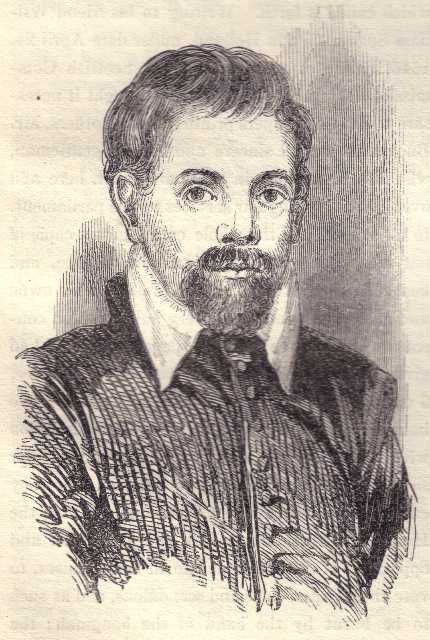
woodcut of
George Buchanan in earlier life
Buchanan’s works are:
Rudimenta Grammatices Thomae Linacri, ex Anglico Sermone, in latinum
versa. at. spud Ro. Stephanum, 1550, 8vo.
Franciscanus, et alia Poemata. Bas. 1564, 8vo. 1594, 8vo. Lugd. Bat.
1628, 24mo. Amst. 24mo. Amst. 1687, 12mo.
Poemata et Tragediae. 1609, 8vo.
Ane Admonitione direct to the treu Lordis maintainaris of the King’s
Grace’s authoritie. Printed at Stirling, 1571, by Lepruicke. Long. by J.
Day, 1571, 8vo. 2d edit. 1571, 8vo.
De Maria Scotorum Regina, totaque eius contra Regem coniuratione, foedo
cum Bothuelo adulterie, nefaria in maritum crudelitate et rabie horrendo
insuper et deterrimo elusdem Parricidio plane Historia. No place, date,
or printer’s name. 8vo.
Detectio Mariae Regine Scotorum, &c. 8vo. The same in the old Scotch
dialect, under the title, Ane Detection of the duinges of marie Quene of
Scottes, touchand the murder of hir husband, and her conspiracie,
adulterie, and pretended marriage with the Erle Bothwell; and ane
Defence of the treu Lordis mainteiners of the Kingis Graces, action, and
authoritie. Translated out of the Latine, quhilke was written by B.B. No
place, date, or printer’s name, 8vo. Both this and the above are
supposed to have been printed by John Day, 1577, 1651, 8vo. in Eng.
1689.
Baptistes, seu Tragedia de Calumnia. Francf. 1578, 8vo. 1618, fol.
Tragediae Sacrae Jephthes et Baptistes. Paris, 1554, 4to. Genev. 1593,
8vo. Amst. 1650, 8vo.
Euripidis Alcestes, ad fidem manuscriptorum ac veterum editionum
emendavit et Annotationibus instruxit Jacobus Henricus Monk, A.M.
Collegii S.S. Trinitatis Socius et Graecarum Literarum apud
Cantabrigiensis Professor Regius, Accedit Georgii Buchanani Versio
Metrica. 1816, 8vo.
Baptistes; translated by John Milton, With Notes, by Francis Peck. In
Peck’s Memoirs of Milton, p. 265.
Dialogus de Jure Regni apud Scotos; or, a Dialogue concerning the due
privilege of Government in the kingdom, &c. Edin. 1579, 4to. 1580, 4to.
1580 8vo. 1580 12mo. 1581, 4to. Francf. 1594, 8vo. 1689, 4to. The same
in English, Edin, 1691, 12mo. Glas. 1750.
Rerum Scoticarum Historia, apud Alex. Arbuthnetum. Edin. 1582, fol.
Eadem, ad exemplar Al. Arbuthneti, Genev. ut creditur, 1583, fol. et
Ultraj. 1668, 8vo. Francf. 1594, 8vo. The same in English. Lond. 1690,
fol. In Latin, Traj. ad Rh. 1697, 8vo. The 14th, 15th,
16th, 17th, 18th, and 19th
books of his history translated into English, and published for an
original, under the title of, An Impartial Account of the Affairs of
Scotland, from the death of King James V. to the tragical exit of the
Earl of Murray; by an eminent hand. Lond. 1705, 8vo. The same in English
by Will. Bond. Lond. 1722, 2 vols. 8vo. In English with cuts, 1733, 3
vols, 8vo. Notes on his History of Scotland, by F.C. Edin. 1708, 8vo,
with the Translation by Bond. 1722, 3 vols. 8vo. appendix to the History
of Scotland, Edin. 1700, 13mo. 1721, 8vo. Rerum Scoticarum Historia, ad
editionem Fribarnii expressa. Accesserunt Auctoris Vita ab ipso scripta,
et dialogus de jure regni apud Scotos; item T. Ruddimani index. Edin.
1582, 1583, fol. Edin. 1727, 8vo.
Paraphrasis Psalmorum Davidis Poetica, multoquam antehac castigatior;
authore Georgio Buchanano, Scote poetarum nostri saeculi facile
principe, ejusdem Buchanani Tragoedia, que inscribitur Jephthes. Antw.
1567, 8vo. Lond. 1582, 16 mo. Paraphrasis Psalmorum, Davidis Pietica.
Antw. 1582, 12mo. Herbornae, 1604, 12mo. Idem Edin. 1621, 12mo. Cum
ecphrasi Alexandri Julii et notis variis. Edin. 1737, 12mo. Amst. 1650,
12mo. apud Henr. Stephanum, Eadem cum Theodori Bezae Psalmorum Paraphasi
è regione opposita. Morgiis. 1681, 8vo. Numerous editions.
De Prosodia Libellus. Edin. 1600, 1689, 8vo.
Poemata quae extant. Lugd. Bat. apud Elzev. 1624, 24mo. Cum Argumentis
singulis Psalmis praefixis, opera Nath. Chytraei. Lond.. 1686, 12mo.
Operum Poeticarum, apud Pet. Sanctandreanum. 1597, 8vo.
Sphaera Poetice descripta cum Supplemento Pincieri. Herb. 1687, 8vo.
Commentarius in Vitam ejus ab ipsomet Scriptus. Edin. 1702, 8vo.
Fratres Fraterrimi; three books of Epigrams, and book of Miscellanies.
In English verse, by Robert Monteith. Edin. 1708, 8vo.
Epistolae ad viros sui seculi clarissimos, eorumque ad illum. Lond.
1711, 8vo.
Opera omnia recognita et notis illustrata, curante Thoma Ruddimano. Edin.
1715, 2 vols, fol. Lugd. Bat. 1725, 2 vols, 4to.
A Censure and Examination of Mr. Thomas Ruddiman’s Notes on Buchanan’s
Works. Aberdeen, 1753, 8vo.
Memoirs of Buchanan’s Life and Writings, by David Irving, A.M., were
published at Edinburgh in 1807, 8vo.
BUCHANAN, DAVID,
a learned writer of the seventeenth century. Very little is known with
certainty respecting him. Sibbald says he was descended from the same
family as George Buchanan, “David Buchananus, ex cadem familia oriundus,”
but on this Dr. Irving remarks, “we cannot discover his authority for
such a statement.” If, however, Buchanan of Auchmar is to be followed,
he was the second son of William Buchanan of Arnprior and consequently
grandson of the first Buchanan of Arnprior, “King of Kippen,” who was
second cousin of the great Buchanan. Irving further says that “a student
named David Buchanan was admitted of St. Leonard’s college at St.
Andrews in the year 21610. His identity with the subject of this memoir
may perhaps be inferred, but cannot easily be proved.” He appears to
have resided for some years in France, where he published his ‘Historia
Humanae Animae,’ in 1636. It is supposed that his ‘Histoire de la
Conscience’ was also published at Paris in 1638; the place of
publication, however, is not mentioned on the title-page. On his return
he seems to have taken a strong interest in the events springing out of
the civil wars. It was probably with a view to influence the public mind
at this juncture that, in 1644, he brought out an edition of the History
of the Reformation by John Knox, adapting it to the times. In this
edition he omitted the celebrated author’s preface, and inserted one of
his own. Many years afterwards Mr. Wodrow, son of the celebrated
historian, meeting in the library of the university of Glasgow with a
MS. copy of the original work, presented to that institution by Robert
Fleming, the grandson of Knox, was surprised, on collating it with the
work issued by David Buchanan, to find various interpolations and
omissions, of which he gives an account in a letter to Bishop Nicolson,
published in the appendix to his Scottish Historical Library, No. vi.
Amongst other observations it is stated that in a note on the margin “fides
sit penes authorem,” he appears to doubt a story which is inserted
on his own authority. To this work a life of Knox was prefixed, in which
he took as great liberties as with the history.
In 1646, he published a work entitled ‘Truth its Manifest,’ having
reference to the conduct of the Scottish nation during the civil war,
which excited a great sensation. In Baillie’s Letters his name occurs in
connection, it is probable, with this publication, and the following
extract from them, with its title as given below, will perhaps best
explain its nature as well as the circumstances which called it forth.
Writing to his friend William Spang, then in Holland, under date April
24, 1646, Baillie says, speaking of the Scottish Commissioners, “many of
our friends thought it necessare to have our papers printed: among
others, Mr. Buchanan, a most sincere and zealous gentleman, who hes done
both in write and print, here and over sea, many singular services to
this parliament, to his nation, and the whole cause, gott a copie of our
late papers by his private friendshipe and hazarded to print them with a
preface of his owne and an introduction, both very harmless and
consonant to the three following papers which we had given in to both
Houses. In two dayes or three, 2 or 4000 of these papers were sold; they
gave immediately to the people so great satisfaction with our
proceedings as was marvellous: our small friends were thereby so
inflamed that they carried first the House of Commons and then the House
of Lords. albeit with the great grief and opposition of the better
pairtie in both Houses, to vote these papers false and scandalous, and
as such to be burnt by the hand of the hangman; the publisher, Mr.
Buchanan, to be ane incendarie betwixt the two nations, and a
declaration to be made for undeceaving of the people. In all this they
knew none of us, they grounded the offence on the preface and
introduction, not on our papers themselfe, so we held our peace. The
burning of the papers, and the House of Commons declaration, very slie
and cunning, hes not yet done much prejudice to us, only it has made the
extraordinar malice and pride of some men shyne more clearly. Mr.
Buchanan is gone to a place safe enough; if he come among yow, he is a
man worthy of great honour for many good services.”
In the preface to the “Truth its Manifest,’ he speaks of himself as
being possessed of moderate means and as being content with little, “and
so,” he adds, “not being urged by a near nipping necessity, or imaginary
poverty, he dare be bold to speak home to the point, and tell downright
the truth of things, according to his best information.”
In the latter part of his life he appears to have been on terms of
intimacy with Sir Robert Gordon of Straloch, and was his coadjutor in
his contributions to Bleau’s Atlas. [See GORDON, SIR ROBERT of Straloch.]
According to Bishop Nicolson, David Buchanan revised a great deal of the
first projected draughts of the Theatrum Scotiae in that work, “but,”
adds the bishop, “his life ended before the troubles [that is, before
the Restoration]; and he only finish’d a very few of the county
descriptions.” [Scottish Historical Library, p. 17.] in the
Bannatyne Miscellany, (vol. ii. p. 3890,) may be found a Latin
description of the city of Edinburgh ascribed to David Buchanan; and it
is supposed, on good grounds, that he furnished to the Theatrum Scotiae
the passages relative to Stirlingshire. According to the same authority
(Bishop Nicolson), he had composed “several short discourses concerning
the antiquities and chorography of Scotland,” which, in bundles of loose
papers, Latin and English, were in safe custody when the bishop wrote,
and are sometimes quoted by him. It is perhaps of these that Buchanan of
Auchmar speaks, when he says that he wrote a large Etymologicon of all
the shires, cities, rivers, and mountains in Scotland, which are
printed, and from which Sir Robert Sibbald quotes some passages in his
History of the shires of Stirling and fife, and Nicolson seems to refer
to him, when he mentions a passage of David Buchanan’s writings as being
“in notis MMS. p. D.R.S.”
The MS. of a work entitled ‘De Scriptoribus Scotis,’ preserved in the
Advocates’ Library and in the university library at Edinburgh, is
attributed to David Buchanan, and was for the first time printed for the
Bannatyne Club, under the superintendence of Dr. Irving, in 1837, in one
volume quarto. Sir Robert Sibbald states in reference to his ‘Historia
Literaria,’ “The Greatest assistance I had is from some manuscripts of
Mr. David Buchanan, who hath written upon our learned men in ane
excellent style of Latin.” [Memoirs of the College of Physicians,
p. 27.]
Buchanan died in August 1652. The last testament of a David Buchanan,
supposed to be his, is inserted in the appendix to the ‘De Scriptoribus
Scotis,’ printed for the Bannatyne Club.
The separate works attributed to David Buchanan are:
Historiae Humanae Animae auctore Davide Buchanano Scoto, Paris, 1636,
8vo, a work of about 700 pages. A subsequent edition has the words,
“Impensis Authoris. Venumdantur apud Melcum Mondiere,” 1638, 8vo.
L’Histoire de la Conscience, par David Buchanan. Fuy le mal, Fay le
Bien. 1638, 12mo.
Truth its Manifest; or a short and true Relation of ivers main Passages
of things (in some whereof the Scots are particularly concerned) from
the very first beginning of these unhappy Troubles to this day.
Published by authority. London, 1645, 8vo. This work, frm the way in
which he spoke of his countrymen, roused the ire of the English, and a
little work appeared in answer, styled ‘Manifest Truths; or an Inversion
of Truths Manifest; containing a Narration of the Proceedings of the
Scottish Army, and a Vindication of the parliament and Kingdome of
England from the false and injurious Aspersions cast on them by the
author of the said Manifest: Published by Authoritie,’ Lond. 1646, 4to.
Vitam Joannis Knoxii Anglice conscripsit, et, una cum ejusdem Historia
Reformatae apud Scotos Religionis, Londoni et Edinburgi quoque edidit
anno reparatae salutis 1644.
De Scriptoribus Scotis, Libri Duo. Edinb. Printed for the first time for
the Bannatyne Club, 1837.
Buchanan of Auchmar mentions a large Natural History which he had begun,
but which was not completed at his death, and therefore never printed;
and Watt, in his Bibliotheca Britannica inserts among his works one
entitled A Short View of the present condition of Scotland, London,
1645, 4to. Watt’s list, however, is not otherwise correct.
BUCHANAN, DUGALD,
an eminent Gaelic poet, was born in the year 1716, in the parish of
Balquidder, Perthshire. His father was a small farmer who also rented a
mill, and who appears to have given him a better education than was
commonly taught in country schools. Having been sent, at the early age
of twelve, to teach in a family, he was tainted by the bad morals of his
associates, and fell into vice, of which he afterwards deeply repented.
He was afterwards apprenticed to a house-carpenter in Kippen, whence he
removed to Dumbarton. Having afterwards become a sincere Christian, he
was appointed schoolmaster and catechist at Kinloch-Rannoch, on the
establishment of the Society for Propagating Christian Knowledge, where
he composed those hymns which will make his name known while the
language in which they are written endures. His mental powers were of a
high order, and during many years he laboured, with extraordinary zeal
and devotedness, in enlightening and instructing the inhabitants of that
remoter district. At that period the extensive tract of country which
surrounds Loch-Rannoch was under the charge of but one minister, who, in
consequence of the wide circuits he was obliged to make, could only
perform divine service at the end of the loch, where Buchanan was
stationed, once in three weeks. On those Sabbath days, however, that the
clergyman was absent, Buchanan used to assemble the people together, and
after prayer and an exhortation, he read to them a portion of the
Scriptures. He is said to have rendered essential service to the Rev.
James Stewart of Killinl, in translating the New Testament into the
Gaelic language; and that he accompanied him into Edinburgh for the
purpose of aiding in correcting the press. While there, he availed
himself of the opportunity to attend the university, where he heard
lectures on anatomy, and the various departments of natural philosophy.
Some gentlemen, struck by his talents, endeavoured, unknown to him, to
procure him a licence to preach the gospel; but without success. He
published his hymns about the year 1767. Of these upwards of fifteen
editions have been printed. He died June 2, 1768, of fever, in the
fifty-second year of his age. “During his illness he was frequently
delirious, and in that state would sing of the ‘Lamb in the midst of the
throne.’ In his lucid intervals he expressed his full hope in the
resurrection of the just, and his desire to depart and be with Christ.
The people of Rannoch wished his remains to be buried among them, but
his relations carried the body away to their own country, and he was
buried in the burying-ground of the Buchanans at Little Lenny, near
Callander. In his person he was considerably above the middle size, and
rather of a dark complexion, but upon a close inspection his countenance
beamed affection and benevolence Among his intimate acquaintance he was
affable, free, jocular and social, and possessed much interesting
information and innocent anecdotes, in consequence of which his company
was much sought after by all the families in the country. In his dress
he was plain and simple, wearing a blue bonnet and a black dress, over
which he generally wore a blue great-coat. After his death his widow
removed to Ardoch, where she remained till the time of her death. He
left two sons and two daughters; one of the latter was alive in 1836.”
“‘The Day of Judgment,’” says the editor of the Beauties of
Gaelic Poetry, “displays great force of imagination, and fixes the mind
on the sublime and awful scenes of a world brought to an end, amidst the
wreck of elements, and the assemblage of the whole human race to
judgment.
“‘The Scull’ is full of good poetry, with appropriate reflections
on the vanity of mortal enjoyments. It shows the fierce tyrant and the
lowly slave – the haughty chief and the humble tenant – the mighty
warrior and the blooming virgin – the mercenary judge and the grasping
miser – all reduced to one level, the grave; to feed the lowly worm and
the crawling beetle.
“‘The Dream’ contains useful lessons on the vanity of human
pursuits, and the unsatisfactory rewards of ambition. The following
lines ought to be remembered by every one who envies greatness: –
“ ‘Cha ‘n ‘eil neach o thrioblaid saor,’
A’ measg a’chinne-daonn’ air fad
‘S co lionmhor osna aig an righ,
Is aig a neach is isle staid.’
“‘The Winter’ begins with a vivid description of the effects of
that season, and the preparation of men and animals to provide food and
shelter. The poet then draws a comparison between the winter and the
decline of human life, warning the old man to prepare for his future
state, as the husbandman prepares food and fuel for winter – to imitate
the prudent foresight of the ant and the bee, and not the idle and
improvident fly, dancing joyously in the sunbeams till he perishes by
the winter’s frost. This excellent poem is deservedly admired as one of
the finest specimens of didactic poetry in the Gaelic language.” –
Mackenzie’s Beauties of Gaelic Poetry, 1841.
BUCHANAN, CLAUDIUS, D.D.,
a divine distinguished by his devotion to the diffusion of learning and
Christianity in India, was the son of Alexander Buchanan, a man of
respectable learning and of excellent character, who was engaged in
various parts of Scotland as a teacher, and was shortly before his death
appointed rector of the grammar school of Falkirk. He was born at
Cambuslang, in Lanarkshire, March 12, 1766. His mother was the daughter
of Mr. Claudius Somers, who had been one of the elders of the church at
Cambuslang about the period of the extraordinary occurrences which took
place in that parish in 1742, in consequence of the preaching of the
celebrated Mr. Whitefield, and retained ever afterwards a deep and
lasting sense of real religion. In 1773 young Buchanan entered the
grammar school at Inverary in Argyleshire, of which his father was then
master, where he remained till 1779, having made considerable
proficiency in the Latin and Greek languages. He spent the vacation of
that year with a schoolfellow, John Campbell, at his father’s estate of
Airds near the island of Mull, and in the following year (1780), at the
early age of fourteen, he became, according to the practice still
observed among the gentry of these parts, where parish schools are
distant and otherwise ill-suited, tutor in the elementary parts of
education to the two sons of Campbell of Dunstaffnage. Being by his
parents intended for the ministry of the Church of Scotland, in 1782 he
left the family of Mr. Campbell and went to the university of Glasgow,
where he remained for two sessions. In 1784, from what cause does not
appear, but probably the want of pecuniary resources, he left Glasgow,
and resumed private teaching in the family of Mr. Campbell of Knockmelly
in Islay, and afterwards at Carradell in Kintyre. In 1786 he attended
with credit one session in the logic class, and returned to Carradell;
but his studies were put a stop to, by a romantic idea which he sometime
before had formed of making a pedestrian tour of Europe in imitation of
Oliver Goldsmith. His chief view in this project was to see the world,
but with an idea of turning his journey to literary account; it might
have remained a project, however, when an imprudent attachment to a
young lady his superior in birth and fortune, a visitor to the family in
Carradell where he was tutor, hastened the execution of the long-formed
design. Their affection was mutual, but the disparity of their rank and
station seemed to form an insuperable barrier to their union.
Pretending, in order to obtain the consent of his parents, that he had
been invited by an English gentleman to accompany his son upon a tour to
the continent, he proceeded to Edinburgh as if to meet the party who had
engaged him, and in August 1787, putting on coarse clothes becoming his
apparent calling, that of an itinerant musician, he left that city with
the intention of travelling to London on foot, and thence to the
continent, carrying his violin, on which he could then play tolerably
well, under his arm. He called at gentlemen’s houses and farm-houses,
playing reels, and he sometimes received five shillings, sometimes
half-a-crown, and sometimes nothing but his dinner and lodging. On
reaching Newcastle, tired with his journey and with living on charity,
he resolved to proceed by sea, and accordingly embarking at North
Shields, he arrived in London on the 2d of September. Reflection,
whetted by the sufferings and danger of a very stormy voyage, now
induced him to relinquish the idea of going to the continent, yet he
continued the delusion as respects his parents by addressing all his
letters to his friends at home from places abroad.
After suffering much distress, being obliged to sell and pawn his
clothes and books, and often wanting a dinner, he one day observed an
advertisement in a newspaper for a clerk to an attorney, and offered
himself, when he was accepted. He subsequently obtained a better
situation with another gentleman in the law, and was next employed by a
solicitor at a salary not exceeding forth pounds per annum. At this
period he led a thoughtless and somewhat dissipated life, but about
three years after he had gone to London, he began to have serious
impressions, and soon became decidedly religious. Having written an
anonymous letter, describing his state of mind, to the Rev. John Newton,
minister of St. Mary’s Woolnoth, London, the friend of the poet Cowper,
that eminent clergyman intimated from the pulpit his wish that the
writer should call upon him. an early interview accordingly took place
between them, and the result was that Mr. Newton introduced him to a
benevolent gentleman of fortune, Henry Thornton, Esq., who, in 1791,
generously sent him at his expense to Queen’s college, Cambridge, where
he distinguished himself in mathematics, and received a testimonial from
his college, but declined to take public honours. He afterwards repaid
Mr. Thornton four hundred pounds for the four years during which he had
maintained him at college. He also placed at Mr. Thornton’s disposal a
sum of money sufficient to support a young man of religious character
and good ability in poor circumstances, at the same university.
In September 1795, Mr. Buchanan was ordained deacon in the Church of
England, by Dr. Beilby Porteous, then bishop of London, and admitted
curate to his friend Mr. Newton. On 30th March 1796, by the
influence of Mr. Charles Grant (father of the late Lord Glenelg), he was
appointed one of the chaplains to the Honourable East India Company, and
having received priest’s orders from the bishop of London, after
visiting his friends in Scotland, he sailed from Portsmouth for Bengal,
August 11th of that year.
Soon after his arrival, 10th March 1797, at Calcutta, he was
appointed chaplain at Barrackpore, a military station about sixteen
miles above that city, where, however, there was no place for public
worship, nor was divine service ever required by the staff to which he
was attached, a circumstance which caused him much concern at that
period. On the 3d April 1799 Mr. Buchanan married Mary, third daughter
of the Rev. Richard Whish, then rector of the Northwold in Norfolk, who
with her uncle and aunt and her eldest sister had shortly before gone
out to India. Mr. Buchanan and his friends had been much disappointed
that after his arrival in India no opportunity was for some time given
to him to promote the great object of his thoughts, the advancement of
Christianity, but he bore his seclusion with patience, although
forbidden by the rules of the Company to preach to the Hindoos. He soon,
however, had a way opened up to him of usefulness beyond his highest
expectations. Towards the close of 1799 he was appointed by the earl of
Mornington (afterwards Marquis Wellesley), third chaplain to the
Presidency at Calcutta, and he immediately removed to that city and
entered on his new duties. In the succeeding February he preached a
sermon at the new church of Calcutta before his lordship and the
principal officers of the government, on the day appointed for a general
thanksgiving for the signal succession then recently obtained. For this
sermon Mr. Buchanan received the thanks of the governor-general in
council, with a direction that it should be printed and circulated.
In 1800, on the institution of the college of Fort William at Calcutta,
founded by Lord Wellesley, and a sketch of the constitution of which
was, by his lordship’s desire, drawn up by Mr. Buchanan, who took an
active part in the formation and subsequent conduct of that
establishment, he was appointed professor of the Greek, Latin, and
English classics, and vice-provost of the college. Already tolerably
versed in the oriental languages, he conceived he should best promote
the honour of God, and the happiness of mankind, by enabling every
Hindoo to read the Scriptures in his own tongue; and in order to carry
out these views had to overcome considerable opposition. He eventually
succeeded in issuing the first versions of the gospels in Persian and
Hindostance, which were printed in India, as well as other translations
fo the Scriptures. Although issued from the college of Fort William,
only a very small part of the expense of these translations was borne by
the public, the rest being at the private cost of various members of
that institution, among whom Mr. Buchanan and the excellent provost held
the first rank. He took a deep interest in the moral and intellectual
improvement of the natives of India, and with the view of interesting
the learned corporations of Britain in this measure, in October 1803 he
despatched letters to the heads of all the different universities in
Britain, and to the headmasters of Eton, Westminster, Winchester, and
the Charter-house schools, with the following proposals, viz.: ‘For the
most approved essay in English prose on the best means of extending the
blessings of civilization and true religion among the sixty millions,
inhabitants of Hindostan, subject to British authority,’ in each
university one hundred pounds. For the best English poem on ‘the revival
of letters in the East,’ sixty pounds. For the best Latin ode or poem on
‘Collegium Bengalense,’ twenty-five pounds; and the same sum for the
best Greek ode on [unreadable]. The sum of fifty pounds each for the
best Latin and Greek poems was offered to the successful candidate at
each of the public schools. No less a sum than sixteen hundred and fifty
pounds was thus appropriated by Mr. Buchanan to this benevolent and
patriotic purpose. These proposals were accepted in the summer of 1804,
by the several bodies to which they were offered, with the exception of
the university of Oxford, by which they were declined on the ground of
certain objections in point of form. Of the prize compositions the
greater number were afterwards published, as well as a few of those
which had been unsuccessful. One of these prize productions was a poem
on ‘the restoration of learning in the East,’ by Mr. Charles Grant, then
fellow of Magdalene College, Cambridge, afterwards Lord Glenelg. In 1805
Mr. Buchanan transmitted to England a work called ‘An Account of the
College of Fort William,’ as also his interesting ‘Memoir of the
Expediency of an Ecclesiastical Establishment for British India,’ a
scheme which has since been carried into effect by the appointment of
bishops in India; both of which were published. The same year his name
appears in the list of members of the Asiatic Society.
On the 4th of June 1805, Mr. Buchanan addressed proposals of
second prizes, of five hundred pounds each, to the universities of
Oxford and Cambridge, for compositions in English prose on the following
subjects, viz.: The probable design of Divine Providence in subjecting
so large a portion of India to the British dominion; the duty, the
means, and the consequences of translating the Scriptures into the
Oriental tongues, and of promoting Christian knowledge in Asia; and, A
brief historic view of the progress of the gospel in different nations
since its first promulgation. He afterwards addressed a letter of
considerable length to the archbishop of Canterbury, upon the promotion
of Christian knowledge in India, chiefly with reference to an
ecclesiastical establishment, and the translation of the Scriptures into
the oriental languages. He was soon after appointed provost of the
college of Fort William, under a new regulation which admitted only of
one superintending officer; this appointment, however, he declined in
favour of his colleague, the Rev. David Brown, the former provost. The
same year (1805) the university of Glasgow conferred upon him the degree
of D.D. The university of Cambridge some years after conferred on him
the same honour. So great was his anxiety on the subject of oriental
translations of the holy Scriptures, that about this time he transmitted
proposals to the universities of Oxford and Cambridge that two sermons
should be preached before each of these learned bodies on that subject,
by such persons as they should appoint; accompanied with a request that
each of the four preachers would accept the sum of thirty guineas, on
condition of the delivery to his agents of a printed copy of the sermon
for the college of Fort William. These offers were in each university
accepted. He sent a similar proposal, with an offer of fifty pounds for
the sermon, to the Directors of the British and Foreign Bible Society,
which was at first accepted, but afterwards respectfully declined as
being considered irregular.
In May 1806 Mr. Buchanan set out on a journey to the coast of Malabar,
and after visiting the temple of Juggernaut, he passed a week with the
native Christians at Tanjore, and afterwards visited the Rajah of
Travancore. From the sea-coast he proceeded into the interior of the
country, to visit the ancient Syrian Christians who inhabit the hills at
the bottom of the great mountains of Malayala. An account of his journey
was afterwards printed in his Christian Researches. In the course of
this journey he was successful in obtaining Syriac, Hebrew, and Ethiopic
manuscripts of great rarity and value, which he afterwards presented to
the university of Cambridge. Previous to his return to Calcutta he made
arrangements for the translation of the Scriptures into the native
language of Malabar.
Thus far he had succeeded in his design, and laid the foundation of that
extensive distribution of the holy Scriptures in their own languages
among the native tribes of the East which, in no long time after, was to
be vigorously prosecuted, under the auspices even of the governments in
India, who, owing to a change of policy, were at that time, from motives
of shortsighted political expediency, opposed altogether to the
enlightenment and christianization of the Hindoo. On his return to
Calcutta he found that the college of Fort William, which, during seven
years of its existence, had been productive of benefit so important to
the service of the East India Company, to oriental learning, and to
religion, had been all but entirely abolished, and his office of
vice-provost, as well as that of provost, suppressed, and his labours
and influence greatly diminished. A sketch of his proceedings on the
coast of Malabar, which, under the title of ‘Literary Intelligence,’ he
had drawn up, he was obliged to print as a pamphlet, for the governments
of Calcutta and Madras refused to authorize its appearance in the
newspapers of these presidencies, although it seems to have been
admitted into the Bombay Gazette. Even the advertisement of a volume of
sermons which, after his return to Calcutta, he had preached on the
prophecies, having reference to the spread of the gospel among the
Hindoos, and which his congregation wished to have in print, was not
only, by authority, refused insertion in the government Gazette, the
press being at that period entirely under the control of the governor,
but he was required, in a letter from the chief secretary, to transmit
his manuscripts for the inspection of the government. It appears from
his letters that this hostility arose in part from the steady adherence
of Dr. Buchanan to the principles of the administration of the marquis
of Wellesley, and in part from dislike on the part of the executive to
his evangelical objects and plans. This prohibition led to a well-timed
and excellent memorial from him, on the subject of the hostility to
religion and its progress in India manifested by the government, which
will be afterwards noticed.
While in the neighbourhood of Juggernaut, as Gibbon first derived the
idea of his History of the Decline and Fall of the Roman Empire from
visiting the Capitol at Rome, Dr. Buchanan conceived the design of the
foundation of some great literary Institution, which might, by means of
books, extend the knowledge of revealed religion and aid in the
translation of the Scriptures, but have no connection with missions, and
he afterwards prepared and even printed, though by his friends in
England it was deemed, in the then unfavourable disposition of the Court
of Directors, not expedient to publish, an elaborate plan of such an
establishment under the title of ‘The Christian Institution in the East;
or the College for translating the Holy Scriptures into the Oriental
Tongues.’ The design was but partially carried into effect, and though
its failure is to be regretted, it reflects great honour both on the
heart and head of its originator, whose single purpose, during all his
labours in the East, was the evangelization of the inhabitants of India.
In December 1807 he left Calcutta, on a second visit to the coast of
Malabar, on his way to Europe. About the middle of the following August
he arrived in England, without any thoughts of again returning to India.
In September he hastened to Scotland to visit his aged mother, and
during his stay he preached in the Episcopal chapel at Glasgow. He soon
after went to Bristol, where, on the 26th February 1809, he
preached a sermon for the benefit of the Church Missionary Society,
afterwards published, entitled ‘The Star in the East.’ This was the
first of that series of able and well-directed efforts by which, in
pursuance of the resolution he had formed in India, he endeavoured to
cherish and extend the interest he had already excited for the promotion
of Christianity in the East. In April 1809 he spent some days at Oxford,
collating oriental manuscript versions of the Bible. He afterwards
visited the duke of Marlborough’s library at Blenheim, which is also
rich in oriental manuscripts. He next proceeded to the university of
Cambridge, where he deposited the valuable biblical manuscripts,
twenty-five in number, which had been collected by himself in India. It
was at this time that this university conferred on him the degree of
Doctor in divinity.
Dr. Buchanan’s first wife had died at sea, on her return from England,
whither she had gone on account of her health, on the 18th
June 1805, leaving him two daughters; and in February 1810, he married,
a second time, a daughter of Henry Thompson, Esq. of Kirby Hall, near
Boroughbridge, in Yorkshire. This lady died in childbirth in March 1813.
She was the mother of two sons, who both died soon after their birth.
After preaching for some time in Welbeck chapel, London, Dr. Buchanan
retired to Kirby Hall, the seat of his father-in-law, where for a short
period he took up his residence. The latter part of the year 1810 was
occupied in preparing for the press his ‘University Sermons,’ and his
great work, the ‘Christian Researches in Asia.’ The sale of the latter
work was extraordinary, four editions being taken off in the course of a
few months. The labour, however, which he had undergone in preparing
this remarkable volume for the press, led to serious consequences as
respects his health. In the spring of 1811, he had been visited with a
slight paralytic stroke and temporary loss of speech, and on account of
his state of health, he proceeded on a tour to Scotland, and
subsequently visited Ireland and Wales. At this time he formed the plan
of a journey to Palestine, but a second stroke in the following
December, which left him in a state of great nervous debility, put an
end to the project.
In April 1813 the affairs of India came before parliament. As already
stated, previous to quitting Bengal in 1807, Dr. Buchanan had addressed
a memorial to Lord Minto, then governor-general, on the subject of the
hostility which had been shown, since the period of the marquis of
Wellesley’s administration, to the progress of the gospel in India. To
this memorial Lord Minto did not deign a reply, but transmitted it to
the Court of Directors in England, accompanied by a commentary of his
own of which Dr. Buchanan remained perfectly ignorant till the subject
was brought before parliament, when, with many other documents relative
to Christianity in India, it was laid on the table of the House of
Commons. He had himself, however, sent a copy of it at the time, to the
Court of Directors, with a letter in which he expressed a hope that some
general principles on the comparative importance of religion in
political relations in India, might be established at home, and
transmitted to our eastern governments for their guidance. This letter
was not published with the memorial to the governor of Bengal, nor does
it seem to have been noticed by the court. Neither of these addresses,
however, though unacknowledged at the time, was unproductive of good. In
Bengal a more favourable disposition on the part of the government
towards the promotion of Christianity appeared shortly after, and the
reply of the Directors to the representations of the governor-general in
council, though not friendly to Dr. Buchanan, was strongly marked by
those enlightened and liberal views, which he had been so anxious to see
established for the guidance of our Indian governments. In the course of
the debates which took place in the House of Commons on the affairs of
India, Dr. Buchanan’s name and writings were frequently mentioned, and
Sir Henry Montgomery and Mr. Lushington took it upon them to deny many
of his statements as to the cruel and immoral superstitions of the
Hindoos. They were, however, ably and eloquently replied to by Mr.
Wilberforce, and Dr. Buchanan himself addressed private letters to these
gentlemen in answer to their remarks. The account given by him of the
atrocities of the idol-worship at Juggernaut was also impugned and
attempted to be invalidated by Mr. C. Buller, M.P. for West Looe, who
addressed a letter to the Court of Directors on the subject. Dr.
Buchanan immediately published a letter to the Hon. East India Company
in reply to Mr. Buller’s statements, and also his ‘Apology for promoting
Christianity in India.’ He had previously published a work entitled
‘Colonial Ecclesiastical establishment;’ being a brief view of the state
of the colonies of Great Britain, and of her Asiatic empire, in respect
to religious instruction, prefaced by some considerations on the
national duty of affording it. He subsequently went to reside first at
Cheshunt, afterwards at Wormley, and latterly at Broxbourne, in
Hertfordshire, where at the time of his death, he was engaged in
superintending the printing of an edition of the New Testament for the
use of the Syriac Christians residing on the coast of Malabar. He died
at Broxbourne, February 9, 1815, at the early age of 48, and was buried
at Little Ouseburn in Yorkshire, near the remains of his second wife and
two infant sons. A monumental inscription, written by the Rev. W.
Richardson of York, records in plain but expressive language the leading
particulars of his life and character. His Memoirs, by the Rev. J.
Pearson, with extracts from his correspondence, were published in 1817
in 2 vols.; and were republished in 1834, in a condensed form by Dr.
Bickersteth for the Christian Library, from which the annexed portrait
is taken.
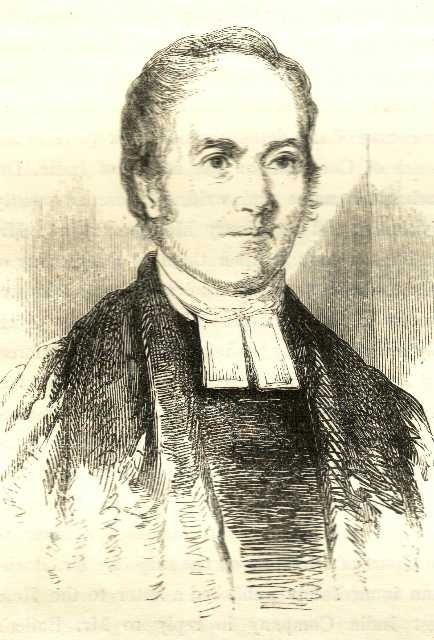
portrait of Dr.
Claudius Buchanan
Dr. Buchanan’s works are:
Memoir of the Expediency of an Ecclesiastical Establishment for British
India both as the means of perpetuating the Christian Religion among our
own countrymen, and as a foundation for the ultimate civilization of the
natives. Lond. 1805, 4to.
The Star in the East. A Sermon. 1809. 8th edit. 1813, 8vo.
Three Sermons on the Jubilee. 1810, 8vo.
The Light of the World; a Sermon. 1810, 8vo. 3d edit. 1813.
Christian Researches in Asia; with Notices of the Translation of the
Scriptures into the Oriental languages. 1811, 8vo. 5th edit.
1813, 8vo.
The Three Eras of Light; being two Discourses preached before the
University of Cambridge, and a Sermon preached before the Society for
Missions to Africa and the East. 1811, 8vo. 2d edit. 1813.
The Healing Waters of Bethesda; a Sermon, preached at Buxton. 1811.
Sermons on Interesting Subjects. Lond. 1812, 8vo.
A Brief View of the State of the Colonies of Great Britain, and of her
Asiatic Empire, in respect to religious instruction. Lond. 1813, 8vo.
An Address to Messrs. Norton, Greenwood, Schnarre, and Rhenius, about to
sail as Missionaries to Tranquebar. 1814, 8vo.
A Letter to the Hon. East India Company, in reply to the Statements of
Charles Buller, Esq. M.P., concerning the idol Juggernaut. 1813, 8vo.
An Apology for promoting Christianity in India, containing two letters
addressed to the Hon. East India Company concerning the idol Juggernaut;
and a Memorial presented to the Bengal government in 1807, in defence of
the Christian missionaries in India. Published by order of the House of
Commons. To which are now added Remarks on the Letter addressed by the
Bengal government to the Court of Directors in reply to the Memorial.
With an Appendix, containing various official papers, chiefly extracted
from the parliamentary records relating to the promulgation of
Christianity in India. 1813, 8vo.
The First Four Years of the College of Fort William. 1814, 4to.
Memoirs: by J. Pearson. 1817, 2 vols. 8vo.
BUCHANAN, DAVID,
an enterprising publisher and printer, of whose ancestry, any more than
of others of the same name in this work, no more is known than that,
as bearing the name of a barony, he was, and must have been,
descended from the ancient family of Buchanan of that ilk, at some
stage, more or less remote, of its various ramifications. He was born in
Montrose in 1745, and studied at the university of Aberdeen, where he
obtained the degree of M.A. He commenced the art of a printer in his
native town, at a time when that art had made comparatively little
progress in the north of Scotland, and, indeed, was practically unknown
in most of the provincial towns, combining with it the business of
publishing. In the course of his trading he republished several standard
works in a style equal, if not superior, to anything previously
attempted in Scotland; among these were the dictionaries of Johnson,
Boyer, and Ainsworth; the first of which was then accounted a great
undertaking. He also printed the first of the small or pocket editions
of Johnson’s dictionary, which was abridged and prepared by himself; to
which may be added a great variety of the English classics in a
miniature form. Being acquainted with the classics, he revised the press
himself, correcting previous errors and supplying omissions to the
dictionaries. Thus the Montrose press of that day acquired a high
reputation, and its productions were extensively circulated. Mr.
Buchanan died in 1812. – Family information.
BUCHANAN, DAVID,
eldest son of the preceding, a miscellaneous writer of some ability, was
born at Montrose in 1779. His earliest essay as a political writer was
in Cobbett’s Political Register, being a reply to certain theories
advanced by that politician on a question in political economy. He was a
contributor to the Edinburgh Review, shortly after the commencement of
that periodical, but the first literary effort of his which attracted
general attention was a pamphlet published in 1806 of 1807, showing the
inefficiency of the volunteer system of Pitt. The opinions so ably
advocated in this pamphlet were supported by Mr. Wyndham in the House of
Commons, and received considerable notice from other public men of the
day. At the time Mr. Buchanan wrote this pamphlet, he resided at
Montrose with his father, but encouraged by the promises and support of
a number of gentlemen belonging to the liberal party, including Francis
Jeffrey and Francis Horner, he repaired to Edinburgh about the end of
the year 1808, and started a newspaper called the Weekly Register. This
paper, although conducted with much ability, did not continue longer
than a year. The services of Mr. Buchanan were then transferred to the
Caledonian Mercury, of which paper he was editor from 1810 to 1827. A
vacancy having, in the latter year, occurred in the management of the
Edinburgh Courant, the editorship of that paper was offered to the
subject of this notice, who at once accepted of it. He was succeeded in
the Caledonian Mercury by Dr. James Browne, author of the ‘History of
the Highlands and of the Highland Clans.’ After him a Mr. Cochrane, at
one time connected with the Foreign Quarterly Review, took the place of
chief editor, and at a subsequent period a son of Mr. Buchanan, and
grandson of the Montrose printer, became and is at present (1852) the
editor of that paper.
About the year 1814 Mr. Buchanan brought out an edition of ‘Smith’s
Wealth of Nations,’ with a Life and extensive notes, and a volume of
additional matter. He also edited an edition of the Edinburgh Gazetteer
in six volumes, and supplied a considerable portion of the articles of
that work. A few years before his death he wrote a small volume on the
principles of commercial taxation, containing valuable matter. To the
seventh edition of the Encyclopedia Britannica, he contributed, amongst
others, the articles on Arabia, Asia, Statistics of France, Hindostan,
Siberia, United States, and Van Diemen’s Land, as well as the article on
general Statistics; – he also, with Dr. Browne and Mr. H. Smith,
compiled the information contained in the Edinburgh Geographical Atlas,
a work published in folio, in 1835. Mr. Buchanan died at Glasgow,
whither he had gone on a visit to his son-in-law, Mr. Duff, engineer in
that city, on the 13th August 1848. For the last five or six
years of his life, he had suffered much from disease of the heart, and
was at last cut off by it so suddenly that, only a few hours before his
death, he had written a paper on taxation for the immediately succeeding
publication of the Edinburgh Courant. He was connected with the
newspaper press of Scotland for the long period of forty years. His
style of writing was at all times clear and concise. He was a man of
unobtrusive habits, mild and gentle in his demeanour, and held in high
respect by all who had an opportunity of forming an estimate of his
character. – Family information, and Obituary at the time.
BUCHANAN, (HAMILTON) FRANCIS,
of Leny, surgeon, and author of several works relative to India, third
son of Thomas Buchanan of Spittal (mentioned in the preliminary notice
of the surname of Buchanan, ante], and Elizabeth Hamilton,
heiress of Bardowie, in the county of Lanark, was born at Branziet, in
the parish of Callander, Stirlingshire, February 15, 1762. He received
the elementary parts of his education at Glasgow, but studied for the
medical profession at the university of Edinburgh, where he received his
degree in 1783. Soon after he was appointed assistant surgeon on board a
man-of-war, but after serving for some time, he was obliged to retire
from that situation on account of bad health, which kept him for some
years at home. He appears to have gone out to the East Indies some time
before 1791, as we find the following reference to him in Dr.
Robertson’s account of Callander sent to the editor in that year, “The
most learned person who is known to have belonged to this parish is Dr.
Francis Buchanan, at present in the East Indies. In classical and
medical knowledge he has few equals, and he is well acquainted with the
whole system of nature.” In 1794 he was appointed surgeon in the East
India Company’s service on the Bengal establishment, and was sent with
Captain Symes on his mission to the court of Ava at Amerapoora in 1795,
when the latter had the satisfaction of concluding an advantageous
treaty of amity and commerce with the Burmese emperor, of which he
afterwards published an account, under the title of ‘Embassy to the
Kingdom of Ava.’ In the course of his medical studies Dr. Buchanan had
paid particular attention to botany and the kindred branches of natural
science, and during his voyages to and from, and his stay in, the Birman
empire, he was enabled to make some valuable collections of the plants
of Pegu, Ava, and the Andaman islands, which, with several drawings, he
transmitted to the Court of Directors at London, and by them they were
presented to Sir Joseph Banks, then president of the Royal Society of
London. He was subsequently stationed for two years at Luckipore, near
to where the Brahmaputra, the largest river in India, joins the Ganges,
the united rivers forming the easternmost deltoid branch of the latter
ten miles wide, and falling into the sea in the Bay of Bengal. At that
place he principally occupied himself in describing the fishes found in
the neighbourhood.
In 1798, the board of trade at Calcutta, on the recommendation of Dr.
Roxburgh, superintendent of the botanical garden recently established in
that city, employed Dr. Buchanan to visit the district and neighbourhood
of Chittagong, or Chatigong, on the west border of the Birman Empire;
and here, too, he collected numerous specimens of plants, which were, as
the previous ones, transmitted to Sir Joseph Banks, and extended his
knowledge of the natural history of Assam. In the following year he was
employed in describing the fishes of the Ganges, of which he published
an account in 1822, with plates. His attainments in the departments of
natural history and statistics became so highly appreciated that, in
1800, he was chosen by the Marquis Wellesley, then governor-general of
India, to examine into, and report upon, the entire agricultural and
manufacturing systems and products of Mysore, then recently acquired by
the British arms, as well as those of the adjacent province of Malabar,
with suggestions for their improvement, as also upon the general
condition of the inhabitants and the climate and physical aspect of the
country. At that period the rapid progress of the English conquests made
it impossible for the local government to find officers versant in the
local languages of their acquisitions, and Dr. Buchanan, whose labours
had been confined in the northern region of the territories of the
Company, was necessarily unacquainted with the dialects of the south. It
was his practice to travel a certain distance every day, and each
morning before setting out from the place where he had rested during the
night, he assembled those who resided in the neighbourhood, and
questioned them on the several points contained in his instructions. The
answers were such as suited the hearers to give and the interpreter to
communicate; and the patient and confiding Doctor noted all down
faithfully in his daybook for the use of the government. Thus, while
everything that he saw was described perspicuously and correctly enough,
it was not unfrequently very different with what he heard. The result of
his inquiries was, after his first return to England, published in 1807,
under the patronage of the Court of Directors, with the title of
‘Travels in the Mysore,’ in three large quarto volumes, illustrated with
maps and drawings. The work, from the manner in which the author
collected his information, is more in the nature of a journal than a
regular and digested account of Mysore; yet, as a writer in the
Edinburgh Review for October 1808 justly remarks, “After all the
deductions that can be made from Dr. Buchanan’s authority, his book
remains an interesting and valuable publication relating to a country
then scarcely known in Europe. He has rendered an essential service to
the Indian historian by collecting a variety of inscriptions extant in
the temples of the peninsula.” The reviewer sums up his opinion of this
work by saying that “those who will take the trouble to peruse Dr.
Buchanan’s book will certainly obtain a far more accurate notion of the
actual condition and appearance of India, and of its existing arts,
usages, and manners, than could be derived from all the other books
relating to it in existence; but they will frequently be misled as to
its religion, literature, and antiquities, and must submit to more
labour than readers are usually disposed for, in collecting and piecing
together the scattered and disjointed fragments of information of which
the volumes are composed.”
In 1802 Dr. Buchanan was appointed to accompany Captain Knox on his
embassy from the governor-general to Nepaul, thus again changing the
scene of his labours from the south to the northern part of Hindostan.
In the course of this journey, and residence in Nepaul, he made large
additions to his collections of rare plants. A description of Nepaul,
which he wrote at this time, he transmitted to the Court of Directors,
and it remained unpublished till 1819, after he had retired from the
Company’s service, and was independent of their smile or their frown,
when with fuller materials he brought it out under the name of an
‘Account of the Kingdom of Nepaul.’ notwithstanding the researches of
later travellers, Dr. Buchanan’s work still remains the standard
authority of the country of which it treats. Indeed it and the similar
work of Colonel Kirkpatrick on the same state (published in 1811) have
furnished the principal materials for most of the recent works on that
country. In Blackwood’s Magazine for July 1852, there is a review of
various publications, all having reference to that kingdom, and all
published many years subsequent to Dr. Buchanan’s work, and they are one
and all stated to be “very largely indebted to the Doctor and the
Colonel, although their authors rarely remember to acknowledge their
obligations.” Such a testimony is honourable to the observation and
acuteness of Dr. Buchanan, who was among the first to visit and to
describe that remote region of Hindostan.
On his return from Nepaul, he was appointed surgeon to the
governor-general, the Marquis Wellesley, of the great merit of whose
administration he had, like his namesake Dr. Claudius Buchanan, formed a
very high estimate. The liberal and enlightened policy of that eminent
statesman did more for the regeneration and civilization of India than
did that of any of the governments which, for many years, had either
preceded or succeeded him. His wise and energetic measures, joined to
his selection and patronage of men distinguished for their attainments
and ability, in the precise departments for which they were best fitted,
enabled him to establish upon a broad basis the foundations of our vast
and mighty empire in India. When not occupied in official duties, Dr.
Buchanan devoted much of his leisure to the superintendence of the
menagerie founded at Calcutta by the marquis, and to the description of
the animals which it contained. in 1805, on the recall, at his own
request, of his noble patron, he accompanied him to England, and in the
following year he was again sent out to India by the Court of Directors,
for the purpose of making a statistical survey of the territory under
the presidency of Fort William, which comprehends Bengal Proper, and
several of the adjoining districts. Several papers taken from this
survey were communicated by him to the Transactions of the Royal Asiatic
Society. After being engaged in this laborious occupation for upwards of
seven years, he returned to Calcutta; and in 1814, on the death of Dr.
Roxburgh, he became superintendent of the botanical garden in that city,
having been appointed successor to that eminent botanist by the Court of
Directors as early as 1807.
Dr. Buchanan had repeatedly received the public thanks of the Court of
Directors, and of the governor-general in council, for his useful
collections and his valuable information on matters relative to the
different countries of India which had been the scene of his exertions
and his investigations. The objects of his ambition had now been fully
attained in India; his services had been not only honourable
acknowledged but liberally rewarded by the East India Company; he had
acquired an ample fortune; and he naturally felt anxious to retire from
the enervating influence of an eastern climate and the responsibility
and labours of public service, to spend the remainder of his life, and
enjoy his well-earned wealth and reputation, in his native land. He
accordingly left Calcutta in 1815, and on his arrival in London, he
presented to the Court of Directors his collections relative to India,
consisting of drawings, of plants, minerals and drugs, coins and
manuscripts, as also some papers on the geography of Ava, several
genealogical tables, and his notes on natural history. Before leaving
Calcutta, probably on account of his being officially employed to
prepare them, he had been deprived by the marquis of Hastings, the then
governor-general, of all the botanical drawings which had been made
under his inspection during his last stay in India, and which he
intended to have given, with his other collections, to the library of
the India House in Leadenhall street, London. This circumstance, Dr.
Buchanan referred to in a paper which he contributed to the Transactions
of the Royal Society of Edinburgh.
Soon after his arrival in England, Dr. Buchanan proceeded to Scotland,
and spent the latter years of his life at Leny in Perthshire, an estate
to which his father had succeeded as heir of entail, and which, on the
death of his eldest brother, Colonel Hamilton *who had taken his
mother’s name on inheriting Bardowie), without children, came into his
possession with the other family estates, when he also assumed the name
of Hamilton as a prefix to his paternal one. He married a Miss Brock,
and had a son, John Hamilton Buchanan, who succeeded him, and a
daughter, who died young. In 1821, when the marquis Wellesley was
appointed lord-lieutenant of Ireland, Dr. Buchanan was asked to
accompany him in an official capacity, but he declined the offer on
account of his health and love of retirement. In 1826 he was appointed a
deputy lieutenant of Perthshire. The same year he established his claim
to be considered the chief of the clan Buchanan (see ante]. He
devoted much of his time to the improvement of his residence at Leny,
and introduced into his garden and grounds many curious plants, shrubs,
&c. He was a member of several learned and scientific societies, and a
fellow of the Royal Societies of London and Edinburgh. He died June 15,
1829, in the 67th year of his age.
His works are:
A Journey from Madras through the countries of the Mysore, Canara, and
Malabar, performed under the orders of Marquis Wellesley, for the
express purpose of investigating the state of Agriculture, Arts, and
commerce; the Religion, Manners, and Customs; the History natural and
civil, and Antiquities, in the dominions of the Rajah of Mysore, and the
countries acquired by the Hon. East India Company in the late and former
wars, from Tippoo Sultaun. Illustrated by a map and numerous engravings.
Lond. 1807, 3 vols, 4to.
Account of Nepaul and of the Territories annexed to it by the House of
Goorkha. 4to, London, 1819.
A Genealogy of the Hindoo Gods. 1819. This work was drawn up by Dr.
Buchanan before leaving India, with the assistance of an intelligent
Brahmin.
An Account of the Fishes of the Ganges, with plates. 1822.
He also contributed largely to various scientific journals of the day,
particularly those devoted to natural history.
More on this name from the Dictionary of National Biography



