|
BLACK,
a name, like Brown, White,
&c., originally given, when surnames began to be first used, which in
Scotland was not till about the beginning of the twelfth century, to persons
in the middle or lower ranks who had no lands, from the colour of the visage
or hair, or some peculiarity in the mental or personal character, and when
the surname was not assumed from a trade or occupation, as Smith, Cook,
Hunter, &c., or from the name of the father, with the addition of son, as
Williamson, Johnson, Robertson, &c.
BLACK, JOSEPH, M.D.,
the founder of
pneumatic chemistry, though not a native of Scotland, was or Scottish
descent, and long resided in this country. He was born on the banks of the
Garonne in France in 1728. His father, John Black, who was a native of
Belfast, but of a Scottish family, had settled at Bordeaux, as a wine
merchant, and lived in intimacy with the celebrated Montesquieu, who
expressed his regret in strong terms on Mr. Black’s quitting Bordeaux, when
he retired from business, as appears by several of his letters. His mother
was a daughter of Mr. Robert Gordon of Hillhead, Aberdeenshire, and by her
Dr. Black was nearly related to the wives of Dr. Adam Fergusson and Mr.
James Russell, professor of Natural Philosophy at the University of
Edinburgh. In 1740, when he was twelve years old, he was sent to Belfast, to
receive the rudiments of his education. In 1746 he entered as a student at
the university of Glasgow, where Dr. Cullen the same year became professor
of chemistry. He prosecuted his studies, particularly in physical science,
with so much assiduity and success that he soon attracted the notice of this
eminent man, who made him his assistant in all his chemical experiments. In
1751, having chosen the profession of medicine, to complete his medical
studies he went to the university of Edinburgh, at that time rising into
reputation as a medical school, where in 1754 he took the degree of M.D. His
inaugural thesis on this occasion was entitled ‘De Acido a Cibis orto, et de
Magnesia Alba,’ in which was contained an outline of his celebrated
discovery of fixed air, or carbonic acid gas; which he now,
for the first time, showed to be the true cause of the causticity of
alkalies. This important discovery, with that of latent heat, for
which we are also indebted to Dr. Black, laid the foundation of modern
pneumatic chemistry, which has opened to the investigation of the
philosopher a fourth kingdom of nature, viz. the gaseous kingdom. In 1755 he
published his ‘Experiments on Magnesia, Quicklime, and other Alkaline
Substances,’ which more fully developed his views on the subject he had
touched upon in his thesis. His opinions, of course, gave rise to
considerable discussion, particularly in Germany, but he was enabled
satisfactorily to answer and refute all objections. In 1756, Dr. Cullen
having removed to Edinburgh, Dr. Black was appointed his successor, as
professor of anatomy and lecturer on chemistry, in the university of
Glasgow. The former chair he soon exchanged for that of medicine for which
he was better qualified. One of his pupils at Glasgow was Watt, the
celebrated inventor of the improved steam-engine, who was led by Dr. Black’s
views and theories respecting the nature of steam, and particularly on the
subject of evaporation, to make those great improvements which have been of
so much benefit to science. Between the years 1759 and 1763, Dr. Black
matured those speculations on latent heat which had for some time
engaged his attention. An observation of Fahrenheit’s recorded by Dr.
Boerhaave, that water would become considerably colder than melting snow,
without freezing, and would freeze in a moment if disturbed, and in the act
of freezing emit many degrees of heat, seems to have suggested to Dr. Black
the notion that the heat received by ice during its conversion into water
was not lost, but was contained in the water. The experiments by which he
demonstrated the existence of what he termed latent heat in bodies
will be found fully detailed in his ‘Lectures.’ The result of these he first
read, in April 1762, to a select society in Glasgow, and afterwards before
the Newtonian Society in Edinburgh. He remained in Glasgow, occasionally
practising as a physician, till 1766, when Dr. Cullen being appointed
professor of medicine in Edinburgh, Dr. Black was removed to the chemical
chair in that university, where he continued for about thirty years. He
contributed a paper to the ‘Philosophical Transactions of London,’ for 1774,
entitled ‘Observations on the more ready freezing of water that has been
boiled.’ The only other paper written by him was published in the second
volume of the ‘Transactions of the Royal Society of Edinburgh,’ being an
‘Analysis of the Waters of some boiling Springs in Iceland,’ in which he
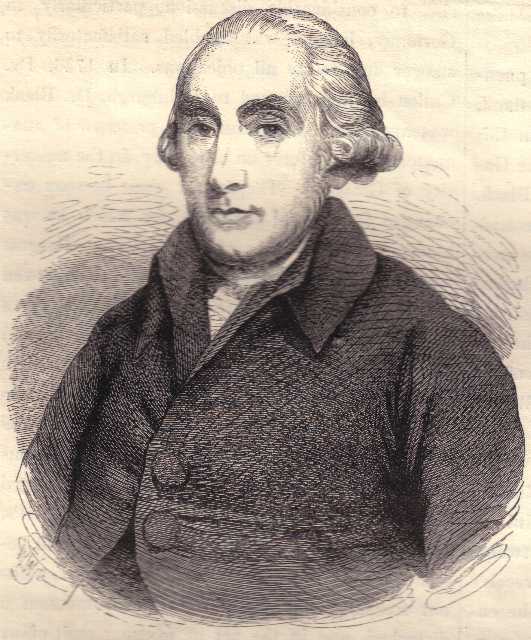
found a considerable quantity of silica. The following portrait of Dr. Black
is engraved from the painting by Sir Henry Raeburn:
Dr. Black was
never married. He long resided in the house in Nicholson Street, Edinburgh,
which now forms the Blind Asylum. He was simple in his habits, and very
abstemious in his diet. He died suddenly November 26, 1799, while sitting at
table with his usual fare, viz., some bread, a few prunes, and a measured
quantity of milk diluted with water. Having the cup in his hand, feeling the
approach of death, he set it carefully down on his knees, which were joined
together, and kept it steady in his hand, in the manner of a person
perfectly at ease; and in this attitude expired, without spilling a drop,
and without a writhe in his countenance, as if an experiment had been wanted
to show to his friends the facility with which he departed. He was in the 71st
year of his age. Dr. Black was of a cheerful and sociable disposition, and,
as his mind was well stored with information, he was, at all times, an
entertaining companion. His company was therefore much courted, and as his
circumstances were affluent, he dedicated as much time to the pleasures of
society as was consistent with his avocations. He left the principal part of
his fortune, which is said to have been considerable, among the children of
his brothers and sisters. After his death his ‘Lectures on Chemistry’ were
published from his notes in 2 vols. 4to, by his friend and colleague, Dr.
Robinson, late professor of natural philosophy in the university of
Edinburgh. – Thomson’s History of Chemistry. – Scots Mag. for 1803.
Subjoined is a
catalogue of the works of Dr. Black.
Experiments on
Magnesia Alba, Quick Lime, and other Alkaline Substances; to which is added,
An Essay of Cold, produced by Evaporating Fluids, and some other means of
producing Cold, by Dr. Cullen. Edinburgh, 1776-82, 12mo. All these Papers
were previously published in the Essays Physical and Literary, vol. ii. p.
157.
The Supposed
Effect of Boiling on Water, in disposing it to freeze more readily;
ascertained by Experiment. Phil. Trans. Abr. xiii. 610. 1775.
An Analysis of
the Waters of some Hot-Springs in Iceland. Ed. Phil. Trans. iii. Part. ii.
94. 1794.
Lectures on the
Elements of Chemistry, delivered in the University of Edinburgh, by the late
Joseph Black, M.D., now published from his Manuscripts, by John Robison,
LL.D. Edin. 1803, 2 vols. 4to.
Entries
from the Dictionary of National Biography |



