|
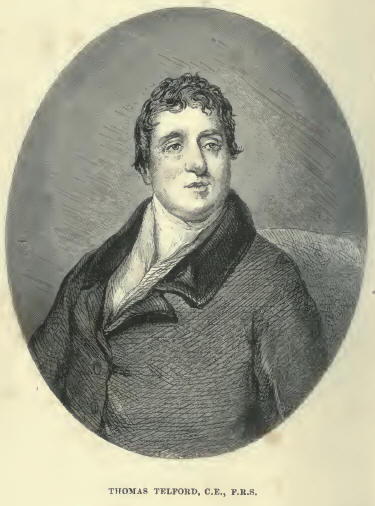 TELFORD,
THOMAS, an eminent engineer and constructor of public works, was born about
the year 1755, in the parish of Westerkirk in Dumfriesshire. His outset in
life was strikingly humble in comparison with its close. He began the world
as a working stone-mason in his native parish, and for a long time was only
remarkable for the neatness with which he cut the letters upon those frail
sepulchral memorials which "teach the rustic moralist to die." His
occupation fortunately afforded a greater number of leisure hours than what
are usually allowed by such laborious employments, and these young Telford
turned in the utmost advantage in his power. Having previously acquired the
elements of learning, he spent all his spare time in poring over such
volumes as fell within his reach, with no better light in general than what
was afforded by the cottage fire. Under these circumstances the powers of
his mind took a direction not uncommon among rustic youths; he became a
noted rhymster in the homely style of Ramsay and Fergusson, and, while still
a very young man, contributed verses to Ruddiman’s Weekly Magazine, under
the unpretending signature of "Eskdale Tam." In one of these compositions,
which was addressed to Burns, he sketched his own character, and hinted his
own ultimate fate – TELFORD,
THOMAS, an eminent engineer and constructor of public works, was born about
the year 1755, in the parish of Westerkirk in Dumfriesshire. His outset in
life was strikingly humble in comparison with its close. He began the world
as a working stone-mason in his native parish, and for a long time was only
remarkable for the neatness with which he cut the letters upon those frail
sepulchral memorials which "teach the rustic moralist to die." His
occupation fortunately afforded a greater number of leisure hours than what
are usually allowed by such laborious employments, and these young Telford
turned in the utmost advantage in his power. Having previously acquired the
elements of learning, he spent all his spare time in poring over such
volumes as fell within his reach, with no better light in general than what
was afforded by the cottage fire. Under these circumstances the powers of
his mind took a direction not uncommon among rustic youths; he became a
noted rhymster in the homely style of Ramsay and Fergusson, and, while still
a very young man, contributed verses to Ruddiman’s Weekly Magazine, under
the unpretending signature of "Eskdale Tam." In one of these compositions,
which was addressed to Burns, he sketched his own character, and hinted his
own ultimate fate –
Nor pass the tentie curious lad,
Who o’er the ingle hangs his head,
And begs of neighbours books to read;
For hence arise,
Thy country’s sons, who far are spread,
Baith bold and wise.
Though Mr Telford afterwards
abandoned the thriftless trade of versifying, he is said to have retained
through life a strong "frater-feeling" for the corps, which he showed in a
particular manner on the death of Burns, in exertions for the benefit
of his family. Having proceeded to London in quest of work, he had the good
fortune to be employed under Sir William Chambers in the building of
Somerset house. Here his merit was soon discovered by the illustrious
architect, and he experienced promotion accordingly. We are unable to detail
the steps by which he subsequently placed himself at the head of the
profession of engineering; but it is allowed on all hands that his elevation
was owing solely to his consummate ability and persevering industry, unless
we are to allow a share in the process to the singular candour and integrity
which marked every step in his career. His works are so numerous all over
the island, that there is hardly a county in England, Wales, or Scotland, in
which they may not be pointed out. The Menai and Conway bridges, the
Caledonian canal, the St Katharine’s docks, the Holyhead roads and bridges,
the Highland roads and bridges, the Chirke and Ponteysulte aqueducts, the
canals in Salop, and great works in that county, of which he was surveyor
for more than half a century, are some of the traits of his genius which
occur to us, and which will immortalize the name of Thomas Telford.
The Menai bridge will
probably be regarded by the public as the most imperishable monument of Mr
Telford’s fame. This bridge over the Bangor ferry, connecting the counties
of Caernarvon and Anglesea, partly of stone and partly of iron, on the
suspension principle, consists of seven stone arches, exceeding in magnitude
every work of the kind in the world. They connect the land with the two main
piers, which rise fifty-three feet above the level of the road, over the top
of which the chains are suspended, each chain being 1714 feet from the
fastenings in the rock. The first three-masted vessel passed under the
bridge in 1826. Her topmasts were nearly as high as a frigate, but they
cleared twelve feet and a half below the centre of the roadway. The
suspending power of the chains was calculated at 2016 tons. The total weight
of each chain, 121 tons.
The Caledonian canal is
another of Mr Telford’s splendid works, in constructing every part of which,
though prodigious difficulties were to be surmounted, he was successful. But
even this great work does not redound so much to his credit as the roads
throughout the same district. That from Inverness to the county of
Sutherland, and through Caithness, made not only, so far as respects its
construction, but its direction, under Mr Telford’s orders, is superior in
point of line and smoothness, to any part of the road of equal continuous
length between London and Inverness. This is a remarkable fact, which,
from the great difficulties he had to overcome in passing through a rugged,
hilly, and mountainous district, incontrovertibly establishes his great
skill in the engineering department, as well as in the construction of great
public communications.
Mr Telford was not more
remarkable for his great professional abilities than for his sterling worth
in private life. His easiness of access, and the playfulness of his
disposition, even to the close of life, endeared him to a numerons circle of
friends, including all the most distinguished men of his time. For some
years before his death, he had withdrawn himself in a great measure from
professional employment, and amused his leisure by writing a detailed
account of the principal works he had planned, and lived to see executed. He
died September 9, 1834, in his seventy-ninth year, and was buried in
Westminster Abbey.
The Life of
Thomas Telford
Civil engineer with an introductory history of roads and travelling in Great
Britain
by Samuel Smiles
"Let us travel, and wherever we find no facility for
travelling from a city to a town, from a village to a
hamlet, we may pronounce the people to be barbarous"
--Abbe Raynal
"The opening up of the internal communications of a
country is undoubtedly the first and most important
element of its growth in commerce and civilization"
--Richard Cobden
PREFACE
The present is a revised and in some respects enlarged
edition of the 'Life of Telford,' originally published in the 'Lives of the
Engineers,' to which is prefixed an account of the early roads and modes of
travelling in Britain. From this
volume, read in connection with the Lives of George and Robert Stephenson,
in which the origin and extension of Railways is described, an idea may be
formed of the extraordinary progress which has been made in opening up the
internal communications of this country during the last century.
Among the principal works executed by Telford in the
course of his life, were the great highways constructed by him in North
Wales and the Scotch Highlands, through districts formerly almost
inaccessible, but which are now as easily traversed as any English county.
By means of these roads, and the facilities afforded by
railways, the many are now enabled to visit with ease and comfort
magnificent mountain scenery, which before was only the costly privilege of
the few; at the same time that their construction has exercised a most
beneficial influence on the population of the districts themselves.
The Highland roads, which were constructed with the
active assistance of the Government, and were maintained partly at the
public expense until within the last few years, had the effect of
stimulating industry, improving agriculture, and converting a turbulent
because unemployed population into one of the most loyal and
well-conditioned in the empire;-- the policy thus adopted with reference to
the Highlands, and the beneficial results which have flowed from it,
affording the strongest encouragement to Government in dealing in like
manner with the internal communications of Ireland.
While the construction of the Highland roads was in
progress, the late Robert Southey, poet laureate, visited the Highlands in
company with his friend the engineer, and left on record an interesting
account of his visit, in a, manuscript now in the possession of Robert
Rawlinson, C.E., to whom we are indebted for the extracts which are made
from it in the present volume.
London, October, 1867.
CONTENTS
EARLY ROADS AND MODES OF TRAVELLING
Chapter I. Old Roads
Roads as agents of civilization, Their important uses, Ancient British
trackways or ridgeways, The Romans and their roads in Britain, Decay of the
Roman roads, Early legislation relating to highways, Roads near London, The
Weald of Kent, Great Western roads, Hollow ways or lanes, Roads on Dartmoor,
in Sussex, at Kensington.
Chapter II. Early Modes of Conveyance
Riding on horseback the ancient mode of traveling, Shakespear's description
of travelling in 'Henry IV.', Queen Elizabeth and her coach, Introduction of
coaches or waggons, Painful journeys by coach, Carriers in reign of James I,
Great north Road in reign of Charles I, Mace's description of roads and
travellers stage-coaches introduced, Sobriere's account of the Dover
stage-coach, Thoresby's account of stage-coaches and travelling, Roads and
travelling in North Wales, Proposal to suppres stage-coaches, Tediousness
and discomforts of travelling by coach, Pennant's account of the Chester and
London stage, Travelling on horseback preferred, The night coach, Highway
robbers and foot-pads, Methods of transport of the merchandize pack-horse
convoys, Traffic between lancashire and Yorkshire, Signs of the pack-horse.
Chapter III. Influence of Roads on Society
Restricted intercourse between districts, Local dialects and customs thereby
preserved, Camden's fear of travelling into the barbarous regions of the
North, Rev. Mr Brome's travels in England, Old Leisure, Imperfect postal
communication, Hawkers and pedlars, Laying in stores for winter, Household
occupations, Great fairs of ancient times, Local fairs, Fair on Dartmoor,
Primitive manners of Dartmoor District.
Chapter IV. Roads in Scotland last centuary
Poverty of Scotland, Backwardness of agriculture, Idleness of the people,
Andrew Flecher's description of Scotland, Slavery of colliers and salters,
Improvements in agriculture opposed, Low wages of the labouring population,
State of the Lothians and Ayrshire, Wretched states of the roads, Difficulty
of communication between districts, Coach started between Edinburgh and
Glasgow, Carrier's perils between Edinburgh and Selkirk, Dangers of
travelling in Galloway, Lawlessness of the Highlands, Picking and lifting of
cattle, Ferocity of population on the Highland Border, Ancient civilization
of Scotland.
Chapter V.
Travelling in England last century
Progress made in travelling by coach, Fast coaches established, Bad state of
the roads, Foreigners' accounts of travelling in England, Herr Moritz's
journey by the basket coach, Arthur Young's description of English roads,
Palmer's mail coaches introduced, The first 'Turnpike' roads, Turnpike
riots, The rebellion of 1745, Passing of numerous highway Acts, Road-making
thought beneath the dignity of the engineer.
Chapter VI. John Metcalf, road-maker
Metcalf's boyhood, His blindness, His boldness, Becomes a Musician, His
travels, Journey on foot from London to Harrogate, Joins the army as
musician in the rebellion of 1745, Adventures in Scotland, Becomes
travelling merchant and horse dealer, Begins road-making, Builds a bridge,
His extensive road contracts in Yorkshire and Lancashire, Manner of making
his surveys, His skill in road-making, His last road--his death, Roads in
the south of England, Want of roads on Lincoln Heath, Land lighthouses,
Dunstan pillar, Rapid improvement in the roads, Application of steam, Sydney
Smith on improved facilities of communication.
THE LIFE OF THOMAS TELFORD
Chapter I. Eskdale
Eskdale, Langholm, Former lawlessness of the Border population, Jonnie
Armstrong, Border energy, Westerkirk, Telford's birthplace, Glendinning,
Valley of the Meggat, The 'unblameable shepherd', Telford's mother, Early
years, Laughing Tam, Put to school, His school-fellows.
Chapter II. Langholm--Telford a Stonemason
Telford apprenticed to a stonemason, Runs away, Re-apprenticed to a mason at
Langholm, Building operations in the district, Miss Pasley lends books to
young Telford, Attempt to write poetry, Becomes village letter-writer, Works
as a journeyman mason, Employed on Langholm Bridge, Manse of Westerkirk,
Poem of 'Eskdale', Hews headstones and doorheads, Works as a mason at
Edinburgh, Study of architecture, Revisits Eskdale, His ride to London.
Chapter III. Arrives in London
Telford a working man in London, Obtains employment as a mason at Somerset
House, Correspondence with Eskdale friends, Observations on his
fellow-workman, Propses to begin business, but wants money, Mr. Pulteney,
Becomes foreman of builders at Portsmouth Dockyard, Continues to write
poetry, Employment of his time, Prints letters to his mother.
Chapter IV. Becomes Surveyor for the County of Salop
Superintends repairs of Shrewsbury Castle, Appointed Surveyor for County of
Salop, Superintends erection of new gaol, Interview with John Howard, His
studies in science and literature, Poetical exercises, Fall of St. Chad's
Church, Shrewsburg, Discovery of the Roman city of Uriconium, Overseer of
felons, Mrs. Jordan at Shrewsbury, Telford's indifference to music,
Politics, Paine's 'Rights of Man', Reprints his poem of 'Eskdale'.
Chapter V. Telford's First Employment as an Engineer
Advantages of mechanical training to an engineer, Erects Montford Bridge,
Erects St. Mary Magdalen Church, Bridgenorth, Telford's design,
Architectural tour, Bath, Studies in British Museum, Oxford, Birmingham,
Study of architecture, Appointed Engineer to the Ellesmere Canal.
Chapter VI. The Ellesmere Canal
Course of the Ellesmire Canal, Success of the early canals, The Act obtained
and working survey made, Chirk Aqueduct, Pont-Cysylltau Aqueduct, Telford's
hollow walls, His cast iron trough at Pont-Cysylltau, The canal works
completed, Revists Eskdale, Early impressions corrected, Tours in Wales,
Conduct of Ellesmere Canal navigation, His literary studies and
compositions.
Chapter VII.
Iron and other Bridges
Use of iron in bridge-building, Design of a Lyons architect, First iron
bridge erected at Coalbrookdale, Tom paine's iron bridge, Wear iron bridge,
Sunderland, Telford's iron bridge at Buildwas, His iron lock-gates and
turn-bridges, Projects a one-arched bridge of iron over the Thames, Bewdley
stone bridge, Tougueland Bridge, Extension of Telford's engineering buisness,
Literary friendships, Thomas Campbell, Miscellaneous reading.
Chapter VIII. Highland Roads and Bridges
Progress of Scotch agriculture, Romilly's account, State of the Highlands,
Want of roads, Use of the Caschrom, Emigration, Telford's survey of
Scotland, Lord Cockburn's account of the difficulties of travelling, the
North Circuit, Parliamentary Commission of Highland Roads and Bridges
appointed, Dunkeld Bridge built, 920 miles of new roads constructed,
Craigellachie Bridge, Travelling facilitated, Agriculture improved, Moral
results of Telford's Highland contracts, Rapid progress of the Lowlands,
Results of parish schools.
Chapter IX. Telford's Scotch Harbours
Highland harbours, Wick and Pulteney Town, Columnar pier work, Peterhead
Harbour, Frazerburgh Harbour, Bannf Harbour, Old history of Aberdeen, its
witch-burning and slave-trading, Improvements of its harbour, Telford's
design carried out, Dundee Harbour.
Chapter X. Caledonian and other Canals
Canal projected through the Great Glen of the Highlands, Survey by James
Watt, Survey by Telford, Tide-basin at Corpach, Neptune's Staircase, Dock at
Clachnaharry, The chain of lochs, Construction of the works, Commercial
failure of the canal, Telford's disappointment, Glasgow and Ardrossan Canal,
Weaver Navigation, Gotha Canal, Sweden, Gloucester and Berkeley, and other
canals, Harecastle Tunnel, Birmingham Canal, Macclesfield Canal, Birmingham
and Liverpool Junction Canal, Telford's pride in his canals.
Chapter XI. Telford as a road-maker
Increase of road-traffic, Improvement of the main routes between the
principal towns, Carlisle and Glasgow road, Telford's principles of
road-construction, Macadam, Cartland Crags Bridge, Improvement of the London
and Edinburgh post road, Communications with Ireland, Wretched state of the
Welsh roads, Telford's survey of the Shrewsbury and Holyhead road, Its
construction, Roads and railways, London and Shrewsbury post road, Roads
near London, Coast road, North Wales.
Chapter XII. The Menai and Conway Bridges
Bridges projected over the Menai Straits, Telford's designs, Ingenious plan
of suspended centering, Design of a suspension bridge over the Mersey at
Runcorn, Design of suspension bridge at Menai, The works begun, The main
piers, The suspension chains, Hoisting of the first main chain, Progress of
the works to completion, The bridge formally opened, Conway Suspension
Bridge.
Chapter XIII. Docks,
Drainage, and Bridges
Resume of English engineering, General increase in trade and population, The
Thames, St. Katherine's Docks, Tewkesburg Bridge, Gloucester Bridge, Dean
Bridge, Edinburgh, Glasgow Bridge, Telford's works of drainage in the Fens,
The North Level, The Nene Outfall, Effects of Fen drainage.
Chapter XIV. Southey's tour in the
Highlands
Southey sets out to visit the Highlands in Telford's company, Works at
Dundee Harbour, Bervie Harbour, Mitchell and Gibbs, Aberdeen Harbour,
Approach to Banff, Cullen Harbour, The Forres road, Beauly Bridge, Bonar
Bridge, Fleet Mound, Southey's description of the Caledonian Canal and
works, John Mitchell, Takes leave of Telford, Results of Highland
road-making.
Chapter XV. Mr
Telford's later years--His death and character
Telford's residence in London, Leaves the Salopian, First President of
Institute of Civil Engineers, Consulted by foreign Governments as to roads
and bridges, His views on railways, Failure of health, Consulted as to Dover
Harbour, Illness and death, His character, His friends, Integrity, Views on
money-making, Benevolence, Patriotism, His Will, Libraries in Eskdale
supported by his bequests. See
also...
Journal of a tour in Scotland in 1819
By Robert Southey (1929) (pdf)
In 1819 Robert Southey, the Poet Laureate, in company with Telford, the
great engineer, made a comprehensive tour through Scotland, and, being a
true bookman, kept a record of the people met and the things seen during
their journey. Although no years have passed since then, that Journal has
not been published. Yet it has its fresh interest to readers generally and
its particular value to social historians and to Scots, for with sincerity
and grace Southey wrote down promptly what he saw, and he was no mean
observer of his times.
Lives of the Engineers
By Samuel Smiles Vol. 3 - Telford (1897) (pdf)
Thomas Telford
by L. T. C. Rolt (1958) (pdf) |



