|
 No
country is more celebrated for its educational institutions than Scotland,
the advantages of moral and
intellectual improvement being secured to all, by the legal provision for
a school and teacher in every parish throughout the kingdom. This system,
so admirably adapted for the low country, is less effective in the rugged
land of the Gaël, where the great extent of the parishes was found to
require subsidiary establishments. No
country is more celebrated for its educational institutions than Scotland,
the advantages of moral and
intellectual improvement being secured to all, by the legal provision for
a school and teacher in every parish throughout the kingdom. This system,
so admirably adapted for the low country, is less effective in the rugged
land of the Gaël, where the great extent of the parishes was found to
require subsidiary establishments.
It is not merely the elementary
branches of education which are taught in these seminaries; the
schoolmasters having to go through a classical curriculum before
being admitted to a parochial charge, and being, indeed, often licentiates
for the ministry, their acquirements are sufficient to enable them to
prepare pupils for college.
The numbers who attend the parish
schools, vary, of course, with the population; but there are always fewer
in the summer months, as parents then require the assistance of their
children in agricultural or pastoral Occupations.
Fees are paid by all who are able to
do so, but the children of the poor have a claim to gratuitous education,
a liberal provision, but far from the constitution of a charity
school.
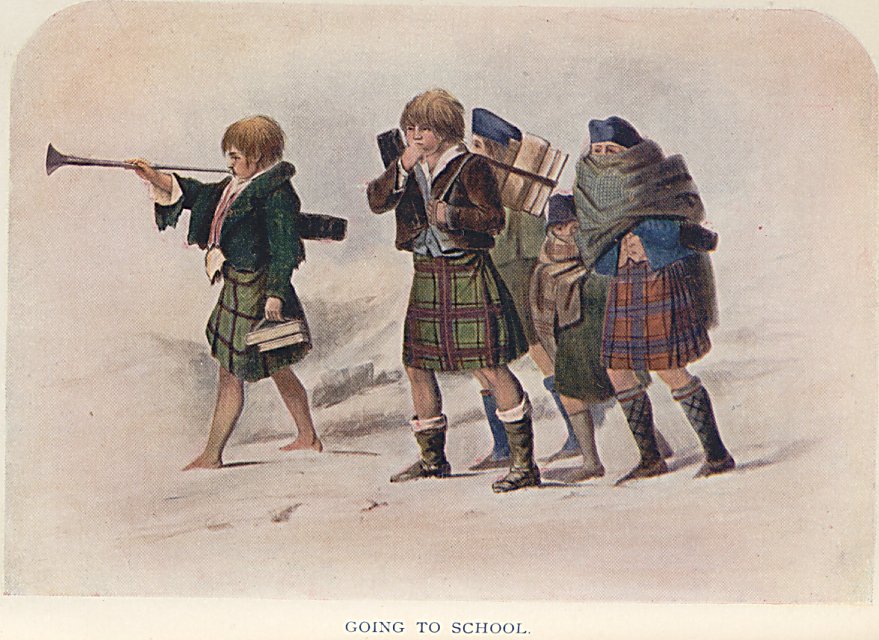
The subject of illustration is a
scene in Lochaber, representing a peculiar custom. One of the poorer boys
is appointed to muster his fellow pupils to their morning tasks, which he
does at half—past eight in summer, and nine in winter: and this juvenile
official is known as the Gille an Adharc, or the Boy of the Horn, from the
instrument he uses to "gather his motley clan," a duty for which he
receives one penny a quarter from each scholar.
It is the practice in rural parishes
for each boy to carry a peat, or piece of turf, to school every morning,
by which means a good fire is kept up for the general benefit. These
ragged-looking, bare-legged urchins, wading through the snow of a cold
morning, are, notwithstanding, strong and healthy, and in general hardier
than children whose parents wrap them in more comfortable-looking
garments. They are also of sharp intellect; and there are few boys in the
Highlands of twelve or fourteen years of age who cannot read and write.
The aptitude of the race for the
acquisition of knowledge, although assertions have repeatedly been made to
the contrary, has been, from the days of Druidism, one of its
characteristics, which, to Roman refinement, appeared only an idle and
importunate curiosity in the people.
Thiery, speaking of a later division
than the Gaël, more truly observes in them a predilection for "the
cultivation of letters, that power of imagination," in which he sees "a
trace of their Celtic origin."
The Highlanders have been rashly
pronounced an illiterate people. Unacquainted with the early history of
those whose language is unknown to their accusers, such writers may be
forgiven, but waving consideration of the Bardic remains, so carefully
held in oral preservation, and the series of illustrious teachers in the
far-famed isle of Iona, for ages the conservators of Gospel light in
Western Europe, it will be admitted that their general literary history
equals neither that of the Celts of Ireland nor the Cumri of Wales,
cognate branches of the same great race. The Highlanders were not,
unfortunately, in a state so favourable to the pursuits of peace and the
gratification of mental solace as that of their neighbours. It was the
attachment of the great Buchanan to the court of King James, that gave him
opportunity to display his classical acquirements and literary talent.
The first book printed in Gaelic was
the Liturgy of Dr. Carsewell, Bishop of the Isles, in 1566, since which
time typography has steadily progressed. Dictionaries and grammars have
been long published; well-conducted periodicals have, from time to time,
appeared, and a cheap newspaper is now circulated. The names of Doctors
Mac Leod, Mackay, Mac Pherson, Ross, Dewar, Armstrong, Stewart, Smith,
Ewen Mac Lachian, and many others, would throw lustre on the literature of
any country.
In the Highlands, there are about
400,000 persons who speak Gaelic, of whom it is calculated that 80,000
know no other. How surprising therefore it must appear, that among a
people so careful of moral and intellectual education, there should not
exist in any of the Scottish colleges a chair for the qualification of
future teachers in a grammatical knowledge of that language!
If, as it has been stated, in a
congregation of 500 persons, not more perhaps than fifty would be found
who could understand an English sermon perfectly throughout, the magnitude
of such an evil is lamentably obvious.
A spirit has frequently prevailed,
strongly opposed to the continuance of old languages, as serving to keep
up inconvenient distinctions, and at one time the Assembly of the Scottish
Kirk, the guardian of parochial education, thought it right to interdict
all tuition through the vernacular tongue. It was alleged by the advocates
of this profound policy, that the Gaelic was an insurmountable barrier to
all mental improvement. The children were, therefore, taught in English,
and the lesson was acquired, and correctly repeated too, without being at
all understood!
The latent nationality of some
individuals, who saw the absurdity and injustice of such a method of
instruction was roused, and funds having been provided, in 1811, "The
Gaelic School Society" was established. The plan met with eminent success,
and not only did the young joyfully attend, but cases have frequently been
reported where the aged have gone to school, learning to read the
Scriptures along with their children and offspring! The Venerable Assembly
thus stimulated, repealed the insane regulation, and schoolmasters, now
most properly, give the first lessons in the mother tongue of the
children, the only one which in early life a majority of the population
can understand. |