 THE
important domestic operation of Washing is generally performed by the
Highland females, in the clear, purling streams of their native glens, the
water from its softness being excellent for the purpose of cleansing.
THE
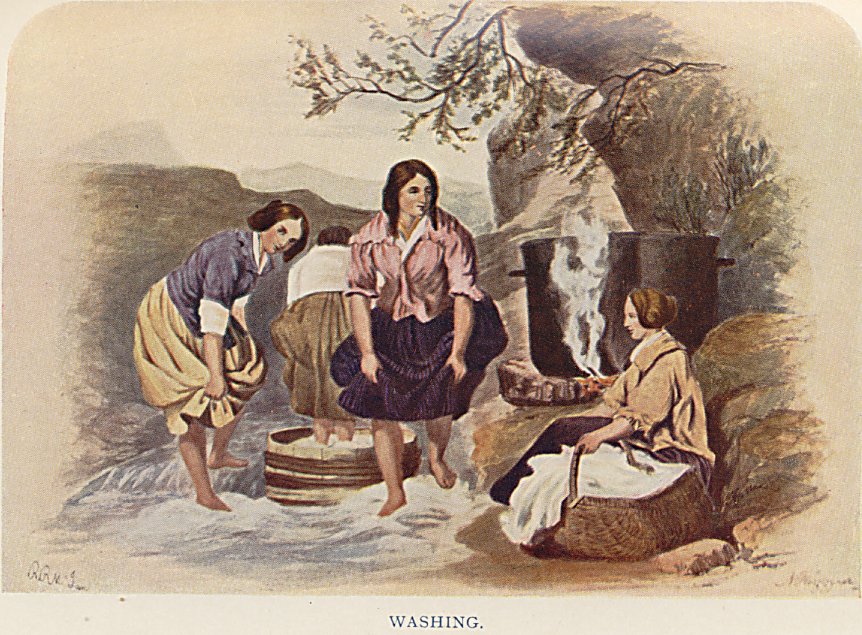
important domestic operation of Washing is generally performed by the
Highland females, in the clear, purling streams of their native glens, the
water from its softness being excellent for the purpose of cleansing.
Blankets and the heavier linen are always taken to this
natural lavatory, but smaller articles are occasionally ‘beetled,’ that
is, they are laid upon a stone in the river and beaten with a wooden
mallet; but treading with the bare feet, as here represented, is the usual
process of purification.
This method is generally termed Strampail na
Plaideachan, or ‘tramping the blankets,’ as these are the stuffs most
frequently washed in this manner.
Companies of young women are sometimes engaged in this
work at the same time, and on the margin of the river at Inverness, which
is reckoned the capital of the Highlands, fifty or sixty girls may be seen
busily employed in this necessary part of their domestic duties, which
they call ‘posting,’ and it presents an animated scene, from its
singularity, particularly striking to a stranger.
The beautiful banks of the stream are a favourite
promenade of the citizens, and the younger portion of the male community
are no doubt fond of sauntering by the river, but no offensive curiosity
is displayed. Were any persons, by unbecoming levity of behaviour or
expression, to draw on them the resentment of these Celtic Naiads, an
unceremonious drenching in the Ness would be the least penalty they might
expect to pay for their indiscretion.
This simple practice, once equally common in more
southern towns, is giving place to genteeler modes of executing a work
indispensable in Highland housekeeping.
Allan Ramsay celebrates Habbie’s How, a romantic spot
in the vicinity of Edinburgh, as a favourite resort of the rural
laundresses of that city, and very prettily describes it, in his
interesting composition, ‘The Gentle Shepherd,’ as
"A flowery howm atween twa verdant braes,
Where lasses use to wash an’ spread their clai’s,
A trottin’ burnie wimplin’ through the ground,
Its channel pebbles, shinin’ smooth an’ round;
Between twa birks out o’er a little un,
The water ía’s an’ mak’s a singin’ din;
A pool breast-deep beneath, as clear as glass,
Kisses in easy whirls the borderin’ grass:
Here view twa barefoot beauties clean an’ clear,
First please your eye, next gratifr your ear."
Sir Walter Scott, also, in the ninth chapter of’
Waverley,’ describes the appearance of the Baron of Bradwardine’s maids
when at this work:-
"The garden, which seemed to be kept with great
accuracy, abounded in fruit—trees, and exhibited a profusion of flowers
and evergreens, cut into grotesque forms. It was laid out in terraces,
which descended rank by rank from the western wall to a large brook, which
had a tranquil and smooth appearance, where it served as a boundary to the
garden; but, near the extremity, leapt in tumult over a strong dam, or
wear-head, the cause of its temporary tranquillity, and there forming a
cascade, was overlooked by an octangular summer-house, with a gilded bear
on the top by way of vane. After this feat, the brook, assuming its
natural rapid and fierce character, escaped from the eye down a deep and
wooded dell, from the copse of which arose a massive, but ruinous tower,
the former habitation of the Barons of Bradwardine. The margin of the
brook, opposite to the garden, displayed a narrow meadow, or haugh as it
was called, which formed a small washing-green; the bank, which retired
behind it, was covered by ancient trees.
"The scene, though pleasing, was not quite equal to the
gardens of Alcina; yet wanted not the ‘due donzelette garrule’ of that
enchanted paradise; for upon the green aforesaid, two bare—legged damsels,
each standing in a spacious tub, performed with their feet the office of a
patent washing-machine.
"These did not, however, like the maidens of Armida,
remain to greet with their harmony the approaching guest, but, alarmed at
the appearance of a handsome stranger on the opposite side, dropped their
garments (I should say garment, to be quite correct) over their limbs,
which their occupation exposed somewhat too freely, and, with a shrill
exclamation of ‘Eh, sirs!’ uttered with an accent between modesty and
coquetry, sprung off, like deer, in different directions."
The girls generally select a retired and romantic spot,
where, in some cases, they are secluded by rocks, with trees, overhanging
foliage, and other beauties of the sylvan scene; and here, when the large
pot or cauldron is used to assist the labour, they light their fire.
Sometimes two girls trample together in the same tub,
when with one arm encircling each other’s waist, they go round, while
their motions are accompanied with a simple and melodious song, the arms
being frequently changed as they move in a contrary direction. Judging
from the hilarity which prevails, the burnside washing seems to be a
favourite ‘ploy’ with these damsels.
The Highlanders, like all primitive people, when at
work, always accompanied their labours with appropriate songs, which
modulated their operations and lightened their toil. The Oran Luathadh is
the melody chanted by the women engaged in washing, and is more
particularly referable to the ancient practice of cleansing and fulling
their woollen cloths.
The process of Luatha’, the ‘waulking’ of the low
country, is likewise performed by the feet; but the parties, eight, ten,
or more, sit on the ground opposite to each other, having the wet material
laid between, on a long hurdle or piece of grooved woodwork. The cloth is
then rubbed and tossed about with great vigour and dexterity until it
becomes properly thickened, the swell of voices and rapidity of execution
rising to a climax as the work proceeds; and the story is told of an
English gentleman, who having come unexpectedly on a number of women in
the heat of their work, made a speedy retreat, believing he had discovered
a company of lunatics! This singular operation forms the subject of one of
the prints in ‘Pennant’s Tour in Scotland,’ 1772.
The wash-house, or laundry, in the house of a Highland
gentleman, is called Tigh Nigheachain.
The picture was made from sketches stolen from three
mountain belles, natives of the lonely vale of Glenco, interesting as the
birthplace of Ossian, the prince of Celtic bards, and long the possession
of a branch of the great Clan Donald, most of whom were treacherously
slain in a winter midnight, by order of King William III., the intention
being to cut off the whole. These nymphs bear the euphonious appellations,
Isabell ruadh, Caorag ruadh, Morag dubh, and Cairistin dail, but they are,
of course, all Mac Donalds.