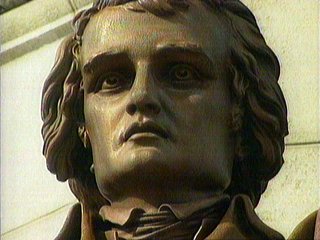
 Colonel Rogers Clark from Virginia, with Governor Patrick Henry's help,
recruited Scotch-Irish and German frontiersmen from Southwest Virginia, and from
Washington and Greene Counties Tennessee (then in North Carolina) and rafted his men 1000
miles down the Ohio River from Pittsburgh (Ft. Pitt), Pennsylvania (on right) in winter to
make a successful surprise attack against British installations in present -day Illinois
and Vincennes, in present-day Indiana. Colonel Rogers Clark from Virginia, with Governor Patrick Henry's help,
recruited Scotch-Irish and German frontiersmen from Southwest Virginia, and from
Washington and Greene Counties Tennessee (then in North Carolina) and rafted his men 1000
miles down the Ohio River from Pittsburgh (Ft. Pitt), Pennsylvania (on right) in winter to
make a successful surprise attack against British installations in present -day Illinois
and Vincennes, in present-day Indiana.Colonel
Clark captured that vast territory for the United States in the American Revolutionary
War. He received ammunition and other munitions aid from Oliver Pollock and the Spanish
Governor De Galvez in New Orleans which was helpful.
Clark's frontier riflemen at times marched through waist-deep
icy waters to make the surprise attack. They were hardy and courageous fighters for
freedom.
Governor Patrick Henry and his frontiersmen fought successful
wars on several fronts during the American Revolution.
Henry supplied men from Virginia for the Washington's
Continentals, his Regular army.
Henry also supplied men to fight from his state militia
forces.
Henry aided Daniel Boone and his westerners in Kentucky which
was then a part of Virginia in holding the Kentucky territory for George Washington.
And Henry backed to the hilt Colonel George Rogers Clark in
Clark's winning of the vast Northwest for the Revolutionary forces of Washington, clear
over into Ohio, Indiana and Illinois. Clark's victories there cinched that territory for
America during the negotiations for peace which settled the war with England.
James McCord who was on the payroll of Virginia Captain John
Allison's Company with George Rogers Clark was killed on July 9, 1780 while on Clark's
expedition to the Northwest.
1776 AND RELIGIOUS FREEDOM IN VIRGINIA
In 1776 John and Samuel McCord, living some 15 miles from
Thomas Jefferson's home at Monticello, and who were in his legislative district when he
was in the Virginia state legislature then, petitioned Jefferson in writing for religious
freedom in order to be able to freely practice their religious faith.
Scotsman Governor Patrick Henry saw to it that a religious
freedom section, section 15, was included in the Virginia Constitution in July 1776 at the
time of Virginia's independence and his election as its first Governor. Patrick Henry
personally drafted that religious freedom section of the state constitution.
These McCords were in the Presbyterian Church while the
Anglican church was the state church of Virginia, the so-called 'established church,' from
which the phrase "Establishment of Religion" in the Bill of Rights is derived.
The Presbyterians and the Baptists were the two principal
forces who successfully fought for religious freedom in Virginia against the
"Established" Anglican church, the official state church of Virginia under its
colonial government.
Governor Patrick Henry of Virginia, a dedicated Christian,
and Governor George Clinton of New York led the fight for Religious Freedom and Freedom of
Speech and the other Bill of Rights guarantees, forcing James Madison to introduce a Bill
of Rights to the Continental Congress in June 1789 which was approved by the Congress in
September 1789 and sent to the states for ratification.
Andrew McCord, close friend of Governor George Clinton of New
York State played a role with Clinton in that successful fight for our Bill of Rights, it
is reported.
James Madison had opposed a Bill of Rights. Clinton and
Patrick Henry's role in the Bill of Rights has been described earlier (see New York).
PATRICK HENRY, PUBLIC ENEMY NO. 1 OF
KING GEORGE III
Earlier in the 1760's Patrick Henry, then a Virginia militia
Colonel, faced down the Colonial Governor of Virginia with Henry's militia troops and
forced the British Governor in the famous "Gunpowder Affair" to return a large
quantity of gunpowder set aside for the Virginia militia by the Colonial legislature.
The Governor had taken the gunpowder away, sequestering it,
where the militia commanded by Colonel Patrick Henry would not have access it, and stored
it aboard his ship anchored in the Virginia harbor.
Colonel Patrick Henry with a regiment of militia then marched
on the Virginia capitol forcing the Governor to return the gunpowder to the militia's
control. For this, Patrick Henry became thereafter "Public Enemy No.1" in the
eyes of the British.
Ever since those days, the Bill of Rights 2nd
Amendment's 'Right to Bear Arms' (including gunpowder) has been a precious liberty and
guarantee of freedom for Virginians. It has been their protection against despotism, they
believe
Patrick Henry of Virginia spoke out against British tyranny
in 1765, and again in 1775 with his famous "Give Me Liberty or Give Me Death"
speech which motivated the Virginia Provincial Convention to bear arms against England and
then to vote for independence from it. Patrick Henry is considered one of the greatest
orators of all time.
Patrick Henry of Scottish descent was later
first Governor of Virginia in 1776 and is given credit for being responsible for our
1789-90 Bill of Rights which we have and its precious freedoms of speech and religion
which it contains.
Patrick Henry is considered one of the world's
greatest orators of all time.
Scottish American Hall of
Fame
Jim Thomson, creator of the
Scottish American Hall of Fame, once wrote: “History books say little
about the Scottish role in the settlement and development of America. The
story is too often lost under the heading English, or British, or even
Scotch-Irish. Nevertheless, the Scottish contribution was considerable and
at times crucial. Before he was 30, Patrick Henry impressed his critics
with his skill at declamation, generally laced with references to the
importance of self-government and human rights.” Thomas Jefferson said
of him, “His voice flowed in torrents of sublime eloquence.”
Patrick Henry was born on
May 29, 1736 at Studley, Virginia. He was the son of John Henry, a
well-educated Scot who emigrated to Virginia with a considerable number of
other people from Scotland. His father served as a judge, surveyor, and
army officer. He had been educated at Aberdeen University. “It was the
rugged, cantankerous Scottish frontiersmen, mainly in Virginia, but also
Pennsylvania, with little or no loyalty to the British monarchs who
touched off the first fires of rebellion. And the man who struck the match
was Patrick Henry, the silver tongued orator, son of John Henry from
Aberdeen.”
“Henry’s was the first
voice raised against England in her attempt to impose taxation without
representation. He rose to his full stature in attacking the infamous
Stamp Act, which was hotly debated at the House of Burgesses in
Williamsburg in 1765. The other delegates quailed when Henry hurled
defiance at George III with the challenge, ‘If this be treason, make the
most of it’.”
His most famous speech was
delivered in 1775 at St. John’s Church in Richmond. His words centered
around human rights and individual liberty which could only win
independence from the British Crown. “With courage and eloquence, he
cried, “Why stand we here idle? What is it that gentlemen wish? What
would they have? Is life so dear or peace so sweet as to be purchased at
the price of chains and slavery? Forbid it Almighty God! I know not what
course others may take, but as for me, give me liberty or give me
death.”
When the revolution ended,
Henry continued working for individual freedom. His greatest contribution
to the nation was in working for the adoption of the Bill of Rights. “He
was adamant in demanding protection of basic individual civil
liberties.”
The first governor of
Virginia, he served five exhausting terms. In 1794, he retired and resumed
private legal practice. “Failing health forced him to refuse numerous
posts, including Chief Justice of the U. S. Supreme Court, Secretary of
State and minister to Spain and to France. He even turned down a sixth
term as governor.
“George Washington
persuaded Patrick Henry to become a candidate for the state legislature in
1799. The foundations of the young republic were endangered by the
rumblings of men who argued that any state has the power to nullify acts
of the Federal Government. Bowed with age and his health deteriorating,
Henry delivered his last public oration. It was an inspiring,
non-partisan, patriotic appeal for unity to preserve the nation. Historian
Henry Adams declared that nothing in Henry’s life was more noble than
his last public act.”
“Three months later, on
June 6, 1799, death came to Patrick Henry. The ‘Voice of the
Revolution’ was silenced forever.”
|



