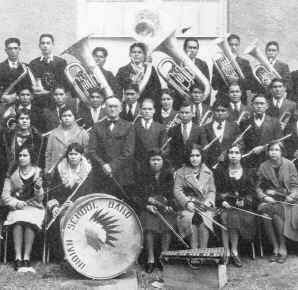
 Velma
Louise Pensoneau Jones, daughter in law of Nancy Bellzona Collins Jones,
wife of Lee Otis Jones is pictured here as a student, front row, two girls
to the right of the drum, light coat. Her brother, Edward Richard
Pensoneau is pictured, back row, two boys from the right. This year is
1931. Velma
Louise Pensoneau Jones, daughter in law of Nancy Bellzona Collins Jones,
wife of Lee Otis Jones is pictured here as a student, front row, two girls
to the right of the drum, light coat. Her brother, Edward Richard
Pensoneau is pictured, back row, two boys from the right. This year is
1931.
Velma is the daughter of Narcisus Pensoneau, granddaughter of Stephen
Pensoneau and great granddaughter of Paschal Pensoneau, full French, who
was married to Shikina, full Kickapoo woman.
Velma worked for Colonel Zack Miller, of the famed 101 ranch after her
eight years at Chilocco Boarding school. She was a strikingly beautiful
girl. When she married into the the Jones family she became a humble,
intelligent young woman subject to the strong Scots culture of Bell, her
mother in law. The American Indian, French, and Scottish blood came
together for Velma and she was quick to combine and use the union. She was
adept at management on the sprawling prairie lands along with her husband
and they lived well with abundant provisions from the land.
Because we have been fortunate to come into possession of her great
grandfather's biography we have more of an understanding of why she was
able to use her intelligence for the benefit of her children. The
following biography I include because it is valuable historical evidence
as to the basic building blocks of the area.
Biography of Paschal Pensineau
Pensineau: I was born in Cahokie, Illinois. I am eighty-seven years
old. I was born April 17, 1795. My father was a Canadian from Fort La
Prairie, across from Montreal; was of pure French blood. My mother was
born in Cahokie. Her father was a native of Paris, France. Her mother was
a half-breed Pottawatomie. I lived at Cahokie till I was thirteen years of
age, among the French people who were the sole inhabitants of that town,
through my boyhood. I only remember three American living at that time in
the American Bottom: Pullam Finisdall, and Bill Savaag. They had
farms in the American Bottom. I went to a French school about six months,
when I was a child.
Of my father's family, none are now living
except my brother Narcisse Pensineau, who is a lawyer, and living three
miles from Muscotah, St. Clair County, Illinois. He is a brother of the
full blood, with me.
When I was thirteen years old I went among
the Kickapoos. My father was head-boss for the American Fur Company
(author's note, this was owned by John Jacob Astor). He bought goods from
Mackinaw to the Kickapoos, Pottawatomies and Miamies, who were then living
in Indiana and Illinois, on the Wabash River, and the Vermillion, and
other branches of the Wabash. I went to Terre Haute, where there was a
trading post. My father gave me a set of tools so that I could repair the
Indian guns, and I followed that business a great deal. When I was
nineteen years of age I came across the Mississippi River with the
Kickapoos. We crossed the Mississippi at Sainte Genevieve, Kaskaskia; 63
families. we first settled on White River. Remained there about five
years. Then we went to the Osage; to the Pomme de Terre.
Two or three years before we crossed at
Sainte Genevieve the Mexican Kickapoos went off. Pam-wy-tum was the name
of the chief who led the Mexican Kickapoos off. That was when I was about
sixteen years old, as near as I can remember.
I was five year as among the Sacs and Foxes
and was in the Black Hawk War: I was assisting Stephen S. Phelps, a
trader, when I was with the Sac and Foxes. He had his trading house on the
Yellow Bank, on the Mississippi, in Warren County, Iowa. He belonged to
the American Fur Company.
When I went to the Sacs and Foxes the
Kicapoos were living on the Pom de Terre. After the Black Hawk War I
joined them on the Missouri River above Fort Leavensworth. I was
twenty-four year old when I came among the Kicapoos on the Missouri. the
American Fur Company sent from their post in Iowa, with a stock of goods.
CAMPBELL was agent for the Kickapoos when they moved across from the
Kaskasia. When I came to the Missouri Richard Cummings was the Agent. He
was agent for four years.
I was the first trader among the Kickapoos
on the Missouri. Mr. Morgan, a settler at Fort leavenworth, also traded
with the Indians at that time. I have been with the Kickapoos ever since.
About 1844 I commenced opening a farm on
the Stranger Creek, near where Mount Pleasant now is, in Atichison,
County. I lived there ten or eleven years, when I moved up on the
Grasshopper, reservation under the treaty of 1854.
I was often in St. Louis when I was a boy,
and began to learn to speak English by association with English speaking
traders and agents.
I was first appointed interpreter by
superintendent WILLIAM CLARK, and I interpreted for Major Menard at
Kaskaaskia about the time the Kickapoos first crossed the Mississippi into
Missouri. I first took delegation of the Kickapoos from Oco, St. Clair
County, Indiana.
I became interpreter at Kickapoo, on the
Missouri River, soon after I came there, after the Black Hawk War. I was
appointed by Henry Tiblos to assist him. He was interpreter for the
Delaware's, Shawnees and Kickapoos and Pottawatomies. Cummings was agent
for all the four tribes. he lived at Westport, Missouri, Titlow had me
interpret when there was any business done at Kickapoo.
Tiblow was a full blooded Delaware. He
could read and write in English. He is still living among the Delawares, I
think, in Indian Territory.
After I had been interpreter some time,
Peter Cadue became interpreter for five years. I then became interpreter
again. I became interpreter under Major Charles B. Keith, and remained
under Bennett and Adams. I was followed by John Anderson, while Adams was
still agent. I was interpreter under Vanderslice and Richardson; was
interpreter when the treaty was made in President Pierce's time in 1854.
I went to the Indian Territory first in
1856 because of the Kansas troubles. My daughter Papone married Armistead
Dawson. she lived with Dawson about three years when she left him, it was
about 1852 or 53 when she left Dawson and came back to the tribe, and
would not live with him any more. She brought her baby back to the tribe,
and rejoined the tribe. Dawson got Jim Whipple to steal the child from his
mother when he was about three or four years old, and he kept him till he,
Dawson, died. James Whitehead became guardian for the boy after Dawson's
death. during agent Adam's time I got the agent to have George Storch
appointed guardian, and young Dawson was brought to me and I put him to
school in Atchison. He is now living at Muscotah. He is 20 years old. Tom
Whipple was a son in law of mine. His wife was Mary Pensineau. They could
not live together. She is now in Mexico and Tom is among the Cherokees.
Tom's boy by my daughter Mary is now living on the reservation in Kansas.
He is twenty-six years old.
When I went to the Indian territory in
1856, seventy or eighty families of Kickapoos living there, and I went
among them. I lived down there then four years, when the war of the
Rebellion broke out.
I was at the Seminole agency, this side of
the Big Canadian, when Albert Pike and Rector came and had a talk with the
Indians about taking sides with the South in the Rebellion. He said the
people of the North were going to rob the South, like stealing the
chickens from a hen's nest. the Seminoles would not join with the South.
Pas-co-ca, the head chief of the Seminoles told Pike that he was shipped
by the People of the United States in Florida, and that he was not going
to fight against the United States again. The Seminoles did not join with
the South. The other tribes did, so far as I know.
The Seminoles and some Kickapoos and
Creeks, left for the north at once. I came with them. We had a fight at
Cross Hollow. The Rebel Creeks fought us all.
I remained in Kansas on the Kickapoo
reservation from 1861 to 1875. I then took my family and went to live near
where I now live. I live now seven miles from Shawneetown on the north
fork of the Canadian, on this side. My family now consists of my wife, and
my son Sephen Pensineau and his wife and children and another son of mine
named Ap-Pak-kee-mah, who is thirty-six years old. Stephen is twenty-nine.*
I was in the Black Hawk War, as I said, and
also in the Mexican war. I got a land grant for my service in the Black
Hawk War, and eighty acre warrant, which I sold to Charles B. Keith, of
Atchison, for two horses. I want to see if I can get a pension for my
service in the Black Hawk War, in the Mexican War, or in the War of the
Rebellion. I have been in the service of the country 63 years and am now
getting old. I was wounded in the Battles of Cross Hollow. I went out at
the time Dr. Badger went. I was with two or three hundred Indians at the
Battle of Pea Ridge. (author's note, this is in Arkansas). These Indians
were regularly organized into the army. I was not mustered into any
company of regiment. We fought as volunteers.
My daughter Papone, after she left Dawson,
was married to Musquot and they have seven children. They belong to the
common band of Kickapoos, now living on the reservation of thirty
sections. They have always lived there. They want a treaty made so they
can get their share and go south.
There are now nineteen families of
Kickapoos living where I live, on the North Canadian, who have claims on
the common reservation of thirty sections in Kansas. They were named in
the treaty of 1852. They were in the Indian Territory at the time the
treaty was made and were provided for in the treaty. They now want a
treaty made so that they can get the benefit of the interest in the land.
My wife became a citizen of the United
States and wants to sell her land which she has near Muscotah. I want you
to get her a patent for the land.
When you visit the reservation, see
Mes-quot. He has a son named Fred, eighteen years old, who is a bright
boy.
*Stephen was the father of Narcisse
(Narcissus) Paschal Pensoneau, who was my grandfather, and father to Velma
Louise Pensoneau Jones, Mrs. Lee Otis Jones.
Donna Flood notes.
Of further interest is a hand written
letter dated 1906 which says, "Louison Pensoneau (father to Paschal)
was for many years a trader among the Kickapoo Indians who occupied
central Illinois from the Illinois river to the Wabash. His home was
at Cahokia, his trading establishment was at Peoria. While his family
remained at or near Cahokia he spent much of his time up the county among
the Indians, and when Paschal grew up he was much of his time with his
father with the Indians, and thoroughly assimilated with them in language,
habits and customs. The old man died in 1832, and Paschal, who had become
almost completely estranged from his kinfolks, went with the Kickapoos to
the west in 1833, and was soon married to a squaw. His brothers and
sisters, who ranked socially among the highest class of citizens here,
regarded Paschal's alliance with an Indian an intolerable disgrace and if
they did not disown him outright, they called him, "off," and
never mentioned his name and really did not know where he was or care to
know. Paschal having become to every intent an Indian, ignored all
his relative and was completely lost to them.
Paschal never came back to Illinois but
once, I think it was about 1876 or 78. His brothers and sisters were then
all dead, and he was about 80 years of age. My brother, then alive, and
residing at Belleville, Illinois where I was raised, entertained him while
there; and afterward described him to me as a striking figure, of stately
patriarchal appearance, and an intelligent, dignified and courteous
gentleman. He was well dressed, and perfectly at his ease, with nothing in
speech or manners to indicate his life long associate with
Indians............From my more mature knowledge of the world and mankind,
I feel quite sure that the Indian woman Paschal married was fully his peer
in all that pertains to moral, social and domestic life."
Sincerely yours,
J.F. Snyder.
Author's note: for those of my dear kinfolk who hate the word
"squaw" please forgive. The word was in the documents.
A chart
of Pensoneaus back to:
Francois Pinsonneau (different spelling) born
1636,
died 1731. Married 1673. A soldier maritime
France
dit LeFleur (He was from the LeFleur region
of France.
Francois's wife, Ann Leber born 1647, died
1732.
Their children were: Pierre 1674-1744;
Anne, 1676-1741; Margarite 1674; Francois, 1684; Agnes,
1687;
Marie Ann1693.
Donna Jones Flood's line, daughter of Velma
Pensoneau & Lee O. Jones:
Jean dit Jacques, b. 1682, died 1712, married
Minnie Elizabeth Bourasea,
They had 15 children and they are:
1. Francois Xavier 1714;
2, Marie Francois, 1717;
3. Marie Ann, 1718
4. Jacques, 1720
5. Marie Francois, 1721
6. Rene, 1724
7. Marie Marguerite, 1725
8. Mamie Francois, 1727
9. Francois
10. Paschal, 1829 Married, 1753 to
Marguerite Bordeau 1731
11. Marie Rose, 1731
12, Joseph, 1733
13. Pierre Marie, 1735
14. Marie Amable, 1735
15. Jeanne Marie, 1743
The above were all born in Canada
Pasqual (number 10) and Marguerite Bordeau
had three children:
1. Louison b. 1772 d. 1832.
He married Lizette LeCompt in 1794. She
died 1841
2. Etienne, 1774-1822.
married
1800 to Elenne Magnable
3. Louis, 1775
Louison and Lizette had 10 children & they
are:
1. Bridget d/ 1831, m. 1818, 2 children. 1.
Louis d.
1850, 2. Francois, d. 1850
2. Marie, m. Louisa S. Jo,
3. Louisa, m. 1820 to Joseph Trotter. They
had 2 children: 1. Joseph 2. Mary,d. 1852, m. 1895 to
Vital Jarot, b. 1805, d. 1877
4. Louis, 1800-1846 m. Henriet Perry, m.
1822, d. 1882
One child, Louis Perry Pensoneau, born
1824
5. Pasqual (my grandfather) m. Shikinah,
Kickapoo daughter of the chief along Illinois River to Peoria.
Their son Steven Pensoneau m. Tilda
SaltuskahLauret.
Tilda was a child of Mary Kell Ross,
whose mother was Cherokee woman, Father, Scottish Man, Kell.
Mary Kell Ross's first husband was Canolis, second husband,
Eck Ross, Cherokee.
Tilda Sultuskah married Steven Pensoneau,
their son Narcisse (actually Narcissus) m. Elizabeth Little
Cook. Her father was Samuel Little Cook, Oo-Hah-Zhingah, Rain
Clain patriarch. Elizabeth's mother was
Esther Broken Jaw, full Ponca.
6. Lauret, (6th child of Louison Pensoneau
and Lizette
LeCompt. Lauret b. 1805 d. 1848 m.
Elizabeth Hays
7. Edward
8. Narcisse
9. Charles d.1860
10. Francois (twin to Charles)
Narcisse(actually Narcissus) and Elizabeth
Little Cook
had:
1. Velma Louise Pensoneau Jones b. Jan 15,
1913 d.
2. Edward Richard Pensoneau
|
Francois Pinsonneau dit Lafleur
·
Born: 1646, Diocese of Saintes, Santonge,
France
·
Married 1 May 1673, St. Ours, Richelieu,
Quebec , to
Anne Leber
·
Died: 27 Jan 1731, La Prairie, Quebec
Because Ann's name is spelled
Leper here this could mean she was English.
This was the way the English spelled it,
meaning Leopard. Maybe the English
orphanages would have records?
|
Flag of the Cargnan-Salieres
Regiment |
Francois Pinsonneau dit LaFleur; born 1646
in the Diocese of Saintes, Saintonge,
France, died 27 Jan 1731 in LaPrairie,
Quebec, arrived in Quebec age 18 as part of
the French Carignan-Salières Regiment which
left May 1665 from La Rochelle, France.
--------------------------------------------------------
The Carignan-Salières Regiment
The pleas of the colonists of New France for
assistance in their struggle with the
Iroquois were answered in 1665 with the
arrival of the first French regular troops
in Canada, the Carignan-Salières Regiment.
Between June and September 1665, some 1200
soldiers and their officers arrived in
Quebec, under the leadership of Lt. General
Alexander de Prouville, Sieur de Tracy.
The series of forts established by the
Regiment along the Richelieu River, along
with the success of its second campaign into
the land of the Mohawk Indians, led to a
long period of peace for the colony, which
permitted it to prosper. However, King Louis
XIV's plan included the permanent settlement
of many of the soldiers and officers in
Canada. Over 450 of these troops remained in
the colony, many of whom married the newly
arrived filles du roi.
Most persons of French Canadian descent can
claim one or more of these brave soldiers as
ancestors. In addition to the list of
soldiers and officers on the official "roll"
of the Regiment, there were many others who
participated in the successful campaign
against the Iroquois, including many
militiamen who resided in the colony but
whose names were not recorded for posterity.
We honor all these 17th century men who
paved the way for growth and prosperity of
New France.
Anne Leber
·
Born: 1647, St. Hilaire, Loulay, Lucon,
France
·
Married 1 May 1673, St. Ours, Richelieu,
Quebec , to
Francois Pinsonneau
dit Lafleur
·
Died: 30 Jan 1732, Laprairie, Quebec
|
"Fille du Roi", from the
National Archives of Canada
|
Anne was a "fille du roi" or daughter of the
King.
These women, known in French as the "fille
du roi", agreed to travel to the new
settlements in North America and marry a
settler there in exchange for a 50 pound
dowry from the French King. Of the nearly
1000 women who undertook the journey, about
800 made it to Canada.
They made contracts of marriage with the men
who had originally settled the New World and
usually married within a few days or weeks
of the contract signing. Often the women
broke the contracts, only to remake them or
make new contracts with other men.
http://www.deloriahurst.com/deloriahurst%20page/194.html
Esther M. Ziock Carroll
|
|
|




