|
THE HIGH ALPINE CARPET PLANTS
We now come to the third type of alpine architecture,
i.e. the carpet plants. This type is fairly common in our mountains and
includes the Trailing Azalea (Loiseleuria procumbent), Reticulate
Willow (Salix reticulata), Dwarf Willow (Salix herbacea) and
the Alpine Bearberry (Arctostophylos alpina).
In carpet plants we find that the short stem is woody
and buried as far as possible in the soil. The root system is very
extensive and reaches down to the moister regions deep below the surface.
The short main stem gives rise to many branches that spread out close to
the ground. Each branch branches again, but the whole plant is prostrate.
In this way no other plant can grown within the circuit
of a carpet plant, and by continually extending its branches it ousts
other plants on the fringe of its territory.
All carpet plants are woody and are like very dwarf
trees that have been flattened out against the ground. Some of them live
for many years, fifty or sixty years being quite a common age.
We will not describe some carpet plants which are found
on our highest mountains at great elevations.
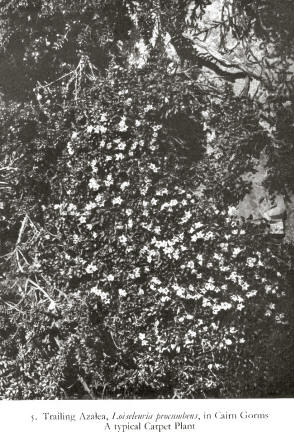 Trailing Azalea
(Loiseleuria procumbent) Trailing Azalea
(Loiseleuria procumbent)
This
beautiful alpine is widely distributed in the Highlands and one can be
sure of finding it on our highest mountains, wherever the slopes are dry.
I have walked through great beds of it on Ben Lomond in the south-west
Highlands, and have seen the side of Cairngorm pink with its multitude of
blooms. Wherever the slopes are covered in fine scree and are dry and
well drained, there one will find the Trailing Azalea.
It forms large colonies which carpet the mountain side
and, when in flower, gives quite a pink effect to the areas where it is
found. The tough woodsy branches of this plant are covered with small
leathery leaves, which are quite smooth on the upper surface, and are
interesting from the fact that their edges curl over. The stomata are
collected in lines between the midrib and the sides of the leaf. The
under side is coveted with short hairs which protect the stomata from
excessive transpiration, but to make quite sure that only necessary
transpiration takes place, the edges of the leaves curl over. This
curling of the leaf edges is common is the Heath Family to which our
present subject belongs.
At the termination of the branches one finds two or
three reddish-purple flowers in the axils of the leaves. They are small
and bell-shaped and contain five stamens. The ovary is situated at the
base of the corolla and the nectary is found at its base. The style is
longer than the stamens and hence the stigma protrudes beyond the
anthers. A butterfly arriving on a bloom must touch the stigma first and
will leave some pollen on it before being dusted by the anthers.
Cross-fertilization is thus ensured.
The Trailing Azalea is placed, by some botanist, in the
same genus as the Azaleas of the tropical and sub-tropical regions. thus
our small, lowly mountain flower can claim affinity with the gorgeous,
scented Azaleas which are such a spectacle in our greenhouses and
ornamental gardens.
THE CARPET WILLOWS
Everyone must be familiar with the Willows which are in
bloom at Eastertide in the Lowlands, although few people have taken the
trouble to notice how greatly they vary, and how many species, hybrids and
varieties we have in our lowland swamps, along the river-banks and in the
woods and copses. As we climb up from the Lowlands, we find that
tree-willows and the tall shrubby willows give place to small bush-like
shrubs. These become very dwarfed, until at last, when we reach the
highest plateaux and summits, they become typical carpet plants. They
belong to completely different species from the lowland and other mountain
species. They are the Reticulate Willow (Salix retculata) and the
Dwarf Willow (Salix herbacea).
To find them one must climb up to the high plateaux of
the Cairngorms, on the Ben Nevis massif and on the other high summits of
the Highlands, for these plants are very definitely alpine plants that
love the high, stony regions, where the lone eagle wheels and the wild
winds career eternally. Regions where many of us have passed some of our
happiest days, browned by the strong sun, lashed by rain and hail or
enveloped in white, cold mist as the clouds crept across the stony
wilderness like wraiths.
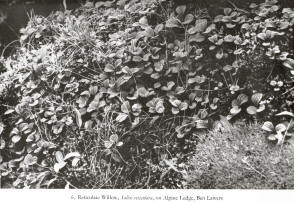 Reticulate Willow
(Salix
reticulata) Reticulate Willow
(Salix
reticulata)
This plant is a very typical carpet plant and often covers considerable
areas. Below ground is a large root system, while above ground branches
radiate in all directions, creeping closely to the surface of the soil.
These branches are covered by many large, elliptical leaves on long
pinkish stalks. The leaves themselves are dark green and highly polished
on the upper surface is coveted by a dense felt of bluish white cottony
hairs. The leaves are often rolled at the edges. This, with the cottony
felt, prevents undue transpiration. As this plant lives in dry, stony
places this is a very important consideration. When the leaves are young
and are more apt to be injured by cold, they are coveted on both sides
with thick hairs. As the leaf matures the hairs disappear from the upper
surface.
The flowers, of course, are different from those of the
other alpines we have studied. The male and female flowers are produced
on different plants and are wind pollinated, i.e the wind blows the pollen
from the male flowers on to the female flowers of another plant and thus
cross-pollination is procured.
The male flowers consist of dense catkins. The
individual flower consists of a single brown bract in the axil of which
arise two or more stamens. The catkin consists of a spike containing
dozens of these small bracts and their stamens.
The female flowers are in similar catkins but these, as
they contain no pollen, are not yellow. Each flower consists of a single
carpel in a brown bract and arranged in a spike.
After fertilization each female flower produces many
very small seeds, each seed having many short, silky hairs at its base.
When the seeds are ripe the wind detaches them and, supported by the
hairs, they may travel a considerable distance from the parent plant.
An interesting feature is that the catkins also contain
honey-glands and so they may also be pollinated by insects which visit
them for nectar.
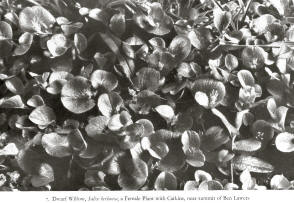 Dwarf Willow
(Salix herbacea) Dwarf Willow
(Salix herbacea)
This
little plant is often spoken of as the ‘smallest tree in the world’. Below
the ground there is a very extensive woody rootstock which may cover a
considerable area. It sends up short shoots covered with small leaves and
terminated by very small catkins, and forms a dense carpet.
The leaves are small, thin, very finely toothed at the
edges, without hairs and have a fine network of veins. The deep striking
roots reaching down to the deep regions where there is always moisture and
the small size of the leaves make the risk from drought very small, hence
the absence of hairs on the leaves.
The catkins are very short and contain very few
flowers. Parachute seeds are formed as in the case of the Reticulate
Willow.
Thus we see that even the great Salicaceae family has
managed to maintain a quite a vigorous, if dwarfed, existence in the
alpine regions.
Alpine Bearberry
(Arctostaphylos alpina)
This
is a plant of the plateaux and high mountain slopes of the north-west
Highlands. If the time be autumn, when the first powdery snows have
fallen and whitened the summits, we shall find that large areas of the
mountains sides are a blaze of red. These bright, flaming patches are
formed by the dying leaves of the Alpine Bearberry, which are shed each
year and beautify the mountain sides for a brief spell before their final
extinction.
If we dug up this plant, we should find that it
possessed a very large and complicated root system which pushed down into
the wetter and warmer layers beneath the surface. Above the ground we
should find that it possessed a strong, woody, main stem which was largely
buried in the stones and herbage and send out short creeping branches
densely covered in small, thin leaves which had a few small teeth around
the apex. Like the Trailing Azalea it is a carpet plant, but its branches
are more herbaceous than the woody stems of that plant.
The flowers are produced on short, drooping stalks,
which usually support from two to three, almost pure white flowers which
are ovoid in shape and crowned by the lobes of the united petals.
It is fertilized in the same manner of the
whortleberry and possesses similar horns to the anthers.
After flowering the corolla withers, whilst the ovary
swells and becomes fleshy to form a round, black, shining berry or drupe
which is eaten by such birds as the ptarmigan and grouse, which thus
distribute the seeds.
We have another bearberry in Scotland, but that is more
distinctly a plant of the dry moorland, under which heading it will be
described. |




