|
By James Macdonald, Special
Reporter for the Scotsman, Aberdeen.
[Premium—Thirty Sovereigns.]
General and Introductory.
The counties of Ross and Cromarty are so thoroughly dovetailed into each
other geographically, and so intimately connected politically, that they
are usually spoken of as one county, and in this treatise we propose to
abide as closely as practicable to this convenient rule. Together the two
form the third largest county in Scotland, and extend in one grand whole
from the German Ocean to the Atlantic; while separately both are cut up,
unconnected, and incomplete.
These combined counties are
bounded by the German Ocean on the east, by the Atlantic Ocean on the
west, by Sutherlandshire on the north and north-east, and on the south by
Inverness-shire. The island of Lewis, which stands away out about 30 miles
from the mainland, forming a huge natural breakwater to check the rolling
waves of the Atlantic, and a few smaller islands, also on the west coast,
belong to Ross-shire. The most northern point of the mainland, at the
mouth of the rivulet Fin (meaning boundary), is in north latitude 58° 7'
20"; the most southerly, near Loch Luing, in 57° 7' 40"; the most easterly
point, Tarbetness, lies in west longitude 3° 45'; and the most westerly,
in the north of Applecross Sound, in 5° 46. The greatest distance in a
straight line from north to south is close on 70 miles, and from east to
west about 67 miles. From north-east to south-west Ross-shire extends 84
miles. According to the census of 1871, the area of the two counties is
about 3151 square miles, or 2,016,375 imperial acres. Cromarty claims
19,247 acres, and Lewis 417,416.
In 1871 the population of
Ross-shire was 77,593, and the number of inhabited houses 15,028. In
Cromarty the population was 3362, and inhabited houses 685; together,
population 80,955, inhabited houses 15,713. The Parliamentary Return of
owners of lands and heritages in Scotland, drawn up in 1872-3, shows that
in Ross-shire there are 324 proprietors of lands of one acre and upwards
in extent, whose total acreage is 1,971,309, and total annual value
L.247,833, 17s.; and that there are 1719 owners of land of less than one
acre in extent, their total extent being 373 acres, and total annual
value, L.21,508, 3s. The total number of landowners is thus 2043; their
total acreage 1,971,682 acres, and their total annual value, L.269,342. In
Cromarty, according to the same authority, there are in all 231
landowners; 217 having each less than one acre. The total annual value of
the lands of these small owners amounts to L.1966, 7s. The 14 owners of
one acre and upwards hold among them 718,184 acres, the total annual value
of which is L.10,268, 1s. The Valuation Roll for 1876-77 shows that the
gross annual value of the county of Ross, exclusive of railways and royal
burghs, is L.252,908, 10s. 9d.; that the annual value of burghs is,
L.14,886, 0s. 6d. (Dingwall, L.6,922, 15s. 3d.; Tain, L.4744, 5s.; and
Fortrose, L.3219, 0s. 3d.); and that the annual value of railways is
L.21,268; grand total, L.289,060. 11s. 3d. The valuation of the county of
Cromarty, exclusive of the burgh, for the year ending 1876-77 is, L.9909,
12s. 6d.; burgh of Cromarty, about L.1900; total, L.11,809, 12s. 6d. The
valuation and area of Cromarty, quoted above, do not include the detached
portions of the county (about 20 in number), which are scattered
throughout Ross-shire. These portions are estimated to extend to about
182,000 acres, of which the Duchess of Sutherland owns 149,800 acres, and
for valuation and all practical purposes they are considered as part of
the county of Ross.
According to the Board of Trade Returns for the present year (1876), the
number of acres under all kinds of crops, bare fallow, and grass, was
124,826 acres; wheat, 6019; barley or bere, 10,461; oats, 29,509; rye,
1192; beans, 86; peas, 146; total, under cereals, 47,413. The acreage
under green crops was—turnips, 17,126; potatoes, 9256; mangold, carrots,
cabbage, &c, 63; tares, &c, 814; total, 27,259. Grasses under rotation
extend to 29,987, and permanent pasture (exclusive of heath and mountain
land, to 19,395; and bare fallow, or uncropped land, to 772 acres. Of the
1,891,549 acres in both counties, exclusive of the area under "all kinds
of crops,bare fallow, and grass," about 600,000 are under red deer, and
1,291549 under sheep, wood, or water, &c.
Ross-shire is divided into 32 parishes,
several of which are small, several very large. The two counties are
united into one sheriffdom, the sheriff principal having three
substitutes. One substitute sits at Dingwall and Fortrose, one at Tain,
and another at Stornoway, in Lewis. They are also politically united, and
the present representative is Mr Alexander Matheson of Ardross. For civil
purposes they are divided into five districts, viz., The Black Isle,
Easter Ross, Mid-Ross, Wester Ross, and Lewis. The burghs of Dingwall,
Tain, and Cromarty are joined with Dornoch, Wick, and Kirkwall in
Parliamentary representation, the present representative being Mr John
Pender. Fortrose is united with the Inverness District of Burghs, which
are represented by Mr Fraser Mackintosh.
There are four royal and parliamentary burghs
in the two counties—Dingwall, Tain, Cromarty, and Fortrose; two seaport
towns—Invergordon and Stornoway; and close on a score of villages, the
more important of which are Alness, Portmahomack, and Ullapool. Dingwall
is the county town. It was created a royal burgh by Alexander II. in 1227,
and has now a population of 2125. The beautifully wooded plain upon which
it stands was once a swampy marsh, but thorough drainage and spirited
agriculture has made it one of the most lovely valleys in the north of
Scotland. The burgh lies snugly among rich clumps of handsome trees at the
entrance of the Strathpeffer Valley, famous all over the kingdom, and even
beyond it, for the healing powers of its sulphurous springs. The scenery
around the "strath" is very fine, the air pure and dry, and for several
years past it has been one of the most fashionable summer resorts in
Scotland. The junction of the Highland and Dingwall and Skye Railway is at
Dingwall, and a short canal from the Cromarty Firth enables small vessels
to reach the town. The town mainly consists of one street, about a mile in
length, and while the majority of the houses are irregularly situated and
unpretentious in an architectural point of view, still there are a good
many very handsome residences, most of which have sprung up within the
past twenty-five or thirty years. Traces of what was once the principal
seat of the Earls of Ross are seen close by, while in the neighbourhood
there is a vitrified fort on a conical hill. The Caithness, Sutherland,
and Ross Rifle Militia have their head-quarters at Dingwall.
Next in importance comes Tain, situated on the
south shore of the Dornoch Firth, and containing a population of 2287. It
was created a royal burgh by Malcolm Canmore, and about the beginning of
the thirteenth century St Duthus, its patron saint, and Bishop of Ross,
constituted it the ecclesiastical capital of Ross-shire. The tower in the
Town House is very ancient, and the bell which hangs in the freestone
spire that surmounts it is about 200 years old. This interesting structure
is now encircled by a very handsome Town's House. On a beautiful level
between the town and the firth stand the remains of a very ancient chapel,
said to have been erected to the memory of St Duthus about the close of
the thirteenth century. It is recorded that in this chapel the wife and
daughter of Bruce took refuge, but the Earls of Ross are credited with
having "dragged them forth and given them up to the English." It is also
said that James V. made a barefoot pilgrimage to this ruin in 1527. Close
by the town's house are the well-preserved ruins of a collegiate church,
founded in 1471, and remarkable for its beautiful Gothic architecture. The
streets are very irregular, but still the town has a cleanly likeable
appearance. Cromarty
has a population of 2180. It is situated at the north-east corner of the
Black Isle, and has very pretty surroundings. Sir John Sinclair and other
sages predicted that Cromarty long ere now would have become one of the
principal centres of commerce in the north of Scotland, and though,
unfortunately, those good predictions have not been realised, Cromarty is
still a little burgh of considerable note. It is well known to have one
of the safest harbours in Europe. Two immense headlands, called the "Soutars,"
form natural breakwaters against the tide in the Moray Firth, and between
these headlands, which are distant from each other only about a mile, the
Cromarty Firth steals away round to the back of the Black Isle almost
unobservedly and quietly even during the roughest seas. Ships once into
this firth are safe from all seas, and often during a storm the firth is
crowded with vessels of various sizes. A fine quay was formed at Cromarty
in 1785. Cromarty is famous in another way. It was the birthplace of Hugh
Miller, and it may well be pardoned for the pride it feels in ranking this
eminent geologist as one of its illustrious sons. A monument to the memory
of Hugh Miller stands in the neighbourhood.
Fortrose is formed of two towns—Rosemarkie and
Chanonry— and has a population of 911. Rosemarkie was created a royal
burgh by Alexander II. A cathedral and bishop's palace once adorned
Fortrose, but Cromwell destroyed both, and sent the stones to Inverness to
be used in the construction of a fort there. Fortrose has still a very
fair trade, and in the sixteenth century it gets the credit of having been
the seat of arts, science, and divinity in the north of Scotland. The
beach here is sandy and very beautiful.
Invergordon is a thriving seaport town, with a
population of about 1157. It is situated on the north-west side of the
Cromarty Firth, and has long been the chief seaport for the eastern
districts of the county. Mr Macleod of Cadboll erected two wooden piers at
a cost of about L.5000. For many years Invergordon was the only town in
the county that could boast of a newspaper, the "Invergordon Times," but
about a year ago the "Ross-shire Journal" was started in Dingwall.
Stornoway, the only town in Lewis, has a
population of about 2498, and is of considerable importance in the
shipping trade. It has been immensely improved of late by Sir James
Matheson, Bart. of Lewis. A lighthouse stands at the harbour mouth.
Ross-shire embraces all the varieties of
Highland scenery; and more than that, it can boast of not a few of the
most charming characteristics of the finest agricultural districts both in
Scotland and England. In the Highlands, or western division of the county,
wood, water, heath, and mountains mingle together in perfect grandeur;
while in the eastern or lower lying districts, green fields, thriving
hedges, rich plantations, and handsome houses tint the landscape into
delightful harmony. The scenery in Easter Ross, and around Dingwall and
Strathpeffer, is really very fine. Almost all the arable land lies on the
east coast; and the main body of the county, lying to the west of the fine
agricultural border on the east, is extremely mountainous and wild. The
hills and mountains are chiefly in clumps or chains, and in in many cases
they reach to a great height. Ben Wyvis is probably the finest mountain in
the county, though other two or three exceed it in elevation. Ben Dearg,
Ben Alton, and Ben Sloich are each close on 4000 feet high, while Ben
Wyvis is only 3700. The west coast is exceedingly rugged and winding. In a
straight line the west coast of Ross-shire measures only about 70 miles;
while by following the indentations, the length extends to something like
400 miles. The number of lochs and small lakes in the two counties is
extraordinary. A large number are small, but still a few are of a
considerable size. Chief among these may be mentioned the beautiful Loch
Maree, which extends to some 18 miles in length, and which is surrounded
with as delightful mountain scenery as is to be met with anywhere in
Scotland. The mountains rise on both sides almost perpendicularly, and are
fringed at the base with rich plantations of larch and fir. The tops of
the mountains arc bare and water-worn; but "about half-way down [says a
recent writer], the combined beauty and sublimity of the scenery are such
as to strongly affect the dullest imagination; and when we come in sight
of the little island towards the lower end of the loch, the picture may be
said to be complete—a picture which, we venture to say, puts fairly into
the shade the much-vaunted beauties of the Trossachs and of Lochlomond."
The majority of these lochs are well stocked with fish of various kinds;
and on the whole, very few counties equal Ross-shire in the facilities it
affords the lovers of the "gentle art." The rivers are numerous, while the
small streamlets and mountain torrents can be counted in scores. The
principal rivers on the east coast are the Carron, the Conan, and the
Alness; the latter two drain a great portion of the southern division of
the county, and fall into the Cromarty Firth; while Carron drains a
considerable extent of the northern end, and empties itself into the
Dornoch Firth at Bonar Bridge. On the west coast the largest rivers are
the Ewe, another Carron, and the Broom. The river Ewe flows out of Loch
Maree, falls into the sea at Loch Ewe, and is considered one of the best
angling streams in Britain. Salmon and sea-trout are abundant; and it is
recorded that the former average about 16 pounds in weight. On the other
rivers generally the supply of salmon and trout is very good, and the
quality of the fish is excellent. The large majority of the lochs and
rivers are reserved by their owners, or let to angling tenants; but still
there is abundance of fishing at the command of the tourist.
Ross and Cromarty stand supreme with respect
to grouse-moors, and deer forests. The latter are numerous, and some of
them very large; the total breadth under deer, as already stated, being
about 600,000 acres. Several of these forests carry excellent covers of
deer, and afford grand sport to their owners or tenants. Complaints,
however, are occasionally heard that the animals are not coming up to the
former standard of weight, but are small in size, and always lean. An
authority on the subject says, "this might be cured by the infusion of
fresh blood, which is known to be the backbone of all good breeding." The
grouse moors are not only numerous, but also large, and very productive,
though, of course, the destructive disease which raged with such virulence
in 1874, thinned the stock of birds dreadfully.
A premium is presently offered by the Highland
and Agricultural Society for a report on the woods and forests in
Ross-shire, and therefore many notes on the subject here would be out of
place. It may be remarked, however, that the breadth under wood in the
county is very great, and that many thousands of acres have been added to
it during the past ten or twenty years. Wood seems to thrive exceedingly
well in the county, and is found to be a most remunerative speculation.
One instance of this may be given. A plantation on the estate of Tulloch
was recently disposed of, and the sum realised was equal to a rent of L.2
per acre for each of the forty years the wood occupied the ground. The
benefits conferred on a cold late district by plantations are well known
to be very considerable; and in these days of dear labour and high prices
for wood, the landed proprietors in some of the other counties in the
north of Scotland would do well, both to themselves and to the community
generally, were they to copy the good example shown in the way of planting
by the proprietors of Ross-shire. There is one little point, however, that
the proprietors of Ross-shire would do well to look at, in the interests
of their valuable plantations. That little lively creature, the squirrel,
is well known to be a destructive enemy to young trees. It gnaws away at
the "leaders;" and in this way a single squirrel has been known to kill
or greatly damage no fewer than a dozen young trees in one day. Several of
the young plantations of Ross-shire are swarming with these creatures; and
in their own interests we would advise the landed proprietors to combine
together and exterminate them. Singly, very little could be done, but were
the owners of all the plantations in the county to unite in their
destruction, their little foes would speedily disappear.
The island of Lewis has been aptly described
as an immense peat, with notches of the moss cut away here and there, to
afford a sure foundation for the inhabitants, and also produce food for
their bodily wants. It lies from 58° 11' to 58° 31' north latitude, and
from 6° 9' to 7° 8' west longitude. The Flannel Islands, belonging to
Lewis, lie in 7° 39' west longitude. The highest hill is 1850 feet above
sea-level; a few hill tops are nearly this height, and there are a few
more from 1000 to 1600 feet; but the largest extent of surface of the
island is under 600 feet. The arable land, and the best pasture round the
sea-shore, seldom rises beyond 200 feet above the sea. Lewis is divided
into four parishes—Stornoway, Barvas, Lochs, and Uig. Stornoway is the
smallest in extent, containing only 67,650 acres, but it is by far the
most important of the four, embracing, as it does, not far short of the
half of the whole population of the island, and standing equally near the
same position in respect of rental. Naturally, the land is divided into
three sections. At the north-eastern end there is a large extent of mostly
flat land (the highest hill here being 800 feet), with a considerable
depth of gravel under the moss and between it and the solid rock. This
section forms a triangle, the base of which is a line drawn from Bayhead,
Stornoway, across by the east end of the Barvas hills to the mouth of the
Arnal river on the west coast, the perpendicular being a line from Arnal
to the Butt of Lewes. The town of Stornoway stands on the south corner of
this triangle, and the Butt of Lewis on the north corner. Lewis Castle and
grounds, so greatly admired by all, stand just outside the base line where
it started at Bayhead. The finest grazing and arable laud in the island is
in this section; and more than half of the population live on it. The
middle section of the island runs from sea to sea, and lies between the
two parallel lines from Stornoway to Arnal on the one side, and from the
northern corner of Loch Erisort to the east corner of Loch Roag on the
other side. Much of this tract of land is also flat, but still it contains
a good deal of land with an undulating surface, and two ranges of low
hills, the highest peak of which is about 1000 feet. The rock comes very
close to the surface in some parts of this section; in others it is bare
altogether, while in the hollows it is covered with moss to a great depth.
On the south edge of this division stands the only inland crofter township
in the island; and along the north side there is a large population from
Callarnich to Arnal. The west and south-western portion is very rocky and
hilly; and here are the highest hills and wildest scenery in the Lewis.
There are also some large fresh water lochs, as well as the extensive
salt-water lochs of Roag, Erisort, Shell, and Seaforth. On the west side
of this section are a number of rocky islands, large portions of the
surface of which are covered with the richest, natural grasses. Cattle and
sheep thrive better on these islands in winter than on any other part of
the Lewis. Opposite this division, and between Lewis and Skye, are the
Shiant islands, on which are first-class natural grasses, which winter
several hundreds of Cheviot sheep as well as any of the runs in the lower
parts of the county. With the exception of these islands, and some other
pieces of good grass and mixed pasture, round low hills, knolls, and loch
sides, the greater part of this section is covered with black heath and
boggy pasture, and a good deal is simply bare rock. There is very little
land here on which the plough could work; but owing to the suitableness of
the sides of the sea lochs for the home of the fisherman-crofter, about
one-fourth of the crofters in the island live along the sea-shore on this
section. In a word, it may be said that the distinguishing features of
Lewis are its large extent of moss and moor, its immense number of lochs,
and the thousands of crofters that live on it.
While Ross and Cromarty rank very high among
other Scotch counties in regard to their sporting importance, they also
occupy a most creditable position in an agricultural point of view. The
county of Ross surpasses almost all other counties in Scotland in one
feature—it has within its bounds one of the best purely arable districts
in the kingdom, and also as large and as fine a purely pastoral range as
is to be found anywhere in the northern counties of Scotland. In the
eastern division "nature has done much to enrich the soil and adorn the
landscape;" and the long-sustained and united exertions of an intelligent,
enterprising, liberal class of landlords, and of a painstaking energetic
race of tenants, have made that part of the county a formidable rival to
the Lothians and to the plains of Morayshire. Easter Ross proper has long
been well known as a perfect garden of richness and fertility. The climate
is good, the soil excellent, and the prevailing system of farming of the
most advanced description. Away in the western districts again we find
purely pastoral farming flourishing at an equally prominent stage of
advancement. The range under sheep is immense, the pasture in many parts
very good, and the system of management pursued quite abreast with the
times—if not indeed in advance in some points. That the past quarter of a
century (the period over which this report extends) has contributed very
largely to the attainment of this prominent position these counties now7
occupy there can not be a doubt; and of this more anon.
Probably nothing has been more instrumental in
bringing the counties of Ross and Cromarty to what they now are, than the
improved means of conveyance both by sea and land. Without proper outlet
no county, however rich its natural resources, can do much in the way of
developing its industry, or at least could benefit to any great extent by
attempts at improvement; and like most of the other northern counties,
Ross and Cromarty were for a very long time greatly handicapped in this
respect. The districts immediately round Cromarty and Invergordon have for
many years been benefited by an outlet by sea, but the further inland
parts lay neglected for many years. Even to Inverness-shire, its nearest
neighbour, the county of Ross seems to have remained almost a stranger for
many hundreds of years. Little more than a century and a half ago the
magistrates of Inverness, anxious to know something of their hitherto
unknown neighbours at Dingwall, despatched a deputation of their number to
"explore the town interview the inhabitants, and report." In the course of
"a few days" the deputation returned with the news of their expedition;
and we believe their formal report is engrossed in the Council Records of
Inverness. Dingwall is now about an hour's ride from Inverness. Verily we
live in changed times!
Regular communication between Ross-shire and
the south by sea was established in 1839, when the steamship "Duke of
Sutherland " began to trade in the Moray Firth, sailing between Leith,
Inverness, and Invergordon, and calling at all the intermediate ports,
going and coming, which occupied about a week. Some time after that two
steamers began to sail from Invergordon once a week, but since the
extension of the Highland Railway into the county there has been scarcely
any regular communication by sea. A steamer sails from Leith to Cromarty,
Invergordon, and Inverness, through the Caledonian Canal to Liverpool once
a fortnight. In 1862 the Highland Railway was opened into Invergordon, and
two years later or thereby it was extended to Tain and Bonar Bridge; and
now it runs right through to Wick and Thurso, allowing the blood of
commerce to circulate freely from Land's End to John O'Groats. The
benefits conferred on the whole north by the efficient railway
communication it now enjoys have been almost incalculable.
Population, &c. The following table shows the
population at various periods since the beginning of the present century:—
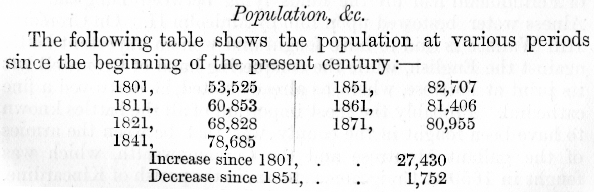
It will be seen from these figures that, while
the population has increased largely during the present century, the past
twenty-five years have diminished that increase very considerably. The
attractions for emigration, the extension of sheep-farming and deer
forests, the absorption of crofts by large farms, and the high rate of
wages in the southern counties of Scotland, have all been mentioned as
active agencies in bringing about this decrease; and doubtlessly they have
all had something to do in the matter. The number of inhabited houses in
1851 was 15,941 in 1861 15,728; and in 1871, 15,713—decrease, 228. The
parliamentary constituency in 1855-56 was 879, and in 1875-76, 1580. The
present population is equal to only about one person for every 25 acres;
and the average number of persons to each house is from 5 to 6. The most
ancient inhabitants of Ross-shire, as of Scotland generally, were known by
the name of Caledonians, but whether they were Celts of the Cymric (or
Kymric) or Erse branch is still an undecided fact. History tells us that
the Scots, that hardy race of Celts that peopled the "Emerald Isle," when
it was known, not as Ireland, but as Scotland, emigrated to this country,
and after the third century occupied the western coast of Scotland, from
the Firth of Clyde to the northern boundary line of Ross-shire. Like those
of almost every other county in Scotland, the early inhabitants of Ross
and Cromarty were frequently disturbed by ambitious and warlike invaders.
The Romans, in their wild depredations in Caledonia, seem to have stopped
short before reaching the northern straths of Ross-shire; for, with the
exception of the discovery in a mound near Tarbet-ness of a few Roman
coins, a rusty sword, and a few other articles of Roman fashion, no traces
have been found of their having been in the county at all. From the few
Scandinavian names that occur in Easter Ross, such as Tain and Dingwall,
it is evident that the Norsemen, who had taken possession of the county of
Caithness, had penetrated into Ross-shire and planted their abodes in the
richest parts of the county. The Danes also invaded the county, but
neither they nor the fierce men of the north were able to retain their
hold for any length of time. The natives rose in rebellion as one man and
drove the invaders from the county. For his heroism in these conflicts
Munro of Ferindonald had all the lands lying between Dingwall and Alness
water bestowed upon him by Malcolm II. On Cromarty Hill Wallace is said to
have fought and won an important battle against the English, while the
conquering hand of Cromwell left its print at Fortrose, where, as already
stated, he destroyed a fine cathedral. Probably the most important of all
the battles known to have been fought in the county was that between the
armies of the gallant Montrose and the Commonwealth, which was fought in
1650 at Craigcaomeadharn, in the parish of Kincardine. Here Montrose
sustained a dreadful defeat, and having been captured, he was conveyed to
Edinburgh and executed. Much as the county suffered from the battles which
were necessitated by the ambitious interference of foreigners, probably
quite as much bloodshed was caused, and as much damage done to property,
by unfortunate feuds which were every now and again breaking out among the
native rival clans. For several hundreds of years, however, the social
atmosphere of Ross-shire has been clear and tranquil; and since the
beginning of the sixteenth century the county has been gradually moving
onwards in the van of progress. Just about the time the Danes and Norsemen
were perpetrating their wild outrages against the untutored natives of the
East, a band of monks from Iona, and headed by St Malrube, with more
peaceful purpose landed on the west coast among the Applecross Hills; and
at Boat Cove, in that district, they founded a monastery, which, says a
recent writer, "shed the first genial rays of Christianity over the
heathenism of the West." The centre of the Christian colony then formed is
still distinguished by a stone cross; while it is said by some that the
remains of an old burying ground, which are seen in one of the small
islands of Loch Maree, mark the spot where the good St Malrube lived and
died. From this they argue that Loch Maree took its name from St Malrube.
It is more probable, however, that the name of this magnificent sheet of
water was derived from a St Maree, who came direct from Iona and took up
his residence in one of the small islets at the north end of the loch.
Since the advent of the present century the
social condition of the people throughout the counties generally has
improved very much indeed. The working class are better fed, better
housed, better educated, and better remunerated for their labour; and, on
the whole, it must be said that the working population of Ross and
Cromarty is in a very satisfactory and comfortable condition. The
educational machinery in several of the districts on the west coast and in
Lewis was for long very inferior and incomplete—a Gaelic teacher, with a
salary of L.15 or L.20 a year, being the only educational luminary some of
the parishes could boast of. The Education (Scotland) Act, however, has
supplied all these wants, and, with such liberal encouragement as is now
given by Parliament, education in the Highlands should soon reach a very
different degree of quality from that at which it has for so long-been
stationary. A large number of very fine new schools have been built
throughout the counties during the past two or three years, and a whole
host of highly certificated teachers have been introduced. The landlords
of Ross and Cromarty are thoroughly intelligent, liberal minded, practical
men, many of them enthusiastic agriculturists; while the farmers,
generally speaking, are shrewd, independent, industrious, and painstaking.
A good deal of southern blood has been infused into the eastern districts
during the past fifty or sixty years, by far the majority of the larger
arable farms in the counties, as well as a good many extensive sheep runs,
being held by gentlemen hailing from the south or southeastern counties of
Scotland. The natives are quiet, easy-going, kind-hearted, contented
people, of high moral character, and very fair intelligence. Gaelic, broad
Scotch, and the purest of English are all heard in curious confusion in
every district of the county. In Easter Ross the labouring classes only
speak Gaelic, but on the west coast the Celtic language still stands
supreme. Many hundreds of the natives in fact cannot speak a single word
of English, though the young people have for a few years been regarding it
as an essential branch of their education to become acquainted with the
English language. The Gaelic schools, of course, have been undermined by
the Education Act, but still, so fondly do some of the more clannish of
the inhabitants lean towards the language of their own early youth and of
their forefathers, that a good many of the old Gaelic teachers have been
reinstated in small temporary schools, old grain barns and the like.
Ross-shire has a large battalion of Rifle Volunteers, while Stornoway and
Cromarty have each an Artillery battery. The two counties also contribute
largely to the Caithness, Sutherland, and Ross Rifle Militia.
Climate.
When the high northern latitude is taken into
account, the climate of Ross and Cromarty must be regarded as most
wonderfully mild. It varies a good deal in the different districts, being
dry and mild on the east coast and very moist on the west. The mean annual
temperature over the whole of both counties which has been put down at
46°, varies very little, but the duration of summer heat on the east coast
is greater than on the west coast; where, on the other hand, the winters
are slightly warmer, but, in the northern parts at least, marked by
heavier falls of snow than on the east. The mean temperature in the Lewis
of the four months—November, December, January, and February—is about 39°,
and that of the other eight months about 49°. The rainfall in the west
usually ranges from 35 to 70 inches, in the Lewis from 30 to 50 inches;
and in the east from 20 to 30 inches. This remarkable difference in the
rainfall between the east and west coasts is easily accounted for. During
eight months of the whole year the winds blow from between the points
south-west and north-west, and consequently have to travel over the
Atlantic Ocean. In their course over such an immense tract of water they
become charged with moisture, which, on striking against the rugged hills
of the west, they discharge in the shape of rain. The higher floating
clouds that are carried on the westerly winds are attracted by Ben Wyvis
and the other more elevated summits in the county, and are led away along
the mountainous range into the wilds of Sutherland; and thus the moisture
that comes with the westerly winds is spent among the hills on the west
before reaching the lower levels of the east. Again, the winds that play
right into the east coast have only a limited stretch of water to pass
over, and thus they bring very little moisture with them. These easterly
winds, however, blow over the coldest regions of Europe, and though they
are much drier they are considerably colder than the westerly winds, which
are raised in temperature by their passage across the Atlantic. The
easterly winds are invariably bitterly cold, and when they prevail in
spring the young crops frequently sustain heavy damage by their blasting
influence. It is the proverbial mildness of these westerly winds that
accounts for the temperature on the west coast being higher during winter
than on the east. In the districts of Balmacarra, Strome Ferry, and other
parts on the south-western borders of the county, snow seldom if ever
falls, and when it does it never lies for any length of time. Here it
rains almost always, as may be seen from the fact that the rainfall at
Loch Alsh in 1875 reached the enormous depth of 6 feet 9 inches.
In Easter Ross the climate is probably as
favourable for agricultural purposes as in any of the more southern parts
of the kingdom. The exposure in the main is southern, the soil chiefly a
rich kindly loam with good subsoil, while its proximity to the genial
waters of the ocean renders the atmosphere around it humid, mild, and
equable. The climatic characteristics of Easter Ross and of the better
parts of Morayshire are very similar, and seed-time and harvest usually
begin and end about the same days in both districts. The soils, too, have
many similarities, though there is probably not so much stiff unmanageable
clay in Easter Ross as there is in the "Laich o' Moray." Harvest in Easter
Ross usually begins about the second or third week of August, though of
course exceptionally wet or dry seasons cause considerable variation in
the exact date of commencement. On some of the earlier farms it began in
1876 about the 17th or 18th of August, and was completed about the 16th of
September. Complaints were made towards the end of the eighteenth century
that the climate of Ross and Cromarty was gradually becoming worse. About
the advent of the present century it was argued that garden, fruit, and
grain crops were well-nigh a fortnight later of ripening than some twenty
or thirty years previous to that. In his admirable survey of the counties
drawn up in 1808, Sir George Mackenzie records a statement he had heard
that during the first half of the eighteenth century it was no uncommon
thing for new meal to be exposed for sale at Contin Fair, which was held
on the 1st of September, and adds— "If our corn looks ready for the sickle
then we reckon ourselves very fortunate." He also says that about 1796 he
had ripe peaches sent to his shooting quarters from the open wall in the
month of August; while he adds—"I have not had them well ripened since
till the middle of September, sometimes later, and often not at all."
Whatever may have been the cause of that decline, or what its duration, we
do not know; but there is not the least doubt that since the advent of the
present century the climate at least of the east coast has improved very
considerably. Originally the eastern districts of Ross and Cromarty were
intersected with numerous small lochs and swampy bogs, but since Sir
George Mackenzie wrote his survey almost all these have been drained and
brought under cultivation. The old land has also been drained over and
over again, and this, combined with extensive planting, has made the
climate of the east coast warmer, more equable, and drier than it had ever
been before. It would be no uncommon thing now to have new meal ready for
the market by the beginning of September, or even a little earlier than
that; while in a moderately warm year open-air peaches might be had for
the table about the end of August. Snow seldom lies to any great depth or
for any length of time on the east coast; and it is only on rare occasions
that the crops suffer any damage during the harvest operations. The whole
of the harvest work is often finished about the third week of September,
and thus a long, open autumn is available for the "ora" work of the farm.
Ploughing is often commenced about the middle of September, and before the
winter is fairly set in the whole of the stubble land, or at least the
greater part of it, is invariably in the black furrow. Winter is an easy
time with the Easter Ross farmers, and in an ordinary year there is less
stir and bustle in spring than in most of the other counties in the north
of Scotland. The land is usually in working order very early in spring,
and with such a long autumn and such an open winter it is only what might
be expected that the work of the farm is usually well advanced by the time
the snowy months have passed away. The greater proportion of the wheat
break is sown in autumn, and this of course also tends to lessen the work
in spring. On the Cromarty lands, in the Black Isle, in the Contin
district, and in Mid-Ross, which lie northwards, the climate is not quite
so warm as in Easter Ross proper, and harvest is usually from a week to
ten days later of being begun. The breadth of arable land on the west
coast is very small, but on what does exist the harvest is generally about
a fortnight later. The crops grow well in bulk, but the mean heat during
summer being less than on the east coast they do not flower so
satisfactorily as they do there, and are much slower in arriving at
maturity. The heavy rains of the west also interfere very much with the
drying of the grain after it has been reaped. The climate of the west
coast does not suit wheat or barley, and consequently little but oats are
grown in these parts, the earliest varieties of course being preferred.
The soil on some parts of the west coast is found to be admirably adapted
for barley, but the amount of sunshine usually enjoyed in these parts is
much too little for this variety of grain. Snow falls heavily among the
higher hills on the west coast, and when the wind happens to be high
during a fall of snow the drifting is indeed terrific. Immense wreaths
collect in the sheltered places, and occasionally considerable loss is
sustained by flock owners by numbers of their sheep being smothered in
these snowy accumulations.
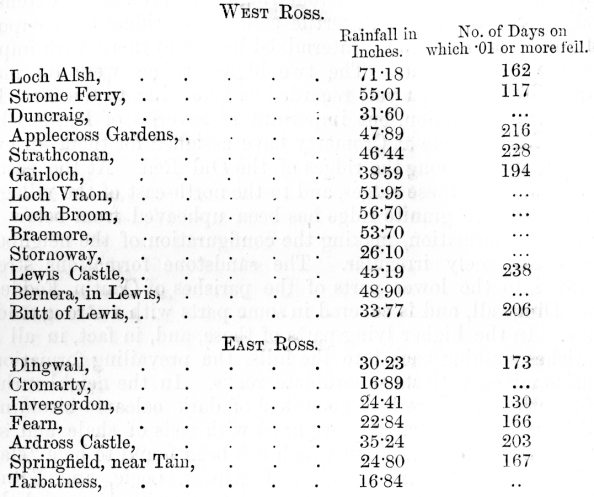
The following table shows the rainfall at
various points throughout the two counties in 1875:—
Geology—Soil.
A complete technical account of the geology of
a county is not absolutely necessary in connection with a survey of its
agriculture. So largely, however, is soil influenced and regulated by the
rocks which underlie it that we shall offer a few sentences regarding
these, avoiding technicalities as much as possible. Speaking generally, it
may be said that all over the east coast, including the Black Isle, Mid
Ross, and Easter Ross proper, the prevailing formation is what we may call
Hugh Miller's Old Red Sandstone. That illustrious geologist was not only
born amidst the Old Red in its most perfect form, but also learned in
after years to make practical use of its blocks. It was around the little
northern burgh which gave him birth that he made his first geological
observations; and in the racy, fascinating sketches which he has given to
the world of his painstaking researches, he has provided an account of the
geology of the northern counties generally, and of Ross and Cromarty in
particular, that will suffice for all time coming. While the Old Red is
undoubtedly the prevailing formation on the east coast, it is greatly
broken up and intersected in several districts by irregular blocks of
granite-gneiss, quartz, hornblende, and other rocks of the primitive
layers. Large unshapely masses of conglomerate occur here and there all
over the east, diversifying the soil and lending an irregular rugged
appearance to the surface. The Old Red is probably found in the most
perfect form in the Black Isle, which in fact consists mainly of a series
of sandstone ridges intervened by extensive valleys covered with rich
fertile soil. The ridges are composed of hard red sandstone, intermixed
here and there with impure granite conglomerate. The two higher ridges
were for many years (by some even yet) regarded as belonging to the New
Bed Sandstone formation, but important discoveries of fossils which Hugh
Miller made at Cromarty have assigned for them an everlasting place among
the ridges of the Old Red. At the eastern termination of these ridges, and
to the north-east of the village of Avoch, a large granite ridge has been
upheaved from below the sandstone formation, making the configuration of
the neighbourhood extremely irregular. The sandstone formations stretch
away into the lower parts of the parishes of Contin, Fodderty, and
Dingwall, and is covered in some parts with a strong reddish clay. In the
higher lying parts of these, and, in fact, in all the parishes running
back into the hills, the prevailing formation is gneiss mixed with its
subordinate rocks. In the neighbourhood of Strathpeffer there is a good
deal of dark calcareo-bituminous schist, soft and foliated, and mixed with
beds of shale and substance resembling coal, but which has been found to
be a "slaggy mineral pitch." The parishes of Alness, Logie, and Kilmuir
Easter rest almost entirely on sandstone, with here and there unshapely
heights of granite conglomerate, gneiss, and coarse quartz rock. Ironstone
also exists in considerable quantities among the gneiss rocks, and a
sample dug from the Alness district was analysed and found to contain 75
per cent. of iron. In Urquhart and Logie Wester the Old Red abounds very
largely; and here, as in several other parts of the counties, freestone is
quarried extensively for building purposes, both at home and in
neighbouring counties. On the higher lands of Nigg a good deal of granite,
gneiss, and schistose limestone is mixed with the sandstone; and to
Rosskeen, Tain, and Edderton similar remarks may be applied. In Fearn and
Tarbat the sandstone strata are more complete, and the surface and soil
more uniform than in most of the other parishes. Unfortunately very little
limestone is found to exist among the rocks on the east coast, though it
is very abundant on the west. One small vein only has been found. Starting
at the Soutars of Cromarty, it runs through the district in the direction
of Tarbat Point, and is visible among the precipitous sandstone rocks
which bind in the Moray Firth at Geanies. This vein is very small, in some
places not more than 10 or 12 inches thick, but, nevertheless (to
appropriate a remark of the late lamented Mr Kenneth Murray of Geanies),
it may be regarded as "the mother of the beautiful white clover that grows
so richly in Easter Ross."
In Kincardine granite and whinstone abound,
while with few exceptions the formation among the hills on the west is
gneiss, mixed or alternating with mica schist, quartz rock, ironstone, and
mountain limestone; the latter exists in great abundance, and is
extensively used for agricultural purposes. The Old Red, however, is not
altogether wanting even on the west, for at Apple-cross, Lochcarron,
Gairloch, and Lochbroom considerable quantities of it are seen. Iron was
at one time quarried in the Gairloch district; but the only fuel at hand
was the natural wood, and when it became exhausted the work was abandoned.
True to the general characteristics of Old Red
Sandstone districts, the surface of Ross and Cromarty is diversified and
irregular. Around Tarbatness, for instance, where the strata are pretty
complete and unbroken by trap upheavals, the surface is flat and bare, and
the soil light and fertile; while in the Black Isle, in the parish of Nigg,
and in other parts where there are marks of trap eruptions and heights of
hard conglomerate, the surface is very irregular and uneven—in the words
of Dr Page, "here rising in rounded heights, there sinking in easy
undulations; now swelling in sunny slopes, and anon retiring in winding
glens or rounded valley-basins of great beauty and fertility." The soil
which usually overlies the Old Red Sandstone is light loam, almost
approaching clay, and invariably the subsoil is composed of sand, gravel,
and friable clay, these in fact being the debris of the formation.
Speaking generally, the soil of Ross and Cromarty corresponds closely to
what might be looked for above their geological formation; but as it is
not the underlying formation alone that regulates the soil, it is only
natural to expect several deviations from the general rule. On the Black
Isle the soil varies a good deal. On the centre ridge, on what was once
Mulbine Common, the soil is very light and gravelly, and on many parts the
underlying rocks come very close to the surface. Dry seasons do much
damage here; in fact, in a very dry year, such as 1868, almost every well
along the top of the isle becomes dry. In the basins between the ridges,
and along the coast the whole way round, the prevailing soil is rich black
loam and fine clay, lying on sand or gravel on the lower flats, and on
firm clay on the slopes. A hard irony pan divides the soil from the
subsoil in some parts, but where it could possibly be done this has been
cured by substantial trench ploughing. A good deal of the land facing the
Cromarty Firth lies on a bed of stiff reddish clay, reaching in some
places as much as 100 feet in depth. On the land sloping south-west
towards Dingwall and Conan, the soil is principally a light sandy loam on
an open bottom, very fertile and easily cultivated. On the land around
Dingwall, and between the town and Conan, there is a deep deposit of loam
with a large admixture of clay, very suitable for the growth of wheat, but
demanding great care in the cultivation. If well manured, timely
cultivated, and well seeded, it seldom fails to yield a good crop. The
soil on the lower parts of the rising land in this district is clayey
also, but the admixture of it being smaller, the land is more easily
cultivated than on the level below, and is suitable for the growth of all
kinds of crops. The higher cultivated land is mountain clay or moorish
soil. The former becomes good soil with long continued good treatment, but
the latter is very difficult to improve. In the Contin district the soil
varies from strong clayed loam to light friable mould. In the valley of
Strathpeffer, also, the soil varies a good deal. On the higher land on the
north side of the valley the soil is excellent reddish loam, with a very
little clay amongst it. On the low land on the same side the soil is mossy
mould on a blue clay subsoil. On the high land on the south side the soil
is a soft fibrous red clay, while on the low land on the same side the
soil is composed chiefly of moss and gravel. The land on the farm of
Fodderty in this valley affords a very striking illustration of what we
hold to be a curious fact, viz., that, speaking generally for the northern
counties of Scotland, the soil as a rule is heavier and richer on land
with a northern and north-eastern exposure than on land lying to the south
or south-west. Mr Arras, the enterprising tenant of Fodderty, finds that
while turnips grow a much heavier crop on the north side than on the
south, grain varies still more. On the north side barley yields 5½
quarters per acre, and weighs about 56 lbs. per bushel; while on the south
side the yield is seldom much over 4 quarters, and the weight usually
about 54 lbs. Wheat and oats show almost a like difference, oats even a
little more in weight. Between Dingwall and Alness the soil varies a good
deal. Close to the Firth some of it is very rich loam, while on the
heights a short distance inland light shingly loam prevails. On the
Ardross property around Alness, the soil varies from light black loam to
heavy brown loam nearly 2 feet deep, lying on arenaceous clay. Between
Alness and Invergordon, and throughout the parishes of Kilmuir, Easter and
Logie Easter, the soil is mainly light, sharp loam, lying on clay or
gravel, and here and there very close on the sandstone rock. While some
patches are very light and shingly, on the other there are a good many
fields of heavy rich black loam. The west end of the parish of Nigg is
covered to the depth of nearly 2 feet with light drifting sand, which on
being removed, is found to overlie a deposit of the very richest of black
loam. Tradition tells us that previous to the 17th century, the west end
of Nigg was one of the most fertile and best cultivated parts of
Ross-shire, and that like Culbin, near Forres, and Morichmore, near Tain,
the whole was buried by drifting sand in one single night. Loam
predominates through the remainder of the parish, but here and there
strong clay takes its place. The soil on the bank land in some parts
varies from 3 to 4 feet of the finest of alluvial loam lying on the red
sandstone, and unless in exceptionally bad years, it never fails to yield
excellent crops. The soil in the adjoining parish of Fearn is also of very
fine quality and much of the same texture as in the better parts of Nigg.
On the estate of Allan, and about the farm of Cullis, the soil is mainly
strong adhesive clay, with a slight admixture on the rising parts of
vegetable loam. In the parish of Tarbat the prevailing soil is light
fertile loam, lying chiefly on the Old Bed Sandstone, but some of it also
on gravel and boulder clay. A good deal of inferior land lies in the
parish of Tain, the soil being light and scarce, and resting on a firm
impenetrable irony pan. What of the soil is good consists chiefly of mixed
loam lying on clay. Throughout this parish, and in fact here and there
over the whole of the arable land in both counties, numerous large
water-worn granitic boulders are found embedded in the soil. These
boulders belong to the primitive formations, and, like the many huge
pieces of granite of similar shape that are occasionally found in the
Lothians of Scotland, must have been carried thither from the hills by
icebergs during the glacial period. Along the coast from Tain to Edderton
the soil is very light, and lies mostly on a sandy bottom. About
Invercarron and Bonar Bridge there are a few fields of very fine alluvial
land, yielding rich returns of all kinds of crops. On the small pieces of
arable land that do exist on the west coast, the soil is not heavy but
wonderfully fertile. As already stated, the whole of the island of Lewis
was originally covered with moss, and the greater portion of the flatter
parts is still in the same condition, except on the sea coast and borders
of sea lochs, where the crofts and farms are situated. In the course of
centuries the moss close to the inhabited parts of Lewis has been cut away
for fuel, and now there are considerable tracts on both sides of the
island cleared of it. It is on the gravelly, strong subsoil thus laid bare
that agriculture is chiefly carried on, the exceptions being where pieces
of moss or sand near the seashore are wrought for crops.
The Farming and Social Customs of Olden Times.
All things are judged by comparison, and
therefore before proceeding to detail the farming of Ross and Cromarty, as
now carried on, it might not be out of place to devote a few pages to the
systems of agriculture that prevailed from fifty to a hundred years ago.
The ancient agriculture of Ross and Cromarty is fully described in Sir
John Sinclair's "Statistical Account of Scotland," and in "A Survey of
Ross-shire," drawn up for the Board of Agriculture by Sir George Stewart
Mackenzie, Bart., about the year 1808, and published in 1810. Much,
however, as is given in these admirable volumes, we are able to supplement
them with a few original notes on the "golden past." We have been favoured
with an old interesting manuscript, written at various times during his
life, by the late Mr John Wallace, who died two years ago at the advanced
age of ninety-three years, and who was for a very long time an extensive
farmer in the parish of Rosskeen. We subjoin the following extracts from
this manuscript:—
Farming Customs.
"My father, John Wallace, had the farms of
Culrane and Gushack for thirteen years, from 1779 to 1792, at a rent of
140 bolls, part barley and part meal; and duties of money, peats, and
hens. At that time he had no 'coup' (box) carts, and neither mattock nor
spade. For driving the manure to the land he had a kind of cart and a
basket of wicker-work. The wheels of the cart were constructed of three
sticks, six inches in diameter, which were crossed and fixed in the centre
by an axle that turned with the wheels on 'tum'lers,' as they were called.
Stones as well as manure were conveyed in these carts, and they would
carry a heavy load. The wicker-basket cost one shilling, and would last
for two years. For carrying home peats, and leading corn, he made a very
simple cart of two long shafts, with cross sticks in the bottom, and
standing rungs with top rails. As soon as the crop was put in, these carts
were taken off the 'tum'lers' and put into some shed until the peats
should be ready for carrying home, when they were used again. All the
carriage of corn, meal, and potatoes was done in bags on horseback. Going
to the mill, seven or eight horse would be tied in a row, the one to the
other's tail, with halters made of horse-hair. A boy led the first horse,
while two men were employed in keeping the bags from falling. My father
had three ploughs, and six oxen to each plough. The ploughs were made by
himself almost entirely of wood, all the iron used being a strong culter,
a sock, and a large hook fixed at the point of the beam, with a 'stepple'
and a few-nails, which were required to fix the clading (or mould-board)
of deals. When the oxen were strong, the ploughs would work as well as any
made for many years after, and would turn over a deeper furrow. The
harrows were made of birch, with five rungs across through the ' bills.'
He had no grapes, only two large forks; and in place of a mattock, he had
a croman or half-mattock, like a pluck for turnips, but much larger. For a
spade, he had a large wooden shovel, mounted with iron at the point and up
both sides. The dung was allowed to lie in the byres for a week, and then
it was carried to the ' midden' on a wheelbarrow, or sometimes on a
two-handed barrow, such as used by masons. Women took part in all the farm
work, except ploughing, thrashing, and carrying bags. Neither clover nor
turnips were grown, but there would be about sixteen bolls of potatoes.
The work in summer, after sowing the barley, about the 20th of May, was
first to cut peats, and then to make ' middens' for next year's barley.
These 'middens' were made of soil cut from the outlying land, mixed with
the manure of horses and cattle. Horses or cattle got very little corn;
but when any of the cattle were weak about end of spring or beginning of
summer, they got sheaves of oats in the morning. At that time there were
very few large farms. On the farm of Millcraig [Mr Wallace himself
occupied Millcraig and Nonekiln for many years up till 1851] about 1760
there were eight tenants and ten ploughs, with sixty animals; now three
ploughs are sufficient. On the farm of Nonekiln I saw seven tenants and
nine ploughs; three ploughs are now sufficient. On Rosebank I saw three
tenants and four ploughs; two ploughs are now sufficient. In my young days
the large farm of Newmore was occupied by Mr Alexander Ross or M'Findlay
and his two sons, the rent being X.80 and 80 bolls of grain. He and his
sons were altogether of the old school. He had eight horses carrying home
his peats, the carts used being the 'rung carts' with the ' tum'lers.'
There was not so much as a pin of iron about the harness of the eight
horses. For shoulder-chains and 'hems,' birch wands were used instead of
iron. I remember well to have seen a pair of horses passing Nonekiln with
furniture from Strathcarron to Inverness, and to have observed that there
was not a single link or pin of iron about the horses or the cart. The
traces (the draught chains) -were made of deerskin, and were very tough
and strong. The collars used on horses at that time were made of ropes of
straw twined threefold. These would last about a year; but when made of
loch rushes, four feet in length, they would last two years. The farmers
made the harness themselves. In short, they made everything. There was no
need for saddlers, but weavers were numerous, and they got plenty of work
to do. There was only one merchant in the parish of Rosskeen, and it was
from him my father bought his first spade. I wondered much at it, as it
was the first spade I had ever seen."
Servants' Wages.
"Married men for the twelve months got L.4,
six bolls of meal, two days to cut peats, straw for a stirk, land for
potatoes for their own manure, land for sowing two pints of linseed, and a
small garden. Women in the half-year got ten shillings, a pair of shoes,
and land for linseed. Shearers got eighteen pecks of oatmeal by measure."
Diets of Servants.
"At breakfast, 'brochan' and peasemeal bread;
at dinner in summer, whey and bread; and in winter, potatoes and bread; at
supper, sowens or 'brochan.' There was cabbage for dinner once a-week; and
next day porridge, made of what remained of the cabbage, was taken with
butter at breakfast. My father always fed a cow, to be killed in winter;
and as long as it lasted, the servants got broth, and sometimes beef.
During winter and spring there was always plenty of home-made ale; and the
servants occasionally got ale, butter, and curds; but porridge was seldom
seen. The servants got three feasts in the year, the one on Old New
Year's-day, another when the barley was sown, and another when the
shearing was finished."
Clothing and Social Customs.
"The clothing was very simple and plain. The
men wore black knee-breeehes and bright blue coats, made by their wives.
The young men generally wore similar attire, but some had kilts. Even the
larger farmers wore broad blue bonnets, and no hats were to be seen. About
1792 some favourite sons began to get trousers, and by 1850 breeches had
almost disappeared. In my father's time no farmers' wives had prints or
cotton gowns Their gowns were of their own making, chiefly wincey. The
wives wore a small tartan shoulder-plaid, and it was considered to be
decent and matron-like for a farmer's wife to have a clean white towel
tied on her head above the 'mutch' or cap. No young ladies covered their
head until married. Their hair was their pride. It was all combed down
their shoulders, and when at work was tied at their back with tape. At the
marriage ceremony the bride was always covered with a scarlet plaid; and
if she had not one of her own, she got the loan of one. The gatherings at
marriages were usually very large, and there was music and dancing on four
nights; on Thursday night, at the feet washing; on Friday night, after the
marriage; on Saturday evening and part of the day; and again on Tuesday,
at what was called the 'home wedding.' "
Memorable Years.
Under this heading Mr Wallace has a number of
very interesting notes on great events of national as well as local
importance. Referring to the remarkably wet year of 1782, which was called
the "Black Year," he says, "there was scarcely a dry day during the whole
spring, while summer and autumn were also very wet. The crop was late and
miserably poor, in fact the greater portion of it never ripened at all. Mr
Calder, the minister of Rosskeen, was paid in grain, and all he got that
year was 16 bolls of barley from my father, and those 16 bolls scarcely
made 8 bolls of meal. Many cattle died in the spring, but none of the
inhabitants succumbed to the hardships of the famine. I was told, however,
that many deaths would have occurred had it not been that cargoes of white
pease (which had been intended for the troops engaged in the American war,
but which on the announcement of peace were sent northwards) came to
Ross-shire, and the pease distributed among the more needful. My father
was present at the distribution. The following year was as singularly dry
as 1782 was exceptionally wet. The crop was very early, some of it having
been stored by the end of August; but, owing to the inferior quality of
much of the seed of the crop of 1782, the general yield was very poor.
Many farmers fell in arrears, and some of them never got over it." The
year 1792 was quite as remarkable in Ross-shire, though from a different
cause. A few years before this sheep-farming was begun in the county of
Ross, and the natives believing that this innovation would compromise
their comforts and privileges, began about this year to display formidable
opposition to the movement. Mr Wallace says:—"The native farmers,
tradesmen, and labourers, resolved to gather the whole stock of sheep in
Sutherland and Ross and drive them over the southern borders into
Inverness-shire. Accordingly, the arrangements for the outrage against
sheep farmers were made known by proclamation at the church doors. A mob
of people met, and having collected above 10,000 sheep, they were
proceeding with their flock along the heights of the parish of Alness,
when they learned that Colonel Sir Hector Munro of Novar was on his way
from Fort George with a company of the 42d Highlanders to suppress their
depredations. The sheep gatherers dispersed immediately, but a good many
were apprehended and tried in the Circuit Court at Inverness. Two were
transported, but the others got off with imprisonment. The commencement of
this affair was as follows:— Captain Allan Cameron and his brother
Alexander Cameron took the farms of Tyrish and Culcraigie, along with the
extensive grazing of Gildermorry on the heights of Alness. The cattle of
the Ardross tenants had previously been grazed all summer on Gildermorry,
and having wandered back to their old pastures, the Camerons poinded them,
and enclosed them in a large fank which they had built for the purpose.
That day the Ardross tenants were hearty at a wedding at Strathriesdale,
but on hearing what had happened to their cattle they proceeded in a body
to Gildermorry, where an ugly fight took place between them and the
Camerons. And thus the feeling against the introduction of sheep-farming
waxed into wrath and displayed itself as already noticed." The year 1800
seems to have been a very dry year, scarcely a single drop of rain having
fallen during the whole summer. Mr Wallace says:—"The crop was not half an
average one in bulk, but so far as it went it was good. Barley brought
50s., oatmeal 48s., and potatoes 40s. per boll." The year 1811 was very
wet, and the greater portion of the crop dreadfully damaged. Mr Wallace
got 54s. per boll for his barley that year. The crops of 1816 and 1817
were also bad, oatmeal being about 40s. per boll, while in 1836 Mr
Wallace's whole crop would scarcely pay his rent.
Mr Wallace's notes give a pretty good idea of
how farming was carried on, and how people lived throughout the counties
generally, about a hundred years ago, and now we shall add a few sentences
regarding the state of matters during the first fifty-years of the present
century. Previous to the advent of the present century no regular system
of rotation seems to have been observed, while not a single turnip, and
only a very little wheat, were grown. Barley, oats, and potatoes were
almost the only crops cultivated. The acreage under grain was small, and
even on the larger farms there were only three stacks,—one for the laird,
one for seed and sale, and one for family use; the barn being filled first
of all. In these days there were no direct roads through the counties, and
no convenient means of getting grain or anything else exported to distant
markets. The implements in common use on the farms and crofts were very
little, if any, improved till well into the present century, while the
ancient and unprofitable system of over-stocking farms with cattle and
horses was totally abolished only some forty or fifty years ago. Sir
George S. Mackenzie states that he has frequently seen on a Highland farm
two working animals for each acre, and gives the following interesting
particulars regarding one notable case:— "Thirty acres were occupied by
two men, who had large families. They possessed the land not in run-rig,
but in common. Both exerted themselves in cultivating the fields, and they
agreed respecting a particular but very irregular rotation of crops, and
divided the produce equally between them. They paid about fifteen
shillings per acre. On this farm were kept ten horses and six head of
cattle, besides young beasts. The land was remarkably full of weeds of all
sorts. After the cattle had done ploughing they were turned upon the field
on which they had been working, in order that they might feed upon the
weeds which had been turned up. I never observed that they got any sort of
food during the day, except a small quantity of oats just before they went
to work. At night the horses and cattle were turned to some patches of
waste ground to pick up a miserable pittance of grass. During the summer
months the animals were sent to graze on some bare hills; the horses being
brought down when the peats were ready for storing, and sent back as soon
as the fuel was got home. When the corn was ready to be taken from the
fields the whole stock was brought home and allowed to range on the
stubbles. No grass seeds were ever sown; the whole farm was under wretched
crops of oats and barley. Three or four, and not unfrequently five crops
of oats followed each other in succession; and when barley was sown with
manure three or four crops of oats followed. No greater quantity of
potatoes was planted but what was barely sufficient to answer the home
demand. During the winter the horses and cattle were fed on straw, but
sparingly. The straw was always very short, and from the system of
management just described it will readily be believed that the quantity
was not very great, and hardly enough to keep six black cattle and ten
horses alive during seven months of the year." The cattle reared in those
days were West Highlanders of an inferior class, and the niggardly way in
which (over the whole north) they were usually fed during winter was
simply shameful. About a hundred years ago, in fact, the provender
available for cattle during winter was so very limited in quantity and
inferior in quality that it was regarded as no mean achievement for
farmers to be able to feed their cattle during the snowy months, so that
when spring came they might have sufficient physical firmness left to
enable them to walk to the hill grazings without first undergoing special
treatment for the journey! As mentioned by Mr Wallace, those animals that
were so weak as to be unable to walk to the hills were fed for a week or
two on sheaves of oats. Feeding, as the term is now understood, was
unknown then. We were told an anecdote the other day of an English lady
having come to take up her residence in Easter Ross about the beginning of
the present century, and having got so awfully horrified at discovering
that the only kind of beef to be had in the county was that of old cows,
that she immediately repacked her "goods and chattels," and betook herself
to the more genial south, where she might feast on the "roast beef of Old
England."
The ancient farm horses of Ross and Cromarty
were the broad low-set "garrons," while the native sheep was of the Kerry
breed, little, and very slow in growth. About the year 1764, Sir John
Lockhart Ross of Balnagown began to turn his attention to sheep-farming,
took one of his sheep-farms on his estate into his own hands and stocked
it with Blackfaced sheep, which he purchased at Linton market. Strong
opposition was shown to Sir John in this scheme, but though he suffered
heavy losses at the outset he persevered, and by the lessons he taught and
the encouragement he held out to others, that extensive system of sheep
farming which has made Ross-shire so famous was fairly inaugurated. The
rise and progress of the movement deserves more than a mere passing
notice, but that had better be done while treating of sheep-farming as a
special subject.
During the first fifty years of the present
century it is not too much to say that the agricultural and social customs
of Ross and Cromarty were completely revolutionised. Large tracts of land
were reclaimed, draining and fencing were executed extensively, new
dwelling-houses and farm-steadings were built, roads were made, improved
farm implements were introduced, threshing-mills brought into the country,
a regular and systematic course of cropping was adopted, artificial
manures introduced; the barley, oats, and potatoes of the olden times
supplemented by wheat, turnips, and clover; better horses, better cattle,
and better sheep were bred; and, in short, almost every trace of the
primitive simplicity and rude barbarities of the feudalistic times were
abolished for ever.. We cannot, of course, go into detail on these
gigantic changes, but we may transcribe from the report on the parish of
Tarbat in Sir John Sinclair's "Statistical Account of Scotland" the
following remarks regarding the introduction of modern husbandry into
Ross-shire:—"In the year 1798 the farm of Meikle Tarrel in the parish was
taken on a nineteen years' lease by a farmer [Mr George Mackenzie] who had
studied the most approved mode of agriculture in East Lothian. The farm,
which then consisted of about 250 acres of arable land, was occupied by
several small tenants, whose lands were in a state of wretchedness, and
their house afforded accommodation for neither man nor beast. This farmer
brought with him horses and implements of husbandry of the very best
description from the south, as also farm servants of his own training.
This was the first introduction of modern husbandry into this part of the
country, from which the introducer obtained the name of Farmer George. In
bringing his system into practice he had at first to contend with many
deep-rooted prejudices. Even the proprietor could not then understand how
his interests were to be forwarded by encouraging his tenants. In the
first place, a dwelling-house was to be built, as also a set of suitable
offices, houses, and a thrashing-mill and garden, &c, enclosed. All this
was done at the farmer's own expense, without any assistance from the
proprietor, and at an outlay of L.1500. The soil being good, and the new
system bringing it into favourable operation, the farmer soon began to
reap the reward of his expense and labours, and in the seventh year after
his entry he had the satisfaction of obtaining for his wheat and oats the
highest price in Mark Lane—circumstances which dissipated the opposition
of prejudice, and raised up a spirit of imitation." Almost simultaneously
with Mr Mackenzie, Mr George Middleton came north from England, and began
farming in the parish of Cromarty. Mr Middleton, whose grandsons now farm
so extensively in Ross-shire, erected the first thrashing-mill used in
this part of the country, and exported the first wheat. Among the others
who took part in the early improvement of the agriculture of Ross and
Cromarty may be mentioned Mr Mackenzie of Allan Grange, Captain Munro of
Teanich, Mr Rose of Glastulich, Mr Cockburn Ross of Shand-wick, Mr
Mackenzie of Hilton, Sir Hector Munro of Novar, Mr Macleod of Geanies,
Lord Seaforth, Major F. Mackenzie of Fod-derty, Mr Mackay of Rockfield, Mr
Reid of Kinnairdy, the Rev. Mr Mackenzie of Fodderty, Mr Archibald Dudgeon
(a native of East Lothian), and Captain Rose of Bindhill.
Progress of the Past Twenty-five Tears.
Probably the second twenty-five years of the
present century saw quite as much improvement effected in the counties of
Ross and Cromarty as the past twenty years have seen—much, indeed, as that
has been. As already hinted, the spirit of improvement began to dawn about
the advent of the nineteenth century, and by the end of the first quarter
a wonderful amount had been accomplished; in fact, by 1825, the better
favoured parts of the counties could boast of agriculture of the highest
description. A faint idea will be had of what condition some of the better
farms were in about that time, when it is mentioned that at a sale which
the late Mr Dudgeon had at his farm of Arboll in 1824, he obtained L.84
for an entire horse, L.52, 10s. for a son of that horse, L.52, 10s. for a
saddle mare, L.25 for a Highland fat cow, L.50 for one Highland bull, and
L.40 for another; while be refused L.100 for a riding pony, and L.75 for a
six-year-old ox that had been feeding for three years. Wheat was unknown
at the beginning of the century, and by 1825, or thereby, it had become
the staple product of several districts. Advanced, however, as the
agriculture was in these times on a few of the finer farms, there was
still much room for improvement throughout the counties generally, and it
was during the next twenty-five or thirty years that the rougher and
probably the larger part of that much-needed improvement was effected.
While in its virgin state the land, or at least the main portion of it,
was wet and swampy, and before it could be cultivated with profit it had
to be thoroughly drained, and many hundreds of acres of it trenched at a
cost per acre of from L.10 to L.20, and in some cases even L.25; and, in
addition to all this, a complete new set of houses had to be built, roads
had to be made, fences erected, and other odds and ends carried out, so
that the cost of early improvements in Ross and Cromarty was indeed very
high. The landlords and tenants, however, were fully aware of the natural
richness of their country, and undaunted by the immense outlay, they
laboured on industriously until they had accomplished their end—the
raising of Ross and Cromarty to a prominent position among the best
cultivated counties in the kingdom. Some of them may have lost money by
their laudable exertions; but if such was the case, they at least had the
satisfaction of leaving their beautiful country better than they found it.
Those who commenced farming, or obtained the possession of land about
1850, found the counties in a very different state from that in which they
were discovered by Mr George Mackenzie and Mr George Middleton when they
settled at Tarbat and Cromarty respectively, exactly fifty years prior to
that. But even at 1850 all that was desired had not been effected. There
was still a corner of the web to weave, and how thoroughly that work has
been accomplished we hope, further on, to be able to show.
Details of the reclamations and other
improvements of recent years will be given afterwards; and here a general
resume only shall be offered. The agricultural returns when first taken up
in 1854 were rather incomplete, and in Ross and Cromarty, as in several
other Highland counties, all holdings rented under L.20 were excluded from
the returns. Correct comparison with twenty-five or thirty years ago is
therefore not very easily obtained. It has been calculated that about
twenty years ago there were close on 6000 tenants in Ross and Cromarty
paying under L.20 of rent, and that their arable areas averaged about 3
acres, which would give an area of 18,000 acres of arable land not
included in the Agricultural Returns. This may be accepted as pretty
nearly correct, and accordingly the arable area in Ross and Cromarty in
1854, on holdings paying L.20 and upwards of annual rent, was 69,919
acres, and on small holdings 18,000—total, 87,919 acres. Compared with the
present day the figures stand thus—
Arable area in 1854, - 87,919
Arable area in 1876, - 124,826
Increase in 22 years, - 36,807
Taking it for granted that the three years
immediately preceding 1854 were as industrious in the march of improvement
as an average of those years that have since elapsed, we may safely put
down the number of acres reclaimed since 1850 at 41,830. This we believe
to be a much greater breadth of land than that brought under cultivation
in any other county in Scotland in a quarter of a century; and in addition
to the reclamation of these many thousands of acres, and all the other
improvements necessary for the proper cultivation of the new land, a very
great deal has been done since 1850 in the draining, squaring up, and
fencing of old land. In fact, it may safely be said that during the past
twenty-five years every acre of arable land that did not happen to be
naturally dry enough for cultivation has been thoroughly re-drained, some
of it even twice over. For some years back great attention has been paid
to fencing, and almost every arable farm is now tolerably well provided
with fences. Wire fences predominate, but stone dykes and hedging also
exist extensively.
In the long run hedges probably form the best
fence, and also . afford the most shelter, but they are slow in growth and
troublesome to keep. Dykes are substantial, but expensive; and on the
whole it is easy to suppose that wire would gain the most favour. It is
cheap, easily moved about, and can be erected in a marvellously short
space of time. Of course, the large addition that has been made to the
arable land during the past twenty-five years has necessitated the
erection of a good many complete new sets of farm-houses; and, in addition
to these, great improvement has of late been effected on the buildings on
the old land.
The systems of cultivation have also improved
very much, while better crops of all kinds are now grown. The supply of
farm-yard manure has increased, taking value and bulk together, nearly
thirty fold during the past twenty-five or thirty years, while probably
ten times as much artificial manure is used now as there was even fifteen
or twenty years ago. When these valuable stimulants were first brought
into this country a great deal of talk and discussion was occasioned by
the high-sounding reports which were circulated as to their wonderful
fertilising powers. Guano was used extensively in several counties north
of the Tay before it reached Ross and Cromarty; and it was no uncommon
thing to hear those farmers who invested in it talked of as extravagant,
venturesome men. About the year 1844 the late Mr George Middleton, Fearn
(one of the ablest and most enterprising tenants Ross-shire could ever
boast of), and Mr Sim, Scotsburn, better known in later times as of
Drummond, agreed quietly together to invest in a ton of guano, keeping
their speculation in the dark lest they should be made sport of for their
adventurous conduct. The guano did its work most admirably, and greatly
astonished all who witnessed its wonderful effects. Small quantities of
bones had been used previous to 1844, but it was the grand success of this
quiet unostentatious experiment that gave artificial manure the first
decided hold in Ross-shire. The quantity of these fertilisers that is now
used in Ross and Cromarty every year is almost incredible. The percentage
of the arable land under turnips and potatoes is a little over sixteen,
and while very few give less than 4 cwt. to every acre under green crop a
good many exceed 7 cwt. The average all over would probably be about 5½
cwt. And beyond all this, a good many farmers speculate heavily in
top-dressing, some of them going even the length of an outlay of from L.1
to L.1, 5s. for every acre on the farm, apart from green crop land, for
top-dressing alone.
During the first fifty years of the present
century the ancient primitive-looking implements of the farm gave way
gradually to a new and more improved set; and now we find in Ross and
Cromarty the most modern agricultural implements of all kinds. The
introduction of these improved implements has not only economised labour,
but has secured better cultivation; while the native labourers
themselves—an industrious, quiet, contented lot of people—have in return
for their greatly ameliorated condition learned to execute their work with
better taste and more care than when driving the "rung" carts or "tum'lers,"
and fed on "sowens" or "brochan." Steam power also came to the aid of the
labourers some four or five years ago; and now it is employed extensively
in farm work. Through roads have been of a high class for many years, but
since 1850 a great deal has been done in the way of constructing and
improving local or service roads.
Probably the last twenty-five years have done
more in the improvement of the live stock of the farm than of any other
branch of agriculture. By the introduction of superior sires the general
standard of farm horses has been raised very considerably, while among
cattle the improvement has been still greater. In a word, it may be said
that Ross and Cromarty are not breeding but feeding counties. Eighty or a
hundred years ago a great many black cattle of a very inferior stamp were
reared in both counties, and sent away into more southern parts to be fed.
Even yet on the smaller farms and lighter land a few cattle are bred; but
throughout the counties generally, feeding is the order of the day. The
extension of the Highland Railway into the counties gave a great impetus
to cattle-feeding, and since then this important branch of farming has
been one of the leading features of their agriculture. It is certainly
within the mark to say that for every bullock fed some forty or fifty
years ago, ten are now prepared for the beef market. On two of the largest
farms in Easter Ross in 1837 only from 5 to 10 acres of swedes were sown,
and even those small plots were considered symptoms of extravagance. Mow
about three-fourths of the turnip break on the better farms of both
counties are sown with swedes, while a few go even the length of
four-fifths. And while the number of cattle fed every year has increased
tenfold within the past forty or fifty years, that of sheep has increased
an hundredfold. These are high-sounding statements, but nevertheless they
are correct. A great many pigs are also kept on most farms, and on some
upwards of 100 are fed off every year.
The extent and character of the agricultural
improvements of recent years having been briefly indicated, it will now be
interesting to turn to the Valuation Roll, from which we are able to give
a few interesting and thoroughly reliable statistics. The following-table
shows the total valuation of both counties (exclusive of railways and
royal burghs) at various periods since 1674:—
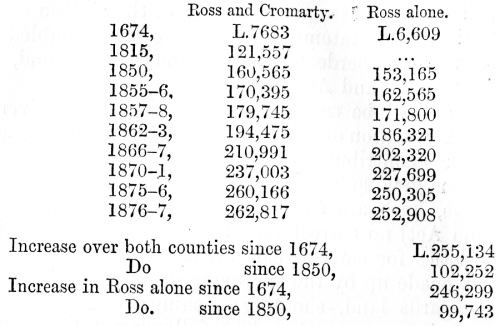
Such an immense increase as L.102,252 during
the short period of twenty-five years must be regarded as very
satisfactory indeed, and as reflecting the highest credit on the landed
proprietors and tenant-farmers of both counties. In fact, as we shall
endeavour to show presently, the counties of Ross and Cromarty have put
almost all the other counties in Scotland into the shade with respect to
increase of valuation. The following table shows the position Ross and
Cromarty occupy, in comparison with the fifteen Scotch counties (excluding
Lanark and Edinburgh, the agricultural value of which is greatly
intermixed with other interests) that exceeded their total valuation in
1815 :—
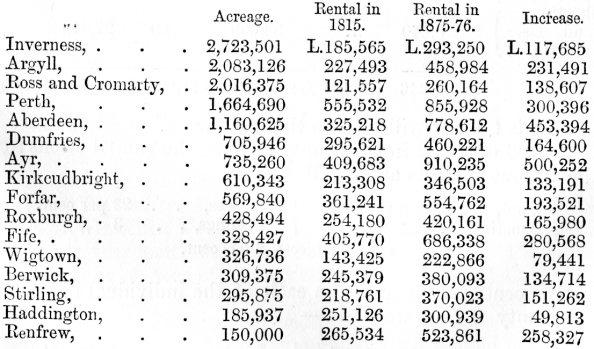
It will thus be seen, that while in 1815 Ross
and Cromarty were behind all these fifteen counties in valuation they have
now surpassed Wigtown by more than L.37,000. And what is a much greater
feat, they have outstripped the whole of the fifteen excepting Aberdeen
and Ayr, in the ratio at which the valuation has increased during the past
sixty years. During that period four (counting Ross and Cromarty as one)
of the sixteen counties included in the above statement, have more than
doubled their annual valuation—Aberdeen coming first, Ayr second, Ross and
Cromarty third, and Argyll fourth.
As a rule, as will be seen from the table
already given, the increase in the valuation of Ross and Cromarty has been
gradual; and the subjects contributing most to this increase in their
order are arable farms, grazing farms, shootings and deer forests, houses,
crofts, fishings, harbours, &c. Prior to 1855 (the first year of the
Valuation Act) no correct rental of these counties existed; and any
statistics for earlier years are taken from the income-tax abstracts, made
up by the surveyors of taxes, which, though correct as regards land,
shootings, fishings, &c, are scarcely reliable as to house property. The
following table, however, will show the gross increase in both counties
from the various sources since 1850, as correctly as can possibly be
ascertained, burghs included:—
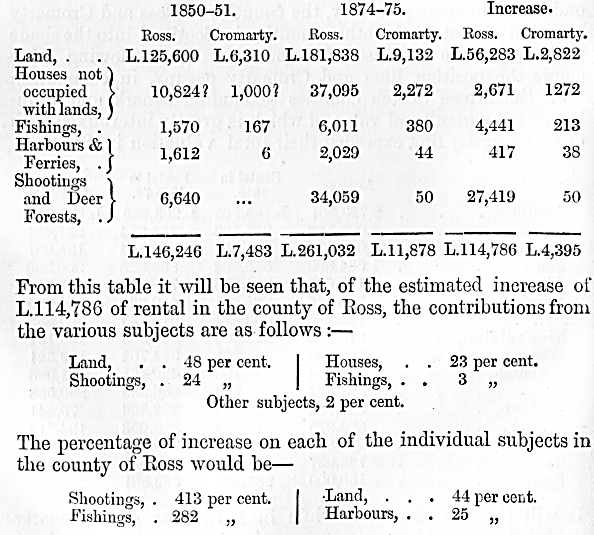
In order to give some idea of the increase
since 1855 (the first year of really reliable statistics) in the valuation
of arable farms grazing farms, and crofts respectively, we shall select
the following specimen parishes;—
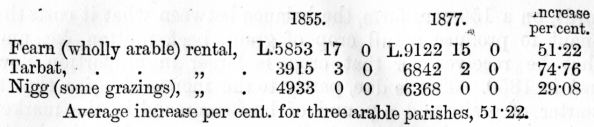
The greatest percentage of increase in these
parishes is on the Balnagown estate, in the parish of Fearn, on which the
increase since 1855 is no less than 109.40 per cent. The least is on the
estate of Shandwick, in Nigg, on which the increase is only 9 per cent. As
regards large grazing farms, we shall take the parish of—
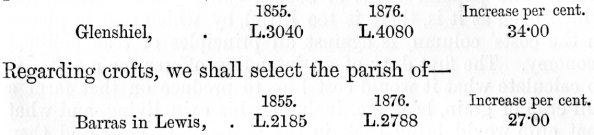
These figures speak so plainly that comment is
unnecessary.
The gross and acreage rentals of a county are
two very different things. An increase in the former, during a certain
period, can be ascertained to within a fraction; but of an advance on the
latter only an approximate idea can be given. The immense increase that
has taken place during the past twenty-five years in the gross rental of
the counties of Ross and Cromarty is due chiefly to the increased arable
acreage, and the growing demand for shootings and fishings; but still the
advance has been swelled considerably by an increase on the acreage
rental. That increase varies in different parts of the counties. On the
arable land in some parts of the counties, the increase has been as much
as 50 per cent.—in a few cases even more; in others, not more than 20 per
cent.; but taking the counties as a whole, it may be stated with safety at
from 25 to 35 per cent. The increase in the rental of grazing farms varies
greatly. In a few cases it has been doubled since 1850; but of the
majority of farms, the parish of Glenshiel, already quoted, may be taken
as a fair specimen. A very pertinent question here would be, Have the
altered circumstances of the agriculture of Ross and Cromarty, since 1850,
warranted this large increase in the acreage rental? Speaking broadly, we
are inclined to answer in the affirmative. A great deal more capital is
required to farm a holding of, say 150 acres, now than in 1850; that is to
say, the amount of grain, beef, &c, which that 150-acre farm is capable of
producing, or rearing, for the market in a year, costs the tenant more now
that twenty-five years ago. But, on the other hand, the advance in the
revenue from a year's yield of grain, beef, &c, is even more than
commensurate to the increased cost of produce. In other words, on a
150-acre farm, the balance between what it costs the tenant to produce a
full crop of grain, beef, mutton, &c, and what he receives for that crop,
is larger in proportion now than in 1850. This is due, partly to the
increased price that a quarter of grain and a pound of beef command in the
market now, as compared with twenty-five years ago; and partly also to the
fact that the improved system of husbandry pursued at the present day
enables a farmer to bring more grain, beef, &c., out of an acre of land
than it was possible for him to have done, by the appliances at his
command, previous to 1850. And it is by the swelling or lessening of this
balance that rent must really be regulated. The popular mode of
book-keeping among farmers (of which, even as it is, there is too little),
by which rent is placed in the costs' colunm is against all principles of
true political economy. The first duty of an intending offerer for a farm,
is to calculate what it would cost him to produce on that farm a full crop
of grain, beef, &c, including his own living, and what that crop would
bring back in the shape of money; and then regulate the rent he could
afford to the landlord for the use of the land, according to the balance
between these two sums. In a few cases, this balance between the cost
price and the selling price of the product of the farm is too small to
warrant the rent now exacted. Speaking for the country generally, the
extraordinary increase in the labour bill during the past few years has
completely upset the whole calculations of many a shrewd, thoroughly
practical farmer, who may have happened to enter on a farm, or a new
lease, ten or fifteen years ago; and indeed it need be no matter for
surprise that in the counties of Ross and Cromarty, as in every other
county in Scotland, there are a few farmers who pay a higher rent for
their land than it is really worth. But on the whole, we are decidedly of
opinion that more money is being made off farming in Ross and Cromarty now
than some twenty or thirty years ago; and that, taking the counties as a
whole, the farming community is living more comfortably, and more
respectably, than during any former period of our history.
It has been remarked that more capital is
required to farm an acre of land now than some twenty-five years ago. The
percentage of this increase is not very easily ascertained, but there can
be no doubt that it is above 200. Thirty or forty years ago, it was quite
common to hear of a farm being stocked and carried on with about L.3 per
acre; in fact, about twenty-five years ago, a farm of 150 acres, in Easter
Ross, was taken on lease by a tenant with a purse of L.200, and all along
he has been doing very well. The sum required to the acre now, of course,
depends very much upon the nature of the soil, and the class of stock
intended to be kept; but, generally speaking, about L.12 per acre is quite
sufficient capital for any ordinary farm in this part of the country. The
farm of Fearn, extending to 510 acres, is at present to let, and it is the
general opinion of the farmers in the neighbourhood, that the purse of the
incoming tenant would require, at the very least, to be equal to about
L.8000. To stock and carry on a farm, however, of, say from 100 to 150
acres of ordinary land, from L.8 to L.9 per acre would be quite
sufficient.
Details of Reclamations and of different
Systems of Farming.
The many and extensive agricultural
improvements that have been effected in Ross and Cromarty during the past
twenty-five years, deserve more than a mere general notice, and therefore
we shall add a few notes, which we collected on a recent tour through both
counties. And while going into detail, we shall also indicate, as briefly
as possible, the various systems of farming pursued in the different
districts. For convenience, the immense tract of land to go over had
better be divided into the following districts: first, the Black Isle;
second, Mid Ross; third, Easter Ross; fourth, Wester Ross; and fifth, the
Lewis.
The Mack Isle.
This extensive tract of land is embosomed in
two curiously bent arms of the sea, the Moray Firth and Beauly Firth on
the one side, and Cromarty Firth on the other. The soil throughout the
peninsula, as already stated, varies a good deal, but still it contains a
large breadth of very fine land. Crossing from Inverness at Kessock ferry,
we enter the parish of Knockbain, in which there are several very fine
farms. The largest proprietors in the district are—Mr J. F. Mackenzie of
Allangrange; Mr C. Mackenzie of Kilcoy; the Right Hon. Henry J. Baillie of
Redcastle; and Mr E. Maclean of Drynie.
The Allangrange estates extend to 3074½ acres,
of which 2102 are arable; 547½ are pasture and waste land, and 425 under
wood. The present rent is L.1891, 18s., and in 1850 it was L.1317, 10s.
8d.; increase during the past twenty-five years, L.574, 7s. 4d. The soil
varies a good deal, and consists of peat, clay, sand, loam, and gravel,
with here and there a pretty strong pan. The farms on the estate vary from
40 to 230 arable acres, while there are a large number of crofts ranging
from 2 to 30 acres in extent. Since 1850 eight farm steadings have been
built, and seventeen new slated dwelling houses and cottages. All new
houses are slated, and are substantial and commodious. Old houses are
chiefly thatched. Fencing is now nearly complete on the principal farms,
wire being the most extensively used. During the past twenty-five years
about 712 acres have been reclaimed by trenching, ploughing, and draining
where necessary. The land thus brought under cultivation was previously,
for the most part, waste moorland, intersected here and there with small
patches of arable land. These reclamations, which will in course of time
be remunerative to the estate, were done chiefly by the proprietor, but in
some cases the tenants assisted handsomely. In addition to these
improvements the greater portion of the old land has been redrained since
1850, and a considerable amount done in the way of squaring up farms and
fields. In many cases the tenants on improving leases held waste land at
1s. 6d. per acre, and the holdings were profitable to them,—the
proprietor's share of the profits coming in only at the expiry of the
leases. Ordinary leases run from fifteen to nineteen years, but there are
also life-rent leases, and life-rent leases to original holders and
fifteen years to their successors. The incoming tenant gets possession of
the grass, manure, fallow, and houses and gardens at Whitsunday, and of
land under grain crop at the end of harvest, he having the option of
taking the grain crop at its valuation. The ancient custom was for tenants
to build on the system of meliorations; but now building is chiefly
executed by the proprietor, the tenant paying either an increased rent or
a percentage on the outlay. When a tenant builds at his own expense some
special agreement is entered into. The rent per acre on farms held under
ordinary leases varies from 15s. to 28s. per acre. Under old leases rents
are collected at Candlemas, Martinmas, and Whitsunday, but under new
leases at the latter terms only. The prevailing system of rotation is the
ordinary five shifts,—two years grass, two grain crops, and one green
crop. Most of the tenants keep cross cows, and rear their own cattle from
these and shorthorn bulls. The home-bred stock, which are supplemented
when the markets suit the buyer, are kept on for grazing, and are fed off
when two years' old. They are tied into the feeding stalls at the
beginning of the previous October, and get abundance of swedes and a
little cake. Probably more of this latter commodity might be used with
considerable advantage to the feeder. There are no sheep farms on the
estate; and the heather pasture, with the run of the arable land, is let
to owners of Cheviot sheep as wintering. About 410 acres have been planted
since 1850. Mr Mackenzie farms about 205 arable acres, and is a thoroughly
practical, intelligent agriculturist. Farm servants are mostly single, or
in the proportion of about three to one. The sons of the smaller tenants
and crofters generally work as farm servants. MrGeorge Maclean's estate of
Drynie is small, but well managed and carefully farmed. It lies chiefly in
the parish of Knock-bain, but a small arm stretches into the parish of
Killearnan. The arable land has been slightly increased of late, and
various permanent improvements have been executed, chiefly by the
proprietor. The rental during the past ten years has increased from about
L.1200 to L.1600. The majority of the farms are small, the Mains of Drynie
being the only large farm on the estate. It is occupied by Mr James E.
Mitchell, and is rented at L.714.
The estates of Kilcoy have been improved
considerably during the past quarter of a century, chiefly by the draining
of old land and buildings.
One of the largest farms in this neighbourhood
is Kilcoy Mains, occupied by Mr William Murray. It extends to about 610
acres, all arable, and is rented at L.732. The rotation pursued in this
neighbourhood varies—the fourth, fifth, and sixth shift being all worked
upon. The five-shift rotation prevails, and is, on the whole, the most
suitable for the district. The soil on Mr Murray's farm is mostly black
loam on a rocky subsoil. A good many cattle are fed in the district, but
on highly-rented land farmers complain that they cannot afford to breed
cattle for themselves. Mr Murray generally buys in Cheviot lambs in the
autumn, and, after wintering them, disposes of them to sheep farmers in
spring. A few farmers in this neighbourhood keep a stock of cross or
Cheviot ewes, and breed lambs from Leicester tups, selling them off in
August. On the larger farms on this estate from 70 to 80 acres of arable
land is alloted to a pair of horses, and on the smaller farms from 50 to
60 acres.
Another large farm on the Kilcoy estate is
Belmaduthy, tenanted by Mr W. G. C. Asher, and rented at L.712. Mr Asher
is an intelligent practical agriculturist, and works his farm on the most
advanced principles.
The farm of Munlochy and Braevil, also on the
Kilcoy property, extends to 210 acres all arable, is occupied by Mr A. P.
Smith, and is rented at L.364. The soil varies. In the valley of Munlochy
and Allangrange there is a good deal of stiff clay, a few fields of good
black loam, and some moss. On the rising ground on either side the land is
generally of a lighter quality; but sharp, and when in good condition is
very suitable for all kinds of crops, wheat excepted. The five-course
shift is pursued here. The heavier land suits wheat very well, and good
crops are always certain if the season is favourable. Wheat, on an
average, yields from 3 to 4 quarters per acre; chevalier barley from 3 to
5, and common barley from 3 to 5½, and oats from 3 to 6. Wheat seldom
exceeds the standard weight—62 lbs. per bushel; barley weighs from 53 to
56 lbs., and oats from 40 to 43 lbs. The land intended for turnips gets a
good strong autumn furrow of 8 to 10 inches in depth, and is in many cases
sub-soiled besides to a further depth of 6 or 8 inches. In spring again it
receives, according as it may happen to be clean or dirty, two, or perhaps
three, cross ploughings, with corresponding harrowing, grubbing, and
rolling, and has all the weeds collected and carted off. The land is then
treated in the usual way, from 20 to 30 loads of farm-yard manure, and
from 4 to 8 cwt. of artificial manure, chiefly dissolved bones and guano,
being-given to each acre. Swedes are generally sown between the 15th and
the 30th of May, and yellows and whites between the 26th of May and the
end of June. Of swedes about 3 lb. of seed are allowed to the acre, and of
yellows and whites about 2½ lbs. Potatoes are not grown at any great
breadth in this district. The land for potatoes is prepared in much the
same way as for turnips, but they receive the best of the farm-yard
manure, generally that which is made in summer, and also a little more
liberal supply of artificial manure than turnips. Mr Smith keeps a
breeding stock of cattle, and sells off his yearlings at from L.12 to L.13
a-head. About the end of autumn he also ties up twenty head of two and
three year olds, which he buys in. The three-year olds are fed off at
Christmas, and usually weigh about 6 cwt., and the two-year olds are sold
off nearly fat about the month of April. The three-years olds, during the
last six weeks of their feeding, get from 1½ to 3 lbs. of cake and a
little crushed corn per day, and, after weaning his calves, Mr Smith gives
each of them a pound of cake per day until they are sold. The farm
servants in this district are mostly married, and cottage accommodation is
how much better than some twenty or twenty-five years ago.
Proceeding along the Fortrose road, we pass
through the parishes of Avoch and Rosemarkie. The principal proprietors in
these parishes are Mr James Fletcher of Rosehaugh, Mr E. G. Mackenzie of
Flowerburn, Mr H. M. Fowler of Raddery, and Mr C. M. M. Millar of Kincurdy.
Though it is only about twelve years since Mr Fletcher made his first
purchase of land in Ross-shire, he is now one of the largest proprietors
in the county, his gross annual rental amounting to upwards of L.9000.
About Martinmas 1864 he purchased the estate of Rosehaugh from Sir James
Mackenzie for about L.145,000. This estate extends to about 6400 acres,
and with the exception of some 200 acres has a pleasant southern exposure.
Two years later Mr Fletcher acquired the estates of Bennetsfield and Ethie,
both adjoining Rosehaugh, and extending respectively to about 500 and 1600
acres. Since then he has acquired the estate of Avoch (including the
estate of Woodhead, in the parish of Resolis), from General Kirkland. It
extends to about 1450 acres, to which are added about C50 acres of the
Milbuie Common, called the Flowerburn Moor. Mr Fletcher's total acreage in
the Black Isle is now no less than about 10,600 acres.
When Mr Fletcher obtained possession of
Rosehaugh there were about 4013 acres under cultivation, about 900 under
wood, nearly 200 under houses, roads, dikes and water, while the
remainder, 887 was chiefly black moor and hills covered with heath and
broom. The soil on the greater portion of this waste land was found to
consist chiefly of rich loam and strong reddish clay, and believing that
it was likely to turn out well under cultivation, Mr Fletcher determined
to give it a trial. Reclaiming operations were begun about six months
after Mr Fletcher got possession, and in the course of about four years
upwards of 600 of the 887 acres of waste land were brought under
cultivation. The land was thoroughly drained in its natural state, the
drains in general being about 30 feet apart and 3 feet 6 inches in depth.
Stones were laid in the main drains, and tiles, chiefly from the
Morayshire Tileworks, were used in the branch drains. The rougher patches
of the land were trenched, but by far the greater portion was ploughed
with strong subsoil ploughs, each drawn by three powerful horses. The land
being naturally level and comparatively free from stones, a furrow was
taken each way to the depth of about 12 inches. In the tract of land thus
reclaimed there were a few acres of moss which had to be drained to a
depth of 10 feet. But heavy as this undertaking was there was still
heavier to accomplish in the way of draining. Loch Scadden covered between
5 and 6 acres at the east side of the property, and this sheet of water Mr
Fletcher resolved to do away with. A large canal about 15 feet deep was
formed through the centre of the loch, from which numerous branch drains
stretched out on both sides. In this way the loch was thoroughly dried,
and where water lay the richest crops are now grown. In addition to
reclaiming these 600 acres, Mr Fletcher has thoroughly redrained almost
the whole of the old land. Such a large addition as this to the arable
area of the estate, of course, necessitated a considerable outlay for
building. Four or five complete new steadings were built, while the
majority of the old steadings were extended and improved. Several handsome
dwelling-houses have also been erected. During the first four years he
possessed Rosehaugh, Mr Fletcher erected close on 15 miles of substantial
stone dikes, and about an equal stretch of wire fencing. For outlay for
fencing as well as on building the tenants pay 5 per cent. interest. Mr
Fletcher also constructed several miles of accommodation roads, and spent
a considerable sum in repairing the old roads of the district. In addition
to the buildings which he erected for his tenants, Mr Fletcher spent
upwards of L.700 in erecting a school and schoolmaster's house on the
Killin part of the property, a district that had hitherto been greatly in
want of educational machinery. A very handsome and commodious
mansion-house has also been built on Rosehaugh, while a considerable sum
of money has been expended in beautifying the grounds, which now make Mr
Fletcher's Black Isle residence one of the most charming country seats in
the north of Scotland. Every acre, aye even every inch, that was not
considered worth reclaiming has been surface drained and planted; and when
it is mentioned that, between 1864 and 1868, Mr Fletcher expended no less
than about L.20,000 on improvements of various kinds at Rosehaugh, some
idea will be had of the activity and stir that characterised the
north-eastern point of the Black Isle during those four years. The cost of
the reclamation of these 600 acres has been roughly estimated at from L.12
to L.15 per acre, according to the nature of the soil.
About one-half of the estate of Ethie was
arable when Mr Fletcher obtained possession of it, and the other half was
partly wood and partly waste moorland. The soil on this estate generally
is very good, and altogether the property is a very desirable one. A very
large breadth of land has also been reclaimed on this estate, while, as on
Rosehaugh, every acre unsuitable for cultivation has been surface drained
and planted. On his recently acquired estates Mr Fletcher has also been
busy at work. In a word, every inch of a gross total of about 3300 acres
of waste and improvable land which Mr Fletcher obtained along with his
different estates has been either reclaimed or enclosed, drained, and
planted, according to the natural qualities of the soil. Besides planting
waste land he has, in re-arranging the farms, formed several beltings of
wood through the estates, which in a few years will both beautify and
shelter the land. Mr Fletcher advances money on interest to his tenants
for suitable and permanent improvements—a privilege that has been largely
taken advantage of. The leases of a considerable number of the farms were
renewed recently, and in the new arrangement a large amount of building
has been stipulated for. The total cost of new farm buildings at present
in course of erection or in contemplation will be upwards of L.15,000; and
altogether, since 1868, the bill for building, exclusive of the
mansion-house, cannot be less than L.20,000.
The soil on Mr Fletcher's estates, generally
speaking, consists of a heavy clayey loam, and in most seasons it grows
excellent crops of all kinds. Wheat, however, is not very extensively
grown. The course of cropping is the ordinary five-shift rotation. Part of
the first year's grass is retained as hay, and the remainder is used as
pasture. Farms range in size from 50 to 500 acres in extent, the average
size being from 100 to 150 acres. The usual duration of leases is nineteen
years, and rents are generally paid at Lammas and Candlemas. On those
farms that were recently re-let, an increase of from 15 to 20 per cent. on
the old rent was obtained. The rental per acre over the estates generally
varies a good deal. In some parts it is upwards of L.2. The majority of
both the farmers and the farm servants are natives of the district, and
are generally quiet, industrious people. Married servants are now most in
favour, but hitherto the number of this class of servants has been limited
in consequence of a want of cottage accommodation, which Mr Fletcher has
already done a great deal to supply. A very good class of both horses and
cattle is kept in the district, and altogether the farming of Mr
Fletcher's estates is quite abreast with the times. Very large quantities
of lime, chiefly taken from Banffshire, have been used on the estates
within the past few years.
Mr Fletcher holds two of the largest farms on
the estate in his own hands, the home farm of Rosehaugh, extending to 550
acres, and Muirhead of Ethie, the annual valued rent of which is L.500.
The home farm of Rosehaugh is under the management of Mr Lawson, and is a
model of neatness and regularity. The stock of cattle is one of the finest
of the kind in the county. The cows hitherto bred from have been crosses
of the best description, while the sires used have been selected, almost
regardless of expense, from the finest shorthorn herds of the day. The
Rosehaugh cross bullocks have been famed all over the north for several
years, and at Inverness and elsewhere they have carried away many
well-contested honours. A few shorthorn cows have recently been
introduced, for the purpose of rearing pure bred bulls for the use of the
tenantry. The improvements now going oil on these estates are under the
able superintendence of Mr Robert Black, factor to Mr Fletcher.
The estate of Flowerburn, a very desirable
little possession, with a rental of about L.960, is divided chiefly into
small farms, the rentals of which average from L.20 to L.195. Several
little improvements have been effected on this estate sinc6 1850. Mr
Fowler's small estate of Raddery has also been considerably improved of
late; and during the past eight or ten years, the rental has increased
from about L.900 to L.1048.
Leaving the parishes of Avoch and Rosemarkie,
we enter Cromarty; and here Lieut.-Colonel G. W. H. Ross is almost sole
proprietor. The Cromarty estate extends to about 7946 acres— 4112 arable,
2625 in pasture, and 1209 under wood. The soil is principally loam, but
clay abounds in some parts, and moorish soil in others. The average rent
per acre is about 33s., and the extremes range from 10s. to 60s. per acre.
Since 1850 the rental of the estate, by reclamations and other
improvements, has been raised from L.5144 to L.6128. The land reclaimed
was previously under wood, and is of a moorish character. The present
value of the new land is about 10s. per acre, and before reclaimed it was
worth only about half-a crown per acre. The reclamations cost about L.20
per acre, and will be fairly remunerative. The farms on the estate are
mostly large—from 100 to 600 acres. The houses are good and substantial,
and have almost all been built since 1850. Most of the fencing was done
before 1850, while the greater part of the other improvements were
effected shortly after that date. The system of rotation pursued on the
estate is either the five or six course shift, and the estate generally is
farmed on the most advanced principles. Almost all the cattle kept are
crosses, and are bought in when young, and fed off as two or three year
olds. The estate is well provided with labourers' cottages. A few have
been built since 1850, but the majority of them was erected previous to
that. The farm servants are mostly married. There are a few crofters, who
eke out the produce of their small holdings by working on the neighbouring
farms. Since 1850 the whole of the available land has been planted. Leases
on the estate are almost all of nineteen years' duration.
Three grandsons of the late Mr George
Middleton, who came to Cromarty from Yorkshire about the beginning of the
present century, occupy three large farms on the Cromarty estate.
Davidston, now occupied by his son, of the same name, was leased for many
years by the late Mr Jonathan Middleton, son of Mi-George Middleton. The
farm has a northern exposure, but still the soil is good, and naturally
dry and fertile. Its arable area was greatly increased by Mr George
Middleton, while the late Mr Jonathan also added a considerable breadth.
The farm is now worked on a six-shift rotation, to suit the cultivation of
potatoes, which have been found to be most remunerative for several years
back. Mr Middleton "soils" a good many cattle {i.e., feeds them in the
house during summer on cut grass and cake), and has thus the command of a
very large quantity of farm-yard manure of the very finest quality. In
addition to a large dose of this dung, potatoes and turnips get from 7
cwt. to 9 cwt. per acre of artificial manure; while about one-half of the
turnips are eaten off the land by sheep. Only as many cows as supply the
farm with milk are kept, but a great many cattle (chiefly Caithness stirks)
are bought in, as the markets are found to suit, and fed off both in
summer and winter. Several hundreds of Cheviot lambs are bought in every
autumn, and fed off on grass, turnips, and cake. Rosefarm, another
desirable farm on the Cromarty estate, and almost adjoining Davidston, is
leased by Mr Alexander Middleton. The soil on this farm is mostly good
black loam; but some patches here and there want " body." The five-course
rotation is generally followed, though a small portion of the farm is
worked in six shifts, to admit of a few potatoes being grown. No cattle
are bred here either, but a good many are grazed and fed off at Christmas
and about February, the byres being again filled during the spring with
lean animals, as feeders for the following winter. About 1000 Cheviot
lambs are bought in every autumn, and part are disposed of the following
spring, and part retained and fed off on turnips and grass and cake as
wethers. Very nearly one-half of the whole turnip crop is eaten off the
land by sheep. The general custom of the district is to feed half or
three-part bred sheep, but Mr Middleton found that the turnips and grass
which grow on his farm are not rich enough in feeding qualities for sheep
of these varieties, and consequently he has taken to Cheviots. The late Mr
Jonathan also had this farm for several years, and reclaimed nearly
one-half of it from moor and wood; while his son, Mr Alexander Middleton,
who has been tenant of the farm for about twenty years, has also reclaimed
about 100 acres. Mr Middle-ton also leases the farm of Poyntzfield, on the
estate of that name, and in the parish of Resolis. The exposure here, as
at Rosefarm, is northern, but the soil is very fair. The system of
rotation pursued here, and the working of the farm generally, is exactly
the same as at Rosefarm. When Mr Middleton became tenant here, about ten
years ago, the land was in very bad order; but since then he has redrained
the whole of it, erected some six or seven miles of wire fences, limed the
whole farm, and reclaimed about 30 acres from waste moor land, all at his
own expense. The 30 acres reclaimed were previously covered with small
whin bushes, and Mr Middleton's first step was to tear out the whins with
a grubber. The land was then ploughed and drained, and well limed; and now
that it has passed through one rotation, it has the appearance of being
good useful land. It was under oats last season, and yielded about 5
quarters per acre, though the bulk the crop had in the stook would have
led one to expect even a higher return. The compact, neatly laid off farm
of Farness, which adjoins Davidston, and to which is attached the small
farm of Peddieston, is held by Mr Thomas Middleton, another of Mr George
Middleton's grandsons. Farness is worked by four pairs of horses, on five
shifts—two years grass, oats, turnips, and wheat sown out with grass
seeds. Mr Thomas Middleton entered this farm fourteen years ago, and since
then he has built a very handsome dwelling-house, and encircled it by a
magnificent garden; removed the farm-steading from an inconvenient site
to the centre of the farm, making it considerably larger than before; has
erected about 1000 yards of stone dykes, and between 6000 and 7000 yards
of wire fences; made nearly a mile and a half of service roads; drained a
considerable part of the farm; trenched-ploughed the whole of it, and
squared up several of the fields. For the erection of the dwelling-house,
a forehand rent (about L.340) was returned to him; and for the stone dykes
erected he receives meliorations at the end of the lease, to the extent of
about L.200. The soil on Farness is good black loam, and yields excellent
crops of wheat, oats, and turnips. "Wheat usually yields about 4 quarters
per acre, and oats from 5 to 6 quarters. The turnips are manured with
about 25 loads of farm-yard manure and 8 cwt. of superficial manure,
including about 1 cwt. of nitrate of soda. Mr Middleton keeps just as many
cows as supply the farm with milk, and buys in cattle (chiefly Caithness
stirks or two-year olds) all the year round. The cattle courts are
covered, and very conveniently arranged for feeding; and for two years
back he has been "soiling" a good many cattle. In all, he feeds about 70
cattle, in two lots, sending the one away about Christmas, and the other
about June. About 400 Cheviot lambs are bought in about the month of
August, grazed till December, fed on turnips from then till April, grazed
during the following summer, and fed on turnips and a little cake from
October till January, when they are sold fat at about L.3 a head. None of
the grass is pastured by cattle, the whole being either eaten by sheep,
cut for hay, or cut and carried to the cattle courts for "soiling"
purposes.
The compact, little, but valuable estate of
Udale, belonging to Mr George Mackenzie of Poyntzfield, and leased as one
farm by Mr James Gordon, lies in this parish. It is beautifully situated
on a pleasant slope running down close to the Cromarty Firth, and has for
several years been one of the best farmed holdings in the counties. It
extends to about 450 acres, of which 270 are arable, the remainder being
partly under wood and partly moorland. The farm faces the north, and rises
from sea-level to a height of about 400 feet. The soil varies a good deal.
On the fields that lie under a level of about 100 feet, it is principally
shingly, with a gravelly bottom overlying the Old Red Sandstone, which is
here covered to a considerable depth. The middle fields, lying between 100
and 200 feet above the sea, consist of a rich deep black loam close to the
sandstone. On some parts of these fields the Old Red Sandstone comes
within 3 or 4 feet of the surface, and here the soil is a strong reddish
clay, suitable for all kinds of crops, though probably not quite so safe
for potatoes as the more gravelly land. On the higher fields the soil is
of an inferior class, and consists chiefly of a moorish boulder clay, with
here and there an irony pan underlying it. Mr Gordon is an extensive stock
farmer, and to suit his cattle and sheep endeavours to have as much grass
in summer and as many turnips in winter as possible. The system of
rotation pursued is therefore rather an exceptional one. He generally
allows the land to lie three or four years under grass, and breaks it up
for a crop of turnips, the farm-yard manure being spread on the lea before
being ploughed down in winter. After turnips comes either wheat or oats,
or oats and tares mixed, the mixture being used for feeding stock. Then
turnips follow again, and after that wheat or oats sown out with grass
seeds. The system is confined to the heavier soils. The lighter soils are
broken up with either potatoes or oats, followed by turnips, and then oats
with grass seeds. A portion of the lighter land on the heights was found
unsuitable for turnips, and consequently it was sown down with whin seed
along with oats, about 30 lbs. being given to each acre. The whins came
away beautifully, and for seven years running from 10 to 12 tons per acre
were reaped every season. The subsoil in these higher parts is very fair
clay, and the roots of the whins must have abstracted nourishment from it.
The whins were used for horses, cattle, and sheep, and it was curious to
observe that the pure bred shorthorns and Leicesters took more readily to
the whins than the other kinds of cattle and sheep. The whins were reaped
with one of Samuelson's mowers, the same implement having reaped a field
of 22 acres for five years in succession. Before being given as food, the
whins are put thrice through a whin-mill, made by Messrs Mackenzie & Co.,
Cork. The first of the crop is used about the beginning of November, and
unless caught on the root by a severe frost, which make the whins woody
and tough, they are quite soft and easily eaten. Cattle and horses get
them under roof, but to sheep they are supplied in troughs on lea fields.
The cultivation of these whins enabled Mr Gordon to carry a heavier stock
of both cattle and sheep than he could otherwise have done; and by their
roots having pierced through and loosened the firm pan which underlies the
soil on these higher fields, the parte on which they were cultivated have
been permanently improved. Of the 22 acres sown down with whins 12 were
ploughed to the depth of about 8 inches last spring, and sown with oats.
The crop was a very fair one, and yielded about 4 quarters an acre—the
highest yield ever reaped from the field.
Mr Gordon grows no barley, but produces both
wheat and oats of the finest quality. As much as 8 quarters of wheat per
acre have been grown on the farm, while the general yield runs from 3 to 5
quarters per acre. The weight per bushel varies from 60 to 62 lbs. Chiddam
and Fenton are the varieties used, about 4 bushels of seed being given to
the acre. The Fenton variety generally affords the largest yield. The
wheat is sown in autumn as soon as the turnips are eaten off the land by
sheep. Finefellow is the variety of oats most largely sown. The yield of
oats varies from 3 to 7 quarters per acre, and the weight from 42 lbs. to
43 lbs. per bushel. About 4 bushels are given as seed to the acre. A
broadcast-sowing machine and manual-delivery reapers are employed. As
already stated, two turnip crops are taken in each rotation, one after lea
and another after stubble. Mr Gordon never cross-ploughs any, but grubs
thoroughly. When he obtained possession of Udale about eleven years ago
the land was very dirty, and at the first rotation a considerable amount
of labour had to be spent in clearing away large quantities of weeds. The
soil, however, is now thoroughly clean, and in a very high manurial
condition. Mr Gordon begins to sow turnips about the 10th of May, and
gives about 3 lbs. of seed to each. acre. About two-thirds of the turnip
break is usually put under swedes. Besides from 15 to 25 loads of
farm-yard manure per acre (spread on the surface before ploughing), a very
heavy dose of artificial manure is applied. The dose ranges from 6 cwt. to
12 cwt. per acre, and is composed of bone meal, crushed bones, coprolite
superphosphate, muriate of potash, nitrate of soda (not more than 1 cwt.),
and common salt. Considerable quantities of seaweed are also used for
manuring both turnips and potatoes. As might have been expected from the
very short interval between the two root crops in the rotation, a good
deal of loss was at first experienced by "finger and toe," but by the
application of the above-mentioned mixture the ravages of this destructive
plague have been completely checked. Mr Gordon gave special attention to
the cultivation of turnips for some years, and has been very successful in
his experiments. He attributes the prevalence of " finger and toe"
throughout the country chiefly to the fact that in the mixture of
artificial manure usually applied to turnips, all those ingredients
necessary for nourishment to the plant are not present in the requisite
proportions. He has grown three crops of turnips in four years, with but
very little appearance of " linger and toe;" but this he thinks could be
done only when then turnips are eaten off by sheep, by which system a good
deal of what the turnips absorbed from the land during growth is returned
to it in the sheep-droppings. Mr Gordon generally grows from 12 to 15
acres of potatoes, chiefly Victorias. The potatoes are usually planted on
the lighter and more gravelly land, and get about the same quantity of
manure as the swedes, except that the potash is slightly increased. Mr
Gordon has cultivated a few new varieties from the plums of Victorias,
which now afford a larger return than the original variety. The farm is
worked by four pairs of good substantial horses. For some years Mr Gordon
kept a stock of cross cattle, breeding from polled cows and shorthorn
bulls, but since 1871 he has been devoting a good deal of attention to
shorthorn breeding. Of the shorthorns, however, more anon. Mr Gordon has
for many years been one of the most extensive sheep farmers in the
counties, and in addition to a large mixed stock of sheep, he has been
rearing a few pure bred Leicesters. Of these, also, more anon.
Towards the end of last year Mr Gordon
purchased the estate of Arabella from Mr Fraser. It extends to about 600
acres, is almost all arable, and lies in one of the prettiest spots in
Easter Ross. The land is very level, and the soil is rich alluvial clayey
loam, close but not stiff, and if properly cultivated should grow heavy
crops of all kinds. The alluvial soil lies on 6 or 8 inches of sand, and
beneath that is a layer of strong blue clay. The land has been imperfectly
cultivated for some years, and is full of weeds and rather rough. The
course of cropping followed by the late tenant was either one or two years
grass, wheat, oats, turnips, and either wheat or oats sown with grass
seeds.
The next parish we enter in the Black Isle is
Resolis, part of which lies in Ross-shire and part (the larger part) in
Cromarty. The principal proprietors in this parish are Mr J. A. Shaw
Mackenzie of Newhall, Mr George Mackenzie of Poyntzfield, Mr C. Lyon
Mackenzie of St Martins, Mr H. K. Fraser of Braelangwell, Captain J. D.
Mackenzie of Findon, and Mr J. Urquhart of Kinbeachie. The Newhall
property contains two large farms, Kirkton and Mains of Resolis; but a
very large portion of the estate is taken up by crofts, which number close
on 100. A few of these crofters pay half-a-crown of rent, while others pay
L.8, L.10, or L.12. The crofts are chiefly situated on the Bog and Muir of
Cullicudden; and by many years of patient toil the tenants of these small
holdings have added considerably to the arable area of the estate. They
have almost all leases of nineteen years, and, generally speaking, they
live comfortably and contentedly. The extensive farm of Mains of
Braelangwell, for some time occupied by Mr John Gordon, now in Balmuchy,
lies in this parish, as also the desirable farm of Mains of St Martins.
Proceeding along Cromarty Firth, in the direction of Dingwall, we pass
into the parish of Urquhart, in which the larger proprietors are Mr Arthur
Forbes of Culloden, Sir Kenneth S. Mackenzie of Gairloch, Bart., and
Captain J. D. Mackenzie of Findon.
The estate or barony of Ferrintosh, extending
to close on G000 acres, though situated in the parish of Urquhart, really
belongs to the county of Nairn. It is owned by Mr Arthur Forbes of
Culloden, and within the past thirty years has been improved to a very
great extent. In 1853 Mr Duncan Forbes, brother of the proprietor,
reported to the Highland and Agricultural Society (see "Transactions" for
1853, series iii. vol. vi.) on extensive improvements, that had been
carried out on the Ferrintosh estate under his own management. Between
1847 and 1853, 672 acres were reclaimed from rough, stony moorland and
brought into profitable cultivation. The greater portion had to be
trenched, at a cost of from L.7 to L.8 per acre, and before it was
thoroughly drained, cleared, and fenced, and prepared for cropping, the
total cost per acre ranged from L.20 to L.23. The drains were cut to a
depth of 3 feet, and laid with horse-shoe tiles, upon the top of which was
placed a layer of about 14 inches in depth of small stones. For leaders 4
and 5 inch tiles were used, and those placed in the branch drains were
about 2 inches. Where stones could be had dykes were made, wire being used
where stones was scarce. And since these improvements, reported upon so
fully by Mr Duncan Forbes, were completed, extensive improvements, in the
way of reclaiming, draining, fencing, building, &c, have been effected. In
1874 the leases of about 120 crofts expired, and, on a measurement of
these holdings, it was found that during their leases, which ranged from
fifteen to nineteen years, these small tenants had reclaimed upwards of
400 acres, all of* which had been thoroughly drained and partly fenced.
These crofters had also drained and fenced the greater portion of their
old land during their leases recently concluded, and by aid from the
proprietor they had also done a good deal in the way of building. The
gross rental has been doubled within the past twenty-five years; and in
many cases, where the land was good, a considerable increase has taken
place in the acreage rental. The tenantry, generally, are in a thriving,
prosperous condition; and we should mention that, with one or two
exceptions, the whole of the 120 crofters, whose leases expired in 1874,
retained their possessions and accepted agreements, under which they are
bound to reclaim at least one-tenth part of the moorland on their
holdings. The waste land, though thin and moorish in some parts, is so
well suited for potato culture, and otherwise so suitable for improvement,
that the conditions of the new leases are certain to be carried out very
soon. While the improvements on the crofts have been important, those on
the larger farms have been still more extensive. Offices and
dwelling-houses of a superior description have been erected at Cornton,
Torgorm, Leanaig, Easter and Wester Alcaig, Kinkell, Drumoureach, Dun-vornie,
Teanalmich and Teanagairn, &c. There are two steam-mills on the estate,
one at Balnabeen and another at Wester Alcaig, but as a rule the tenants
use water power for their thrashing mills. Almost every tenant who has any
waste land attached to his holding sits under an improving lease, and
there is every prospect of a good deal of reclaiming and other
improvements being accomplished before the end of the current leases.
Plans have been made and levels taken for clearing the high lands of large
lakes of stagnant water, which, when carried away, will render a great
deal of land improvable; and arrangements have also been completed to
enclose for planting a large portion of the waste land on the top of
Milbuie, belonging to the property. One of the principal farms on the
Ferrintosh estate is Eye-field, occupied by Captain A. S. C. Warrand. It
extends to about 320 arable acres, and about 50 acres of pasture. The soil
is a medium loam on freestone rock, and the rent about 30s. per acre. A
five-course rotation is pursued,—1st, Oats; 2d, turnips, | being swedes;
3d, wheat and barley; 4th, hay (1/3) and pasture; 5th, pasture. Oats
usually yield about 5½ quarters per acre, and weigh 42 lbs. per bushel;
wheat yields 3½ quarters, and weighs 62 lbs.; barley yields about 5
quarters, and weighs 55 lbs.; turnips average about 30 tons per acre, and
the hay crop is usually good, and pasture fair. The land intended for
turnips is ploughed parallel to old furrows in autumn, from 10 to 12
inches deep. In spring it is ploughed across, or, if dirty, is first
grubbed and then ploughed across, and thoroughly harrowed and cleaned of
weeds. The land is manured with 20 loads of farmyard manure, with a cwt.
of crushed bones, 2 cwt. of bone meal, 1½ cwt. of dissolved bones, and 1/3
cwt. of nitrate of soda to each acre. Swedes are sown from 15th to 25th
May, and yellows from 25th May to 12th June, Potatoes are grown only for
home consumption. Captain Warrand has fenced the whole of his farm, and
partly drained and reclaimed about 10 acres, all at his own expense. About
fifteen cross cows are usually kept, and from these and a shorthorn bull
excellent cross calves are reared. Five or six calves are bought in for
fostering at a week old, while four yearlings are also bought in, and thus
twenty-four two-year olds are sold off every year. About half this number
is fed to an average weight of about 6 cwt. by February, when they are
despatched to the beef market. The other twelve are sold off when about
half fat. Those intended to be fed out are tied up about the 1st of
October, having had turnips previously given to them on the open field.
The diet till Christmas consists of yellow turnips and a mixture of wheat,
barley, oat, and Indian corn meal; and after that swedes are substituted
for the yellows, and a little linseed cake added to the meal. The cattle
bred at home are found to be the best paying animals. About 200 Cheviot
and half-bred ewes are now kept on the farm, and Captain Warrand expects
to sell 280 lambs every season. He allots 80 acres to each pair of horses.
Cottages are scarce, and therefore unmarried servants are in the majority.
Captain Warrand kept a very fine stock of pure bred Leicesters for several
years, but in September last the whole hirsel was dispersed at very high
prices.
The largest farm on the estate is Cornton,
occupied by Mr George Middleton. It extends to about 400 acres, all
arable, and is rented at about 28s. per acre. The soil is light sandy
loam, and the climate is good. The ordinary five-course rotation is
pursued. The various crops yield well, except in dry seasons. Wheat
usually yields about 4 quarters per acre, and weighs from 61 to 62 lbs.
per bushel; barley yields 5 quarters, and weighs 55 lbs.; and oats yield
5½ quarters, and weigh from 41 to 42 lbs. The grain is usually of the
finest quality. The land intended for turnips, if not dirty, gets one deep
furrow in autumn and a cross-ploughing in spring; but, if dirty, it is
grubbed once or twice before being ploughed in spring. About 15 tons of
farm-yard manure, and from 5 to 7 cwt. of artificial manures, principally
bone compounds, are usually applied to the acre. Mr Middleton has recently
been trying the system of spreading the farm-yard manure on the stubble
land in autumn, to be turned over with the first furrow, and as yet the
results have been favourable. As already stated, the farm has been
considerably improved since 1850 by reclamations, draining, fencing, and
building. A "flying" stock of cattle is kept. They are bought in once a
year, and sold off fat from January to April, weighing generally about 6½
cwt. No cattle are bred on the farm. A little cake is used, but for
feeding turnips are supplemented chiefly by a mixture of meal made from
the different varieties of grain. A small flock of half-bred and
three-parts bred lambs are bought in in August. As they are newly weaned
when bought, they are treated as kindly as possible 'for some time on good
grass, and soon after the 1st of January cut turnips are given them, and
after the 1st of May a little cake is added. They are clipt about the 26th
of May, and sold off in June. The farm horses in this district are
Clydesdale crosses, very much improved of late, but still short in supply.
About 80 acres are usually allotted to each pair. Married servants are in
the majority as yet, but married men are becoming scarce. Rents in this
district have risen from 30 to 40 per cent. at the expiry of each lease;
but now, when labour and taxes are so high, there is not much room for a
further increase. We might be asked, Is this rise of rent due to. improved
tillage of the original acreage? or to an increase of the arable land by
reclamation? or to a diminution of the farmer's profits? We think that the
rise is due partly to all these three causes, but mainly to the former
two. The rents of several farms, on which there have been no reclamations
for many years, have advanced upwards of 20 per cent. since 1850, and in
these cases the rise is mainly due to improved systems of farming.
Sir Kenneth Mackenzie's beautifully situated
estate of Conan comprehends the western end of the parish, and has been
immensely improved by reclamation, draining, fencing, and building, both
by the present proprietor, and by the late Sir Francis A. Mac-kensie of
Gairloch, who is spoken of in "The New Statistical Account of Scotland,"
as being " distinguished for zeal in agricultural improvements, as
respects both the reclaiming of waste ground and introducing the modern
system of husbandry among his servants." Sir Kenneth is convener of the
county of Ross; and is a painstaking practical agriculturist, and a
considerate landlord. He holds the home farm of Conan in his own hands;
and under the careful management of Mr Mackenzie, the overseer, it is kept
in a high state of cultivation. It extends to about 400 acres, of which
340 are arable, and 60 under permanent pasture. The soil is partly black
loam, and partly sandy loam, with a subsoil of sand. The ordinary
five-shift course is pursued, wheat being taken after turnips and
potatoes. From twelve to fourteen thoroughly good cross cows are kept; and
from these and a shorthorn bull excellent cross calves are reared. The
bull in use at the farm just now was purchased from. Mr R, Bruce, late of
Newton of Struthers, Forres. Two or three good pure bred shorthorn cows
are also kept at the farm. A good many cattle are fed during winter; and a
large lot of pure Berkshire pigs are reared and fed in the courts at the
steading. From 400 to 500 cross ewes are pastured on the farm; and from
these and Leicester tups a crop of lambs is raised every year that
commands the top prices at the Inverness Wool Fair. The steading on the
home farm was built in 1822; and it is worthy of remark, that Hugh Miller
worked at it as an apprentice mason. The entrance into the steading is
surmounted by a tall handsome tower. Sir Kenneth has also an extensive
estate in the parish of Gairloch, his rental there alone amounting to
L.7300. There are a few small-sized arable farms on the Gairloch property,
and between 400 and 500 crofts, averaging about five acres in extent. A
good many of these crofters have reclaimed the whole of their possessions,
while others have improved little more than one-half. The system of
cultivation on these and other crofts throughout the counties will be
noticed more fully afterwards.
The Findon estate has been very considerably
improved, by reclaiming, draining, fencing, and building of late; and
during the past eight or nine years the rental has increased from L.3774
to L.4624. There are a great many crofts and small farms on this estate,
and some large and very fine farms, The largest farm on the estate is
Woodlands, situated in the parish of Kiltearn, and occupied by Mr Jonathan
Middleton, Davidston, at a rent of L.555.
Continuing round towards Beauly Firth, we pass
through the parish of Kiltearn, which joins Knockbain, near our starting
point on the Black Isle. The large proprietors in this parish are—Mr
Mackenzie of Kilcoy (whose estates have already been noticed), and the
Eight Hon. Henry J. Baillie of Redcastle. The improvements on the
Redcastle property since 1850 have been extensive, important, and costly.
A considerable extent of land has been reclaimed, while building,
draining, and fencing have been going on apace. The rental since 1868 has
increased from about L.5800 or L6500.
We have now made a complete circuit of the
Black Isle; but before taking leave of the peninsula, we must refer
shortly to the old "Mulbuie Common." This immense tract of land, extending
to 7044 acres, stretched along the whole top of the Black Isle and for
hundreds of years was used as a common outrun for the Black Isle
generally. It was originally covered with little else than black heath,
and its pasture was of no great value. It was asserted that the soil, over
at least the greater portion of the common, was quite suitable for
improvement, and likely to make very fair arable land; but while it
remained the property of no man, because the property of all, nothing
could be done by way' of either reclaiming or planting. Several attempts
were made among the proprietors of the Black Isle, nearly a hundred years
ago, to have Mulbuie divided, but new difficulties were continually
cropping up, and proposal after proposal fell to the ground. By agreement
among themselves, a few of the proprietors, towards the west end, made a
sort of an interim division of what lay opposite their possessions; and
part of the land thus apportioned off was planted. Before the present
century had advanced many years, the agitation for division again
manifested itself, and this time with more success. The subject came up in
the Court of Session, and on the 10th July 1827, the then Lord Ordinary
(Mackenzie) issued an interlocutor, dividing the whole community
(including what had been already extra-judicially apportioned) among the
various proprietors in the peninsula. The royal burgh of Fortrose claimed
a right of commonage, and on the division got the largest portion of any,
namely, 687 Scots acres. To the Cromarty estates 577 Scots acres were
apportioned, 550 to Kilcoy, 523 to Flowerburn, 446 to Sir James Mackenzie
of Scatwell, 411 to Newhall, 370 to Ferrintosh, 358 to Redcastle, 245 to
Allangrange, 196 to Conanside, 158 to Drynie, 127 to Avoch, the remainder
going in smaller portions to the other proprietors in the district.
That the division of this community had
beneficial results there can be no doubt. A great extent of the 7000 acres
has been brought to produce very fair oats, turnips, and potatoes; while,
with a few exceptions, almost all that was found unsuitable for
reclamation has been planted, and is now carrying thriving wood. There is
still a considerable extent of moor and waste land throughout the Black
Isle; but compared to the immense tract that existed before the division
of Mulbuie, it seems little more than a mere handbreadth. The improvement
these reclamations and plantations have effected on the scenery of the
Black Isle is very marked. Before the division a dark dreary shade was
cast over the whole peninsula by the bleak heathy moor, which then ran
along the ridge; now, the many green fields and thriving plantations that
occupy the greater part of old Mulbuie, lend a pleasant, smiling aspect to
the whole district. The greater portion of the better land, after the
division, was let to crofters, in holdings varying from 10 to 30 acres. In
most cases leases of nineteen years' duration were granted to these
crofters, and other substantial encouragement held out to them to bring
their holdings under cultivation. By patient toil and untiring energy,
these small tenants have reclaimed many hundreds of acres, and converted
into a pleasant agricultural district what was before a wilderness of
stunted heath and bent. The soil generally is light, and very susceptive
of drought, but still very fair crops are usually grown, and the majority
of the crofters live comfortably and contentedly.
The 196 Scots acres allotted to the Conanside
estate formed part of what had been previously divided and planted; and
the wood was not removed for about ten years after the division in 1827.
In 1841 this land, extending to about 245 imperial acres, was let, along
with 20 acres of adjoining land, at a rent of 1s. 6d. per acre, on leases
of nineteen years, to fifteen crofters who undertook to reclaim the whole,
receiving therefor L.5 for each acre of improved land at the close of
their leases. Some of these crofters, notwithstanding this encouragement,
did nothing; others improved only part of their land, while some improved
the whole during the first lease. By 1860 about half the improvable land
had been reclaimed; and at that time new nineteen years' leases were
entered into at an average rent of 14s. per arable acre, and 1s. 6d. per
acre of waste land, with the L.5 premium on its improvement. But
practically most of the crofters sit at about 6s. per arable acre, having
sunk this melioration for a reduction of rent equivalent to 8 per cent. on
the L.5 per acre to which they were entitled. By 1878, when the leases
again expire, most of the land will be under rotation. This piece of land
is probably one of the worst on the whole commonty. The soil is light and
gravelly, the rock underlies it at no great distance from the surface;
and the crops are always light, and suffer much from drought. In fact,
very few of the wells retain water all through a dry summer; and at the
present rate of wages it can be profitable neither to the landlord nor the
tenant to reclaim and cultivate land of such inferior quality. Sir Kenneth
lately trenched and brought into cultivation about 40 acres of waste land
adjoining these crofts, from which he now receives a rent of L.1 per acre.
The land was worth about 8s. per acre before being reclaimed, and when
under heath as wintering for hill sheep. The increase of rent is thus only
12s. The cost of the improvement, including cleaning and draining and
building, came to about L.24 per acre, so that the interest received on
the outlay is only 2½ per cent. From the improvement of a similar subject
Sir Kenneth would not now realise even this profit; and really it is very
doubtful whether or not such an unremunerative speculation is worth the
toil and trouble of the crofter. There was a good deal, however, of richer
land on other parts of Mulbuie, and on most of these parts both the
landlords and tenants have been very fairly remunerated for their outlay
and labour. The 306 imperial acres attached to the Allangrange estates
have almost all been made -arable, and are now producing very fair crops
of oats, potatoes, and turnips. The greater portion of this piece of the
old commonty was given off in crofts and improved by these small tenants,
as was the case with the land apportioned to Sir Kenneth. The whole of the
577 Scots acres attached to the Cromarty estates have been planted, and
are now carrying valuable wood; and of the 370 apportioned to the
Ferrintosh property, part has already been planted, and part reclaimed by
crofters, while arrangements have now been completed for having the
remainder enclosed with a view to its being planted.
Mid Ross.
Mid Ross proper includes all of the Black Isle
that lies in the county of Ross, as well as the parishes of Urray, Contin,
Dingwall, Fodderty, Kiltearn, and Alness. But for convenience, the Black
Isle was taken separately. By train the traveller enters Ross-shire near
the Muir of Ord, in the parish of Urray. Part of this parish lies in
Inverness-shire, but by far the greater portion is in the county of Ross.
The principal proprietors in the Ross-shire portion of the parish are Mr
J. A. F. H. S. Mackenzie of Sea-forth, Mr John Stirling of Fairburn, Mr
James F. Gillanders of Highfield, the Right Hon. H. J. Baillie of
Redcastle, Mr Thomas Mackenzie of Ord, Mr A. J. Balfour of Strathconan,
and Mr J. S. Chisholm of Chisholm, who owns the estate of Rheindown. The
Ord estate, though not very extensive, has, nevertheless, been the scene
of great activity and enterprise for many years, and is now one of the
best farmed little properties in the county. The Rev. James Macdonald,
writing on the parish of Urray for the New Statistical Account of Scotland
in 1841, says, "The principal agriculturist within the parish is Mr
Mackenzie of Ord, who has improved his lands very much of late." And since
then the value of the estate has been very much increased both by
reclaiming new land, and draining, and otherwise improving the old. The
rental in the parish of Urray in 1840 was L.342, now it is L.1494.
The estates belonging to the Seaforth family
have been considerably reduced by selling off detached portions during the
past twenty-five years; but on what still attaches to Brahan Castle (the
beautifully situated residence of the family), a good many improvements
have been effected of late, while the general system of husbandry pursued
on the estate is of the most advanced description. The estate of Highfield
has also been very largely improved within the past twenty-five or thirty
years. In 1840 the rental was L.402; in 1868, L.1895; now it is L.2315.
The Rheindown estate has advanced in rental during the past eight or ten
years from L.540 to L.615.
Last year Mr John Stirling purchased the
estate of Fairburn from the Seaforth family, the estate of Anchonachie
from Mr Douglas Mackenzie, and the estate of Muirton from Mr Robert
Ainslie. These estates adjoin each other, and lie in the valleys of the
Conan and the Orrin. Their united rental is L.350.
These estates had all been very much improved
by then respective owners before coming into the possession of Mr Stirling.
The arable land, particularly on the Fairburn estate, had been increased
by hundreds of acres; many new steadings had been built, the farms all
squared up, and an immense stretch of wire and other fences erected, while
almost every acre of land unsuitable for reclamation was planted. On the
Fairburn estate there are upwards of 1200 acres of excellent planting, the
main portion of which was planted by the present laird of Brahan and his
mother. The system of rotation on Mr Stirling's estates is chiefly the
five shifts. A good many cattle are reared and grazed in the district, and
in this respect it forms one of the few exceptions to the general rule of
Ross-shire, which is the buying in and feeding of cattle, not rearing and
grazing. A very large portion of the turnip crop is eaten off the land by
sheep, chiefly Cheviot hill hoggs. The largest and most expensive of all
the improvements effected within recent years by the Seaforth family was
the draining of the bog of Arcan, on the Fairburn estate. Mr John Mitchell
provost of Dingwall, whose experience in land improvements is very
extensive, had the planning and superintendence of this gigantic
undertaking; and, on its completion some twenty years ago, he reported
upon it to the Highland and Agricultural Society. This report—a complete
and very interesting one—will be found in seventh volume of the third
series of the Transactions of the Society, at the 108th page; and
therefore lengthy reference to the subject here would be superfluous. A
great extent of land, in what was called the Bog of Arcan, lies at such a
low level, that originally it was continually in a wet marshy state, and
frequently completely submerged by the overflowing of the Conon; and
notwithstanding the care and skill employed in the undertaking by Mr
Mitchell, and the money expended, large portions of the lower lying parts
of the bog again began to be almost useless in consequence of flooding and
back-lying water; and some ten years ago an attempt was made to redrain
the land. First of all, a large culvert, about 3 feet in diameter and
about a mile long, was constructed from a convenient point in the bog away
seawards, and discharging itself into the Conon. The construction of the
culvert was a matter of very great difficulty, and the expenditure for
this part of the work alone amounted to between L.7000 and L.8000. Branch
drains were cut from the culvert throughout the whole of the marsh, and in
this way close on 500 acres, that formerly were almost useless, are now
bearing the richest grain and root crops of all kinds.
Lying alongside Urray is the parish of Contin,
a very extensive parish containing some very fine arable land, and a large
extent of hill grazings. The principal proprietors in these parishes are
Sir A. G. E. Mackenzie of Coul, Bart., Mr A. J. Balfour of Strathconon,
and Mr Mathieson of Ardross. The most of the arable land on the estate of
Coul lies in the Contin valley, one of the prettiest of straths. A
gentleman who has been a resident in this valley for many years
writes—"From my windows I can see at a glance about 1400 acres of land,
reclaimed within the last thirty years, now bearing rich crops of all
kinds. One old farmer in my neighbourhood actually took in 400 acres
himself. All the modern improvements, such as using reapers and artificial
manures, are greatly in vogue, by which reaping is much accelerated, and
crops greatly improved." In 1868 the rental of the Coul estates in Contin
was L.3766, now it is L.4180. One of the prettiest situated farms on this
estate is Achilty, occupied by Mr P. Robertson, and lying along the banks
of the Black Water, around the base of Tore-Achilty, a rugged
perpendicular elevation looking down the valley of Contin, and beautifully
covered with richly foliated weeping birch. The farm extends to about 300
acres arable and 100 acres pastoral, and is rented at L.300. Mr Robertson
also holds several sheep farms, but these shall be referred to afterwards.
The soil on Achilty is chiefly sharp light brown loam, slightly mixed with
sand. The five-course shift is generally followed, though occasionally it
is varied into a six shift-rotation. Turnips are sometimes grown after
lea, and they are found to do very well. In November of 1874 a six-year
old field of grass was ploughed, and in the spring sown with yellow
turnips, manured liberally with bone meal and dissolved bones. The plants
came away very satisfactorily, but mildew interfered with them towards the
end of summer, and the crop turned out only a moderate one. The turnips
were all eaten off by sheep, and the land ploughed again in April across
the old drills. In the end of May it was thoroughly harrowed, and the sods
reduced to a fine tilth. It was then drilled up, manured with about 7 cwt.
per acre of crushed and dissolved bones, and sown with turnips. The crop
was still in the field when we visited Achilty, and the appearance was
most promising. Barley is generally grown after turnips, and oats after
grass. The average yield of barley is from 4 to 6 quarters per acre, and
the weight from 53 to 54 lbs. per bushel. The yield of oats ranges from 5
to 6½ quarters, the weight from 42 to 43 lbs. The favourite variety of
barley is chevalier, while sandy oats are grown almost entirely. These
remarks apply pretty generally to the whole of Contin valley. Mr Robertson
keeps four or five cows to supply the farm with milk, and rears six
calves. He buys in from forty to fifty Highland heifers in October. They
are wintered at Achilty, sent to the hills to graze during summer, and
sold when the markets are favourable.
The Strathconon estate extends to about 72,000
acres, chiefly hill ground taken up by a deer forest, sheep farms, a few
crofts, and a home farm. It extends in three parallel glens, from Glen
Orrin to the Dingwall and Skye Railway, only the south side of Strathbran
belonging to Mr Balfour. The river Meig, a tributary of the Conon, runs
through the centre glen of Strathconon. It is only 16 miles from the Muir
of Ord, and 20 miles from Dingwall and Beauly, but still the estate is
very much isolated; nevertheless, it has been greatly improved within the
past thirty years. The glens are so very narrow, and the rivers so
tortuous in their courses, that there is really little room for
reclamations of any extent. On the home farm there are about 60 acres
under rotation, and here and there along the river sides there are small
patches of arable land. In fact, almost the whole of the limited extent
suited for growing crops has been reclaimed by trenching and draining. It
is not a profitable speculation, however, to trench such small spots as
these. The soil on the arable land, and all low ground, is gravelly,
light, but moderately fertile. Since 1870, three new farm-houses and
steadings, and nine cottages for shepherds and labourers, have been
erected; while, since 1850, several old buildings have been enlarged and
renovated. About 35 miles of strong wire fences and three miles of stone
dykes have been erected during the last six or seven years, while a good
deal of the arable land has been redrained, and the permanent pastures on
the river sides well limed. The ordinary five-course shift is followed,
and very fair crops of all kinds are grown. The cows generally are strong
substantial crosses, while Mr Balfour keeps a good pure shorthorn bull.
The extent of arable land is so limited that there is often scarcely
sufficient wintering for the cows, and consequently the calves are sold
off early in autumn. The calves of last season were sold at the Muir of
Ord in September, and were as fine a lot of cross calves as we have ever
seen brought into a market in the north of Scotland. There are about a
dozen crofters on the estate, and these eke out the produce of their small
holdings by employment received from Mr Balfour, and by cartage. There are
in all about a dozen sheep-farms, ranging in size from 1000 to 7000 acres.
On several of these there are small patches of arable land; but unless the
tenant happens to reside on the farm, these plots are not cultivated.
Three or four of the sheep farmers, who hold the green hills or richer
pastoral lands, keep Cheviot ewes, while the others have blackfaced ewe
and wether stocks. A considerable extent of the hill pasture was improved
several years ago by surface draining, but a good deal of it is almost as
bad as ever. A commencement was made at redraining those wet swampy parts
last summer, but the rainfall was too heavy and continuous to admit of
much being done. There are about 500 acres of excellent wood—Scotch fir
and larch, from 28 to 30 years old. About 400 acres were planted within
the last two years, and it has been arranged that a similar breadth is to
be planted during the coming two years. The rental in 1868 was L.2522, now
it is L.2834. The greater part of the parish of Dingwall is taken up by
the valuable estate of Tulloch, belonging to Mr Duncan Davidson. The
extent is about 2000 acres arable, and 30,000 acres pastoral. During the
present proprietor's possession, a great deal has been added to the arable
area, while the system of husbandry pursued generally on the estate has
been improved immensely. About sixty years ago, the valley of Strathpeffer,
formerly a wet swampy marsh, was thoroughly drained and reclaimed, and now
it is one of the richest agricultural spots in the county. It has almost
all been redrained, and is now quite dry. A considerable portion of the
farm of Pitglassie, close to Dingwall, was reclaimed from the sea. The
waters of the firth were dyked off by large embankments, and the soil then
thoroughly drained. The buildings have been very much improved within the
past twenty-five or thirty years. Formerly they were almost all thatched,
and anything but commodious; now they are all slated, and have ample
accommodation. Very recently a good many additions have been made to farm
steadings built some ten or fifteen years ago, chiefly in the way of
covered courts. The implements in general use on the estate are of the
most modern kind, and every improvement is quickly taken advantage of.
Within the past ten or fifteen years a large addition has been made to the
cottage accommodation, and now the larger farms are well supplied. The
majority of servants are married, and live in these cottages; and there
are now very few bothies on the estate. A great deal has lately been done
in the way of fencing, and the arable farms are now nearly all enclosed.
The policies around Tulloch Castle have been much improved by Mr Davidson,
by planting. The scenery in the neighbourhood is picturesque, and close to
the castle there is a number of fine old trees. The soil on the higher
lying land on the estate is light gravelly loam, while a little lower down
it is dark loam, slightly heavier; and on the low land it is chiefly a
stiff adhesive clay. The rotation pursued on the best land is the
four-course shift—one year's grass, then oats or wheat, then turnips or
potatoes, and then wheat or barley sown out with grass seeds. On the very
heaviest of the land a few acres of beans are introduced into the turnip
break, and invariably they turn out very fairly. The ordinary five-course
shift is followed on the lighter land. The yield of wheat averages about
3½ quarters per acre, and weighs about 62 lbs.; barley yields 4 quarters,
and weighs 55 lbs.; oats yield 4½ to 5½ quarters, and weigh 42 to 43 lbs.
Potato oats often reach 45 lbs. per bushel. The land is specially adapted
for turnips, and very heavy crops are usually grown. The turnips are
exceptionally rich in feeding properties, but are deficient in phosphate
ingredients, and therefore not calculated to rear big-framed animals. So
rich, in fact, are they in fattening compounds, that indiscriminate, or
even irregular use to young stock, has frequently been known to cause
quarter-ill and kindred diseases. Among the larger farmers, scarcely any
cattle are bred. Stirks and two-year olds, chiefly from Caithness, are
bought in during the summer months, and fed off from Christmas till April
on abundance of turnips and a fair allowance of cake. During the past two
years the " soiling" system of feeding has been practised pretty
extensively, and is likely to become very popular. Probably more than
double the number of cattle fed on the estate twenty years ago is now
fattened. The selling prices range from L.25 to L.35. On the crofts a
number of very fair cross calves is reared every season. Some of the
larger farmers rear three-fourth and half-part bred sheep, and feed off
the lambs when yearlings. The. general custom, however, on the estate, is
to buy in cross lambs for feeding in winter. The arable farms vary in
extent from 100 to 500 acres, though a few do not exceed 50 acres. There
are also many crofts, varying from 4 to 10 acres; and several labourers'
cottages have attached to them about half an acre. These cottages are let
at a nominal rent of half-a-crown, with the view to retain in the district
an abundant supply of labourers. The town of Dingwall lies into the
property, and of course the land immediately adjoining the burgh is turned
to good account by dairy farming and the like. The rent of this land
varies from L.3 to L.4 per acre. The average for better land throughout
the estate is about L.2 per acre, while for crofters' land it is little
more than 10s. The rental of the arable land generally has advanced about
20 per cent. since 1850, and that of the pasture land has been nearly
doubled.
Part of the Brahan estate lies in the parish
of Dingwall, and on this section is situated the fine farm of Humberston,
occupied by Mr Æneas Adam. It extends to about 560 acres, all arable, and
is rented partly at L.1 and partly at L.2 per acre. Since 1850 Mr Adam has
reclaimed about 120 acres, one-half with the pick and spade, and the other
with a plough drawn by oxen. The first half reclaimed was pretty good
soil, and was not so difficult to get into crop growing-condition. On the
other half the soil was very poor, and a great deal more money was
required both to reclaim it by ploughing, draining, and fencing, and to
enrich it so as to make it yield crops. The proprietor allowed L.5 per
acre for the land thus reclaimed, to be paid at the end of the lease. The
new land proved very suitable for growing grass, and is yearly improving
in condition. The five-course rotation is followed, and very fine crops of
all kinds are grown. Mr Adam now gives nothing to turnips but artificial
manures; and spreads the whole year's dung on lea for wheat, and finds
that turnips thrive well in this way. The ground in preparation for
turnips receives a good winter furrow, and is afterwards wrought with
grubber and harrows. Mr Adam has for a few years sown the artificial
manures outside the marker when drilling, and thus the land receives only
one drilling. The plants come away quite as well in this way as when twice
drilled. From 100 to 200 head of cattle are usually kept on the farm, and
nearly all the grass is pastured. Mr Adam rears a good many, and having
discovered that the soil is more suitable for the growth of young stock
than for feeding, he does not feed on a large scale. A good deal of
feeding stuffs is used, however, during winter along with turnips. All the
turnips that can be spared along with the outrun are eaten off by sheep
taken in for the winter. The horses on this farm, and in the district
generally, have been considerably improved of late by the introduction of
really good sires from the south, but further improvement is still
desirable. The majority of the servants in the district are married,and
cottage accommodation is more complete than inmost other parts of the
north. Rents generally, in the neighbourhood, have risen about 25 per
cent. during the past twenty-five years.
In the parish of Fodderty, adjoining Dingwall
on the west, lies the beautiful valley of Strathpeffer, the scenery and
climate of which are equalled by few spots in the kingdom. The estate of
Strathpeffer belonging to the Duchess of Sutherland, Countess of Cromarty,
takes up the most of this parish, and stretches down from the foot of Ben
Wyvis in the direction of Dingwall. The Duchess also owns the properties
of New Tarbat, in the parishes of Kilmuir Easter and Logie Easter, and
Coigach, in the parish. Loch Broom, and also small patches of land in the
parishes of Tain, Kincardine, and Dingwall. For convenience, these estates
shall be noticed here. Since 1867 the Duchess';estates have been under
the efficient management of Mr William Gunn, and during the past eight or
ten years a large amount of money has been expended on improvements of
various kinds, such as buildings, fencing, draining, road-making, and
planting. Nearly all the farms having been gone over, attention is now
being directed to the improving of the dwellings of the many crofters that
live on the estates. The system adopted in this work, and which is found
to suit very well, is to give an allowance of timber, lime, and glass
gratis, and slates at interest, the tenants themselves doing the labour.
The Strathpeffer estate has an arable area of
over 2000 acres, 700 acres of wood and young plantations, and 2000 acres
of hill pasture, which embraces the south-west side of Ben Wyvis, and
which grows pasture of fair quality. The stock of sheep on this pasture is
chiefly Cheviots, with a few of the Black-faced breed on the higher parts
of Ben Wyvis. In 1850 the rental was L.2300, now it is L.4960. The valley
of Strathpeffer is very fertile,'and is well and judiciously farmed by an
intelligent and thriving tentantry. There are several farms on this estate
varying in their extent from 120 to over 600 acres, while the higher
slopes are occupied by a well-to-do class of crofters. The leases of all
the farms, both here and at Tarbat, have been renewed within the last ten
years, at rents varying from 24s. to 33s. per acre, and in almost every
case the proprietrix has been at the expense of enlarging and improving
the farm-houses and steadings, all of which are now in excellent order,
and fitted up with all the modern requirements. Many miles of wire fencing
have also been erected, the tenants executing the carriages for these and
the buildings. A well-observed rule on the estate is to hand over every
arable farm well and substantially fenced, and with a strong iron gate for
each enclosure. The rotation usually observed is the five-course shift,
but the tenant, as long-as he does justice to the farm, is allowed ample
freedom in this respect, providing he leaves the farm in the five-shift
rotation at the expiry of his lease. Within the past ten years every farm
has been supplied with good slated houses for the farm labourers, each
provided with two rooms and a pantry on the ground-floor, and two
commodious attics. Within the period stated no fewer than thirty-two of
these cottages have been erected. The fine farms of Fodderty and Keppoch
have been drained since 1867, the tenants paying interest on the outlay,
and performing the carriages. Much attention has been paid to planting on
all the Duchess' estates within the past few years, and from 100 to 200
acres are planted annually, chiefly with a mixture of larch and Scotch
fir, with a sprinkling of hard-wood trees where the soil and exposure are
suitable. About twenty-five years ago a considerable extent of land was
reclaimed on the Strathpeffer property, and now it is in eighteen
holdings, varying from 7 to 10 acres in extent. The land is of very fair
quality, is rented at 22s. per acre, and the occupiers are industrious and
thriving. Several miles of hedges (thorn and beech mixed) have been
planted within the past ten years, all of which are growing admirably, and
contribute much to the well-cared-for appearance that this valley
presents.
New Tarbat contains about 2000 acres of arable
land, 150 of rough pasture and about 1000 of woods and young plantations.
In 1850 the rental was L.1800, now it is L.2750. The soil on one or twoof
the farms is exceedingly rich, equal to any in Ross-shire, but, generally,
speaking the land is light loam overlying gravel. Farms vary in size from
120 acres to 520 acres, and crofts, which are numerous, range from 5 to 40
acres. The home farm is under the careful management of Mr Elliot, and is
chiefly adapted to dairying purposes. Mr Elliot rears his own stock, and
always keeps a superior shorthorn bull. The woods are extensive and well
managed, and the young plantations are thriving very well. Very little
land has been reclaimed on the Tarbat estates for several years, but a
good deal has been done in the way of squaring up fields and removing old
and useless hedges. The majority of the Tarbat farms have also been
recently re-drained on the same terms as the farms of Fodderty and Keppoch.
Coigach is chiefly pastoral, and lies in the
parish of Loch Broom, and has a coast line of nearly 40 miles with an area
of about 150,000 acres. In 1850 the rental was L.2720, now it is L.4900.
Along the coast there is a large population of crofters, who, in addition
to allotments of arable land varying from 3 to 20 acres, have in
connection with each township a considerable extent of hill pasture, upon
which they graze their cattle and sheep. There are several large sheep
grazings on this estate, ranging from 5000 to 50,000 acres, but these
shall be referred to afterwards. Until within the last few years this
extensive Highland property, with its splendid mountain and loch scenery,
was almost inaccessible except by sea. But now it is thoroughly opened up,
nearly 30 miles of new roads having been constructed by the proprietrix
since 1871, at a cost ranging from 2s. to 3s. per yard, or L.176 to L.276
per mile.
To aid the small tenants on her estates in
improving the quality of their stock (chiefly Highlanders), the
proprietrix gives assistance in the procuring of good bulls. Many of the
crofters engage in fishing pursuits, both at home and on the east coast,
in the counties of Caithness, Aberdeen, and Banff. It should be mentioned,
that a considerable portion of the rise of the rental, both of Coigach and
Strathpeffer, is accounted for by the large increase in the rental of
shootings.
The large arable farm of Fodderty, and sheep
farm of Glen Skeach, both on the Strathpeffer property, are occupied by
Messrs Adam and Walter Arras. Fodderty extends to about 500 acres of
arable land, and is rented at L.844. The rotation followed is the ordinary
five-course shift, and good crops of wheat, barley, oats, and turnips are
grown. The turnip land gets a heavy dose of farm-yard manure, and a
liberal allowance of artificial stuffs, chiefly dissolved bones and
superphosphates, and from 1 to 1½ cwt. of nitrate of soda. About 2 cwt. of
this latter stimulant was tried one year, but found not to have a very
beneficial effect. On the mossy land on the level part of the farm grain
crops are very apt to lodge; and to prevent loss in this way, beans are
sometimes sown along with oats, No cattle are bred on the farm, but a good
many are bought in and fed off for the spring markets, when they realise
from L.22 to L.31. A stock of about 700 Cheviot ewes is kept on Glen
Skiach; and the wether lambs are brought down to Fodderty about the 12th
of August, and sold fat when about twenty-two months old. Fodderty is
worked sometimes with five and sometimes with six pairs of horses, and is,
probably, one of the best managed farms in the district.
On the estate of Foulis, in the neighbouring
parish of Kiltearn, belonging to Mr Charles Munro, various improvements
have recently been effected, and the rental during the past eight or ten
years has increased from L.3200 to L.4083. The valuable little estate of
Swordale, the property of Mr W. Munro, has also been very largely
improved.
The estate of Culcairn, belonging to Mr H. A.
M. Butler Johnston, M.P., and the Novar property, both in the parish of
Alness, have been improved in various ways by reclaiming, draining,
building, fencing, and the like, since 1850, the rental of the latter
having increased since 1868 from L.2413 to L3124. Mr S. C. Munro's
well-farmed little estate of Teaninich has also been slightly improved of
late, and the rental has increased from L.1200 to L.1590 during the past
eight or ten years. On the Novar and other properties in the parish of
Alness a great breadth of land has been planted, chiefly with larch and
Scotch fir, within the past thirty or forty years, and now the extent of
wood in the district is very considerable.
Easter Ross.
This division is the most important in the
county, and is indeed one of the finest agricultural districts in
Scotland. Leaving Mid Ross, we enter Easter Ross, in the parish of
Rosskeen, and at once reach the scene of, perhaps, as extensive
improvements as have ever been attempted in this country by a single
proprietor. The honour of these undertakings belongs to Mr Alexander
Matheson, the respected Member of Parliament for the county. This
gentleman retired from the bustle of the commercial world several years
ago, and returning to his native county, devoted himself to the promotion
of the higher interests of agriculture. With this view he, between 1840
and 1861, acquired possession of several large estates in the county; and
some idea of the extent of his property can be got from the fact that his
gross annual rental is close on L.22,000. His more valuable possessions
lie on the east coast, and were purchased from the Duke of Sutherland, Mr
Ross of Pitcalnie, Mr Munro of Lealty, Colonel Ross of Cromarty, Mr
Macleod of Cadboll, and Mr Ogilvie of Corrimony. His possessions on the
west coast were purchased from Mr Mackinnon of Ardintoul, Mr Mackenzie of
Inverinate, Mrs Lillingstone of Lochalsh, Colonel M'Barnet of Attadale,
Sir James Mathieson of the Lewis, and Mr Tennant of Auchnashellach. The
entire combined property is generally known as the Ardross estates, though
it may be mentioned that the original Ardross is on the east coast, in the
parish of Rosskeen. The original Ardross was bought in 1846 from the Duke
of Sutherland, and along with the other smaller properties acquired in the
neighbourhood, has been the centre of. the principal improvements by Mr
Matheson.
In 1858 Mr William Mackenzie, factor on the
estates, under whose able management the improvements have been carried
out, reported to the Highland and Agricultural Society what had been done
at Ardross up till that time; but, notwithstanding, it would perhaps be as
well to give a general resumé of the improvements from their very
commencement. We shall first, however, contrast the Ardross of 1846 with
the Ardross of 1876, and then attempt to describe the elaborate
improvements that led up to the present result. When Mr Matheson obtained
possession of these estates the land was held principally by small
tenants, whose arable areas varied from 6 to 20 acres. The houses were
small and uncomfortable, the stock kept was of inferior quality, and the
general system of cultivation was of a very primitive order. The
configuration of the land was rough, stony, and uneven, and not at all
inviting for cultivation. Now Ardross is a picturesque, rich-looking,
fertile agricultural district, laid out in moderately sized farms and
crofts, well fenced, well arranged, with handsome commodious houses, and
bearing profitable crops of all kinds. In all, about 4000 acres have been
reclaimed from waste land, by draining, trenching, liming, &c. This land
is situated along the north side of Alness river, and stretches back from
Cromarty Firth, a distance of ten miles, to the top of Strathrusdale, and
embraces the off-shooting valleys of Auchnacloich and Strathy. The
elevation varies from 50 feet to 900 feet above the level of the sea. The
first step in the improvements was a thorough survey of the whole land,
and the drafting of a plan to guide the operations. New farms for the old
tenants were laid out, the boundaries of plantations were traced out and
lined off, the positions of farm offices were indicated, the sizes and
forms of fields were decided upon, and the courses of all the principal
leading drains were staked off on the ground (vide Mr Mackenzie's Report
in "Highland and Agricultural Transactions" for 1858). These preliminaries
over, the real work of reclamation was begun. The supply of native labour
being wholly inadequate for the work, men were procured from other
districts, and housed in a large and commodious barracks built for the
purpose. About 200 men lived in these barracks during the whole period of
the improvements, and this system was found to work very satisfactorily.
In addition to these 200 labourers, about 100 of the residenters were
usually employed at the works. First of all, a broad service road, 10
miles in length, was run right back through the centre of the land to
facilitate operations; and as the work proceeded, about other 40 miles of
accommodation roads were constructed. The roughness of the land made
ploughing impossible, and therefore the first turning-over had to be done
by the pick and spade. The land having been thus trenched, drains were
then cut, and the stones upturned in the trenching were utilised in the
drains. The leading drains were all made in the natural hollows of the
ground, however winding these might be, and in this way a cutting of 3
feet in most of the hollows was equal to 5 or 6 feet of depth on either
side. Immediately behind the trenchers companies cleared off the surplus
stones, and this necessitated blasting on an extensive scale. The stones
were carried to the edges of the fields, and used in the building of
dykes, an operation that went on simultaneously with the other
improvements. Building was also begun very early, and thus trenching,
draining, stone-clearing, dyking, road-making, and house-buildings were
all proceeding apace. In his report Mr Mackenzie says—" To a casual
observer, when the works were in progress, the expenditure might appear
profuse, and perhaps reckless. Instead, however, of this being the case,
the works were executed upon the principles of strictest economy. In the
apparent confusion of trenchers, drainers, dykers, blasters, masons,
carpenters, &c, there was the most perfect order; and the carrying out of
a design, although each operation was separate in itself, still all of
them were yoked in heartiest co-operation; and to this feature of the
works must be largely attributed their success as a whole." The works were
almost all executed under small contracts, the labourers having been
divided into small contracting companies, ranging from two to twelve in
number. But Mr Mackenzie has described the modus operandi so fully in his
excellent report, that anything more than a general sketch of what has
been done would be out of place here. True, the Ardross improvements were
little more than half completed in 1858, but the lines laid down at the
very commencement, and detailed so clearly by Mr Mackenzie, have been
strictly adhered to all along.
The draining of a large flat of swampy boggy
land on the estate of Delny, one of the' little properties attached to
Ardross, was so difficult and so interesting an undertaking that a short
notice of the method adopted might be acceptable. The greater part of the
flat was at one time a common among five surrounding proprietors, the
tenants of whom cut their peats from this common up, in fact, till it was
acquired by Mr Matheson. The Burn of Delny, which has its source in the
valley of Strathy, near Strathrory, and passes through the loch of
Achnacloich, at one time winded in a circuitous course through this boggy
flat, frequently overflowing and covering the whole of it with water. In
its dry state the pasture caused black cattle to turn grey in the course
of one season, so poisonous was the stunted herbage the land produced. The
soil consisted of the lower stratum of peaty bog and marsh and spirity
sand, charged with noxious ochrey-coloured water impregnated with sulphur
and saltpetre. Former occupants frequently attempted to drain the flat,
but all their efforts were fruitless, in consequence of want of proper
outfall. In 1868, shortly after he acquired the property, Mr Matheson
began the draining of this fiat in thorough earnest. The first step was
the securing of proper outfall for the waters, and for this purpose a
large stone-built 2-feet square drain was run from the sea west of
Ballintraid farm-house right back into the flat, while a main leading
drain laid with "spigot and faucet" vitrified pipes 10 to 15 inches in
diameter, and jointed with cement, was continued for about 800 yards
through the flat, the depth in some places reaching 8 feet. To relieve
this main drain, part of the drainage was directed to the old mill-dam of
Delny and part also towards Polo. The land drained by these three outfalls
extends to about 800 acres. The subsoil of the whole flat is running sand,
and was so much charged with running water that in cutting the drains for
the main leading pipes, the sides had to be supported with a framing of
wood, and at the bottom of the drain no more than the length of one pipe
could be excavated at a time. Each successive pipe was carefully laid in
and jointed with cement as its bed was cut out; and to prevent the sand
getting in, a board was placed at the outer end. At the time the main
drains were cut, the 2-feet square stone drain and the 15-inch pipes were
fully required to carry off the water led into them, and the water was so
charged with noxious elements, such as iron, sulphur, saltpetre, &c, as to
form incrustations on the bars of the iron gratings on the air-shaft so
hard that considerable force was required to break them off. The silt-in
the bottom of the pipes had also to be cleaned out at intervals during the
first two years. From these main drains a complete network of minor
drains, ranging from 3½ to 4 feet deep, laid with tiles from 2 to 4 inch
bore, stretches out in all directions. Here and there along the leading
drains ventilating shafts with iron gratings were built to admit
circulation of air, while at two or three points, where the larger
collections of drainage enter the principal drains, large stone cisterns
were built for the purpose of receiving the silt. These cisterns are from
8 to 10 feet deep, or from 2 to 3 feet deeper than the drains, and thus
there is a space for a considerable deposit of the sedimentary matter
brought in by the incoming drain. The mouth of the outrunning drain is
covered with an iron grating, and by attending carefully to the cleaning
out of the cisterns, very little silt can get into the main drains, This
bog is now so thoroughly drained, and the land so consolidated, that a
6-inch pipe is sufficient to carry the water; and the noxious substances
with which the water used to be impregnated have entirely disappeared. The
land, too, yields excellent crops both of cereals and of turnips. Indeed,
the tenant of Ballintraid informed us that he had this year upwards of 4
quarters of oats per acre from what used to be the most swampy part of the
bog. Mr Mackenzie was also sole engineer of this important draining
undertaking, and the complete success that has followed his efforts must
be very gratifying both to himself and his employer.
Mr Mackenzie gives details of the cost of
reclaiming one of the first improved sections of the property, and also
indicates the system adopted in bringing the new land into proper
crop-growing condition. On this section, which extended to about 160
acres, and which was divided into fields, the average cost per acre of
trenching was L.8, 13s. 0|d.; draining, L.6, 10s. 10d.; blasting, L.5, 2s.
0½d.; clearing off the stones, L.2, 8s. 3¾d.—total average per acre, L.22,
14s. 3d. The cost of all these works of course increased considerably
before the improvements were wholly finished, owing to the general
increase of labourers' wages throughout the country, but these figures
give a pretty correct idea of the real cost of the Ardross improvements.
The more recently reclaimed lands cost about L.24 per acre. On the section
referred to, the whole of the fields, with one exception, were limed
according to the texture of the soil with from 14 to 20 bolls per acre;
manured with composts of barrack sewage and moss and vegetable matter
taken out of drained ponds, and Peruvian guano; and sown, some with wheat,
others with oats, and one with turnips. The yield was very good indeed in
every case excepting one field, which was not limed for two years after
being reclaimed, and on which the yield of oats was nearly 2 quarters per
acre behind the average of the other fields. Wheat averaged about 5
quarters per acre, and weighed 64 lbs.; oats about 6 quarters, and weighed
44 lbs. The turnip crop was an average one, and having been eaten off by
sheep, was followed by an excellent crop of oats sown out with grasses for
permanent pasture. Two of the fields, one sown with wheat and another with
oats, were at once sown out into permanent pasture, while on two or three
of the others turnips, manured with farm-yard manure and guano, and then
oats or wheat with seeds for permanent pasture followed the first grain
crop. The permanent grass came away very well every season, and for
several years the parks were let at an average of about L.3, 10s. per
acre. The system of "breaking in" thus briefly indicated has been followed
very generally all along, though in late years two or three slight
variations were introduced.
How, it may now be asked, have these 4000
acres of reclaimed land been apportioned ? To begin with, upwards of 1200
acres are held in the proprietor's own hands. Of these 800 acres are
worked under a five-course rotation in the farms of Mains of Ardross and
Easter Ardross. The remaining 400 acres are laid down under permanent
pasture, and of these 300 acres form part of the pleasure grounds around
Ardross Castle, which grounds extend altogether to about 700 acres under
wood and permanent pasture. The castle, which was erected by Mr Matheson,
is situated upon the north bank of the river Alness, at an elevation of
500 feet above the level of the sea, and about five miles distant
therefrom. The castle itself is a very handsome edifice; and the
situation, now that the grounds are in thorough trim, is indeed charming.
The river Alness runs close by, and is in full view from the castle
windows. The laying down of the permanent pasture was considered very
carefully by Mr Mackenzie, and the course pursued is worthy of more than a
mere general notice. Where the soil was thin and moorish, the seeds were
sown broadcast with rape seed (without a grain crop), at the rate of 12
lbs. to the acre, the trenched land having been well harrowed and broken,
and top-dressed with 1 cwt. of superphosphate and 2 cwt. of bone meal to
the acre. In the months of August and September sheep were put on to crop
the rape and grass, and early in winter the land was ploughed so as to get
the soil exposed to the action of the weather and thoroughly pulverised.
Next year a crop of oats was grown, and immediately after harvest the land
was again ploughed. In the following spring it was thoroughly grubbed with
rank teethed harrows and sown with the following mixture:—
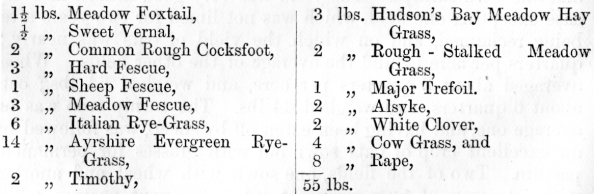
The land was top-dressed with 1 cwt. nitrate
of soda, 1 cwt. of dissolved bones, and 3 cwt. of bone meal to the acre.
All the covering the seed got was a careful rolling with the Cambridge
roller, and thus all the seed came up regularly. About the beginning of
August the ground was ready for sheep, but care was taken lest the sheep
should make it too bare. They were allowed to crop only so as to secure a
good sole. In September following the land was again heavily rolled with
the view of preventing the plants from being thrown out by the action of
the frost. It is now twenty-three years since the piece of land these
remarks refer to was laid down as permanent pasture, and since then it has
not been broken up. But thirteen, ten, and nine years ago it was re-sown
with the same mixture of seeds as at first, with the exception of rape,
cowgrass, timothy, and trefoil, and top-dressed with 1 cwt. nitrate of
soda, 1 cwt. superphosphate, and 3 cwt. bone meal, and afterwards rolled
about the end of April. Before being re-sown the land was gone over with
heavy iron harrows to loosen and tear up the fog with which the ground had
become overrun, especially the poorer soils. The fact of the land having
been under sheep made it run much more quickly to fog than if it had been
grazed by cattle and horses. By the above method, however, the pasture was
renewed at less expense and more satisfactorily than if had been broken up
and put through another complete rotation, which would have necessitated a
lapse of six years before the pasture would have reached its previous
richness. And besides this, the breaking up of the land would have created
an eyesore in the pleasure grounds. The other portions of the ground which
were of a better quality were first cropped with turnips, laid down with a
compost of pulverised earth and lime in proportion of a cubic yard of peat
earth to 6 cwt. of English lime, mixed together several months before
being used. Of this mixture 28 loads were given to the acre, along with 1
cwt. Peruvian guano, 2 cwt. bone meal, and 2 cwt. of the best dissolved
bones. The turnips were eaten off by sheep, and in spring oats were sown
which yielded at the rate of 6 quarters to the acre with a heavy crop of
straw. After harvest the land was ploughed, and in spring grubbed and
harrowed, and in May sown with grass seeds of the same variety and
quantity as already mentioned, mixed with a bushel of barley to the acre,
for the purpose of sheltering the plants while young. At the sowing of the
seed the land was top-dressed with 3 cwt. bone meal, 1 cwt. Peruvian
guano, and 2 cwt. best superphosphate of lime. The grasses came away so
rapidly that sheep were pastured on the land about the end of July. Since
first sown out, the better land was treated in the same way as the lighter
soils. For several years back cattle have grazed upon these permanent
pasture lands from the beginning of July till the middle of September,
which has greatly improved the grasses as wintering for sheep, and has
destroyed the fog and strong tufts of natural grasses which sheep do not
eat. Old as the pasture now is, it still continues good, but the poorer
parts and the portions most overrun with fog will be re-sown and
top-dressed as formerly.
The portion of the reclaimed land not included
in what Mr Matheson holds in his own hands was laid out in carefully
graded crofts and farms, the latter ranging from 30 to 300 acres, and the
former from 5 to 20 acres. The advantages of gradation were fully
recognised by Mr Matheson, and in this respect his property is a perfect
model. The new farms and crofts were all laid out according to a
pre-arranged plan, and before being handed over to the tenants were fully
supplied with roads, fences, and houses. As already stated, about 50 miles
of private roads were made; and in enclosing and subdividing farms and
crofts, 92f miles of stone dykes and 62½ miles of wire fences were
erected. The stone dykes are 5½ feet high, exclusive of the cope, above
the surface of the ground. There are three courses of through bands in the
height of the dyke, 6 feet apart, and bedded in lime. The cope is also
bedded in and pointed with lime, while all the dykes along the roads, and
the most of those forming divisions between farms, are harled on both
sides with lime. The wire fences are from 3 feet 10 inches high with 6
wires to 4 feet high with 7 wires. According to the position and the
required strength of the fences the wires are from No. 2 to No. 6 of
bright wire, galvanised wire, and galvanised strand wire. The wire fences
along roads have iron standards 1½ inch by 3/8 of an inch 6 feet apart,
and the subdividing fences have posts of larch from 6 to 7 feet apart,
with the bark taken off. The extreme straining pillars are 1½ inch square
with double stays, and at every 80 yards there are intermediate straining
pillars of the same size. The whole of the wire fences are painted with
Carson's anti-corrosive paint, which, on account of its durability and
cheapness, is also used extensively in painting outside woodwork of
buildings and farm implements.
In addition to the 4000 acres reclaimed, a
considerable extent of old land was redrained and remodelled and fenced,
and now there are upwards of 5000 acres under cultivation on the Ardross
east coast estates. There are in all 27 farms, paying from L.50 to L.800
of rent, and on the majority of these complete new steadings and
dwelling-houses have been erected by Mr Matheson, while most of the others
have been repaired and extended. The farm steadings are all furnished with
thrashing-mills, some being driven by steam, some by horses, and others by
water. The dwelling houses as a rule are handsome and commodious. The
crofters' dwellings and office houses are neat and convenient, A large
number of labourers' cottages have been erected of late, and now the
supply of these cottages on the Ardross estates is complete. The number of
resident labourers is quite sufficient for all the works on the estates,
and care is being taken that this shall continue so. The farms were all
subdivided to suit the five-shift rotation, and almost without exception
this course of cropping is adhered to. The soil, generally speaking,
consists of heavy brown loam lying on a clayey subsoil, and is found to
produce very good crops of both cereals and green crops. Almost the whole
of the arable land has a pleasant southern exposure. The average rent of
the new land is 21s. per acre, and of the old land which has been
remodelled, from 28s. to 40s. per acre. The first nineteen years' lease on
most of the new farms will expire within a year or two, and the farms have
all been re-let to the old tenants at a slight increase of rent. The
estate regulations under which these farms are let are carefully drawn out
printed documents—much superior to the ancient written lawyer leases. The
clause bearing on improvement is as follows:—"The tenants will be allowed
on interest lime, at the ship's side, in such quantity as may be
considered necessary for their lands, and a sum per acre as may be agreed
upon for trenching, draining, and otherwise improving their lands. They
will also be allowed on interest, iron wire, and cost of erection of
fences for closing and subdividing their farms where stones cannot be
obtained. All the above interest to be at the rate of 5 per cent. per
annum, payable along with the rent. The tenants will be allowed, free of
charge, tiles for draining where stones cannot conveniently be got, wood
for intermediate standards for wire fencing, and timber, and lime for such
additions as may be considered necessary for the accommodation of their
farms erected to a plan approved of by the proprietor, such fences and
buildings to be left in a tenantable state of repair at the end of the
lease."
Before leaving Mr Matheson's east coast
estates, we may briefly refer to the extensive and important improvements
he has carried out on his west coast properties at Strathcarron in the
parish of Lochcarron, at Strathbran in the parish of Contin, at Ardintoul
in the parish of Glenshiel, at Inverinate in the parish of Kintail, at
Balmacara, and Duncraig. At Duncraig a very handsome new mansion has been
erected since 1866, and furnished and fitted up with all the modern
appliances. New gardens have also been made here, the site chosen being a
narrow gully between two high ridges of rock. The rock was cut away on
both sides, and a level upwards of two acres in extent having been formed,
soil composed of virgin soil and turfy loam, from a loch near by, was
spread at considerable depth on the level, and thus a very rich fertile
garden was formed, where before there was nothing but bare rock. The
scenery around Duncraig is really magnificent, and the landscape
immediately in front of the mansion very picturesque. The grounds are
formed of wooded knolls and grassy valleys, which have been improved and
tastefully laid out under permanent pasture, and the blending of rock,
wood, and waving grass is pleasant in the extreme. About 12 miles of
private drives and walks were formed around Duncraig, and in some cases
these had to be cut out of the solid rock. At one or two points, in fact,
the road had to be formed in the face of a rocky precipice, rising more
than 100 feet sheer up from the sea. It is intended to form a home farm at
Achindarroch, abort a mile south of Duncraig, and there some 200 acres of
land have been reclaimed. Operations were begun here about eight years
ago, and have proceeded quietly and steadily since then. Roads had first
to be formed, and then draining, trenching, &c, and stone clearing
followed. The land in its natural state was dreadfully rough and quite
full of stones, and before it was ready for the first crop it necessitated
an outlay of from L.25 to L.30 per acre. Rape, top-dressed with from 4 to
8 cwt. of bone meal, was grown as a first crop, and this having been eaten
off by sheep, the land was ploughed and sown with oats. Turnips and
potatoes followed next year, and then the land was sown out with oats and
grass seeds, and allowed to lie under grass for a few years. The crop in
every case was excellent, and there is every prospect of the new land
becoming very rich and productive. The original value of the land
reclaimed from moor and moss was very little over 1s. or 1s. 6d. per acre,
and now it is worth from 30s. to L.2 per acre. A few small patches of
these 200 acres have been in cultivation for many years, but when it is
mentioned that the whole, along with a very large outrun, was leased,
previous to 1868, by two tenants at a gross rent of L.40, it will be
imagined that it was not in a very fertile condition. A barn, about 30
long by 10 feet wide, afforded ample storage room for the whole year's
crop! Ten dairy cows, twelve Highland cows, and the carriage and riding
horses, are kept at Achindarroch, while Mr Matheson's Cheviot hoggs are
wintered here. His stock of sheep numbers about 1700 Cheviot ewes. A great
many crofters are situated along the coast in this neighbourhood, and, by
encouragement from Mr Matheson, almost all of them have considerably
improved their holdings.
At Balmacara 50 acres have been reclaimed,
within the past five years, from hill, moor, and moss. The land here has a
southern exposure, looking right into the Isle of Skye, and the. soil is
sharp and fertile. The subject here was not nearly so rough as at
Achindarroch, and the cost of reclamation was considerably less. The land
was first drained, then ploughed with a heavy plough drawn by three
horses, and cleared of stones and prepared for cropping in the usual way.
Oats generally yield from 3½ to 5 quarters per acre, and weigh about 42
lbs., while turnips and potatoes grow well. Barley has been tried, but for
this variety of grain there is too much rain and too little sunshine all
along the west coast. A great many new houses have been built on the west
coast properties within the past twenty-one years; and for some years back
the whole rental of these estates, and sometimes a good deal more, has
been expended upon them in improvements of various kinds.
At Inverinate, on the shores of Loch Duich, Mr
Matheson really began his west coast improvements about 1847, A fine
mansion-house was built, and surrounded by tastefully laid out gardens and
grounds, the greater part of which was reclaimed from the sea; and, in
addition to all this, close on 300 acres of land were either reclaimed or
remodelled and improved. Inverinate Lodge is let to a sporting tenant, and
a new lodge, recently built at Dorrisduan, is also occupied by a
sportsman.
At Strathcarron about 200 acres of land have
been reclaimed and a good many crofters' cottages built, concrete having
been used in consequence of stones being difficult to procure.
Arrangements have been made for the building of other eight concrete
cottages; and here, as well as at Strome Ferry and Balmacara, a commodious
hotel has been built. The arable land at Strathcarron is taken up
principally by "Club Farms," of which there are no fewer than seventeen on
Mr Matheson's estates. This "club" system is an excellent one. A tract of
say 50 or 60 acres of arable land is occupied by four or five tenants,
each having his own separate croft, and attached to these 50 or 60 acres
is a large outrun, upon which a "common" flock of sheep is kept. The flock
is not composed of so many belonging to one tenant, and so many to
another, as in the case of the ancient commonty system, but is the joint
property of these four or five tenants. Two of the tenants are appointed
annually to buy in the sheep, manage them on the pasture, and sell them
off at the appointed time. A balance is struck every year, and the
proceeds are divided equally among the tenants. Each club farm has its own
mark for its flock, which, in fact, is managed in every way as if it
belonged to one man. Of the seventeen club farms on Mr Matheson's estates
three are on the east coast and fourteen on the west coast. The total
number of tenants on these farms is 101, the number in a club ranging from
two to ten. The total sheep stock is about 8000, and the arable area about
900 acres. Blackfaced sheep principally are kept on these farms.
In addition to all these gigantic agricultural improvements, Mr Matheson
has done a great deal in the way of planting. On the east coast estates he
has planted 5000 acres, divided into 56 plantations and 43 clumps; on the
west coast properties he he has planted 1500 acres, divided into 21
plantations and 12 clumps; and thus he has planted in all 6500 acres,
every acre of which is substantially enclosed.
It is worthy of remark that among the first
steps taken towards improvement at Ardross was the establishing of a
school in the district. The school stands at the roadside, not far from
the castle, and is now attended by about 140 pupils. The whole population
of the district, in 1847, was only 109. Great as the land improvements
have been they are not yet finished. At Ardross there are at present two
farms—Baldoon and Crannich— in course of improvement, and it is in
contemplation to form a new farm at Stittenham. On the west coast the
improvement of the estate of Attadale is contemplated. This estate is at
present in the hands of one tenant, but it is intended to divide the
estate into four farms with new steadings and dwellings, and also make a
considerable addition to the arable land. The improvements of the farms of
Fernaig, Achmore, and Braeintrah is also contemplated. We have devoted a
good deal of space to Mr Matheson's many and various improvements, but
when it is mentioned that, in round numbers, they entailed an outlay of
something like L.150,000, it will be admitted they fully merit the notice
they have got.
One of the principal holdings on the Ardross
estates is the farm of Dalmore, occupied by Mr Andrew Mackenzie, son of
the respected factor on the property. The extent is about 370 acres'
arable and 50 in pasture. The soil is light, but kindly, and has curious
veins of gravel running through it all over the farm. The usual
five-course rotation is followed, the best land being sown with wheat, the
medium soils with barley, and the lighter gravelly parts with rye. With
the view of obtaining a good supply of straw, as much wheat as possible is
grown, and the favourite varieties are Chedham and Hunter or Essex white
wheat. The seed is changed every three years, generally from the south of
England, and from 3 to 4 bushels are given to the acre. The yield varies
from 3½ to 4 quarters per acre, and the weight from 60 to 62 lbs. per
bushel. The favourite variety of barley is Hallet's Pedigree Barley. The
barley seed is also changed every three years, and about 3 bushels of seed
are allowed to each acre. The Pedigree variety grows more straw than the
ordinary chevalier variety, and for this reason is used the most
extensively. The yield averages about 5 quarters per acre, and the weight
ranges from 54 to 56 lbs. per bushel. The Sandy variety of oats stands
supreme in Ross-shire. It usually affords a heavy yield of straw, and
where so much attention is paid to feeding, the crop of straw is a very
important consideration. Mr Mackenzie grows no oats but the Sandy variety,
and usually reaps from 4 to 5 quarters from each acre, the weight ranging
from 40 to 42 lbs. per bushel. About 4 bushels of oats are allowed to an
acre as seed. Eye grows very well on the thin gravelly land, and is on the
whole a remunerative crop, considering that it will grow well where no
other variety of grain would come away at all. It affords a fair crop of
straw, which is valuable for thatching purposes, and usually yields from 3
to 3½ quarters per acre, and weighs from 56 to 60 lbs. per bushel. The
land intended for turnips is subsoiled early in autumn by a steam tackle,
the "knifer" or subsoiling plough being always used. The object of this is
to stir up and loosen the land to a greater depth than it had hitherto
been. The knives of the plough penetrate to a depth of about 18 inches,
and give the soil a most thorough stirring. The plough takes a breadth of
3 feet at a time, and from 4 to 5 acres can be gone over in a day. The
total cost is about 30s. per acre, but high as this may seem, the system
has been found to be a most profitable one. A great many stones never
before touched by the plough have been taken to the surface by the knifer,
the smaller ones being used in "boxing" service roads. Immediately after
this stirring the land is cross ploughed by a pair of horses to a depth of
from 10 to 12 inches. In this condition the land lies till early in
spring, when it is grubbed and harrowed and cleaned in the ordinary way.
The weeds are carted into a heap and soaked with liquid manure, and after
being allowed to lie in this state for several years, the compost is used
as top-dressing. The farm manure is carted out into the field on which it
is to be used during the leisure hours of winter, and in this way time is
economised in spring. Turnip-sowing commences about the 18th of May, and
about a week previous to that the manure heaps are saturated with liquid
manure, which is poured into trenches dug across the midden to the depth
of about 2 feet and about 2 feet apart. About three-fourths of the turnip
break is put under swedes, the other fourth being sown with yellows and
white varieties for early use. For swedes the land is manured with from 30
to 35 loads of farmyard manure and 2 cwt. of bone dust, 2 cwt. bone meal,
1 cwt. of guano, and 1 cwt. of superphosphate per acre; and for other
varieties the dose is lessened a little. Mr Mackenzie is this year
experimenting upon the action of nitrate of soda. On one plot he added 1
cwt. of nitrate of soda to the mixture of artificial manure, on another ½
cwt., and on another ¼ cwt, and on the remainder of the field no nitrate
of soda has been sown. The effect of these special applications has not as
yet been ascertained, as the crop at the date of this report was still on
the field, but the result of the experiment will be of considerable
interest. [The turnips (Swedes), grown on each plot were weighed in the
last week of November, and, though the difference did not exceed a few
pounds, the greatest weight was reached by the roots grown without any
nitrate of soda. The conclusion come to, is that nitrate of soda is thrown
away when applied to a turnip crop on light land, such as that on which
this experiment was conducted. The turnips off each plot were stored
separately, with the view of testing their keeping qualities; and having
been examined the other day about the middle of February, were found to be
all equally sound.] The drills are about 28 inches wide, and from 10 to 12
inches deep. Turnips of all kinds usually grow very well, and afford a
yield of from 24 to 30 tons per acre. It will be seen that a very large
percentage of the mixture of artificial manure consists of bones in
various forms, and the object of this is to favour the growth of grass in
after years. Potatoes are grown only for home consumption. Almost all the
first year's grass is retained and cut as hay, not a hoof being allowed to
enter the field from the time the grain is removed till the gathering of
the hay. At one time the stubble land was overrun by sheep in autumn, but
Mr Mackenzie observed that in this way a great many of the roots of the
young grasses were torn out and destroyed from all further vegetation, and
now the land sown out with grasses in spring is kept clear of all kinds of
stock till after the cutting of the hay. About the first week of April the
young grass is top-dressed with 1 cwt. of nitrate of soda and 1. cwt. of
dissolved bones per acre, and about the beginning of July the hay is cut
with a mower, first put into "coles," and then stacked. The crop of hay
generally averages about 180 stones to the acre, and is invariably of the
finest quality. The aftermath is utilised in feeding sheep. Mr Mackenzie
keeps from eight to ten cows, and breeds from these and a shorthorn bull,
the present stock bull being Neagle, bred by Mr W. S. Marr, Uppermill,
Aberdeenshire, and after Royal Prince, Mr Marr's well-known K.C.B. bull.
The extent to which feeding is carried on at Dalmore is really wonderful,
but this shall be noticed at greater length further on. About the end of
September or beginning of October Mr Mackenzie buys in from 250 to 300
Cheviot wethers and about 200 cast Cheviot ewes. The ewes are fed on cut
turnips and about 1 lb. per day of the feeding mixture; and the wethers
get turnips on the root, along with hay draff and 1 lb. per day of the
mixture. They are sold off generally in January or February. A very large
number of swine are also fed off every year, the variety kept being
Duckering's improved breed.
Reference has also been made to the farm of
Balintraid, on the property of Delny, which Mr Matheson acquired. This
large and highly-cultivated farm is tenanted by Mr Andrew Monro, banker,
Invergordon, and is rented at L.766. Mr Monro is an enthusiastic liberal
farmer, and besides cultivating his farm on the most approved principles,
feeds a large number of bought-in cattle during winter. He owns extensive
manure-works at Invergordon, and from these and the well-known
establishment of a similar kind at Bunchrew, owned by Messrs John Cran &
Co., more than two-thirds of the whole of the artificial manure used in
the counties of Ross and Cromarty are obtained.
On Mr Roderick Mackenzie's desirable little
estate of Kin-craig, in the parish of Rosskeen, is situated the fine farm
of Tomich, occupied, along with the adjoining small farm of Broomhill, by
Mr John Hall. Mr Hall has for many years been well known as an experienced
valuator of land, and thoroughly practical, intelligent agriculturalist;
and both with respect to cultivation and general arrangements, his farm is
indeed a perfect model. Tomich extends to about 400 acres, all arable, is
worked in seven shifts; and Broomhill, measuring 150 arable acres, in five
shifts. The land intended for turnips is subsoiled in autumn, cross
ploughed in spring, and well cleaned, and dunged with from 20 to 25 loads
of farm-yard manure, and 7 cwt. of bone meal, dissolved bones, and bone
ash, and 1 cwt. of Peruvian guana per acre. Of swedes about 3 lbs. of seed
are given to the acre, and of yellows about 2 lbs. Swedes usually yield 25
to 27 tons per acre. About one-half of the yellows and one-third of the
swedes are eaten off by sheep, the greater portion of the turnips being
cut and given to the sheep in boxes, instead of being left to be eaten on
the root. Mr Hall usually plants about 30 acres with potatoes, and for
this crop he prepares the land much in the same way as for turnips. About
the same quantity of farm-yard manure is given for potatoes as for
turnips, and for the former the following mixture of artificial manure is
allowed to each acre, viz., 1 cwt. Peruvian guano, 1 cwt. potash, 1 cwt.
dissolved bones, and 4 cwt. bone meal. The favourite varieties are Rocks
and Regents, and the yield usually varies from 5 to 7 tons per acre.
Potatoes are planted as early as possible in March. Wheat on an average
yields about 4 quarters per acre, and weighs from 60 to 62 lbs. per
bushel; barley from 4 to 4½ quarters, and weighs about 54 lbs.; and oats
from 4 to 5 quarters, and weigh from 40 to 43 lbs. The varieties most used
are White Hunter and Fenton wheat, Chevalier barley, and Sandy oats. Mr
Hall keeps six cows to supply the farm with milk, and in the months of
April and May he buys in about 120 two-year olds, which he feeds for the
Christmas and January markets. In addition to an abundant supply of
turnips and hay, a liberal feed of cake and corn—a mixture of oats and
rye—is given all along, beginning with 3 lbs. a day, and increasing
gradually till from 8 to 10 lbs. per day are reached during the last
month. These 120 animals generally average about L.30 in the beef markets;
and in addition to these Mr Hall winters about 30 six-quarter olds and
about 20 calves. He also buys in 200 half-bred ewes, and by these about
300 lambs are usually reared. Both the young stock and the old are fed off
on turnips, hay, and cake during winter, and sold partly at Christmas and
partly in spring. Besides these, about 300 Cheviot wethers are invariably
bought in, and fed chiefly on turnips taken on other farms. These also get
a little cake and hay along with the turnips, and are sold off in January
and February. Mr Hall has been twenty-five years at Tomich, and during
that time he has drained the whole of it, some of twice over, in fact, at
his own expense; and in the way of fencing he has done a good deal. He has
also improved the farm steading, and built a very handsome dwelling-house,
all at his own expense; and in many other ways he has greatly improved
the farm. There are eight or nine cottages on the farm, and the servants
employed are mostly married.
Invergordon Castle and four or five very fine
farms in the neighbourhood belong to Mr R. B. Æ. Macleod of Cadboll, whose
very valuable and carefully managed estates lie in the parishes of
Rosskeen, Fearn, Tarbat, and Tain. The Cadboll property extends to 12,000
acres, all arable, with the exception of 1500 acres chiefly in the lands
of Fendorn, in the parish of Tain. The total rental of the property, which
contains several of the finest farms in Ross-shire, is L.11,568, the
increase during the past twenty-five years in the acreage rental being
about 25 per cent. Since about 1850, 1000 acres of woodland and rough
pasture have been reclaimed and converted into arable land of fair
quality, worth from 15s. to 25s. per acre. A large portion of the
reclaimed land was trenched to a depth of 14 inches, at a cost of about
L.12 per acre; and the remainder was ploughed with a substantial
implement. The soil generally in the property is light, sharp land, either
on boulder clay, gravel, or the Old Red Sandstone. The quality varies a
good deal throughout the property, and in some parts the rent per acre is
only 15s., while in others it reaches L.2. The rotation generally followed
is the five-course shift, with two years' grass. Few cattle are bred, but
a large number of crosses are bought in and fed for the winter and spring
markets. The farms vary in extent from small holdings of 10 acres to large
farms of 600 acres, all arable. The number of small holdings is very
large, the proprietor being-anxious to hold out inducement to careful
ploughmen, labourers, and others to take crofts or small farms equal to
their means, and thus to retain the working population in the country.
Many important changes have been introduced in the general system of
farming on the property since 1850. Artificial manures are now very
largely applied, the turnip break has been doubled in extent, and on many
farms double the number of cattle and sheep are kept now, as compared with
twenty-five years ago. In addition to the reclamation of these 1000 acres,
Mr Macleod has erected a number of excellent farm steadings, repaired and
extended others, drained 5000 acres with tiles, and erected two wooden
piers at Invergordon Harbour, at a cost of L.5000. The most correct idea
of the extent of these many improvements will be had from the fact that
since 1850 Mr Macleod has expended no less than L.40,000 upon his
property; and in addition to this, the tenants themselves have expended a
very large amount which it would be difficult to calculate.
The larger farms on the Cadboll property lie
near to Tarbat Point, but for convenience one or two of them may be
noticed here. Mr James Young, the able and enterprising factor on the
property, holds the farms of Cadboll, Cadboll Mount, and Loch-slin, which
together extend to 1000 acres, and are rented at L.1080. The course of
cropping generally pursued on these farms is the five and seven shift,
with two years' grass. Turnips are never repeated without an interval of
at least five years, but the lighter land is allowed to remain in pasture
as long as it retains the grass, and then it is broken up and sown with
turnips,
and laid down again with grass. Mr Young's consignments of live beeves to
the London Christmas market have been a credit to Ross-shire for several
years. He feeds 160 cattle, usually three-year olds, for the southern
markets, and winters 60 younger beasts. He breeds none, but buys in the
very best crosses to be had throughout the country, and in recent years he
has competed creditably with the well-known Aberdeenshire feeders in the
Smithfield market. His cattle are fed on turnips and straw, with a liberal
allowance of cake and corn during the last two months of their feeding. He
also keeps a superior stock of about 400 half-bred ewes, and from these
and Leicester-tups he rears from 500 to 600 three-part bred lambs, which
he feeds for sale in May or June of the following year. Sheep are fed on
turnips and hay, with a moderate quantity of cake and corn during the last
two months.
Almost adjoining Mr Young's farms is the
extensive farm of Balmuchy, occupied by Mr John Gordon. It extends to 450
acres, all arable, and is rented at L.630. The soil is mostly light
fertile loam lying upon the Old Red Sandstone, and has been under
cultivation for a very long time. The farm is worked on a six-shift
rotation—1st, turnips; 2d, barley; 3d, 4th, and 5th, grass; and 6th, wheat
and oats. The land intended for turnips is ploughed immediately after it
is cleared of grain, and allowed to lie in the furrow till sufficiently
dry in spring, when it is grubbed and harrowed, and thoroughly cleaned.
With the exception of a few acres of yellows for early use, the whole
break is put under swedes. In addition to 28 loads of farm-yard manure,
each acre gets from 6 to 8 cwt. of artificial manure, chiefly dissolved
bones and bone ash, with ¼ cwt. of nitrate of soda, as a stimulant. The
crop of turnips is generally a very heavy one, and very rich in quality.
The farm steading was thoroughly repaired by the proprietor at the
beginning of the present lease, and is in every way suitable for the
advanced system of farming pursued by Mr Gordon. The courts are all under
cover, and are very extensive and convenient for feeding, which is here
carried on on a most extensive scale. One large court, measuring 87 feet
long-by 50 feet wide, is covered by one immense roof, and is divided in
the interior into stalls, boxes, and folds, which afford ample
accommodation for no fewer than 53 feeding cattle. The arrangements for
distributing the food are very convenient, and with respect to light and
ventilation the erection is all that could be desired. These additions to
Mr Gordon's farm must have entailed a considerable outlay on the
proprietor, but considering- the facilities they afford for the production
of beef, the money must be regarded as economically applied. Mr Gordon
keeps four cows for a supply of milk, and rears the calves of these cows.
He buys in a great many of the best two-year olds to be had in the
country, and usually feeds about 130 cattle in the course of a year. But
of cattle feeding more anon. Mr Gordon also leases the large sheep farm of
Cashachans, lying on the Achinalt hills, and on the property of Mr Balfour
of Strathconon; and here he keeps a stock of Cheviot ewes. The weak ewes
and their lambs are drafted down to Balmuchy in December, and fed on grass
till the end of January; and in addition to this he buys in about 600
three-part bred hogs in the month of August, and sends them to the
Edinburgh market in prime condition for the butcher in the end of April or
beginning of May. For the first while they are fed on grass alone, and
afterwards they get turnips and a little artificial feeding stuff. They
are clipped before being sold, and when killed they usually weigh from 60
to 84 lbs. a head.
In noticing these farms here we have been
cutting before the point, and therefore we must retrace our steps a
little. In the parish of Kilmuir Easter, the fine old castle of Balnagowan,
the seat of Sir Charles W. A. Ross, Bart., lies snugly ensconced in one of
the most richly wooded policies in the north of Scotland. The Balnagowan
estate is spread over a wide district, and measures about 300,000 acres,
of which about 8000 acres are arable, 400 acres under wood, and 288,000
acres under pasture. In 1850 the rental was about L.7000; now it is
L.14,343. In 1850 no revenue was derived from fishings, and very little
from shootings, while now from these two sources Sir Charles derives an
income of L.4035. The actual rental for farms and pasture is thus about
L.10,308, which indicates a rise during the past twenty-five years of a
little over L.3000. The soil is generally light, except on about 1500
acres, where heavy clayey land abounds. The light land lies on an irony
pan or gravelly bottom. The holdings range from crofts of 1 acre up to
farms of 400 acres of arable land; and with one or two exceptions, they
have all less or more pasture land attached. On farms of above 100 acres
in extent, the houses have been very much improved of late, and now form a
most creditable feature on the estate. On the other hand, on the small
farms they are of an inferior class, built chiefly with stone and clay,
and thatched with "divots," overlaid with straw and clay. The proprietor
is turning his attention to the improving of these houses, and the work is
progressing rapidly. Since 1850 a good deal has been done in the way of
fencing. At that time only a few farms were fenced with dry stone dykes,
but now, all the large farms and many of the smaller ones are thoroughly
fenced. About 10 miles of fencing has been erected during the last two
years. The roads throughout the estate are very inferior, and a moderate
sum of money might be spent on their improvement with great advantage.
About 200 acres of woodland and waste pasture have been reclaimed, by
trenching to a depth of from 15 to 18 inches, within the past thirty
years. A large portion of this land, before being reclaimed, was worth
only 1s. per acre per annum, while now each acre yields a rent of from
20s. to 30s. The cost of complete reclamation, inclusive of draining to a
depth of 4½ feet with tiles, was from L.15 to L.20, and the prospects of
remuneration are good. For a few years new land is let at a nominal rent,
which rises in regular gradation every five years until it reaches its
real value, when it proves profitable to both owner and cultivator. A
considerable extent of old land has been drained, and great care is taken
in the cleaning out of outfalls and open ditches. All tenants paying
upwards of L.20 of rent have leases of nineteen years' duration; but the
majority of the crofters are simply tenants at will. Generally speaking,
the proprietor executes all improvements himself; and unless other
arrangements are made in the lease, the tenant pays interest on the
outlay, The average rent of arable land is about 25s. per acre, the
extremes being 5s. and 42s. The rise in the acreage rental of arable land
since 1850 varies from 5s. to 10s. The supply of labourers' cottages is
almost complete, though some of them are of limited dimensions. Servants
are mostly all married. The system of rotation generally pursued on the
estate is the five-course shift. Few cattle are reared, but a large number
of crosses is bought in and fed. The proprietor himself holds the Forest
farm, an extensive stretch of valuable pasture land, away up in the parish
of Kincardine, on which he has a large and very excellent stock of Cheviot
sheep. A considerable breadth has been planted since 1850, and every year
so many acres are cut down and so many planted.
The home farm of Balnagown is occupied by Mr
John Forsyth, factor on the estate, and it is worked on the five-course
shift. A few cross cows are kept, and the home-bred cattle are
supplemented by stirks bought in at convenient times. A few are tied up
for feeding about the 1st of September, and sent off about Christmas;
while the others are stalled in October, and sold off in spring. A large
quantity of cake is used in feeding. One of the finest holdings on the
Balnagown estate is the farm of Balnagore, occupied by Mr William Kelman.
It extends to a little over 300 acres, all arable, is rented at L.625, and
is probably one of the best lying, most compact, and neatest laid-off
farms in the county. In 1848 the proprietor took it into his own hands for
the purpose of improving it, and on the 13th of June of that year
operations were commenced in earnest. The greater portion of the land has
been under a sort of cultivation for hundreds of years. At the time the
improvements commenced there were, in the words of a talkative inhabitant
of the parish, no fewer than "thirteen reeks on the farm," mostly the
"reeks" of crofters' houses. Part of the low-lying land was in a wet,
marshy, useless condition, while a portion of the high land was under
stunted heath and green pasture. Squaring off the fields was the first
operation; and this, a most important point in connection with land
improvement, was done neatly and tastefully. The whole of the farm was
then thoroughly drained with tiles, brought into Invergordon by sea. The
draining done, the land was then ploughed with a heavy implement drawn by
three powerful oxen. Hedging was planted around the farm and between the
fields, and double wooden fences erected to protect the plants in their
tender years. These wooden fences were continually breaking down, and in
1853 substantial wire fences were erected in their stead; so that, in
addition to the hedges, which are now full grown, and which greatly
beautify and enliven the landscape, the whole farm is enclosed and
subdivided by double wire fences. The Fearn public road passes through the
farm; and for local convenience, an excellent turnpike road was
constructed right down the centre, striking off at right angles from the
district thoroughfare. A large and very convenient farm-steading, with a
steam thrashing-mill, was erected at the same time. The improvements
lasted well-nigh four years, and cost close on L.9000—rather a large sum
to be expended on one farm in those days. About twelve or fourteen years
ago, a handsome dwelling-house was erected by the proprietor, and recently
a large addition was made to it by the then tenant, Mr James Middleton. On
the completion of the improvements, Balnagore was leased by Mr Williamson,
who was factor on the Balnagown estate for many years, and in the hands of
Mr Williamson and his son it remained till about five or six years ago,
when it was let to Mr James Middleton, who held it for only two or three
years. Mr Kelman, who was formerly the tenant of an extensive farm in the
parish of Mortlach, in the county of Banff, entered the farm at Whitsunday
1873, and is working it on the most approved principles. The ordinary
five-course rotation is being pursued, and in the live stock department he
intends giving the breeding system a thorough trial. He has introduced
from Banffshire several very fine . black polled cows, and from these and
a shorthorn bull he is rearing calves of a very superior kind. He intends
breeding about fifteen, calves every year; and these, along with a lot of
bought-in stirks, will be fed off on turnips and cake when two and three
years old.
In close proximity to Balnagown grounds, but
in the parish of Logie, lies the valuable little estate of Calrossie,
belonging to Mr Andrew Hall. The Mains of Calrossie is one of the finest
farms in Rosshire, and is rented by Mr John Douglas for L.676. When Mr
Douglas entered this farm about ten years ago, the land was in very bad
order, but having been twice thoroughly cleaned and well cultivated, it is
now in excellent condition, and produces very fine crops of all kinds.
Almost the whole of the land is old, and lies on sandy subsoil, the soil
generally being heavy alluvial loam, ranging from 3 to 4 feet in depth.
There are a few patches of stiff clay throughout the farm, which is worked
on a five-course rotation. The heaviest of the alluvial land is allowed to
lie one year only under grass, a second crop of oats being taken instead
of a second year's grass. Wheat follows one of the oat crops, and the land
is dunged on the stubble with from 20 to 25 loads of farm-yard manure per
acre. Wheat usually yields about 4 quarters and 6 bushels per acre, and
seldom exceeds 60 lbs. in weight—which is accounted for partly by
insufficient drying in the stook, caused by the numerous clumps of trees
throughout the farm. Mr Douglas used to top-dress his wheat with about 1
cwt. of nitrate of soda and 1 cwt. of bone dust per acre, but believing
that this tended to lessen the weight of the grain, he has abandoned the
practice. He grew no barley for some years previous to 1874, but last year
a splendid crop of about 7 quarters per acre, weighing 55 lbs. per bushel,
was raised on one field; while this year he reaped an equally rich harvest
of barley from a small field after turnips which had been eaten off by
sheep. Oats weigh from 43 to 44 lbs. per bushel, and yield very well. The
average yield of wheat on Calrossie when Mr Douglas became its tenant was
only about 2½ quarters per acre, and that of other varieties of grain was
correspondingly low. Mr Douglas pays special attention to the cultivation
of the land intended for turnips. Early in autumn he ploughs it, in spring
he grubs it and rolls it, and grubs it and rolls it again, if necessary,
and harrows it thoroughly with rank iron harrows. Thorough cultivation is
found to be a great advantage, not only to the turnips,' but also to the
grain crop which follows, especially when that crop is barley. From 7 to 8
cwt. of artificial manure—bone manure chiefly—and about 25 loads of
farm-yard manure are allowed to each acre, and very fine crops both of
swedes and yellows are grown. A good deal of the turnips is eaten off by
sheep, the "stripping" system (i.e., pulling the one drill and leaving the
other) being adopted occasionally. Mr Douglas buys in from 400 to 500
three-part bred lambs in August, and gives them foggage and grass till the
middle of October, when they are put on white and yellow turnips till the
New-Year. They are then fed on cut swedes, hay, and a ½ lb. of
linseed-cake per day, which is by and by increased to 1 lb., and at the
1st of April this is supplemented by an equal weight of grain. As soon as
they are clipped—about the middle of May—they are sent to the market, and
usually average about 70 lbs. in weight. A large number of cattle is also
fed at Calrossie, but of this more anon. The farm horses are strong and
heavy, with a dash of the Clydesdale. The farm-steading is good and the
dwelling-house excellent, having been recently enlarged by the proprietor.
Two new and commodious labourers' cottages have also been recently erected
by the proprietor.
Another valuable little property in this
neighbourhood is the estate of Allan, belonging to Mr David Monro, an
enthusiastic agriculturist, and a gentleman of ability. He cultivates the.
home farm of Balinroich himself, and has taken a lively interest in the
agriculture of Ross-shire for many years. The soil on the greater part of
Balinroich is very rich fertile loam, and the finest crops of every kind
are raised on the farm. A part of it has been under grass for many years,
and still affords most valuable pasture for cattle, and in these days of
expensive labour, it is more remunerative to retain it under grass. Mr
Monro buys in cross stirks, and feeds them off when two and three years
old. Allan House, with its beautiful garden, spacious lawn, and
magnificent trees, lies in the centre of Balinroich, and is one of the
most charming residences in the county. Mr Monro at one time farmed the
whole of his estate himself, and about thirty years ago he reclaimed about
100 acres of rough, marshy land, on the farm of Clay of Allan, which forms
the other part of the estate.
About eight years ago Mr Jonathan Middleton
took the "Clay" on a lease of twenty-one years, at a rent of L.1039. The
Clay extends to about 570 acres, and lies almost as level as a
billiard-table. The soil is mostly strong adhesive alluvial loam, with
here and there subsoil beds of sand. Mr Middleton takes two grain crops in
succession, after one year's grass—first oats, and then wheat on his best
land, and wheat and barley after turnips on the second-rate land. His
course of cropping, therefore, is as follows:—Best land—1st, turnips; 2d,
wheat; 3d, hay; 4th, oats; 5th, wheat. Second-rate land—1st, turnips; 2d,
wheat; 3d, barley; 4th, grass; 5th, oats. This rotation may seem rather
strange, but it has been found to suit the peculiarities of the soil
better than any other yet tried. Every corn crop grown on the farm is
top-dressed, and the cross-cropped wheat is heavily dunged in autumn. The
hay crop is also well top-dressed, and for his outlay for top-dressing Mr
Middleton usually finds himself handsomely remunerated. Besides feeding
about 300 cattle (to which we shall afterwards refer), he feeds about 500
sheep every year. The sheep are bought in as lambs from local
sheep-farmers in the beginning of August, and are kept on grass till the
first of November, when they are put on turnips and hay, ad libitum. About
the first of February a small allowance of cake is given them, and in the
end of April or beginning of May, they are clipped and sent off to the
market.
Mr Middleton has been cultivating part of his
land by steam power during the past two seasons, and as far as can yet be
ascertained the effect is likely to be beneficial. The land intended for
turnips is very carefully cultivated and heavily manured, and the crop of
turnips usually ranges from 25 to 30 tons per acre.
Leaving the Clay and proceeding eastward, we
pass the extensive farm of Fearn [Since the above was written the farm of
Fearn has been let, along with Mulderg, on lease of nineteen years, to Mr
James M'Gregor and Brothers, at a consider-able rise on the former rent.]
so long occupied by the late Mr George Middleton, the neat, well-managed
little farm of Mulderg, leased by Mrs M'Gregor and family, and the compact
little estate of Rhynie, which has been considerably improved of late by
its owner, Mr John Robertson, and reach the property of Geanies, belonging
to the heirs of the late Mr Kenneth Murray. We were invited by the late Mr
Kenneth Murray to visit his picturesque residence and valuable little
estate, on Saturday the 8th of July last, and fearing that he would be
unable to return from a business trip to Stirling to meet us at Geanies,
he favoured us with a letter of introduction to his eldest son, asking him
to show us "the house and grounds, and be hospitable!" He was there
himself to welcome us, and exercise that hospitality which was so
characteristic of him; but alas! poor man, he is now no more. While on a
visit to the Duke of Sutherland at Dunrobin Castle, along with Sir Salar
Jung, he was taken suddenly ill, and on Monday, the 24th of July, he died,
his death being sorely lamented by a very wide circle of friends. The late
Mr Kenneth Murray was a gentleman of no ordinary stamp. His business
capacities were indeed wonderful; and besides acting as the Duke of
Sutherland's chief adviser in the carrying out of the extensive
reclamation works now going on at Lairg, and managing his own property and
superintending improvements and changes on several other estates
throughout the country, he acted as agent for the Commercial Bank of
Scotland in Tain, was Provost of that burgh, and paid close attention to
all matters connected with the county. His experience as an agriculturist
was extensive, and by farmers and others his advice was often asked, and
always heartily given. Verily, we shall not soon look upon his like again!
In 1840, when Mr Kenneth Murray obtained
charge of the estate of Geanies from his late brother, Mr William Murray
(who died about ten years ago, leaving Mr Kenneth as proprietor) the
arable area was only 2016 acres. But Mr Kenneth immediately began
improving and reclaiming, and in a wonderfully short time he extended the
arable land to about 4000 acres. The new land was reclaimed partly from
moor, partly from bog and moss, and partly also from lochs. Lochs were at
one time very numerous in this district, and in consequence the
inhabitants were frequently troubled with ague and kindred diseases.
Mildew used to prevail greatly, but the thorough draining of several of
the smaller lochs and the land around them has done away with it entirely.
In 1843, the rental of the estate was L.2160; now it is L.4397. The
mansion-house of Geanies is beautifully situated on the top of a mound,
terminating abruptly in the Moray Firth. The garden and grounds are
magnificent, and from the lawn in front of the house a most delightful
view is obtained across the Moray Firth, and all around on the right and
left. An eminent Scotch professor, who happened to visit Geanies shortly
before the death of Mr Murray last summer, remarked to the writer, that,
"without doubt it is the finest view of the kind in Britain, if not indeed
in Europe!"
The land reclaimed by Mr Murray turned out
exceedingly well, and of this one notable instance may be given. About
thirty years ago a field of 20 acres, near the public road from Fearn to
Tarbat, was reclaimed and cultivated according to the advice of the late
Mr George Middleton, and manured well with farm-yard manure and fish
garbage, and sown with wheat in the month of November. The crop came away
very well, and no less than 5 quarters of very fine grain were reaped off
each acre, the variety of wheat being Red Lammas, supplied by Mr Monro of
Allan. For this very fine sample of grain, weighing 64 lbs. per bushel, Mr
Murray obtained only 36s. per quarter!
The home farm of Geanies is leased, along with
the large farm of Ardboll Mains, by Mr William Douglas. Both are worked on
the usual five-shift rotation, and by liberal and systematic farming the
richest crops of all kinds are usually produced. The farm of Arboll has
already been referred to as the scene of early agricultural improvements,
and within the past thirty or forty years it has been greatly improved by
draining and fencing and the like, chiefly by the late Mr Douglas, father
of the present enterprising tenant. On the compact little estate of
Rockfield, the proprietor, Mr Munro, has executed considerable
improvements of late.
Retracing our steps from Tarbat, through Fearn,
and turning away northwards into Tain, we pass from a rich agricultural
district to an immense stretch of thin, barren, mossy land, intersected
here and there with small patches of arable land. The small estate of
Bogbain, containing one moderately-sized farm and four crofts, lies only
about a mile northwards from Fearn Station, around which the land is
rented at about L.2 per acre; and yet the soil on Bogbain is so very thin
and unproductive as to be worth very little more than 10s. per acre. The
subsoil is almost as close and retentive as a block of hardwood; and when
water collects on the hollows of the fields, which it often does in
consequence of the low level at which the estate lies, a considerable time
usually elapses before it wholly disappears. It is no uncommon thing in a
wet harvest to see the sheaves of grain submerged in a flood of water.
The majority of farms in the parish of Tain
are small, and in Edderton there are very few large farms. The larger
portion of the latter parish is on the estate of Balnagown, which has
already been noticed pretty fully. The largest farm in the parish is
Ardmore, occupied by Mr George Cruickshank, and situated on the Balnagown
property. It extends to about 400 acres of arable land, and 400 pasture,
and is rented at L.662. The soil generally is light, and the climate very
dry. The five-shift rotation is pursued, and very fair crops are raised.
Mr Cruickshank has reclaimed close on 150 acres during the past nineteen
years, mostly at his own expense, and has otherwise improved the farm. No
cattle are bred on the farm, but a good many are bought in and fed off
during the winter with turnips and from 2 to 6 lbs. of cake per day. Mr
Cruickshank also holds the large sheep farm of Strathbran, in the parish
of Contin, and here he keeps a stock of Cheviot sheep.
The parish of Kincardine contains an immense
stretch of pasture land and only a few large arable fauns. On the little
estate of Invercharron, around Bonar Bridge, there is a small tract of
very fine arable land, worth about L.2 per acre. The farm of Mains of
Invercharron is occupied by Mr James Davie, a native of Aberdeenshire, and
is rented at L.400. The soil on the most of the farm is rich alluvial
land, and under Mr Davie's liberal treatment it yields excellent crops,
both of grain and turnips. Wheat often yields as much as 5 quarters, and
the average is about 4 quarters. Oats average about 5 quarters, while as
many as 30 tons of turnips are grown on an acre. Mr Davie breeds very few
cattle, but he feeds a good many, selling them off as two and three-year
olds. A small portion of the Ardross estate lies in this parish; here also
improvements have been executed by Mr Matheson. In 1847, when the
potato-disease left so. many Highland homes destitute of food, Mr Matheson
organised a scheme whereby the starving natives were tided over their
difficulties, and his own estate and the country generally very
considerably benefited. Plans were drawn out and arrangements made for the
reclamation of large stretches of waste land, and at these works the
natives were employed and remunerated for their labour by meal and money
for the maintenance of themselves and their families. In this way the
greater portion of the farm of Upper Gledfield was brought under
cultivation. It extends to 180 acres, and is leased by Mr George Anderson
at a rent of L.162. The soil generally is thin, but fairly productive. The
fields are nearly square, and well fenced with dry stone dykes. The
five-shift rotation is pursued, oats being the predominating variety of
grain. From 10 to 12 acres are usually put under barley, and the yield
averages close on 4 quarters per acre. Oats range from 4 to 5 quarters,
and weigh about 43 lbs. per bushel. The exposure is northern, and harvest
is seldom commenced before the first week of September. The land was limed
with about 20 bolls per acre when reclaimed, and the effect of the lime is
still appreciable on the grass, though the most of the farm would be
better of another dose of this valuable fertiliser. Only a few cattle are
fed, and consequently Mr Anderson seldom manages to spread his farm-yard
manure over more than about half of the turnip land, the other half
being-laid down with from 2 to 3 cwt. of bones and superphosphate. The
turnips grown by artificial manure are eaten off by sheep, and thus the
land is partly compensated for the want of the more substantial manure
from the court-yard. Ten cross cows are kept, and the progeny of these are
usually fed off as two-year olds. A small outrun is attached to the farm,
and on it about 200 blackfaced sheep are grazed.
Wester Ross.
This division contains by far the greatest
number of acres, but consisting, as it does, almost entirely of high hills
and sheep grazings, it is of little importance in a purely agricultural
point of view. The arable area in the whole division is very small, and
indeed there is no great encouragement, either to landlords or tenants, to
add much to it. For sheep farming, however, Wester Ross is quite as
favourably known as Easter Ross is for arable farming; and it is the
combination of these two branches of rural industry in such perfection
that places the counties of Ross and Cromarty so well into the front among
the other counties in Scotland.
Mr Matheson's extensive improvements on the
west coast have already been noticed, and now we shall refer briefly to
the operations of another enterprising proprietor of hill lands in
Ross-shire, Mr John Fowler of Braemore. The estate of Brae-more was
purchased by Mr Fowler, who is well known in engineering circles in
London, in 1865, and the adjoining property of Inverbroom in 1867. The
total acreage of both is about 40,353, and the annual valuation about
L.2500. They lie in the parish of Lochbroom, and are very romantic and
mountainous. Immediately on obtaining possession, Mr Fowler began
improvements in real earnest, planting having been commenced in the autumn
of 1865. By the end of the season of 1867 about 1000 acres had been
planted and fenced; and since then other 200 acres have been put under
wood, mostly Scotch fir and larch, with a few spruce and hardwood trees,
where the ground was thought suitable for these varieties. In the autumn
of 1866, the erection of a mansion-house commenced, and in two years it
was completed and ready for occupation. It is a very handsome structure,
and stands on the side of a hill, looking right down Lochbroom, and
commands views, in front, to the right, and to the left, which for
grandeur and extent it would be difficult to surpass. A large garden and
vineries were also constructed, while at the same time a commodious range
of stabling and other houses was erected. On Inverbroom there is a
considerable extent of arable land along the river sides, and of this
several acres have been reclaimed and improved by Mr Fowler. A good deal
of the old land has been drained, and the fields squared up and fenced. In
addition to all this, several miles of roads and hill paths have been
made, and three very handsome iron bridges have been erected. One of these
bridges carries a roadway over the river, and has a span of 100 feet; and
another is a light foot suspension bridge, thrown over the picturesque
gorge of Corrie-Halloch. This gully is described as a high longitudinal
fissure in the mountain side, over a mile in length, and from 200 to 300
feet in depth. The bridge is 84 feet in span, and crosses at a point where
the river takes a sheer leap downwards of about 100 feet; and the view
obtained while standing on the bridge is not surpassed by anything of the
kind we have ever seen in the Scottish Highlands. Mr Fowler has also
expended a good deal of money in improving the accommodation for salmon
and trout in the river and lochs, and even yet minor improvements are
being carried out every season. Sir Ivor B. Guest, the enterprising
proprietor of Achuashelloch, has also effected great improvements on his
mountainous property, by planting, fencing, building, road-making, and
reclaiming small pieces of land; while on the estate of Lochcarron not a
little has been done.
The Lewis.
In 1844 this immense tract of land, extending
to 417,416 acres, was purchased from the Seaforth family by Sir (then Mr)
James Matheson. Immediately on obtaining possession Sir James began
improvements on a very large scale, and ever since they have been carried
on with surprising vigour and enterprise. In 1844 the condition of the
Lewis was primitive in the extreme, and even after thirty years of great
activity and heavy expenditure of money, the island is hundreds of years
behind the social standard of the nineteenth century; so gigantic and so
stubborn is the subject with which Sir James has had to deal. We cannot
acquiese with those modern tourists and other writers, who so unmercifully
denounce the landed proprietors of the Highlands of Scotland for what they
are pleased to call their " utter neglect of the many hundreds of starving
subjects that live among their hills and glens." No doubt, more activity
and consideration might be displayed in one or two individual cases, but
we maintain, that over the country generally a great deal more is being
done at the present day for the amelioration of the population of the
Highlands than at any previous period of our nation's history. Many
influences combine to make improvement in the Highlands a very slow
process; but, nevertheless, a great stride has been taken in the march of
civilisation during even the last quarter of a century. And we make bold
to say, that no living man has done more in this good work than the
respected proprietor of the island of Lewis.
Since 1845 Sir James has trenched, drained, enclosed, and divided into
farms and crofts about 900 acres, and drained, remodelled, and fenced
another 1000 acres, most of which had previously been under rude
cultivation. In addition, the extensive grounds which surround the castle
have been thoroughly trenched, drained, and levelled; and within the
policies large tracts have been laid out in pasture grass, part of which
is kept for meadow hay. All the farm-houses and steadings on the estate
have either been built anew or added to and repaired by Sir James; and
substantial assistance has been, and is still given, to the crofters, to
enable them to improve their houses, crofts, and gardens. When it is
remembered that there are about 3500 crofters' houses on the island, and
that wood, lime, and slate have all to be imported, it can well be
imagined what a huge and expensive task the thorough improving of these
holdings really is. Railways are as yet unknown in the Lewis, though an
approach has been made in a line of tramway about four miles in length,
laid for the conveyance of the estate peats from the peat banks to the
cart roads. Since 1844, about 170 miles of thoroughly substantial roads
have either been made anew or completely overhauled and repaired, supplied
with firm stone and lime or wooden bridges. Soon after Sir James got
possession, the work of building a castle was commenced; and in 1870 a
handsome and imposing pile was completed, at a cost of L.40,000. The
ground around the castle was at one time very rough and uneven; and in
bringing this into harmony with the castle, Sir James has expended close
on L.49,000. Within these policies large gardens have been laid out, and
numerous walks and carriage drives constructed with true artistic taste.
The result of all this outlay of money and labour is, that Sir James
possesses a castle and policies, which for beauty and extent compare
favourably with any in the kingdom. In various other ways, in educating
and feeding the population, in improving the town of Stornoway and its
harbour, in planting woods, &c, Sir James has also expended much labour
and money. Instead of dilating further on all these undertakings, we
simply subjoin a table of his principal expenditure, as the best way of
affording a correct idea of the magnitude of his works:—
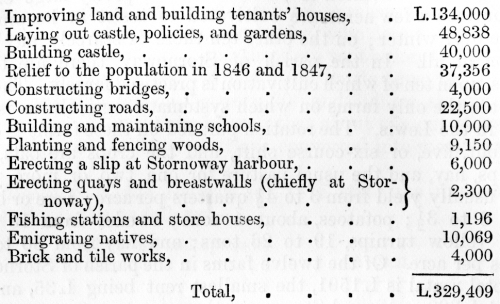
In addition to this immense sum, Sir James
expended many smaller sums for the benefit of his estate and its
inhabitants; and, with the exception of L.30,000 obtained from the
Government Drainage Loan Commissioners, the whole outlay has been direct
from his own purse. In the years 1846 and 1847 the potatoes in the Lewis,
as in the north generally, were destroyed by the potato blight, and the
inhabitants left almost destitute of food. At this juncture Sir James came
forward with true and characteristic liberality, and imported large
quantities of meal, potatoes, &c, for distribution among his starving
tenants, who afterwards repaid him by labour to the extent of L.23,531.
The agriculture of the Lewis is so peculiar to
itself, that instead of treating of it along with the mainland of the
county, we shall here discuss it as concisely as possible. According to a
return taken up in 1875, there were in all 14,362 acres under cultivation
and permanent pasture, exclusive of hill, moor, and mixed grass and
heather pasture. These acres were disposed as follows:—
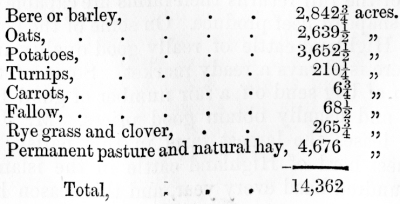
Fishing and cultivating crops are the chief
industries in the Lewis; but to the crofting system we will afterwards
refer. There-are only thirty-six farms on the island, and most of these
are small, their total rental being L.4827, 16s. 10d. On twelve of these
farms cultivation is carried on to a pretty large extent; on fourteen a
few acres are cultivated to assist in keeping the cattle over winter; on
the other ten there is scarcely any cultivation at all. In the parish of
Stornoway there are twelve farms, upon ten of which cultivation is
practised largely. These, in fact, are the only farms on which systematic
agriculture is pursued in the Lewis. The rotation pursued on these farms
is either the four, five, or six-course shift, and the crops are oats,
bere, turnips, hay, and the usual pasture for one, two, or more years.
Oats usually yield from 3 to 4½ quarters per acre; bere or barley from 3
to 3½; potatoes, about 4 tons; swedes from 18 to 24 tons; yellow turnips,
19 to 26 tons; and hay from 80 to 120 stones per acre. Of the twelve farms
in the parish of Stornoway, the total rental is L.1501, the smallest rent
being L.35, and the largest L.320. Around Stornoway there are twenty-seven
parks, let to townspeople at rents from L.1 to L.3, 10s. per acre, the
total rental of these fields being L.272. There are also fifty-seven lots
of potato land of ¼ of an acre and upwards in the neighbourhood of the
town, and these are let to townspeople at a total rental of L.40, 9s. The
other twenty-four farms are mostly devoted to the rearing of sheep and
cattle, and are apportioned among the other three parishes as follows:—Barvas,
eight farms, with a rental of L.510; Lochs, six farms with a rental of
L.1093; and Uig, ten farms, with a rental of L.1410.
According to the Board of Trade Returns, the
number of cattle in Lewis in 1875 was a little under 12,000. On the farms
in the Stornoway district and on a few others, the cattle were mostly
Ayrshires, or crosses between the Ayrshire and other breeds; but on the
grazing farms on the other parts of the island, as on the crofts, the
cattle are of the Highland breed, and generally of an inferior class. The
Lewis farmers, like many of their brethren in other parts of Scotland,
breed too few cattle for themselves, and have too often to fill their
byres with the inferior animals reared on the crofts around them; and thus
they deprive themselves of the full returns their farms are capable of
affording them in the shape of beef produce. On some of the better grazing
farms, a few Highland cattle of really good quality are bred, and for
these there is always a ready market. Some of the farmers in the parish of
Uig send off a fair number of good Highlanders every year, and usually
obtain good prices. Mr James Mackenzie, who leases the largest farm in
this parish, Lynshader, owns the finest herd of Highland cattle in the
island; he sells about one hundred head every year, and this season he
obtained L.15 a-head for a fine lot of thirty-three three-year old
Highland bullocks at the farm. The Lewis cattle are sold off, partly at
the Stornoway market, which is now held three times a year (instead of
twice, as formerly), and partly to dealers who traverse the island, buying
up the cattle for the Stornoway butchers. A large number both of cattle
and sheep are purchased annually by Mr Samuel Newell, Skipton, Yorkshire,
who leases two farms in the parish of Stornoway, and these are sent either
to Skipton, Glasgow, or Falkirk Tryst. About 1500 cattle leave the island
annually, and in addition, between 200 and 300 are slaughtered in
Stornoway. It will thus be seen that about one out of every seven or eight
of the Lewis cattle is converted into money every year.
The Board of Trade Returns for 1875 state the
number of sheep in the Lewis as follows:—
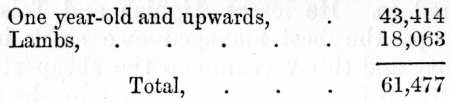
Considerable difficulty is usually experienced
in obtaining correct returns from the crofters, and therefore these
figures can hardly be guaranteed. The principal sheep farms are Park, in
the parish of Lochs; Lynshader, in Uig; Galson, in Barvas; and Gress,
Tolsta, Coll, and Aignish, in Stornoway. Besides these there are eleven
farms upon which sheep stocks of from 350 to 700 head are kept along with
cattle, and a few others upon which there are from a few scores to one or
two hundred sheep. The breeds kept are Cheviots, Blackfaced, and crosses;
and for a few years past half-bred and grey-faced lambs have been tried on
two farms. The farm of Park, extending to upwards of 70,000 acres, is
rented by Mr P. P. Sellar, at a rent of L.778, 2s. On the best of the land
he keeps a hirsel of ewes, and on the more moderate parts a stock of
wethers are grazed. Mr Sellar leases a large extent of sheep grazings in
the mainland of the county, and from these he brings the wether hogs to
Park in the month of April, retaining them there till they are two years
and five months old, when they are removed in the month of September for
feeding. Mr Sellar also rents land from year to year in the neighbourhood
of Stornoway, and here he winters hoggs and Dinmonts, and lambs, and the
weaker portion of the Park ewes. Mr Mackenzie, Lynshader, leases some of
the finest grazings in the island, and pays a rent of L.425. He is more a
breeder of Highland cattle than a sheep farmer, but still he keeps a very
fine flock of Cheviot sheep, and sends away from three to four
hundred-well-conditioned sheep every year. Galson is the next largest
sheep farm. Mr Smith, from Caithness, entered this farm at Martinmas 1869,
but after trying several experiments with his stock, and getting a good
deal of money laid out on the farm, he handed over his lease at Whitsunday
last to Mr Helm, tenant of the Holm farm, in the parish of Stornoway. Mr
Helm now holds, in addition to Galson, the Barvas Glebe grazings, on the
north-west side of Lewis; the farm of Holm and the Sandwich Hill parks,
&c, on the south-east side of the island, and a large sheep farm in Morven,
in Argyllshire. He keeps a mixed stock of Cheviot, Blackfaced, and cross
ewes on Galson; and this season he had four different breeds of lambs for
sale off the one farm—rather too many kinds for a farm that is barely able
to maintain a stock of 2000 sheep. Mr Helm took over this mixed stock from
Mr Smith, and it is more than likely he will take an early opportunity of
reducing the number of breeds. The next largest sheep farmer in the Lewis
is Mr Samuel Newell, already referred to. He leases Aignish and Tolsta for
L.220, and has perhaps the best managed ewe stock in the Lewis. Between
twenty and thirty years ago the sheep stock on these farms were little
better than those reared by the crofters; but since that time they have
been carefully bred and fed, and are now as fine a flock of Cheviot sheep
as any in the island. In 1875 Mr Newell got the old arable farm of Aignish
to be managed as a grass farm (Yorkshire graziers know how to manage farms
of this kind). Both proprietor and tenant have done much to improve the
farm within the last eighteen months; and by this extension of territory,
Mr Newell and his nephew, Mr Thomas Newell (who is acting manager in
Lewis), have been able to improve their sheep stock still further, and
also extend their cattle-dealing operations in the island. On the farms of
Gress, Coll, and Tong, Cheviot sheep (mostly ewes) are kept along with
cattle. Upon other six sheep and cattle farms in Uig, and four in Lochs,
the sheep stocks are Cheviot, Blackfaced, and crosses, partly ewes and
partly wethers, the ewes being sold off when five or six years old, and
the wethers when three years old. On the regularly managed sheep farms,
where the sheep stock is mostly or wholly ewes, the annual sales are the
wether lambs, the shott ewe lambs, and the cast ewes. Generally speaking,
the Lewis farmers pay more attention to their sheep than their cattle, and
do not overstock their land with the former as with the latter. In all,
the Lewis farmers sell annually from 3000 to 3400 old sheep, and 1600
lambs; the greater portion of the stock being sent out of the Lewis every
year.
The number of horses of all kinds in the Lewis in 1875 was 900, the
majority being small ponies kept by the crofters. On the smaller farms
middle-sized ponies are kept for light carting and for cultivating their
land. On the larger farms the horses are rather under-sized, but lively
and durable workers. Sir James has imported thoroughly good stallions at
various times to improve the native breed of horses, and at his manor
farm, so skilfully and carefully managed by Mr Gavin Fowlie, two or more
stallions are always kept for the benefit of the different classes of
tenantry in the island. Lewis horses, however, stand in need of
improvement in feeding, usage, and grooming as in breeding. Small one-year
old ponies sell at from L.5 to L.7, older and larger from L.15 to L.30,
and the better class of farm horses from L.40 to over L.50.
In 1875 pigs of all ages numbered 600. These
are confined chiefly to the north-west side of the island, whence they are
mostly shipped in store condition to Glasgow in winter and spring. Very
few pigs are kept by the crofters, and what they do rear are of an
inferior sort.
Cotter Farming.
As already hinted, the number of small
holdings in the counties of Ross and Cromarty is very large; in fact, the
number of holdings under 20 acres in extent is not far short of 6000, and
this we regard as a very important and in some respects a highly
satisfactory feature in the rural economy of these counties. There is no
doubt much to be said against the crowding together of too many of these
small holdings, but much more could be hurled against the policy that
would completely abolish these little homesteads. A few crofts in an
agricultural district are as essential to the welfare and prosperity of
that district as farms of five or six hundred acres: the one without the
other is incomplete; both combined make a perfect whole. Without crofts
and small farms the native supply of labour would very soon become
exhausted; and again the frugal, industrious tenants of these small plots
of land add largely to the arable area of a county by whole lifetimes of
incessant toil with pick and spade. What has been done in this way in the
counties of Ross and Cromarty is really marvellous, in fact many hundreds
of acres have been brought under cultivation by the crofters' pick and
spade during even the past twenty-five years, and still they are as lively
at work as ever. It is invariably the case all over the country that
crofters and cotters are planted upon the thinner soils and higher lying
tracts of land—tracts that are usually easily reclaimed, but seldom of a
kind that would remunerate cultivation on a large scale. Generally
speaking, the counties of Ross and Cromarty form no exception to this
rule, though in several districts there are a few patches of very fine
land taken up by crofts. Those who occupy these better soils grow very
rich crops both of grain and roots, and by care and frugality they live
very comfortably. Some sow small patches of tares and pay their rents by
disposing of the seed, while others work in a similar way with beans. Many
hundreds of these crofters are located in the Black Isle, chiefly on the
more elevated parts, and of how these " live and move and have their being
" some idea will be had from our remarks upon the ancient commonty of
Mulbuie. Both in Mid and Easter Ross crofts and small farms lie in scores,
chiefly in straths and river sides along the eastern base of the irregular
range of hills that occupy such an immense extent of the western division
of Ross-shire. These holdings vary from 5 to 20 acres in extent, and only
in a few cases have the whole been brought under cultivation. The bringing
of these crofts to what they are has been the work of hundreds of years,
and even yet there is much to be done. In too many cases the little fields
are unshapely and unequally divided, while small unseemly patches of waste
land frequently lie into the arable land in dovetail fashion:
occasionally, in fact, these ugly patches are to be seen right in the
centre of an arable field. Time, however, is gradually dispelling these
unpleasant features of the crofting system, and where they have already
disappeared, and where taste and care have been bestowed on the
cultivating of the land, the homestead of the crofter has a quiet
comfortable serenity about it that is very pleasing to observe. The
produce of these small holdings of course is not sufficient to maintain a
large family, and the home-revenue is eked out by employment which is
always to be had on the neighbouring farms. Along the west coast there are
many hundreds of crofters, but these work on a rather different system
from the majority of those on the east coast. Their holdings range from 5
to 10 acres in extent, little more than one-half of which is under
cultivation, and instead of eking out the produce of their land by
agricultural labour they ply the oar and net, and in a good fishing season
they make a very comfortable living. Generally speaking, however, the
crofters on the west coast, chiefly because of the want of agricultural
employment in the neighbourhood, are not so well to do as their brethren
in the eastern districts of Ross and Cromarty, Their houses are generally
bad; and in some cases they are mere hovels, combining under one roof the
crofter's abode and cow byre. These little houses are usually divided into
three apartments by low loose wooden partitions—one for the cows, one for
the crofter and his family to sit and eat in, and one for beds for
sometimes six or seven grown-up men and women. On Sir Kenneth S.
Mackenzie's estate of Gairloch there are some 400 or 500 crofters, whose
holdings average only about 5 acres, of which there is frequently little
more than one-half under cultivation. They have all a share in a common
outrun for sheep and cattle, but their living is in the main derived from
the sea and from wages earned in the south in summer, The course of
cropping followed by these crofters is rather curious. Of the crofters on
Sir Kenneth's estate only about 100 pursue a regular rotation, and that
rotation is a four-course shift—one year's grass, one green crop,
principally potatoes, and two grain crops, chiefly oats. The majority of
the crofters follow what they call a four-course shift, but then they have
three-fourths of their land under oats, all manured with about 30 loads
per acre of sea-ware and cows' manure, and one-fourth under potatoes; the
three crops of oats coming in succession. A few follow a three-course
rotation— two successive crops of oats and barley manured as above, and
one of potatoes; and others, where crofts are small, and who have only one
cow and one stirk or two cows alone, pursue a two-course rotation—one crop
of oats and barley and one of potatoes. Only a very few turnips are grown.
In some exceptional cases, where part of the croft is wet and
insufficiently drained, oats are sown year after year for more than a
dozen of years, the land being heavily manured every year with sea-ware.
Again, the dry portion of the croft is cropped with potatoes for ten or
fifteen successive years, and manured every year with cows' manure and
guano. About one-fourth of the crofters use from 1 cwt. to 1¼ cwt. of
guano for their potato shift, which is generally about 1 acre in extent.
The guano and cow dung are found to suit very well together, the potatoes
grown by their manuring being generally drier and of finer quality than
those grown by sea-ware or even dung alone, During the past eight or ten
years better crops of oats are grown on account of seed having been
introduced from Caithness through Sir Kenneth's west coast manager, Mr
Donald Mackenzie; while the potatoes have also been improved both in
quantity and quality by the crofters having been supplied with fresh seed
at intervals during the past dozen years by their liberal and indulgent
landlord, Sir Kenneth. Before the Caithness seed was introduced a quarter
of oats grown on these crofts would scarcely return a boll of meal, and
the weight per bushel seldom exceeded 35 lbs. Now the average weight per
bushel is close on 40 lbs., and the yield per acre varies from 2 to 3
quarters. One cow is kept for every acre of arable land, and when this
ratio is exceeded oats have to be given to the cattle in spring without
being thrashed, in order to keep the animals alive. In an open winter the
cattle are kept out on the hills with very little straw till the beginning
of February, and from that time till the 1st of May they get straw and hay
regularly. Almost all these crofters sit under leases of twelve years'
duration, and pay rents varying from L.4 to L.8, the average being about
L.5.
Numerous as these crofters are on the west
coast of the mainland of Ross-shire, the island of Lewis is undoubtedly
the stronghold of the fisherman-crofter. In the Lewis there are no fewer
than 110 crofter townships, containing 2750 crofters, and on many of these
crofts more than one family reside. These townships are in four groups. In
the parish of Stornoway, chiefly around Broad Bay, there are 942 crofters,
paying a gross rental of L.2393; in the parish of Barvas and part of the
parishes of Lochs and Uig, from Callenish to the Butt of Lewis, there are
1059 crofters, paying a gross rental of L.3247; in the southwestern corner
of the island, in the parish of Lochs, there are 491 crofters, paying a
total rental of L.1390; and in the western corner of the island, in the
parish of Uig, there are 226 crofters, paying a gross rental of L.941. The
total rental derived from these 2750 crofters is L.7972, 7s. 44, or an
average of L.2, 18s. from each. In addition to his croft each crofter has
a right to common pasture on the moors along the whole length of the
centre of the island, which enables him on an average to keep four cattle
and ten sheep. The average yearly produce of 2000 of these crofts is about
8 bolls of meal and 4 tons of potatoes, the soil on the remainder being so
thin and unproductive that the yield of both grain and potatoes is
considerably less. Only a very few pigs are kept, but a large number of
eggs are produced, and exported to southern markets.
The system of cultivation and general
management followed by the Lewis crofters are even more strange than those
purused by their brethren in the mainland of the county. No regular course
of rotation is followed, and the system of manuring the potatoes is,
perhaps, the most primitive pursued in any part of Scotland at the present
day. The grain is not cut in the ordinary way, but pulled out of the
ground by the hand, and after being bound up in sheaves the root ends are
cut off. The dwelling-houses are built purposely without chimneys, roofed
with a close "sarking" of sticks, and thatched with these pieces of
stubble, which are spread thickly, and held down either with straw or
heather ropes. To make the system understood, we shall suppose that a
house has been erected about the beginning of summer, and roofed and
thatched in the above manner. By the time winter sets in another supply of
stubble ends has been procured, and a second layer of these is put on to
keep out the cold and in the heat! When spring arrives the uppermost layer
of thatch is taken off and laid carefully aside, and then the lowermost
layer, which has by this time become richly mixed up with soot, is also
taken off and spread upon the potato drills. The layer of thatch which had
been laid aside is then replaced on the house, is overlaid with another
layer of stubble ends in autumn, and utilised as potato manure in spring;
and from year to year this strange old system has gone on for several
generations. Soot is well known as a powerful fertiliser, and the Lewis
crofters find it a most suitable manure for potatoes. Of course a good
many have abandoned this ancient practice, but still a large number adhere
to it. The whole of the older houses on these crofts, as already stated,
are minus chimneys, and otherwise they are of a most primitive'
description. They are long, low, and round in the roof, and in general
outward appearance they closely resemble a magnified potato pit. The walls
are mostly constructed of turf, and are in some cases 3 or 4 feet thick.
The roof generally starts from the inner edge of the wall instead of
projecting beyond it; and in this way (says a writer in the Scottish
Farmer) I have seen something like a series of terraces extending over
half a town or township. One use of them was that when the children became
troublesome, or the mother was more than usually busy, the children were
disposed of on these terraces or high places: and it was quite amusing to
see the little whittercts looking down over the wall at what was going on
below." The interior of the house is quite as primitive as the exterior.
In most eases the people and cattle are all stowed away under one roof,
the end at which the only door in the building opens being partitioned off
by a box-bed and a press, or a few loose boards for the cattle. The cattle
end is about a foot lower than the other end, and in this way they are
enabled to leave the whole winter's dung beneath the feet of the cattle,
until it is required on the land in spring. Does not this exhibit an
instinctive knowledge of chemistry which it would be well for many of our
larger farmers to study? In many parts of the country the farm-yard manure
is thrown out from the byres from day to day and allowed to collect in a
consolidated heap, by which the very richest properties of the dung are
almost entirely lost. Contrast this with the care bestowed by the Lewis
fisherman-crofter on the preservation of his cows' manure ! The furniture
is usually very ancient and of rustic appearance, while the sleeping
accommodation is limited in the extreme. In consequence of the want of a
chimney a dense moving cloud of smoke is continually hanging over the
people's heads, and when a stranger enters he is invariably invited to
"sit doon oot o' the reek;" if the visitor happens to be a native the
gentle command of course is given in the native tongue, Gaelic, which is
spoken exclusively among the inhabitants themselves. Only a very few of
the crofters keep horses, and their arable land is cultivated almost
entirely by the spade, or in some cases by a "Cas-Chrom," a crooked stick
shod with iron, which it may be mentioned was the only plough in use at
one time, over almost the whole north of Scotland. With a few exceptions
the cattle kept by the Lewis crofters are of the Highland breed, while the
sheep are a nondescript class. Both are of inferior quality, though a
considerable improvement has taken place within the past ten or fifteen
years. The shieling system is still extant in the island, and the
crofters' wives and daughters go to the shielings every day in summer to
milk the cows and carry food to the herds; and to make the cows stand to
be milked they take with them baskets full of fish-bones and sea-weed,
which the animals chew away at till they are relieved of their milk. The
great extent of pasture in the island enables the crofters to keep more
cattle during summer than they can carry on through the winter, and
generally by the time the stormy months are past the cattle are very lean
in condition, so lean in fact that they often require well-nigh the half
of the whole summer to make up for what they lost during winter. The
crofters also err in keeping their cows to too long an age. They
frequently keep their cows till they are twelve or fifteen years old, and
throughout the whole of their lives these animals are fed well during
summer and reduced to mere skeletons in winter. This system is undoubtedly
a very bad one, but as a class the crofters are slow to adopt new plans,
however good they really may be. Of the principles of breeding cattle they
have no idea whatever, and though Sir James is laying out large sums of
money to improve the breed of cattle, the native crofters are very
unwilling to take advantage of these opportunities. Badly as they manage
their cattle, the crofters are still less careful in the management of
their sheep. No care is taken to select good tups, and from generation to
generation they have gone on continually breeding from the same stock.
Like the cattle, sheep are fed sparingly in winter, and before pasture can
be had outside large numbers of them frequently die solely for want of
food. The only outlet for the crofters' cattle and sheep when fed is the
Stornoway market, and when killed their sheep usually average about 34 lbs
in weight. Poor though many of the sheep be, the average price obtained is
now about 6d. per lb. First of all the crofters should be induced to
lessen the number of their sheep, and then by the securing of really good
tups a great improvement would be effected very speedily. The Lewis
crofters eke out the limited revenues of their small holdings from the
sea, and when fish are plentiful they earn a considerable amount in a
comparatively small space of time. Prom all sources their incomes are very
small, but they are frugal, moderate-living people, and on the whole they
live a quiet, contented, comfortable life.
Rotation, Rent, Leases, and Size of Farms.
Rotation.—By far the majority of farmers in
both counties pursue a five-shift rotation—1st, turnips and potatoes; 2d,
wheat and barley; 3d, hay and grass; 4th, grass; 5th, oats. And there can
be no doubt that as a rule this system of cropping is the most suitable
for both counties. It is neither too heavy nor too light on the land, and
yet it affords facilities for bringing out of the land the utmost it is
capable of producing. On the richer soils, and where abundance of manure
is to be had, a four-course shift with only one year's grass is followed,
but the area of land suitable for such a trying rotation as this is rather
limited. On the lighter land a six-shift rotation is followed— 1st,
turnips; 2d, barley; 3d, grass; 4th, grass; 5th, grass; 6th, oats and
wheat. The extent of land adapted for the growth of beans is very small,
but where it is sufficiently strong for this crop a four-course shift is
usually pursued, and part of the turnip break set apart for beans. On a
few farms a seven-course rotation is adopted chiefly to suit the
cultivation of potatoes. In this rotation there are two root crops in the
seven years, but potatoes and turnips are so alternated in the break that
turnips are never repeated on the same ground without an interval of at
least five years. The lighter land is allowed to remain under pasture as
long as it retains sufficient grass, and then it is broken up with turnips
and laid clown again into grass. Of all these systems there are numerous
modifications, but these have already been noticed in detailing the
farming customs, and need not therefore be repeated here.
Rent.—Half a century ago the large majority of
rents were paid in kind, chiefly grain; but in very few cases is this
antiquated system still adhered to. On the estate of Baluagown there are
still two tenants who pay rents in kind, but when their present leases
expire the arrangement will be done away with. With very few exceptions
rents are payable at Martinmas and Whitsunday, though under old leases a
few tenants pay their rents in three instalments—at Candlemas, Martinmas,
and Whitsunday. This ancient arrangement, like the grain rents, will die
with the leases under which it now exists. The rental per acre of the
arable land varies very considerably; in some parts it does not exceed
10s. per acre, while in the finer districts, such as Nigg, Fearn, Dingwall,
&c, it reaches as much as 40s. per acre; on a few farms even four or five
shillings more than that. With such an immense stretch of waste land and
mountain ranges, an average rental per acre over the whole county of Ross
gives no idea whatever of the real value of its arable land. Last year the
average value per acre for the whole county, including shootings, but
exclusive of fishings, houses, &c, was 2s. 1¾ d., the highest rented land
being in the parish of Fearn, of which parish the average was 15s. per
acre, and the lowest in the parish of Lochs in Lewis, where the average
per acre was only 7½d. In the Black Isle the arable land varies from 10s.
to 35s. per acre, the greater breadth ranging from 25s. to 30s. per acre.
In Mid-Ross the larger farms vary from 20s. to 40s., the majority being
from 28s. to 35s.; and in Easter Ross the average is a little higher, the
extremes being 10s. and 43s. In the parishes of Nigg and Fearn there are
several farms about 40s. and upwards, and yet these holdings cannot be
said to be higher rented than many other farms where the average does not
exceed 25s. The rental of sheep grazings is not fixed by the acre, but
according to the number of sheep the farm is estimated as capable of
maintaining. The rate ranges from 3s. to 5s. a head, and the average may
safely be put down at 4s.
Leases.—The system of granting leases seems to
have been in vogue in Ross and Cromarty at an earlier period than in
several other counties in the north of Scotland, and there can be no doubt
that these forms of contract were the means of bringing about great
improvements in the early agriculture of both counties. On some estates
there are a few life-rent leases to original holders, and fifteen or
nineteen years to his successor, and leases of twenty-one years' duration,
while on others some farms are held under fourteen or fifteen years'
leases. A large number of the crofters are simply tenants-at-will, but the
great majority of them enjoy leases of ten or twelve years' duration. A
few have even nineteen years' leases.
Size of Farms.—The apportionment of the land
of a county,, or, in other words, the size of its farms and crofts, is a
matter of the utmost importance; and in this respect the counties of Ross
and Cromarty will stand favourable comparison with most other counties in
the north of Scotland. The following table shows the number of holdings of
various sizes from 5 acres and under to above 100 acres in extent in both
counties:—

The percentage of holdings under 20 acres is
87, of farms above 20 and under 100 acres 9, and of farms above 100 acres
4. Ross and Cromarty have double the number of crofts under 5 acres of any
other county in Scotland; stand sixth on the list of holdings above 5 and
under 20 acres, eleventh of holdings of from 20 to 50 acres, seventeenth
of holdings above 50 and under 100 acres, eighteenth of holdings above 100
acres, and second with respect to the total number of holdings, Aberdeen
coming first with a total of 11,656.
Steam Cultivation. Steam cultivation is only
in its infancy in these counties, and considering that such a large extent
of their arable land is well adapted for cultivation by steam power, and
that in other respects their agriculture is so thoroughly abreast of the
times, this seems not a little strange. The advantages of steam
cultivation are fast becoming known and appreciated all over the country,
and the substitution to a large extent of steam engines for horses in the
execution of the work of the farm we regard as the most important
improvement in the counties of Ross and Cromarty during the next quarter
of a century. Steam power is far as yet from being reduced to its proper
simplicity as a cultivator of the soil, but every coming year will bring
it nearer and nearer to the point so ardently desired, and by and by we
hope to see the steam tackle as indispensable and as popular an
agricultural implement (if it may be called such) as the reaper is at the
present day. With the view of introducing steam cultivation into Easter
Ross, a few proprietors and farmers formed themselves into a sort of an
association in 1874 for acquiring a steam tackle; and to raise the
necessary capital they assessed themselves at the rate of 10 per cent. on
their agricultural rents. A set of Fowler's double engine tackle was
purchased, and let by contract to Mr Alexander Bain, an enterprising young
man in the district, who already owned two or three portable thrashing
mills and engines. The main points in the agreement were that Mr Bain
should annually pay 5 per cent. interest, on the capital invested, and a
further sum of not less than 5 per cent. in the reduction of the capital;
and that when he repaid the whole capital invested, with 5 per cent.
interest, the whole plant should be handed over to him without any further
charge, the subscribers reserving right, till their capital is repaid, to
a preferential use of the tackle on the same conditions as those offered
to the general public. Mr Bain began his work under this arrangement in
the autumn of 1874, and as yet the system has been found most
satisfactory. A few years previous to the formation of this association
the Duchess of Sutherland brought a set of Fowler's tackle to the home
farm at Tarbat, but not till last year, when she also acquired a set of
Fowler's baby double engine tackle, was it used off the home farm. It is
now offered for hire when not required at Tarbat House, and finds
abundance of employers. About three years ago Captain Grove of
Invercharron introduced a set of Fisken's tackle and worked it on his own
farm till last year, when he disposed of it to a company formed for the
purpose of hiring it out in the Bonar Bridge district. There is thus at
the present time two sets of Fowler's double engine tackle and one set of
Fisken's steam-plough tackle in regular employment in Easter Ross, in
addition to four or five thrashing mills and traction engines; and there
is every probability of the force being considerably increased before many
more years have passed. Almost the whole of Easter Ross is very well
adapted for cultivation by steam, and the only drawback is that the high
price of coals (usually above 20s. per ton) makes the cost rather high.
The district roads and bridges are not very suitable for the shifting
about of the tackles, but these small difficulties are fast being
overcome. As yet steam power has been employed most largely in preparing
the turnip land, and the plough is used only to a very limited extent. The
stubble land is steered by the "digger," or (where there is a hard pan) by
the "knifer" in autumn, and allowed to lie exposed to the frosts during
winter. In spring it is easily and very efficiently broken up by the
cultivator and a double overgoing by steam harrows; and thus little if any
horse power is required in preparing the turnip land for drilling. Digging
or ploughing by steam to a depth of from 9 to 12 inches costs about L.1
per acre, exclusive of. coals and water and attendance, which are equal to
an additional 10s. per acre; cultivating with double harrowing costs from
15s. to 17s. per acre, exclusive of coals, water, &c.; and harrowing
single tine from 3s. 6d. to 4s. 6d., and double tine from 5s. to 7s. 6d.
Buildings, Roads, Fences, and Drains.
Buildings.-—What has been done in the way of building on the various
estates during the past twenty-five or thirty years has already been
noticed pretty fully, and therefore little remains to be said here. A few
general remarks, however, may be added. Probably in no feature of the
agriculture of the counties of Ross and Cromarty has there been greater
improvement during the past thirty or forty years than in the houses of
farmers and crofters. Previous to 1840 houses generally, both on farms and
crofts, were of a very primitive description; and during the period that
has since elapsed almost every farm-steading and dwelling-house has been
either built anew, or greatly improved and enlarged. The improvement in
the crofters' houses has not been so marked all over both counties, but in
the majority of districts, especially on the east coast, these small
abodes have been most thoroughly renovated. On several estates a good deal
still remains to be done, and in almost all these cases the work is
proceeding speedily. We have already referred to the great number of
beautiful little properties throughout the county of Ross; and on these,
as a rule, the mansion-houses are comparatively new and extremely pleasing
in architectural appearance. The grounds and gardens around them have been
laid out at great expense, and these picturesque little spots tend greatly
to enliven and beautify the landscape. Throughout both counties there are
a number of very fine old family seats, surrounded with magnificent
ancestral trees and tastefully laid out gardens. During the past
twenty-five or thirty years a great many handsome shooting lodges have
been erected, chiefly on the west coast and in the glens of the hills of
Ross-shire. Most of these are let to sporting tenants, while others are
retained as summer residences for their proprietors and their families.
The dwelling-houses on the larger farms are of a very superior class, many
of them large, handsome, imposing structures surrounded with beautiful
gardens and rich clumps of trees. The smaller farmers, of course, have
less pretentious residences, but still they are both comfortable and
lively in outward appearance. The supply of labourers' cottages is
probably as complete in these counties as in any other county in the
kingdom. Many of these cottages are of humble pretensions, but on the
other hand a large number are new, commodious, and comfortable. Generally
speaking, the farm-steadings are quite suited to the requirements of the
advanced system of agriculture now pursued. A large percentage of the
farm-steadings is entirely new within the past twenty-five years, while
with few exceptions the whole of the others have been enlarged and
repaired. The main feature in the improvements on farm buildings within
recent years is the increased accommodation provided for the feeding of
cattle. Covered courts are quite the order of the day in old as well as
new steadings, and on the most of the larger farms court accommodation is
indeed very large. Probably over the counties generally the greater number
of thrashing mills are driven by water; but still a large number is driven
by horses, and in Easter Ross especially the propelling power on many of
the larger farms is steam. From a little knoll on Cadboll Mount no fewer
than eighteen steam stalks can be counted. Of these several have stood for
upwards of twenty-five years, while a few have been erected recently. At
the farm of Balmuchy a fine new steam-mill was fitted up by Mr E. G.
Morton, Errol, Perthshire, in 1873, and so satisfactorily was it found to
work-that since then Mr Morton has erected other four on the same
principle in the neighbourhood. The mill is fitted up with all the modern
appliances for thrashing, dressing, and bruising grain. A special feature
is an arrangement for working either of two drums—a comb drum, an easy
perfect working piece of machinery, or a common English crush-drum used
for preparing thatch. The apparatus for bruising oats or barley and
crushing Indian corn is very simple in construction, and can be worked
along with the mill without necessitating much additional propelling
power. It is not to be supposed, however, that there is no room for
improvement in the buildings of the counties. The steadings on a good many
of the small farms are rather old and dilapidated, but with the present
rate of progress these relics of the past will very soon be numbered among
"the things that were."
Roads.—Generally speaking, both Ross and
Cromarty are well supplied with roads. In these counties, as in most
others in the north of Scotland, a very large sum of money was expended in
improving the parliamentary roads and bridges by the commissioners
appointed under an enactment of George III. for the repair of Highland
roads and bridges. In this way the principal thoroughfares were overhauled
and thoroughly repaired, and by local efforts the district roads were also
greatly improved. In 1866 an Act was obtained for the maintenance and
repair of the roads in both counties—the Ross and Cromarty Roads Act,
1866—the local roads especially having been put into much better order
than they had ever been before. An assessment is annually imposed under
this Act for the maintenance and repair of the roads and bridges, and that
assessment this year is a little over 5d. per pound upon proprietors,
feuars, and tenants. Much as has been done in this way of providing local
or district and farm accommodation roads during the past twenty-five
years, there is still room for improvement in this respect. The value of
thoroughly good service roads throughout a farm is undoubtedly of very
considerable importance, and over the county generally too little
attention has hitherto been bestowed on the subject.
Fences.—Twenty-five or thirty years ago little
more than 5 per cent, of the farms of Ross and Cromarty could boast of
anything like complete fencing, and probably as many as 70 per cent. were
entirely devoid of these modern conveniences. Now there is not a single
farm in either county entirely without fencing, and more than
three-fourths of the whole are completely enclosed. It is not very easy to
calculate the real value of thoroughly efficient fencing to a farm, but
where the grazing of cattle or sheep is pursued to any great extent we
would not be inclined to put it down at less than 3s. 6d. per acre. The
advantages of fencing seem to have been early recognised by the Ross and
Cromarty proprietors and tenants, and neither labour nor expense has been
spared to make the supply complete. A good many farms, especially in
Easter Ross, are enclosed and subdivided with hedges, while others are
fenced with dry stone dykes, but wire fences predominate to a very great
extent.
Drains.—We believe it is no exaggeration to
say that four-fifths of the whole arable area of Ross and Cromarty have
been drained, a great extent twice over, within the past thirty or forty
years. A good deal of the land was naturally very wet, and consequently it
was only after most thorough draining that it was got into anything like a
remunerative crop-growing condition. The expenditure on draining alone on
some of the larger estates within the past twenty-five years has been
enormous, but still there can be no doubt the money was economically
expended. For some years back tiles have been extensively used in drains,
but in early days stones alone were applied. Even yet where they can be
had conveniently stones are used, and in most cases they are found to suit
exceedingly well, quite as well as the best tiles that can be had. Like
every other variety of labour, draining has become very much more
expensive than even ten or fifteen years ago. The increase since 1850 is
about 60 per cent.
Grain Crops. The following table shows the
number of acres under all kinds of grain crops in both counties at various
periods since 1854:—

It will be seen from this table that during
the past three years the area under grain crops has decreased by 328
acres, which will be accounted for in our figures relating to permanent
pasture. The percentage of grain crops to the total acreage under all
kinds of crops, bare fallow and grass, in 1869 was 38.2, and in 1873 it
was 38.7, which places these counties seventh in Scotland with regard to
the percentage of grain crops, Haddington and Clackmannan coming first
with a percentage of about 40 each. With such variety of soil and climate
in these counties it is only what might be expected that the grain crop is
much more valuable in some districts than in others. Easter Ross is
undoubtedly the best grain district; in fact, that division of Ross-shire
is well known to be one of the finest grain-producing districts in
Scotland. The climate and soil suit the cultivation of grain extremely
well, and those natural provisions are fully taken advantage of by the
enterprising tenants. Barley is not grown so extensively in Easter Ross as
in some other districts, but the acreage under wheat is large, and the
yield of this fine variety of grain is usually very good; while for
quality and colour the sample has been famed in the southern grain markets
for more than fifty years. Speaking generally for both counties, the
quality and quantity of the grain crops will bear favourable comparison
with any other county in the north of Scotland, and there can be no doubt
that within the past twenty-five years very considerable improvement has
taken place both in the yield and quality. The work of the harvest is now
accomplished in a short period compared to what was required some thirty
or forty years ago, when nothing but the antiquated "hook" was used in
cutting the grain. On the larger farms in those days from sixty to eighty
women and ten or twelve men were employed in the harvest work, and not
only was this system a slow one, but it was also more expensive than the
mode of harvesting now in vogue. Each of those sixty or eighty women got
30s., and each of the ten or twelve men L.2 for the work of five weeks,
and in addition to this sleeping accommodation had to be provided, which
in itself entailed a small outlay. All the people now required on these
farms are nine or ten women at about L.2, 5s. and six or seven men at from
L.4 to L.5; and instead of lasting five or six weeks, as formerly,
harvesting operations seldom extend over more than a month, while on
several of the farms in the earlier districts three weeks often suffice.
In the later parts, of course, harvest generally lasts longer than in the
better favoured parts, and in a wet unsteady season, such as 1876, as many
as seven weeks occasionally elapse between the cutting of the first
sheaves on some farms and the ingathering of the last fragments of the
crop. On all the larger farms, and on many of the smaller holdings,
reapers are used, while in some cases three or four crofters club
together, and purchase a reaper for the cutting of their united crops.
Recently a few self-delivery machines have been tried, but the manual
deliveries are greatly in the majority. The first reaper was brought to
Ross-shire some fourteen or fifteen years ago, and during the past three
or four years the importations might be counted by scores. Sowing
machines, both drill and broadcast, are employed on, the large majority of
farms, and when carefully used there can be no doubt that these implements
are of great benefit to the farmer. More attention is now being bestowed
on the preparing of grain land than some twenty or thirty years ago, and
farmers are becoming more and more alive to the influence thorough
harrowing has in the success of a grain crop, especially if that crop
happens to be barley. During the past few years the top-dressing of all
kinds of grain crops has come greatly into vogue, especially in Easter
Ross. A few farmers in the Easter Ross district top-dress every acre of
grain crop on their holdings, the dose applied generally ranging from 2 to
3 cwts. of bone manure, and nitrate of soda in about equal proportions.
Where the climate is good, and the land heavy and rich in silica,
top-dressing invariably pays well; but where the climate is bad, and the
land light and scarce of silica, it does very little good. When a very
heavy crop of straw is hurriedly forced out of light soft land by such a
stimulant as nitrate of soda it is almost certain to lodge. The larger
farmers build their grain into stacks varying from 10 to 20 quarters, and
smaller tenants into stacks ranging from 5 to 10 quarters. In a wet season
in some of the later districts, especially on the west coast, the grain is
occasionally built into what are called " Caithness screws," or small
loosely built stacks on the fields until more thoroughly dried, and then
stacked in the ordinary way. Another prevention from the weather in some
of these later parts is the ancient "hooding" system—the placing of two
sheaves over the top of the stook in riggin-stone fashion, the heads of
the sheaves hanging down over both sides of the stook, and the stubble
ends standing right up. This system is a very antiquated one. It was at
one time general all over the north of Scotland, but while it keeps out
the rain it also holds out wind, and on the whole it has very little to
recommend it. As already stated, there are a good many travelling steam
thrashing mills in these counties, and when the markets are inviting large
quantities of grain are thrashed early in the season.
Wheat.—The following table shows the acreage
in both counties under wheat at various periods since 1854:—

The price of wheat has been rather low for a
few years back, and as a natural consequence the cultivation of it all
over Scotland is gradually decreasing. Ross and Cromarty form no exception
to this rule; and unless prices brighten up again very soon, the rent of
wheat-growing land must necessarily decline. With regard to their acreage
under wheat Ross and Cromarty stand fifth in Scotland, and in point of
yield and quality they usually rank even a little higher. Over these
counties generally wheat yields on an average from 3½ to 4½ quarters, and
weighs from 61 to 63 lbs., the standard selling weight being 62 lbs. In
Easter Ross and on the better soils in the Black Isle and Mid Ross the
yield usually averages from 4 to 5 quarters, and the weight varies from 62
to 64 lbs. Even as many as 6 and 7 quarters, weighing 64 and 65 lbs., are
occasionally grown on some of the richer soils and better managed farms,
but these are rare exceptions. It is a curious fact that previous to the
advent of the present century the Crown feu-duties in Ross and Cromarty,
which were payable chiefly in kind, convertible at the fiars prices of
corn, were fixed at two-thirds of the fiars of Fifeshire, and not
according to the fiars then struck of the Ross and Cromarty grain. In 1868
the fiars prices in Ross and Cromarty, for wheat, were for first quality,
L.2,8s. 9 3/4d.; for second, L.2, 4s. 10½d.; in 1874 for the whole crop,
L.2, 1s. 11d.; and for the seven years from 1868 to 1874, both inclusive,
the average was L.2, 8s. 3¼d. The highest prices were in 1873 and 1871,
when the fiars were respectively L.2, 18s. 3¼d. and L.2, 17s. 8½d. The
above average for these seven years was exceeded by six Scotch counties,
viz.:— Kirkcudbright, L.2, 9s. 11¾d; Haddington, L.2, 9s. 11½d.; Roxburgh,
L.2, 9s. 6d.; Berwick, L.2, 9s.; Elgin, L.2, 8s. 9d.; and Nairn, L.2, 8s.
6d. By far the greater portion of the wheat crop is sown in autumn, as
soon as the land can be cleared of turnips, or grass when wheat follows
pasture, but this system is not pursued so extensively as some fifteen or
twenty years ago. When it is sown after grass the land is manured with
from 15 to 25 loads of farm-yard manure per acre, and well broken down by
heavy harrows. From 3 to 4 bushels of seed are usually allowed to the
acre. The varieties most largely grown are Chedham, white Essex, or white
Hunter's, and red wheat.
Barley or Bere.—The following table shows the
acreage under barley or bere at various times since 1854 :—

While wheat has been falling in value during
the past few years, barley has been increasing at quite a corresponding
rate, and therefore it is only natural to expect that the cultivation of
barley should be receiving increased attention. The increase in the
acreage of barley during the past twenty-two years, it will be seen, is
considerably more than equal to the decrease in that of wheat, and at
present there is every appearance of barley growing still farther in
favour. There is little doubt that for a few years back barley has been
the most remunerative of all the grain crops usually grown in this
country, and were it not that a good deal of the Ross-shire land is
considered unsuited for barley, this variety of grain would be cultivated
to a much greater extent than it is. Barley is usually grown after
turnips, and when the land is in good heart and well cultivated—a matter
of the greatest importance for the success of barley cultivation—the crop
is invariably a very good one, not always heavy, but generally rich in
grain of the finest quality. Barley will grow to perfection in much
lighter soil than is required for wheat, but if the soil is not in a rich
manurial state, and thoroughly harrowed and broken down, the crop is
seldom a remunerative one. The system, so extensively pursued in Ross and
Cromarty of allowing sheep to eat the turnips off the land, is very
beneficial to the growth of barley. The manure left on the land by sheep
is well known as a sharp valuable fertiliser, and as land after turnips is
seldom ploughed to such a depth as stubble land, the barley roots, which,
unlike the piercing roots of wheat, spread laterally, can easily command
the nourishing ingredients imported to the soil by this manure. A friable
medium loam is better suited for the growth of barley than the very
heaviest of mould. Ross and Cromarty stand eleventh in Scotland with
regard to the acreage under barley. The yield on an average in both
counties varies from 4 to 5 quarters per acre, and the weight from 53 to
55 lbs. per bushel. On the better soils the yield ranges from 5½ to 6
quarters per acre, and the weight at times reaches 58 lbs. In one or two
cases in Easter Ross as many as 8 quarters per acre have been reaped, but
a return of more than 6 quarters per acre is the exception rather than the
rule, even in the very finest farms in either county. The fiars prices for
barley and bere, in Ross and Cromarty in 1868 and 1874 respectively, were
L.2, 0s. 8½d., and L.1,16s. 9½d.; the average for these and the five
intervening years being L.1, 13s. 8½d. This average was exceeded by
fifteen other counties in Scotland. Barley sowing usually begins about the
middle of April, and from 3 to 3½ bushels are given to each acre. The
Chevalier is most largely cultivated, but there is also a good deal of
common barley sown. The standard weight of barley is 54 lbs. per bushel.
Oats.—This variety of grain is very
extensively grown in Ross and Cromarty. The acreage under oats was in:—

These figures show that the change in the
acreage of oats is greater than in that of any of the other varieties of
grain, which may be accounted for by the fact that by far the greater
portion of the land reclaimed within the past twenty or twenty-five years
is what might be called oat land, or land better suited for the growth of
oats than of the finer varieties, wheat and barley, Oats will grow fairly
with less manuring than any other variety of grain, and therefore by
nine-tenths of the crofters they are cultivated almost exclusively. Ross
and Cromarty stand seventeenth in Scotland in the acreage under oats, but
with regard to the yield they stand much higher up, generally from fifth
to tenth, the counties which usually exceed them being Haddington, Ayr,
Berwick, Kincardine, Clackmannan, Fife, Forfar, Lanark, and Roxburgh. Oats
are grown chiefly after lea, and the best crops are generally reaped when
the land is ploughed early in winter, and thus exposed to the ameliorating
influence of the winter's frost. The demand for sheep pasture in winter is
so great in Ross and Cromarty that farmers are often tempted to allow
their lea land to lie unploughed till well into spring, but still winter
ploughing is pursued to a very large extent. As is the case with wheat and
barley the oat seed is changed from distant counties every four or five
years, care being taken not to sow the same grain twice in succession on
the same land. The yield of oats ranges from 4 to 6 quarters per acre, and
the weight from 41 to 44 lbs. per bushel. On a few of the better farms the
yield is sometimes over 6 quarters, but on the other hand very little of
what is grown on the crofters' land yields more than 3 to 3½ quarters. The
sandy variety prevails, but of recent years several new varieties, such as
long fellow, fine fellow, and other similar kinds have been introduced,
and are found to suit very well. From 4 to 4½ bushels of oat seed is
generally allowed to each acre. The fiars prices for grain in 1868 and
1874 respectively were L.1, 8s. 0d. and L.l, 6s. 9¼d.; the average for
these two and the five intervening years being L.1, 5s. 7½d. This average
was exceeded by other seven counties in Scotland. Oat sowing begins about
the last week of March or first week of April, according to the weather.
Bye, Beans, and Peas.—For many years rye has
been grown at considerable breadth in Ross (and Cromarty, and of late its
cultivation has been extending largely. The area under rye in 1854 was
161f acres, in 1869 it was 935 acres, and in 1876, 1192 acres. This
variety of grain is sown generally on the drier and lighter land, usually
yields from 3 to 4 quarters per acre, and weighs from 56 to 60 lbs. per
bushel. The rye straw is mostly used for thatch, and large quantities of
the grain are given to feeding cattle in mixture with other stuffs. Sowing
commences about the end of March, and cutting about the first week of
September. About 4 bushels of seed are given to each acre. Beans require
very rich heavy land, and only a comparatively small area in these
counties is suited for their cultivation. The area under beans in 1854 was
271¼ acres, in 1869, 67 acres, and in 1876, 86 acres. Peas are now grown
more extensively than beans, but of late they have also been declining in
favour. The area under peas in 1854 was 561 acres, in 1869, 212 acres, and
in 1876, 160 acres.
Hay, Grass, and Permanent Pasture. Hay and
Grass.—The following table shows the area under hay and grass worked in
regular rotation at various periods since 1854:—

It will be observed that the area under hay
and grass has all along been almost equal in extent to that under oats,
both these crops being affected about equally by the reclamation of land.
A great deal more attention is now being bestowed on the cultivation of
hay and grass than even some ten or fifteen years ago, and considering the
greatly increased value now attaching to grass fields, this need not be
wondered at. A good supply of grass need not be looked for unless the land
is really in high condition, for probably no crop in the rotation affords
a more trying test of the manurial state of land than two or three years'
grass—and in such counties as Ross and Cromarty a bad crop of grass is
indeed a very serious matter. Farmers, therefore (at least the majority of
them), pay special attention to the laying down of land into grass, and
besides sowing it in a rich manurial condition, a great many farmers top
dress their grass every spring, mostly with 1 cwt. of nitrate of soda and
1 cwt. or 1½ cwt. of dissolved bones per acre. If judiciously applied, top
dressing grass might be a little more remunerative than top dressing
grain, but still we do not approve of a very heavy dose being given to the
young grass the first year, especially if that grass is intended for hay,
as by the forcing the plants to too great an extent the first year, the
quality and quantity of the grass in after years are considerably
degenerated. A very heavy crop of hay is not always the most remunerative
to the farmer—at least on moderate land—for if the land is too much
exhausted the first year the supply of grass the second year must
necessarily be limited. In a word, we approve of top dressing grass-land,
but instead of giving a heavy dose the first year, we would give a
moderate allowance the first, and a small the second. This system is
pursued on several farms, and found to work admirably. About one-third of
the grass land is usually retained for hay, and the average yield ranges
from 150 to 200 stones per acre. A large quantity of hay is now used in
feeding cattle and sheep as well as horses, but on medium-sized farms a
considerable portion of this crop is sold off. The quality of the hay and
grass in Ross-shire is of the very finest, and in a favourable year cattle
thrive exceedingly well on the fields. The large majority of farmers now
sow the grass seeds by machines, but a few still commit them to the soil
by the hand. It would be impossible to give anything like a correct idea
of the mixtures of grass and clover seeds supplied generally in these
counties, as almost every farmer sows a mixture of his own. In most cases
about a bushel and a half of perennial rye grass, and from 10 to 14 lbs.
of various kinds of clover seeds, such as red, white and yellow, alsyke,
cow grass, cocksfoot, &c. Mr Mackenzie, Dalmore, sows the following
mixture, and finds it to suit very well:—
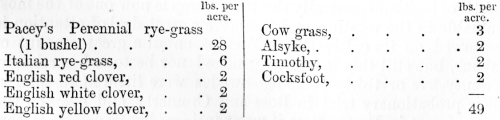
Permanent Pasture.—With such a great demand
for sheep grazing, and with the high price of labour, it is only natural
to expect that very much more attention should be bestowed on the laying
out of permanent pasture now than fifteen or twenty years ago. Indeed, we
are not a little surprised that over the north of Scotland generally the
area of land laid out in permanent pasture should be so limited as it is.
With an increase in the cost of labour, during the past thirty years,
equal to an increased rental at the rate of about 7s. 6d. per acre, it is
difficult to imagine how land worth only 15s. or 17s. of rent per acre can
possibly repay regular cultivation. Of land of this description there are
many thousands of acres in the northern counties of Scotland that are at
present worked in regular rotation, but we should not be in the least
surprised though a large portion of this should be laid out in permanent
pasture in the course of the next eight or ten years. Under pasture very
thin land may pay fairly, but under regular rotation, and so long as the
present circumstances continue, we cannot conceive how any man can make a
living upon it for any length of time. The area under permanent pasture in
Ross and Cromarty has increased by about 2000 acres during the past eight
or ten years, and there is every probability of the increase going on
still further. The area under permanent pasture at the present time is
19,395 acres.
Root Crops.
Turnips.—The following table shows the number
of acres under turnips at various periods since 1854:—

In 1854 Ross and Cromarty stood seventeenth
among the Scotch counties with regard to the acreage under turnips, and
now they stand as high up as tenth. Turnips are indispensable where cattle
feeding is carried on to any great extent, and it is the extraordinary
development of this branch of agriculture in Ross and Cromarty that has
swelled the acreage of turnips so greatly. For some time back at least,
stock farms have been paying better than grain farms, and so long as this
continues to be the case turnips will continue to grow in favour. Over the
north of Scotland generally the turnip crop is now one of the most
valuable in the rotation, and therefore a great deal of attention is
bestowed on its cultivation. Turnips entail a great amount of labour, but
still this is neither grudged nor bestowed carelessly. Twenty-five or
thirty years ago swedes were little more than in their probationary trial
in Ross and Cromarty, and even on the larger farms in Easter Ross it was
considered extravagant to sow more than 10 or 12 acres of swedes. In the
year 1848 the late Mr Douglas sowed 75 acres of turnips on his farm of
Arboll, in the parish of Tarbat, and with the exception of 5 acres of
swedes for the farm horses, the whole were soft varieties. Part of the
crop was eaten off by sheep at a charge of 2d. a head per week. Now nearly
three-fourths of the whole turnip area on the heavier soils in Easter Ross
are put under swedes, and on the lighter soils the proportion of swedes to
other varieties is about half and half. There can be no doubt that swedes
are the most valuable variety of turnips grown at the present day, but to
begin cattle in the autumn a few acres of yellows and globes are quite
essential. On the very thinnest of land, yellows suit equally as well as
swedes, as the latter variety requires more substantial nourishment than
the former to secure a really good crop. Turnips usually follow oats, and
in some cases wheat, and as soon as the land can be cleaned of the grain
the plough is started. The land is turned over (sometimes by steam as
already indicated) to a depth of from 10 to 12 inches, and allowed to lie
exposed to the frosts till spring, when it is cross ploughed once or
twice, or grubbed two or three times and thoroughly harrowed, and the
weeds, if there are any, cleared away. In the earlier parts of the county
sowing swedes commences about the first of the second week of May, and
from then till the end of June the sole work of the farm is sowing
turnips. The land is drilled at a width of from 26 to 29 inches : manured
with from 20 to 30 loads of farm-yard manure, and from 4 to 8 cwts. of
artificial manure per acre, chiefly bone manure with a little phosphates,
and in some cases 1 cwt. or 1½ cwt. nitrate of soda; and sown, if swedes,
with about 3 lbs., and if yellows, or whites, 2½ lbs. of seed per acre.
The earlier sown portions are generally ready for thinning before the end
of June, and for well-nigh a whole month this work goes on incessantly.
When very rank the plants are sometimes thinned by the hand, but the hoe
is used as a rule. Swedes are left at from 9 to 12 inches apart, and
yellows at from 8 to 10 inches. The thinning of turnips is now a very
expensive process, and is almost the only branch of farm work that modern
genius has done nothing to economise by the adoption of machinery. Several
attempts have been made during the past few years to devise
turnip-thinning machines, but not one of these has yet reached that state
of perfection which is necessary to insure its being extensively employed.
During the hoeing process the drills are cleaned two or three times by the
drill harrow or "skim plough;" and with this the work of the turnip crop
falls out of the farmers' calendar till the arrival of the storing season,
which usually commences about the middle of November. The advantages of
preserving turnips from the winter's frosts are now fully recognised, and
almost the whole crop, except what is to be eaten off the land by sheep,
is stored either in pits on the fields, or in heaps around the farm
steadings. When wheat follows turnips, which is very often the case, the
roots are always driven to the steadings immediately on being pulled, in
order to relieve the land for winter sowing. A very large breadth of the
turnip break is now eaten off by sheep,—partly off the turnip fields and
partly out of boxes on the land. On a good many farms one-half of the
yellows and one-third of the swedes are eaten off by sheep, and when from
L.7 to L.9 per acre can be had for this purpose, the system must be
regarded as a profitable one. The turnip crop generally over these
counties is invariably heavy and of excellent quality. Swedes on an
average range from 20 to 28 tons per acre, and on the better farms a yield
of 30 tons is considered nothing very unusual. The average of yellows is a
little higher than of swedes, and occasionally this variety yields as many
as 35 tons per acre. As in the general management of the crops, more care
is now bestowed on the selection of turnip seed than formerly, and a good
many farmers grow the greater part of their seed on their own farms.
Potatoes.—Potato farming is pursued more
extensively all over the north of Scotland now than some fifteen or twenty
years ago. The following table shows the area under potatoes in Ross and
Cromarty at various periods since 1854:—

Potato farming has more of the speculative
element than the cultivation of any of the other ordinary crops, and
therefore it has strong attractions to some. Occasionally it pays
exceedingly well, better than any other ordinary crop, but on the other
hand it often proves very unremunerative. Disease often destroys more than
half the crop, and the prices now and then are very low; and on an
average of say eight or ten years few farmers can boast of a very large
return of potatoes. In Easter Ross, in the Black Isle, and in Mid Ross
there are a few farmers who plant small fields of potatoes, some going the
length of 70 acres, and others only 10 or 12. On some farms they are grown
after grass and on others after oats. Medium land suits potatoes better
than rich heavy land, and in fact the best crops are often grown on the
lightest land. The land is prepared for potatoes much in the same way as
for turnips, and while the latter require a very large amount of labour,
the former entail a great deal. The lifting of potatoes is a very slow and
expensive operation, and when the weather is wet and unsteady the crop is
often slightly damaged in the process. About the same quantity of farmyard
manure is given to the acre for potatoes as for swedes, but the dose of
artificial manure is generally increased a little. The yield of potatoes
varies very much, ranging from 4 to 8 tons per acre, according to the
condition of the land and the season. The crop in 1876 proved
exceptionally good, and as much as L.28 was offered for the acre. In 1875
a large farmer in the Black Isle pocketed about L.1800 for the. potatoes
grown on a field of 70 acres.
Other Green Crops.—About 20 acres are put
under mangoldwurzel every year, and in a favourable season the crop is
generally good. Only from 6 to 8 acres is sown with carrots and from 30 to
40 with cabbage, kohl-rabi, and rape, but tares are grown pretty
extensively. A great many crofters grow small patches of tares, and on
almost every farm there is a little corner of tares for early use among
cattle. The acreage under tares in both counties in 1876 was 814 acres,
and in 1854 it was 878 acres.
Cattle.
It has already been stated incidentally that
Ross and Cromarty are not cattle-breeding, but extensive cattle-feeding
counties. In fact there are few counties in Scotland in which so small a
number of cattle is bred; and on the other hand in which so much beef is
prepared. According to the Board of Trade returns the number of cattle in
Ross and Cromarty was in:—
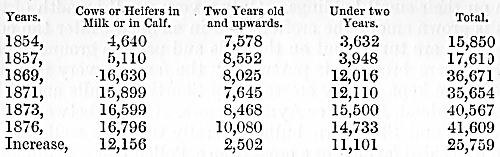
The increase in the number of all kinds of
cattle, especially cows and young stock, during the past twenty-two years,
as will be seen above, is very great, but when it is mentioned that there
are barely three cows to every farm and croft in the two counties, some
idea will be had of the small extent at which cattle-breeding is carried
on. Probably several hundreds of the smaller crofters keep no cattle, but
with this in view it has been calculated that the 461 farms above 50 acres
in extent do not average more than ten cows each. The little breeding that
is carried on is confined chiefly to holdings under 100 acres and to farms
on light land. In fact, it may safely be stated that on eight out of every
ten of the farms on the latter class of land only as many cows are kept as
are sufficient to supply the farm with milk; and in a few of these cases
the calves are sold off as soon as they are able to stand the fatigue of
removal. With very few exceptions the cows kept by the crofters are of the
Highland breed, and though perfection is yet a long way off, a very
decided improvement has taken place in the crofters' cattle within the
past quarter of a century. More care is now exercised in the selection of
cows, but it is mainly by the use of a better class of bulls that the
improvement has been brought about. Several proprietors have very wisely
been assisting the crofters on their estates to procure really good bulls,
and recognising the benefits that follow these efforts, the crofters
themselves are now manifesting considerable care in the selection of
sires. On the smaller of these crofts, where only one cow can be kept, the
calf is usually sold off when two or three weeks old or when fostered; and
on the larger crofts the young animals are generally kept till they are
stirks, and sold in winter or spring according to the supply of food. No
feeding takes place on crofts, but the cows are much more liberally
treated with food than some fifteen or twenty years ago. Overstocking has
disappeared to a very large extent, but in many cases the cows are still
kept to too great an age. It would be greatly for their own benefit if
crofters would change their cows much oftener than they do. Though the
majority of the crofters rear from Highland bulls', a large number are now
availing themselves of the Shorthorn bulls imported by the larger farmers;
and from Highland cows and Shorthorn bulls they are rearing much better
cattle than have ever before been seen on their small holdings. Only a
very small breadth of turnips is grown among the crofters, and in an open
winter the cows and stirks are turned out on the hills and pasture grounds
every day. Where breeding is pursued on the farms a very fair class of
cows are kept, mostly crosses from Shorthorn bulls and either West
Highland, Polled, or Ayrshire cows. Crosses between West Highland and
Shorthorn bulls generally turn out well, but we have a decided favour for
a cross from a Polled cow. Animals of this latter stamp are growing more
and more in favour every day, as might be inferred from the demand that is
presently displaying itself for females of the polled breed. Among farmers
generally shorthorn bulls are now used almost exclusively, and have been
so by a few for more than thirty years. Long prices are frequently paid
for sires of this fashionable breed, and there can be no doubt that the
money expended in this way is wisely spent. Hitherto the Ross and Cromarty
farmers have had to appeal to more southern counties for bulls for their
farms, but now they can boast of a fruitful vineyard of their own, of
which, however, more anon. On farms where cows are kept solely for the
supply of milk, Ayrshires or crosses between Shorthorn bulls and Ayrshire
cows, are in the majority, and for the purpose for which they are kept
these classes of cows are probably the best to be had. The question as to
whether or not farmers should breed more of their own cattle than they do
forms a very important and difficult problem. To discuss it fully would
necessitate more space than we have at our command here, and therefore we
shall content ourselves with recording our opinion that the farmers of
Ross and Cromarty should breed a good many more cattle than they do at
present. Undoubtedly there are several farms in these counties unsuited
for cattle breeding, partly because the land grows inferior grass, and
partly owing to the high rent which the tenants have to pay; but we are
decidedly of opinion that it would be beneficial both for themselves and
the country at large, were nine-tenths of the Ross and Cromarty farmers to
rear, at least, one-third, probably one-half, of their cattle on their own
farms. As already stated, a few do breed about this proportion, some even
more, but the general system pursued is to breed as few cattle as
possible, and to buy in stirks and two-year-olds from Caithness,
Inverness-shire, and elsewhere in the north, and from Irish drovers and
feed them off. Cattle feeding is now so important a branch of agriculture
in these counties as to merit more than a mere passing notice. But before
speaking at length upon it, we must refer briefly to another important
system of live-stock farming recently introduced into these counties, viz:—
Shorthorn Breeding.—For many years the most
northern herd of shorthorns in Scotland was at the farm of Hillhead in the
county of Nairn, but now there are two in Inverness-shire, one in the
Black Isle, and two in the county of Caithness. The Inverness-shire herds
are at Dochfour and Kirkton, and both are well known for their superior
blood and careful management. The Black Isle herd is at the fine farm of
Udale, and judging from the foundation that has been laid, it promises to
be one of the most valuable herds of shorthorns in the north of Scotland.
Mr James Gordon, the enterprising tenant of Udale, reared a very fine
class of cross cattle up till 1871, when he began to turn his attention to
shorthorn breeding. At a public sale at Huntly, Aberdeenshire, in March
1871, he purchased a handsome dark roan yearling heifer, "Mayflower" after
"Prince of Worcester," and descended from the stock of Mr Bruce, Broadland,
Huntly. "Mayflower's" first calf was "Maid of Ross" by "Grand Duke," bred
at Broadland. Both the mother and daughter are still in the herd and
breeding regularly. The daughter, though only four years old, has had no
fewer than five calves, having had three at a birth last spring. All the
three died, but the other two are still on the farm—"Maid of Ross 2d," and
"Maid of Ross 3d." Both are by "Balliemore," bred by Mr Bruce, Newton of
Struthers, and now at Rosehaugh. Besides "Maid of Ross 1st," "Mayflower"
has had four calves—two bulls and two heifers, the latter being "Helena"
by "Balliemore," and "Queen of Ross" by "Royal Eden," bred by Mr Dent,
Katerfold Brough, Westmoreland, and out of a cow bred by Mr Linton,
Sheriff Hutton, Yorkshire, and after a bull of mostly Booth blood, named
"Eden." "Royal Eden," who has been a frequent prize taker in England, was
bought by Mr Gordon at Birmingham in March 1875. In 1872 Mr Gordon
purchased "Clara," a nice yearling heifer, bred by Mr Cantlie, Keithmore,
Dufftown, Banffshire, and after "Argus," a Dalkeith bull; and her progeny
at Udale is "Rhua Eden," a fine red heifer calf after "Royal Eden." In
1874 he purchased "Beauty," a handsome two year old heifer, bred by Mr
Macdonald, Wester Moy, Morayshire, and after " Knight of the Gale," bred
at Newton of Struthers and descended from the Hillhead stock. This heifer
has bred two bull calves. In the spring of 1875 Mr Gordon purchased
"Elsie," a full sister to "Beauty," and she too has bred a bull calf. In
March of the same year he bought ten females and a bull ("Royal Eden") at
a public sale at Birmingham, and these are all in the herd still. The more
noted of these were " Luxury," a thick square cow with good low line, bred
by Mr William Howe, Tottington, and after " Heir of Windsor " of pare
Booth blood, and closely related to the famous "Royal Windsor;" "Chloris,"
a richly fleshed red and white cow, bred by Mr John Lynn, Church Farm,
Stroxton, and after " Cambridge Duke" (25,706); "Beeswing" (three years
old), bred by Mr Bradburn, Wennesfield, Staffordshire, and after "Surley"
(32,635), and tracing back to very famous stock; and "Lady of the Lake"
(three years old), bred by Mr Lamb, Abourn Hall, Lincoln, after "Lord of
the Manor" (29,178), and tracing back to "Great M'Gull," who won twice at
the Royal English Society's Show. "Chloris" produced a fine heifer calf, "
Highland Cherry," in September 1875, after "Duke of Cerisia 2d" (33,595),
a bull of excellent Bates blood, while the cow herself is of splendid
Booth descent. At the dispersion of the herd so long and carefully reared
at Orbliston, Morayshire, by the late Mr Geddes, in October 1875, Mr
Gordon purchased seven females—four of the well-known "Magnet" family, one
of the "Flowery" tribe, one of the "Cherry" tribe, and one of the
"Undines." At the dispersion of Mr John Outhwaite's famous herd at
Bainessie, Yorkshire, in March 1876, he purchased a very fine roan five
year old cow, "Rosebud" by "Royal Windsor," from "Moss Rose" by "Baron
Kellerby." She cost 200 guineas, is in calf to "Lord Godolphin," and is a
lengthy massive roan with fine style and good shapes and excellent
quality. "Miss Danby 2d," a nice yearling by "Royal Windsor," was
purchased at the same sale for 80 guineas. At the dispersion of the
well-known herd of Mr Robert Bruce, Newton of Struthers, Forres,
Morayshire, in October last, Mr Gordon secured no fewer than twelve very
good cows and heifers at an average of about 30 guineas. But the most
important purchase of all has yet to be recorded. At the Highland and
Agricultural Society's Show at Glasgow, in 1875, Mr Gordon paid 400
guineas for "Rosario," undoubtedly one of the finest bulls that ever
entered a show-yard. He was bred by Mr Browne, Doxford, Northumberland,
after the famous "Duke of Aosto," and has been three times first at the
Highland Show—at Inverness, Glasgow (where his sire and younger brother
were also first in their respective classes), and at Aberdeen last summer.
He has [also been a "Royal" winner in England, and at the Royal Irish Show
in 1875 he topped his own class, and beat his illustrious father for the
Challenge Cup. The securing of a thoroughly good stock-bull is one of the
main points of shorthorn breeding, and the purchasing of "Rosario," to
begin with, speaks well for Mr Gordon's judgment and determination in this
respect. Twenty-two cows are in calf at Udale to "Rosario" this season
(1876). Mr Gordon's herd now numbers in all thirty-four cows and heifers
and two bulls ("Rosario" and "Royal Eden"); and forms an interesting and
important feature in the agriculture of the counties of Ross and Cromarty.
Cattle Feeding.—It has been calculated that
the annual produce of beef and mutton on five farms in Easter Ross is
about equal to the amount of beef and mutton consumed in Edinburgh in a
month—rather a contrast to those days in which that worthy English lady,
previously referred to, had to abandon her residence in Ross-shire because
the only description of beef she could find for her table was that of old
cows. The Board of Trade returns do not place Ross and Cromarty very high
up among other Scotch counties with regard to the number of cattle above
two years old, exclusive of cows, or in other words of cattle that have
reached the feeding age. But it must be explained that the buying-in
system of cattle management so extensively pursued in these counties
excludes from these returns many hundreds of animals that are annually fed
within their bounds—at least excludes them from the returns referring to
Ross and Cromarty. A very common practice among a great many of the Ross
and Cromarty farmers is to buy in stirks or two-year-olds about the end of
summer or autumn, and feed them off for the February, March, and April
markets, and as the Board of Trade returns are not collected till the
various crops have been sown, no cognizance can be had of the sojourn in
Ross and Cromarty of these buccolic birds of passage. The 10,000 cattle of
two years and upwards that are allotted to these counties by the Board of
Trade returns do not therefore represent anything like the total number
fed off every year. What that total might be no correct idea can be given,
but it may very safely be affirmed that Ross-shire is now one of the most
extensive cattle-feeding counties in the kingdom. On many small farms of
from 100 to 150 acres in extent, from twenty to thirty cattle, and in some
cases even forty, are fed off every year; while several farms of from 150
to 200 acres often send in a season very close on 100 animals into the
beef markets in the primest condition. To detail the various systems
pursued by all these different feeders would be useless, but we shall
append a very few notes on the modes adopted by three or four of the
larger farmers, who may be described as the more extensive beef producers.
In a word, it may be stated here that the system of feeding most generally
followed among the large body of farmers is to tie up the cattle about the
end of September, feed them on soft turnips for three weeks or a month, or
perhaps a little more, then with swedes, along with straw or hay, and for
two months or so before selling off, from 4 to 8 lbs. per day of cake, or
cake and a mixture of grain.
Some idea may be had of the expensive system
of feeding pursued by a few of the larger farmers, when it is mentioned
that they do not consider themselves fairly remunerated for their outlay
and trouble in the preparing of their cattle for the market, unless the
balance between the buying and selling prices is equal to L.2 a head for
every month the animals have been on the farm. Under the ordinary system
of cattle-feeding prevailing throughout the north of Scotland generally,
about L.1 or L.1, 5s. a month is considered fair remuneration.
Mr Mackenzie, Dalmore, is one of the most
extensive feeders of cattle in the north of Scotland. He feeds off every
year from 200 to 300 cattle according to his supply of fodder, and usually
commands the top prices in the markets. He commences to buy in for the
Christmas markets in the spring months, and selects the best two-year-olds
(generally crosses) that can be had in the country in the north
exclusively. They are fed on grass fields from the first week of May till
the middle of August, when about fifty (or about one-half of the lot) of
the better animals are housed for preparation for the London Christmas
market. For about six weeks they are fed on an equal mixture of cut hay
and tares, along with 4 lbs. per day of a feeding mixture with draff and
dray from the Dalmore distillery, which adjoins the farm steading. About
the end of September the diet is changed by the introduction of a small
quantity of white globe turnips and the increasing of the dose of the
feeding mixture (to which we shall afterwards refer) from 4 to 6 lbs. per
day. The globes are continued for a week or ten days, and then displaced
by yellows, for which in about three weeks or a month, or about the end of
October, swedes are substituted. From this onwards each animal gets 100
lbs. of swedes per day, along with 6 lbs. of the feeding mixture (which,
if necessary, is increased to 9 lbs.); about 12 lbs. of hay, and about a
pailful and a half of draff. The first diet is given between five and six
o'clock in the morning, and consists of 2 lbs. of the feeding mixture and
half a pail of draff to each beast. Shortly after, about 50 lbs. of swedes
are allowed, and again at eleven o'clock other 2 lbs. of the feeding
mixture, and a half pailful of draff and 12 lbs. of hay are given to each
animal, and followed at three o'clock by about 50 lbs. of swedes, and in
the evening by another allowance of the feeding mixture and draff. In this
way from forty to fifty fine bullocks are prepared every season for the
Smithfield Christinas market, where they usually command prices ranging
from L.32 to L.40 a head. The byres emptied by these bullocks are filled
up by bought-in two-year-old heifers, and these are fed exactly in the
above manner, and sold off as they become ready for the butcher; the
stalls thus emptied being filled up by others so long as the supply of
turnips and litter lasts. About the end of May "soiling" is commenced with
a few heifers, grass being cut and supplied to them in the byres along
with 6 lbs. per day of the feeding mixture. By this system, as already
stated, Mr Mackenzie feeds off from 200 to 300 cattle every year,
according to the supply of the straw—rather extensive feeding for a farm
of 370 acres of light land. From 10,000 to 12,000 stones of hay are
consumed by feeding cattle every year, and in addition to this, and
exclusive of turnips, Mr Mackenzie's annual feeding bill usually amounts
to about L.1000, from which it may be calculated that every season he puts
double his rent under his turnip crop in the shape of farmyard manure and
exclusive of artificial manure. As yet he has found that, by this high
scale of feeding, he has done more good to the land than to his own
pocket; but he looks forward with confidence to a full return by and by.
And certainly such enterprise richly deserves a handsome return. It may be
mentioned that the cattle courts at Dalmore are covered, and that some of
the cattle are fed in stalls and others in loose boxes. The feeding
mixture used by Mr Mackenzie is a very excellent one, and being new, a few
particulars regarding it may be read with interest. It consists of the
following ingredients, viz., 1 ton of pure linseed, 1 ton of oil-cake
(linseed), 1 ton of beans or tares, 1 ton of oats, 1 ton of rye, 1 ton of
Indian corn, 1 ton of locust beans, 3 lbs. of common salt. All these
stuffs are ground separately, and then thoroughly mixed into one " big
batch." The average cost of the mixture for the past four years was from
L.9 to L.10 per ton, or about 1d. per pound. For about eighteen months the
mixture was used without any linseed, but it was found to heat the cattle
too much, and to have a binding effect on their bowels, but since the
introduction of the ton of linseed the mixture has done its work
admirably. From the following analysis it will be seen that flesh-forming
and blood-forming ingredients and bone and muscle producers are combined
in the mixture in about their proper proportions. The linseed was added
since the mixture was analyzed, and therefore we are unable to give an
analysis of it, but it is well known that linseed is very rich in oily
ingredients:—
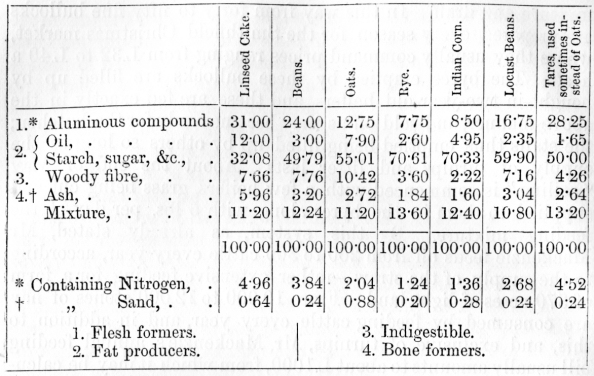
At the home farm of Ardross a number of very
fine cattle, chiefly crosses from Highland cows and Shorthorn bulls, are
both bred and fed, and in fat stock shows they have become quite famous. A
very fine red and white bullock, bred and fed at Ardross, won the L.100
prize at Birmingham in 1875 as the best Scot in the hall, and of all the
grand animals that left Scotland for the English fat shows last year he
was undoubtedly the most meritorious. When at Ardross this fine animal was
fed on the mixture used at Dalmore. At Ballintraid Mr Munro feeds close on
100 very fine cattle, mostly crosses picked up in Caithness or elsewhere
in the north. He uses a very large quantity of cake and other feeding
stuffs. At Farness, Davidston, and Rosefarm, in the Black Isle, occupied
by three brothers,—Messrs Thomas, Jonathan, and A. A. Middleton,—a large
number of excellent crosses are bought in and fed. At Farness and
Davidston, together, upwards of 100 cattle are fed in the house in summer
upon hay, cake, and grain.
At the fine farm of Calrossie, in the parish
of Nigg, and occupied by Mr John Douglas, feeding is also carried on
extensively. "In the spring and summer months Mr Douglas generally buys in
from 90 to 100 two-year-old cross stots, mostly Caithness cattle, and
nearly one-half of these he feeds on cut grass, hay, and cake in covered
courts, while the remainder are grazed on the fields till about the end of
September, when they are housed for the winter, and fed on turnips, straw
and hay, linseed cake, and grain. At first only 2 lbs. of cake are given
per day to each animal, but as the market approaches it is gradually
increased to 5 lbs., while in addition about the same weight of a mixture
of rye, barley, and wheat is allowed during the last six weeks. From
thirty to forty are usually in prime condition for the Christmas markets,
and the others are sent off as they become thoroughly fat, their stalls
being filled up as opportunity occurs with cattle for the following
winter.
Mr Jonathan Middleton, the enterprising tenant
of the Clay of Allan, generally feeds every year close on 300 cattle of
the best sorts to be had in the north. From one-fourth to one-third of
these are "soiled" in covered courts in summer, and sent away at various
times during the summer and autumn. Their food in summer consists of a
liberal supply of cut grass, hay, tares, cotton and linseed cake, and a
mixture of wheat, oats, rye, and Indian corn. The winter-fed cattle are
begun on yellows, and after three weeks or a month get abundance of swedes
along with cake and meal; and as many as possible are sent away about
Christmas.
Mr John Gordon, Balmuchy, is one of the most
extensive and most systematic feeders of cattle in Ross-shire. He feeds in
all about 130 cattle every year, and his lot for the Smithfielcl market
have for two or three years been among the heaviest and finest lots
exposed in that immense mart. He buys in the greater number in February
and March—a few being bought in July and August—and selects the best
home-bred two-year-olds to be had, taking an Irish beast only when a
home-bred animal cannot be had. When bought in the cattle are stalled and
fed liberally on swedes, cake, Indian corn, and hay. From thirty to forty
of the heavier animals are fed in the house all summer on cut grass, cake,
and Indian corn, and the others are sent to the grass about the 3d or 4th
of May. From the 12th of August to the 1st of September, according to the
supply of grass, they are housed again, and for three weeks they are fed
on artificial food and foggage. By about the middle of September yellow
turnips are ready for use, and after a short seasoning with these the
regular feeding system for the winter begins. About 6 a.m. each animal
gets 4 lbs. of a mixture of cake and Indian corn or oats (1 part of cake
and 2 of corn), and immediately after a moderate quantity of swedes is
given. The byres are cleaned out during this time, and from nine till one
o'clock the cattle are allowed to rest. At the latter hour other 4 lbs. of
the mixture are given and followed by turnips as in the morning. About six
in the evening a little hay is allowed, and at eight Hugh Munro, the
experienced and careful cattleman, takes a round among his valuable herd
to see that every thing is quiet, but takes care not to disturb the
peaceful slumbers of those already "retired to rest." Shortly before the
market the mixture of cake and corn is increased by 1 or 2 lbs., according
to how the animals are feeding, and how their constitutions are standing
out. Mr Gordon's lot of forty bullocks, sent to the Smithfield market last
year, ranged in weight from 8 to 12 cwt, the average being about 10 cwt.
The remainder of the cattle fed at Balmuchy range from 6 to 9 cwt. in
weight.
At the farms of Cadboll and Cadboll Mount, Mr
James Young-feeds annually about 160 very fine cattle, all for the
southern markets, and pursues a system of buying and feeding similar in
the main to that followed by Mr Gordon. Mr Young selects his cattle with
great care and taste, and his consignments to the Smithfield market are
equalled by very few from north of the Tweed.
Sheep Farming.
Prominent as is the position that Easter Ross
has won for the county in an arable-farming point of view, Wester Ross has
gained it quite as good a name by the advanced system of sheep-farming
pursued among its hills and glens. Not only is sheep-farming carried on
very extensively in Ross and Cromarty, but the system of management
pursued by the flock-owners will bear favourable comparison with that
obtaining in any part of the kingdom. The class of sheep, too, is very
excellent; and though bigger-boned animals may be reared on the
green-mantled hills in the south of Scotland, more kindly feeding sheep
are not to be found anywhere. They are well bred, carefully tended in
their youth, and fed with no niggard hand, neither in summer nor winter.
These seemingly high-sounding words will probably be appreciated all the
more, when it is mentioned that about a hundred years ago sheep-farming,
in thetrue sense of the term, was as little known in Ross-shire as
coffee-planting at the present day. It has already been mentioned that Sir
John Lockhart Ross of Balnagown was the first to introduce sheep-farming
into Ross-shire, and that amidst strong opposition among the natives,
amounting even to open revolt, he succeeded in laying a most substantial
foundation for a most extensive and highly remunerative branch of rural
industry—a branch hitherto entirely unknown in the north of Scotland. For
seven years he was the only sheep-farmer in the county of Ross, if not
indeed in the whole range of country north of Aberdeen. In 1781 he gave up
his farm to a Mr Geddes from Perthshire, who in the face of great
opposition from the natives laboured diligently in the good work for many
years. At last he succeeded very well, and after his death his son renewed
his lease and rented some adjoining lands. Between 1781 and 1790 other
three gentlemen began operations as sheep-farmers in Ross and Cromarty on
an extensive scale, viz., a Mr Cameron from Fort William, who took a hill
farm on Mr Munro's estate of Culcairn; a Mr Mitchell from Ayrshire, who
rented a large tract of pasture land on the Tulloch property, and Mr
Macleod of Geanies, who leased a large extent of pasture land among the
hills on the west coast. Mr Cameron and Mr Mitchell were thoroughly versed
in the business of sheep-farming themselves, and Mr Macleod obtained an
experienced shepherd from Perthshire to manage his flock. Despite the
extraordinary opposition of the natives already referred to,
sheep-farming, by the laudable efforts of these gentlemen, was fairly
established in Ross and Cromarty by the advent of the present century. By
the introduction of this new industry the population of several glens was
considerably reduced, but that sheep-farming has proved an immense benefit
to the north of Scotland is too plain a fact to require any discussion
here. During the first half of the present century several experienced
sheep-farmers from the south of Scotland planted themselves away north
among the Ross-shire hills; and in the hands of these and native farmers
who became enthusiastic in the movement, sheep-farming developed into huge
proportions. For some time black-faced sheep only were bred, but about
sixty years ago a good many Cheviots were introduced, and found to suit
very well. Among the first to breed Cheviots to any great extent in
Ross-shire was the late Mr Walter Mundell, who went north from
Dumfriesshire some fifty years ago, and leased the extensive grazing farm
of Inverlaul, now held by his son of the same name. Even before Cheviots,
Leicester tups were imported, and from these and Cheviot ewes a very
superior class of cross lambs, commonly called half-breds, was reared.
This system of breeding was found very profitable, and during recent years
it has become very general. Sheep-farming extended very rapidly during the
first forty or fifty years of the present century, and by about 1860 it
had almost reached its height.
The following table shows the number of sheep
in Ross and Cromarty at various periods since 1854:—
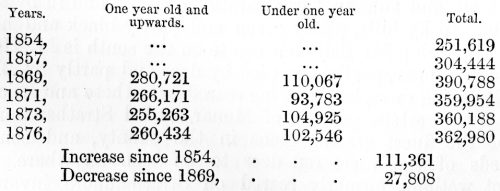
The decrease during the past seven or eight
years is due chiefly to the increased area of hill grazings now under
red-deer, but partly also to the fact (to which we may afterwards refer)
that several of the farms will not carry so many sheep at the present day
as they did some years ago. According to a return in 1857, considerably
more than one-third of the total number of sheep in both counties were
breeding animals, and since then Ave are inclined to think the proportion
has increased rather than decreased. Fifteen or twenty years ago Cheviots
and half-breds were largely in the majority, and are so still, but during
the past eight or ten years the Black-faced breed has been gradually
making up upon them. But before summing up the general system of
management, we shall offer some details regarding the operations of a few
of the larger sheep-farmers, and a very brief sketch of the hills and
pasture-lands of both counties.
Sheep-grazings and different Systems of
Management.
To make a complete tour throughout the hills
of Ross and Cromarty would be no easy matter, for they are very extensive
and wild. But imagination is a speedy pedestrian, and our wanderings shall
not last long. Starting from the Muir of Ord, on the borders of
Inverness-shire, we proceed westward along the course of the Orrin,
passing through the highly cultivated and beautifully wooded estates of
Highfield, Fairburn, and Muirton; and the first traces of sheep-farming
are found in the lower end of Glen Orrin, where there are one or two small
stocks of Black-faced sheep. Along the upper reaches of the glen for about
twenty miles the land is flatfish, black, and heathy, and occupied by
red-deer. Passing through the forest we come upon better land, moderately
even surface with green pasture and very steep hills, rising on the
borders of Inverness-shire to a height of about 3000 feet. On the northern
part of this glen the land is blacker and more scant of pasture, and is
occupied by Black-faced sheep, while the land on the other side carries
deer-principally. Continuing our rapid flight, we enter the extensive
property of Mr Balfour of Strathconan, which is taken up by a deer forest,
several very fine sheep-farms, and a few crofts. It extends from Glen
Orrin to the Dingwall and Skye Railway at Strathbran, and runs in three
parallel glens, bound in by steep, irregular, rocky hills, partly green
and partly black and heath-clad. Adjoining Mr Balfour's estate on the
south is Mr Holm's portion of Monar, partly occupied by deer and partly by
Black-faced breeding ewes, lambs being reared from these and Leicester
tups. The western portion of Monar, called Strathanmore, is one of the
finest grazing glens in the county, and contains hundreds of the finest
red deer to be seen anywhere. The Cheviot wethers, formerly reared on
Strathanmore, invariably topped the market. Continuing about five miles up
this glen we come to the water-shed of Loch Alsh, while on the north we
have the sources of the Carron and the Meag, this height being also the
water-shed between these two rivers. Turning down the Meag we enter
Glennaig, where the hills are steep and wild, green on the tops with month
(mountain grass), which affords very fine pasture for three months of the
year. Near to the base of the hills the surface is very rough, and mostly
covered with heather mixed with green grass; while on the flat there is a
good deal of wet marshy land, with here and there a beautiful green plain,
seemingly formed by soil washed from the mountain sides by the rocky
torrents that stream into the Meag in such large numbers. Glennaig is on
the property of Sir Ivor B. Guest, Bart., of Auchnashellach, and is leased
by Mr James Gordon, Udale, who also holds the extensive farms of Corrywick,
Camashie, and Glenmeanie, on the estate of Strathconan, and situated
further down the course of the Meag. Glenmeanie extends to between 4000
and 5000 acres, and consists of a long narrow glen, with steep rocky hills
on either side and level in the bottom; and on the farm generally the
pasture is fair, a large extent being green and partially mixed with
heather. The wind blows very fiercely through this narrow trough-shaped
glen in winter, and to save the sheep from being blown up by the drifting
snow, and to afford them shelter, circular walls about 6 feet high, called
"rounds," or "sheep stells," are erected. Glennaig extends to about 10,000
acres and Camashie to about 7000, and Corrywick to upwards of 5000 acres.
The latter two together are rented at L.400, Glennaig at L.375, and
Glenmeanie at L.300. The best of the pasture land on Glenmeanie is under
Cheviot ewes, and the more inferior parts under Black-faced ewes, but Mr
Gordon intends increasing his Black-faced stock considerably. Cheviot tups
are put to the Cheviot ewes, and Leicester tups to the Black-faced ewes
about the 24th of November, and left among them till the end of December,
when they are brought back to Udale, the weakest of the Cheviot ewes being
drafted out and brought along with the tups, or sent to the arable patches
(extending to about 100 acres) on the lower parts of the glen. Lambing
commences about the 20th of April, and the lambs are allowed to suckle
till about the end of August. The Cheviot wether lambs are sent to a
higher farm to be kept for two years, being taken down every year for
wintering in the low country about the 1st of October, and sent back to
Glennaig about the 1st of April. Camashie is wild and heathy, and here
Black-faced ewes only are kept. Corrywick, though surrounded with huge
rocky hills, in recesses of which snow lies almost throughout the whole
year, has pasture richer and better mixed with green grass, and on the
lower and north side of this farm Black-faced ewes are kept, and from
these and Leicester tups a superior class of grey-faced lambs are reared;
while on the other parts of Corrywick grey-faced lambs, one-year-olds of
the same class, and two year old Cheviot wethers are grazed. The
grey-faced two-year-olds are either taken down to the low parts of the
county to be fed off by the end of February or beginning of March, or sold
off in store condition about the middle of September. The Cheviot wethers
here, as generally over the north, are sold by reputation at the Inverness
wool fair for delivery in September. Mr Gordon begins to clip about the
20th of June, and immediately afterwards he dips the wethers in a mixture
of his own manufacture, the ewes and lambs being dipped at weaning time.
Again, about the middle of November, the whole stock is dipped for the
winter.
Between Camashie and the Meag on the south are
the farms of Carnock and Scardroy, occupied by Messrs Maclennan, and
carrying a fine stock of Cheviot ewes and wethers. Passing down the glen
from these farms we reach Mr Balfour's shooting-lodge of Dalbreck, the
home farm of Strathconnon, and a number of tidy little crofts with neat
comfortable-looking cottages. The braes on both sides are covered with
thriving plantations of fir and larch, the former predominating. Between
this and Scatwell, about six miles further east, there are several small
farms covered with Black-faced stocks, the land being black and rocky. On
the south side of the Meag, where it joins the Conon, Scatwell House, the
residence of Mr Mackenzie of Scatwell, nestles beautifully in a
picturesque romantic corner.
Another sheep farm on the Strathconon estate
is Cashachan, occupied by Mr John Gordon, Balmuchy, and rented at L.215.
This farm lies on the Auchinalt Hill, and in lower parts the pasture is
good, while higher up the surface is very steep and rocky. A Cheviot ewe
stock is kept here, and the weak ewes and lambs are drafted down to
Balmuchy in December and January, and fed on grass for two or three
months, and then returned to Cashachan. In addition to this breeding stock
Mr Gordon buys in about 600 three-part bred hogs on the 12th of August,
and feeds them on Balmuchy on grass, turnips, and cake, sending them,
after being clipped, about the 1st of May, to the Edinburgh market. When
fat, they usually weigh from 60 to 70 lbs. a head. The Cheviot wether
lambs from Cashachan are sold off in August, and the ewe lambs are
wintered at Balmuchy and on pasture taken in the neighbourhood. Turning
back towards Mr Balfour's home farm we proceed down the Conon, till the
fine arable valley of Contin is reached; and just as we enter this valley
another extensive sheep farmer comes across our path—Mr Peter Robertson,
the enterprising tenant of Achilty.
Mr Robertson has a sheep run of about 1000
acres attached to Achilty; and in addition to this he holds the grazing
farms of Garbat, on the Duchess of Sutherland's Strathpeffer property, and
of Langwell and Glasstullich on Her Grace's Coigach estate. These farms
are far ahead of us yet, but for convenience we shall notice them here.
Garbat lies on Ben Wyvis, and on the higher grounds there is good green
pasture, but the greater portion of the farm is covered with snow for five
or six months of the year. Mr Robertson entered the farm in 1872, and took
over at valuation a very fine stock of Cheviot sheep, belonging to the
outgoing tenant, Mr Mackenzie of Ord. Mr Robertson considered the
elevation of Garbat too high for Cheviot sheep, and accordingly he
displaced Mr Mackenzie's stock by a very fine stock of Black-faced ewes.
He finds that Black-faced sheep thrive exceedingly well in Garbat, and
intends breeding them extensively. He bestows great care on the selection
of tups, and as a natural result he is rearing some of the finest tup-lambs
to be seen anywhere in the north. His first crop of Black-faced tup lambs
was disposed of at a public sale at the Muir of Ord, held by the Northern
Counties Pastoral Club, in September last, and the prices ranged from L.3
to L.27. The lambs are dropped on this farm from the 20th to 22d of April,
and the ewe lambs are allowed to suckle their mothers up till the 12th or
15th of August, while the tup lambs are left with their dams till the 1st
of October. The wether lambs and cast ewe lambs are sold at Inverness Wool
Pair, and delivered immediately after being weaned. The better class of
ewe lambs is retained for breeding, and are sent to winter in
Aberdeenshire in the first week of October. The tup lambs are allowed to
remain on the hills till October, and then brought down to Achilty, where
they are kept till sold off in the following September. If brought down
sooner, their horns would spring so fast on the rich grass, that the flies
would interfere with them, and spoil them dreadfully as well as impair the
growth of the lambs themselves. The ewes are kept on the lower park of
Garbat throughout the whole autumn. Mr Robertson has been well-known as a
successful breeder of Black-faced sheep for well nigh a quarter of a
century, and on leaving the grazings of Novar at Whitsunday, 1875, he
handed over to the Messrs Chutton of London a breeding stock of 3000
Black-faced sheep at the large average (by valuation) of L.2, 5s. a head.
Langwell and Glasstullich lie in the parish of Lochbroom, and form a very
extensive range of fair pasture, rather mossy and wet, with a vein of
limestone—which is said to be traceable all the way north from
Ballachulish—running right through it. Mr Robertson got possession of
these farms in 1863, and in the first few years he surface-drained a large
portion of it, and straightened the water-courses of streamlets by
experienced workmen from Wigtownshire. He also got the proprietrix to
shift and embank the course of a river for about a mile and a half, at a
cost of about L.500, for which he pays interest. He also erected at his
own expense from four to five miles of wire fencing, and pays interest on
several miles more of march-fences. The stock on these farms consists of
Cheviot ewes and wethers, and the system of management is pretty much the
same as at Garbat, except that he rears no tups here, and sells no wether
lambs. The wether lambs here are sent to wintering in the first week of
October, and a few "Dinmonts" are brought down to Achilty for turnips in
the month of December, and in a very severe winter a second draught is
sometimes taken down in February, the whole being returned about the
middle of March. The tups from the various farms are brought in from the
ewes about the 1st of January, and kept on turnips at Achilty until the
12th of April, when they are sent back to the hills. Mr Robertson does not
approve of giving turnips to tups during close time, as he thinks it has a
tendency to make them soft and lazy. Mr Robertson smears all his old
sheep, commencing about the 12th of October, and dips the younger lots.
The yeld sheep are clipt from the 15th to the 22d of June, and the ewes
shortly after.
Our next route through the hills will be along
the Dingwall and Skye Railway. Passing Ben Wyvis on the right and black
bare pasture land on the left, we very soon enter the Kinloch-Luichart
district; and here on the north side of the Bran some very good grazings
are under red deer. To the west of Loch Luichart the Bran is joined by a
river which drains the valuable grazing lands of Fannich forest, while on
the south of the Bran there is a considerable extent of mixed heath and
grass land occupied by sheep. Around Auchinault station there is a
beautiful green plain, very inviting for cultivation, but under Cheviot
sheep. On the south side of the line lies the extensive sheep-farm of
Strath Bran, occupied by Mr George Cruickskank, Ardmore. It extends to
about 14,000 acres, is on the estate of Mr Matheson of Ardross, and is
rented at L.670. Mr Cruickshank keeps a breeding stock of Cheviots here,
and takes down the lambs to be wintered at Ardmore. About the upper
reaches of the Bran the land becomes blacker, and is occupied chiefly by
Black-faced sheep. Passing Auchnasheen, around which there is some very
good pasture-land, chiefly under Black-faced sheep, we reach the farm of
Ledgowan, tenanted by Mr William Mackenzie, Auchandunie, factor for Mr
Matheson of Ardross. Ledgowan is also on the Ardross property, is very
good pasture land, and carries an excellent stock of Cheviot sheep. At the
west side of this farm we again reach the watershed, and proceeding on we
enter Strathcarron, the property of Sir Ivor B. Guest, Bart,, in which
strath there is a large extent of fine green pasture. Between Strathcarron
and the west coast the hill pasture becomes blacker and the surface more
uneven and rocky. Before arriving close upon Strome Ferry the hills are
very steep and rocky, and along the side of Loch Carron there are a few
irregular patches of arable land, with hill grazings attached, on which a
mixture of Black-faced and Cheviot sheep is kept. Passing Strome Ferry we
land upon the Lochalsh Hills, which are mostly low and covered with rich
green pasture, with a very little heath intermixed. Crossing at the top of
Loch Luig, into which falls the river Luig, we enter a very fine grazing
strath, in which are situated the fine farms of Killilan and Blackwater
occupied by Mr Brown. We are now in the parish of Kintail, and proceeding
up the shore of Loch Duich, on either side of which there are some very
fine grazing lands, principally green, but steep and rocky and very grand,
we come into full view of Inverniate House, the property of Mr Matheson of
Ardross, and beautifully situated on the east side of the loch.
A few miles right inland from this point lies
the fine grazing farm of Lienassie, occupied by Mr Alexander Maclennan. It
extends to about 14,000 acres, is on the estate of Mr Matheson of Ardross,
and is rented at L.815. The farm is steep and mountainous, but the pasture
is mostly green and of very fine quality. It is stocked with very fine
Cheviot ewes and wethers. Mr Maclennan winters both his ewe and wether
hogs in the low lands of Ross-shire, Inverness-shire, and sometimes
Aberdeenshire, and also sends away for nearly three months in the winter a
considerable number of his "Dinmonts." The remainder of the flock is kept
all the year round on Lienassie. In this neighbourhood generally the land
is well adapted for Cheviots, but there are now several "hirsels" of
Black-faced sheep throughout the district. The large farm of Invershiel,
tenanted by Mr Macrae, and stocked principally by Cheviots, lies at the
top of Loch Duich, while a little further south is situated Mr Andrew
Mitchell's fine farm of Ratagan on the estate of Glenshiel, belonging to
Mr Baillie of Dochfour, extending to about 15,000 acres, and rented at
L.715. The pasture is a mixture of heath and grass, affording abundance of
food in summer, but rather backward in spring, there being no "mossing" or
fresh growth till rather late for giving sheep a good start. The hills are
very high and rocky, and intersected with rapid running burns, which in
wet weather come down very large and are apt to sweep away sheep. The
stock is Cheviot sheep, partly ewes and partly wethers, and a few Highland
cattle not bred on the farm. Mr Mitchell smears the whole of his sheep,
with the exception of a few hogs sent away to lowland winterings, and the
process of smearing usually continues for about three weeks from the 6th
or 8th of October. The wethers are clipt about the 18th of June, and the
ewes about ten days later. The older sheep, with the exception of part of
the "Dinmonts," are wintered at Ratagan, and all the wether hoggs and
about three-fourths of the ewe hoggs go to the lowlands for wintering. In
very stormy weather the wethers on the high ground have to be taken down
to the low ground, which is usually preserved for the ewes, and they are
kept there till the snow storm subsides. The hoggs leave for the wintering
about the 20th September, and return about the 1st April.
Retracing our steps towards Strome Ferry, and crossing Loch-carron, we
enter the far-stretching hills of Applecross, mostly under red deer and
crofters. The principal proprietors in this district are Lord Middleton of
Applecross, Sir John Stuart of Lochcarron, and Mr David Darroch of Gourock.
The extensive estate of Torridon belongs to Mr Darroch, and as in
Applecross, it is chiefly occupied by crofters and red deer. Leaving
Torridon and proceeding towards Loch Maree, we pass through a considerable
stretch of very fair grazing land, and before reaching the loch we find on
our right the large grazing farm of Kinlochewe, tenanted by Messrs Elliot
& Scott, and stocked with excellent mixed Black-faced, cross, and Cheviot
sheep. The land is mostly black and heathy, with here and there a few
green patches. On the west side of Loch Maree lies the extensive deer
forest of Gairloch, and on the north-east the extensive grazings of
Letterewe. Taking a rapid flight over the romantic hills of Lochbroom, we
rest for a little at Inverlaul. On the south-west side of Lochbroom lie
the extensive conjoined farms of Auchluanachan and Auchindrean, for
several years occupied by Major Davidson, yr. of Tulloch. These farms are
on the estate of Braemore, and in addition to 500 arable acres they
contain 30,000 acres of moderate pasture land. Major Davidson paid a rent
of L.1250. Little more than twenty years ago these farms were rented at
L.500. On the north-east side of Lochbroom lies the fine farm of Inverlaul,
extending to close on 30,000 acres, situated on the Coul property, and
rented by Mr Walter Mundell at L.742. The late Mr Walter Mundell, who, as
already stated, was one of the first to breed Cheviots extensively in
Ross-shire, leased this farm close on fifty years ago, and since then it
has been in the possession of the family. Part of the land is good, with
abundance of green pasture, but a considerable extent is of little value.
In the days of the late Mr Mundell, the Inverlaul Cheviots were famed all
over the country, and of recent years there has been no falling off. The
stock on the farm consists of Cheviot ewes and wethers, and is managed
very much in the manner already described on one or two other farms. Mr
Mundell's wethers, when sold at the Inverness Wool Fair for delivery in
September, generally bring from L.2, 3s. to L.2, 8s. a head, and the cast
ewes from L 1, 10s. to L.1, 15s. The large grazing farm of Inverpolly, on
the Coigach property, and also in this parish, is leased by Messrs
Marshall & Scott, and stocked with very fine breeding Cheviots. They rear
a large number of excellent wethers, and buy in a good many more.
Proceeding in a north-easterly direction from
Lochbroom, we enter the parish of Kincardine, in which Sir Charles Ross of
Balnagown owns an immense stretch of pasture land. He himself occupies the
forest farm, which is valued at L.1000, and on which he keeps a large and
very fine breeding stock of Cheviot sheep. The hogs are wintered in Easter
Ross, but the others remain all the year round on the forest farm. The
pasture is generally pretty good, with several very beautiful green
straths, in which limestone exists extensively. Leaving Kincardine and
proceeding towards the south-east, we pass through the large and valuable
forests of Strath Vaich and Strath Rannoch, with Glen Diebidale and
several other fine grazings on our left; we at last join a welcome
friend—the "Iron Horse" —at Garve; and here our hurried notes must end.
General System of Management.
From these necessarily hasty notes it may be
gathered that wherever green pasture is plentiful Cheviot sheep are to be
found; where the pasture is mixed a few half-breds or three-part bred
sheep are reared; and where it becomes more moderate the Black-faced
breed prevails. A few farmers have ewe stocks only, and a few wether
stocks only, but by far the majority have a mixture of ewes and wethers.
As a rule the wethers are kept separate from the ewes and marked off into
different "hirsels," each shepherd having his own distinct mark. Almost
all breeding stocks, whether Cheviot, cross, or Black-faced, are managed
pretty much on the same broad principles, though in the minutiae of the
systems of several of the farmers there may be a little variety. The tups
are let loose from the 20th to the 27th of November, and taken in again
about the end of December or 1st of January, and from forty to sixty ewes
are apportioned to each tup, according to the lie of the land. The lambs
thus drop during the last two weeks of April and first week of May, and
are allowed to suck their mothers till about the 12th or 15th of August,
when they are shifted on to good pasture for a short time. The "shotts" or
small ewe lambs, and "cast" or old ewes (about five years), are sold
either by reputation at the Inverness Wool Fair, or at the autumn markets
at the Muir of Ord. Cast Cheviot ewes usually bring from 25s. to 35s.,
while shott lambs vary from 8s. to 16s. Black-faced cast ewes sell at from
18s. to 24s., and "shott" lambs from 8s. to 15s; three-year-old wethers
are generally sold at the Inverness Wool Fair for delivery about the month
of September; and for those of the Cheviot breed the prices range from
35s. to 48s.; while Black-faced wethers usually bring from 28s. to 37s.;
Cheviot wether lambs sell at from 15s. to L.1. Those who keep ewe stocks
only, sell off their wether lambs, the cast ewe lambs, and the cast ewes
every autumn, and retain the better ewe lambs to recruit their stock of
ewes. A good many sheep-farmers hold also arable farms in the lowlands of
the counties, and two or three of these feed their wether lambs for the
spring markets, while others utilise their low ground pasture as wintering
for their hill stocks; bringing down the hoggs all winter, and sometimes
the weakest of the old sheep for a month or two. Those who hold the
bleacker and more elevated farms have to remove the greater number both of
their old and young sheep during winter, but, generally speaking, the
system is to send the hoggs away down to wintering to the low lands of
Ross and Cromarty, Inverness, Moray, and Aberdeenshire, and to retain the
older sheep at home on the lower and better sheltered grounds. Many
thousands of the Ross-shire hoggs go to Aberdeenshire every winter, and in
an ordinary year they come back in good condition. These hoggs generally
leave home about the 1st of October, and return about the 1st of April. In
some cases the ewe hoggs only are sent off to wintering, in others the
wether hoggs alone leave home, while in a few instances part of both.
Generally the weaker beasts are shifted to escape the hardships of the
stormy months among the higher hills. When the wether hogs return in
spring they are generally sent on to the higher lands for the summer
months, the lower valleys and straths being retained as ewe ground. Older
sheep are generally smeared about the beginning of October, and in some
cases also dipped, immediately after being clipped, if wethers, and at the
weaning of the lambs, if ewes. The lambs in some cases are dipped at
weaning and about the middle of November, and in others, dipped or
smeared, generally dipped, about the end of September before leaving for
their winter quarters. A few farmers dip the hoggs again in February, but
this is done only occasionally.
Clipping.—This important part of the
sheep-farmer's work commences about the third week of June, and is seldom
all accomplished before the end of the month. The collecting of the sheep
from the wide mountainous ranges on which they are grazed sometimes
occupies several days, and the mustering of labourers for clipping is
occasionally a matter of considerable difficulty. All these preliminaries
over, however, the work proceeds rapidly. The weight of the fleeces varies
very much according to the season and the quality of the pasture on which
the sheep are grazed. The following may be taken as pretty near the
average:—
Cheviots {smeared)—Wethers, 6 to 7 lbs. of
wool; Ewes, 4 to 5 lbs.; Hoggs, 5 to 6 lbs.
Cheviots (dipped)—Wethers, 4 to 6 lbs. of wool; Ewes, 3 to 3½ lbs.; Hoggs,
3½ to 4 lbs.
Black-faced (smeared)—Wethers, 5 to 6 lbs. of wool; Ewes, 3½ to 4½ lbs.;
Hoggs, 4 to 5 lbs.
Black-faced (dipped.)—Wethers, 3½ to 5 lbs. of wool; Ewes, 2½ to 3½ lbs.;
Hoggs, 3 to 4.
Grey-faced Hoggs (dipped), 4 to 5 lbs. of wool.
Rents.—The rent of the Ross and Cromarty
grazing farms varies considerably. For the better class of ewe land, or
land with abundance of green pasture, as much as 5s. a head is paid for
the stock the land is computed as capable of carrying; while for black
heathy and highly elevated land 3s. a head is a very general figure. Over
both counties the average is probably a little over (certainly not under)
4s. a head; and compared to twenty-five or thirty years ago this shows an
increase of fully 1s. a head. A good many ewe farms, i.e., farms adapted
for breeding, have been very nearly doubled in rent since 1840, while
almost every ewe farm in both counties has been increased at least
one-third. Rents of grazing farms are paid in one sum at Martinmas for the
year from the Whitsunday preceding to the Whitsunday following the term of
payment.
Shepherds.—The large majority of shepherds are
married, and live in cottages in the midst of the glens in which they tend
their flocks. Some of them have small patches of arable land, and on these
they grow potatoes and occasionally a little meal for themselves and their
families. The general rate of wages is from L.18 to L.20 a year, with free
house, keep for two cows, and from ten to twenty sheep, 7 bolls of meal,
and potato land free, or an allowance of potatoes. The unmarried shepherds
usually reside with those that are married, and in these cases the married
men are allowed to keep three cows, and sometimes have additional
allowances otherwise. When away from home with sheep at wintering, their
food and lodgings are provided either by their employers, or by those from
whom the pasture is taken. Some have no allowance to keep sheep, while
others have even larger flocks than what we have mentioned. Shepherds'
wages, like those of ploughmen, have nearly doubled since 1850, and during
the past few years they have been increasing rapidly. It cannot be said,
however, that they are overpaid as yet; they were considerably underpaid a
quarter of a century ago. The size of the "hirsel" allotted to a shepherd
varies according to the class of sheep and the description of the land. Of
breeding stock they range from 400 to 600, and of wethers they are
generally a little larger. A few additional shepherds have to be employed
to assist in winter.
Profits now and Twenty-five Years ago.
We are inclined to think that sheep-farmers at
the present day do not make quite so much profit off their flocks as they
did some twenty-five or thirty years ago, though it is pretty generally
recognised as a fact that, of all the varieties of British farming,
sheep-farming is still the most remunerative. The agencies at work in the
reduction of the sheep-farmer's profits have been many and various, and
that reduction, in the case of wether stocks especially, has been very
considerable. The farmer who keeps a wether stock only has just the
balance between the buying and selling prices, after deducting keep and
other expenses and losses, to live on and to pay his rent from.
Twenty-five or thirty years ago he paid about 12s. a head for lambs
(Cheviots) and L1. for hoggs, and sold them as three-year-old wethers at
about 36s. a head. Now he pays about L1. for lambs and 30s. for hoggs, and
obtains 45s. or 46s. a head for three-year-old wethers. It will thus be
seen that the buying and selling prices have stood in almost the same
relation to each other during the past quarter of a century. But not so
with the expenditure between the day of purchase and the day of sale.
Wintering has been doubled, shepherds' wages nearly so, smearing and
dipping expenses increased, and losses also very largely increased. Even
during the past ten years wintering has increased nearly 100 per cent.
During the six years from 1863 to .1868 one of the largest sheep-farmers
in Ross-shire informed us that his average for wintering his black-faced
hoggs in Aberdeenshire was 3s. 6d. a head, and that now he pays exactly
double. When the wintering is very good, or a little turnips added, the
average cost is never under 7s. 6d. a head. And again, by some unknown
cause, the losses from death are heavier now than formerly, while a
greater number have invariably to be noted in the shepherd's day-book as
"unaccountable." As a rule, of every twenty wether lambs bought in August,
or sent away to wintering, only fourteen or fifteen remain for sale as
three year wethers; and by the increased price that is paid for it and the
expenses laid out upon it, every hogg or wether that dies or goes amissing
now is nearly equal to the loss of two some thirty years ago. To make up
for all this increased expenditure and losses, farmers have to depend
mainly on the crop and sale of wool, which in fact may be said to regulate
almost entirely the profits of a wether farmer. Though the "clip" is
usually heavier now than thirty years ago, and the prices for wool
occasionally higher, the latter are frequently even lower; and taking
everything into account, we are of opinion that no more rent can be
afforded for wether land now, with mutton at 9d. per pound, than when it
was selling at about 4d. Breeding stocks pay considerably better now than
previous to 1850, and chiefly on this account we anticipate a large and
speedy increase in the number of Black-faced sheep in these counties as
compared with that of Cheviots, for it is well known that where only
wethers of the Cheviot breed can be kept, a breeding stock of Black-faced
sheep would/thrive admirably. But still we do not think that the increase
in the profits from breeding stocks have quite kept pace with the advance
in the rent of ewe land, and consequently the owners of breeding as well
as of wether stocks, have to be contented with a balance of slightly
smaller proportions now than some twenty-five or thirty years ago.
It is not alone of increased rent, wintering,
and other expenditure that Ross and Cromarty sheep-farmers complain; some
of them are beginning to find that their farms will not carry so many
sheep, or keep them in so high condition, as fifteen or twenty years ago.
Considerable portions of the grazings are becoming foggy and rough and of
little value as sheep pasture. We could point to one or two hirsels which
carried stocks of from 1000 to 1100 over winter some twenty years ago, and
which will now winter scarcely 800. The cause of this, we believe, is the
covering of the land for so long a period exclusively by sheep, without
any Highland cattle being allowed upon it, as was the case before
sheep-farming reached its height. An experienced sheep-farmer says, "The
land is getting tired of sheep, and is needing to be cropped, and thereby
sweetened, by Highland cattle;" and we have not the least doubt but the
pasture would be considerably improved by being overrun by Highland cattle
for a few years. The present holders probably could not afford to try this
experiment without the co-operation and assistance of their landlords; but
we think that on several farms a few cattle might be kept without
lessening the stock of sheep to any appreciable extent. Two or three
farmers, in fact, have recently been adopting this plan, and are finding
that it is likely to have beneficial results. Some farmers think that if
those parts of grazings that have become foggy were inclosed for two or
three years, and the grass allowed to rot on the ground, the fog would
thereby be destroyed, and the grass-producing qualities of the soil
revived. We certainly think some scheme ought to be tried.
Pure Bred Leicesters. The Ross and Cromarty
sheep-farmers are very careful in the selection of tups, and every year
large numbers are introduced at heavy outlay from the finest stocks
throughout the country. The large majority rear a certain proportion of
their own Cheviot and Black-faced tups, but the breeding of Leicester tups
is confined to a very few. Mr Hosack, Docharty, Dingwall, has reared a few
very good tups of this breed for upwards of twenty years, and finds a
ready sale for his annual crop among the farmers of the county. Mr Hosack
began with Blainslie ewes and a Polwarth tup, and has all along been
rearing from the original stock of ewes and strong well-bred Border
Leicester tups purchased at high prices. He has now about seventy ewes on
his farm. Mr Gordon, Udale, has been rearing a few very fine Leicester
tups for five or six years, mostly for his own use, though of late a small
number have been offered for sale. The nucleus of his stock came off the
stock of the Rev. Mr Bosanquet, Rock, while about four years ago he
introduced about forty ewes and gimmers from Marvingston. The tups used at
first were purchased from Mr Lees, and latterly from the Messrs Clark, the
top prices being always paid for these tups. There are now about 100 ewes
at Udale. Mr Munro, Ord, also breeds a few; while Captain Warrand,
Ryefield, reared a good many for several years, but dispersed his stock in
September last.
Horses.
The following table shows the number of horses
in both counties at various periods since 1854:—

Of the number of horses returned this year
about 5300 are employed in agriculture exclusively, while about 1700 are
either mares kept solely for breeding purposes, or young animals not yet
trained to work. The increase of this latter class during the past five or
six years is close on 70 per cent., and this no doubt is due to the
enormously high prices which have been current for farm-horses for a few
years back. These exorbitant prices have turned almost every farmer to the
breeding of horses for himself, and we believe there is a larger number of
foals and young horses throughout the county at the present day than there
has ever been at any former period in the history of agriculture. This
must inevitably bring farm horses nearer to their proper value than they
have been for some time, and indeed in most counties they are beginning to
decline already. The farm horses generally throughout Ross and Cromarty
have been improved very much during the past quarter of a century, chiefly
by the action of Farmers' Clubs and landed proprietors in bringing in
improved stallions; but still they are far from what might be desired.
They are rather light and leggy, with too little of the real Clydesdale
stamp about them; and it is by the introduction of the best Clydesdale
stallions to be had that the desired improvement is most likely to be
effected. Some farmers seem to cling to light leggy horses because they go
at a smart pace in the reaper; but this advantage, if it is such, is
surely more than counterbalanced by the shortcoming of these animals at
the heavier work of the farm. Farm-horses are usually worked pretty
steadily, but they are also well fed and well cared for otherwise. From 60
to 80 acres of land—in a few cases where the land is light and level, even
as much as 100 acres—are allotted to each pair of horses. Ponies are very
numerous among the crofters; and among the farmers generally there is a
very excellent class of gig and saddle ponies from twelve to sixteen hands
high.
Swine, Poultry, 'and Markets. Swine.—Swine do
not get that care and attention which they really deserve. They ought to
be kept in much greater numbers, and fed and housed better than they are
in most cases. These remarks apply very generally to the whole north of
Scotland. The number of pigs in Ross and Cromarty was, in

Considering that there are so many crofters in
these counties, it seems rather strange that so few swine should be kept.
Recently several farmers have been feeding a good many, and taking this
into account we do not think that many more than one-half of the crofters
keep swine at all. Those that are reared among the crofters are of a mixed
and rather inferior breed.
Poultry.—Poultry-farming is not practised to
any great extent, except by some of the landed proprietors and on a few
large farms.
Markets.—Ross and Cromarty are well supplied
with cattle, sheep, and horse markets. The most important of the lot is
the Muir of Ord market, the stance of which is close upon the borders of
Inverness-shire. This market, in fact, has been the most important sheep
fair in the north of Scotland for many years, while it is also attended by
large droves of Highland cattle, Caithness crosses, and Irish cattle. It
is held every month all the year round, excepting April, for cattle; in
all the months excepting January, February, and December for sheep, and
excepting January, February, April, and December for horses.
Cattle-markets are also held monthly at Kildary and Fortrose, and
occasionally at Alness Bridge, Dingwall, Invergordon, &c, while sheep
markets are held at Coigach and elsewhere. Weekly grain markets take place
at Dingwall, Tain, Cromarty, and Fortrose.
Labour.
It has already been stated that Ross and
Cromarty are particularly well supplied with labourers' cottages, better,
in fact, than most other counties in the kingdom. And we cannot help
regarding this as one of the most satisfactory and pleasing features in
the agriculture of these counties. The scarcity of farm labourers
throughout the country is gradually becoming more and more serious, and
while so little is done in so many counties to provide for these labourers—what
is put within the reach of every other class of the community—a home of
his own and the prospects of a comfortable married life, can it be
wondered at that men of spirit and enterprise would refuse to remain
plodding at the horse's head, while there are other (and to him seemingly
better) fields open ? Give the farm-labourers cottages, and the prospects
of some day having what they might call a home of their own, and less will
be heard of emigration and the limited supply in the labour market. Ross
and Cromarty provide these most reasonable comforts for their farm-labourers,
and as a natural consequence those "anxieties, doubts, and fears,"
manifested among agriculturists in other parts of the country have never
yet disturbed the social atmosphere of these counties. There are very few
"bothies," only one here and there, and the unmarried servants (little
more than a third of the whole) either live with married men or in the
farmer's kitchen. There are no feeing markets, and engagements are usually
made from year to year through register offices, or quietly in a private
way between the farmers and the servants themselves. Men's wages have
advanced from 60 to 80 per cent. since 1850, and women's about 120 per
cent. Ploughmen generally receive for the twelvemonths from L.15 to L.18,
with from 8 to 11 bolls of oatmeal, 6 bolls potatoes, and in some cases a
few hundred yards of "harvest" potatoes; 1 pint of milk in summer and ½
pint in winter, free cottage and garden, with allowance to keep a pig and
a few hens, and about 2½ tons of coals. Labourers get from 12s. to 18s. a
week, with free house and garden, and women about 1s. a day, with potato
land and some coals; and in harvest 1s. 8d. a day. Harvest hands, when not
resident on the farm, are usually employed for a month at wages slightly
higher than the above rates.
Subordinate Industries.
So much space has already been taken up with
the subject proper of this report that only a sentence or two can be added
regarding the subordinate industries. Excepting the fishing they are not
of very great importance. There are three fishing districts, Stornoway,
Lochbroom, and Cromarty, and along with Skye, Lochcarron forms another. In
1874 the number of boats at Stornoway was 1045; the number of fishermen
and boys employed, 3959; the number of fish-curers, 40; of coopers, 70;
the value of boats, L.20,337; the value of nets, L.23,814; the value of
lines, L.11,314, and the total estimated value, L.55,465. At Lochbroom in
the same year the number of boats was 656; of fishermen and boys employed,
2815; of fish curers, 10; of coopers, 4; the value of boats, L.8451; of
nets, L.18,360; of lines, L.2548; and the total value, L.29,359. At
Cromarty the number of boats was 292; of fishermen and boys, 955; of
curers, 8; of coopers, 28; the value of boats, L.6998; of nets, L.12,512;
of lines, L.2027, and the total value, L.21,537. At Lochcarron and Skye
(in Inverness-shire) the number of boats was 695; of fishermen and boys,
2067; of curers, 37; of coopers, 13; the value of boats, L.6996; of nets,
L.16,932; of lines, L.2235, and the total value, L.26,163. The number of
barrels of herring cured or salted at these districts in the same year
was:—Stornoway, 75,471¼; Lochbroom, 3070; Cromarty, 2388; and Lochcarron
and Skye, 17,932. The number of cod, or ling, or skate, taken was:—
Stornoway, 325,141: Lochbroom, 43,880; Cromarty, 14,471, and Lochcarron
and Skye, 15,180.
There are five distilleries—Dalmore, Teaninich,
Ord, Glenmoragie, and Balblair. Between 10,000 and 12,000 quarters of
barley are distilled at these five establishments every year, the consumpt
of Dalmore itself varying from 5000 to 6000 quarters. |



