|
ON THE AGRICULTURE OF THE
COUNTIES OF EDINBURGH AND LINLITHGOW, AND THE INDUSTRIAL PROGRESS AND
DEVELOPMENT OF THESE COUNTIES DURING RECENT YEARS.
By Thomas Farrall, Aspatria,
Carlisle.
[Premium—Fifteen Sovereigns.]
Introductory Remarks.
The agriculture of the
Lothians already possesses a considerable literature, especially the
county of Haddington, which has often formed the subject of essays,
reports, and reviews. In the present paper it is our intention to describe
the agriculture of Mid and West Lothian, which are embraced in the
counties of Edinburgh and Linlithgow. The two Lothians under consideration
lie side by side, and on the north are washed by the waters of the estuary
of the river Forth. They are therefore situated in the eastern part of the
southern division of Scotland. The figure of Edinburgh proximates closely
to that of a half moon, resembling, on a coloured map, the outstretched
wings of a butterfly. Its extreme length from east to west is about 36
miles, and its breadth from north to south about 24 miles. The superficial
area was computed by the authors of " Caledonia," and of the "Agricultural
Survey of Mid-Lothian," at 229,120 and 227,832 imperial acres
respectively; but more recently it has been ascertained on reliable
authority, that the area is 367 square miles, or 234,926 statute acres.
Mid-Lothian lies between 55° 39' 30" and 55° 59' 20" north latitude, and
between 2° 52' and 3° 45' 10" longitude west from Greenwich. The shire
containsforty-eight quoad civilia parishes and part of two others. The
county throughout presents a striking scene of industry, not only in an
agricultural point of view, but also with respect to mining and other
profitable resources. Though it cannot lay claim to high mountains, like
the lofty Ben Nevis or the majestic Ben Lomond, yet it is not entirely
destitute of mountain chains of an inferior order. Most prominent are the
Pentland Hills, which appear in continuous and parallel ranges from
Peeblesshire, on the south, and sweep along the centre of the county,
rising in Cairnhill to upwards of 1800 feet above sea-level. In the east
are the Muirfoot Hills, which are a continuation of the Lammer-muir Hills.
About one-third of the entire extent may be estimated as the proportion
inaccessible to the plough. This lies chiefly in the south and south-east
parts of the county, and produces sweet and healthy herbage, which
supports large flocks of sheep. In the north and west, the land, although
diversified by rising grounds and gently undulating eminences, is mostly
capable of cultivation, and produces a variety of crops which tend to
bring credit to the farmer, to enrich the agricultural district, and
beautify the far-extending prospect.
Owing to its peculiar
configuration, Edinburgh possesses no stream deserving to be dignified
with the title of river; it is, nevertheless, well watered by numerous
burns or waters. The Almond, after intersecting a wing of the parish of
Mid-Calder, forms the north-west boundary line to the sea. Leith water
rises in the parish of Mid-Calder, and after pursuing a course of over 20
miles in a deep bed between well-wooded declivities, enters the sea at
Leith. The largest stream in the county is the Esk, which, with its
tributaries, drains the whole extent of country lying between the Pentland
and Muirfoot ranges of mountains, and empties itself into the sea at
Musselburgh. The remaining notable streams are the Tyne and the Gala. The
former holds a sinuous course of 7 miles, and then flows into East
Lothian; while the latter, after running a distance of 10 miles, leaves
the county at its south-west angle.
Linlithgow, or West
Lothian, lies between 55° 49' and 56° .1/ north latitude, and 3° 18' and
3° 51' west longitude. Its greatest length is about 20 miles, and its
extreme breadth about 15 miles. According to Armstrong's map of the
Lothians, the area is only 112 square miles, or 71,680 statute acres, but
the area given by the Ordnance Survey is 127 square miles, or 81,114
acres. The surface of Linlithgow, though not so interesting as that of
Edinburgh, is, notwithstanding, exceedingly diversified and beautiful. The
centre of the country may be described as an elevated plateau surrounded
by an amphitheatre of hills, the culminating point being Cairnmaple, which
rises to a height of 1498 feet. Other elevations are Kipps-hills,
Knock-hills, and Drumcross-hills; and in the west, Cuckold-le-Roi, with an
elevation of about 500 feet. Generally, the eminences are inconsiderable
hills or elevated grounds, covered with fields of waving corn, ornamental
plantations, or pasture lands dotted over with sheep. About three-fourths
of the land is arable, and the soils are generally fertile and
well-drained.
Linlithgow is very well
watered. Logie-water, a tributary of the Avon, and its affluents
Barbauchlaw-burn and Ballencrieff-water, drain much of the western
division; while Broxburn and several inferior streamlets drain the
eastern, and find their way into the Almond. Flowing into the Forth are
Nethermill-burn, Dolphinston-burn, and some tiny brooks. These several
streams, though totally insufficient for navigation, are useful in
supplying power for driving machinery, and furnishing never-failing
supplies of water for other purposes. The principal lakes are Loch-coat in
Torphichen, and Linlithgow-loch in the parish whose name it bears, with
two or three smaller ones on the boundary.
Interesting associations
crop up in the mind of any one who "loves to dwell on bygone scenes," as
he visits the various towns in Mid and West Lothian. Edinburgh, the
capital of the former, and the metropolis of Scotland, is delightfully
situated upon a group of hills overlooking the Firth of Forth. On the
highest of these the old town is built. Prom the castle, which stands upon
an elevation 380 feet high, a commanding and magnificent prospect may be
had. This gorgeous view has been well described by Sir Walter Scott, in
his "Marmion." The Gaelic form of the name of the city was Dunedin, from
dun, a Celtic word meaning hill or fort, and Edin or Edwin, king of
Northumbria, 617 a.d. Hence Dunedin and Edinburgh have the same meaning.
When the fine palace of Holyrood Abbey was erected in 1128, the city was a
royal burgh, and a royal residence was supposed to have been built a short
time afterwards. Until the 15th century Edinburgh remained defenceless,
when King James II. granted a licence for fortifying it. Great
improvements and enlargements in buildings have been made within the past
seventy years, but the union of the two kingdoms doubtless checked very
much the advancement of the city. The new town, for beauty of design and
excellence of architecture, is not rivalled by any town in Great Britain.
Edinburgh is supplied with water from the Pentlands, and the sanitary
condition has much improved of late years: The population in 1871 was
196,500. Two members are returned to the House of Commons. Dalkeith is
distant from Edinburgh about 6 miles in a south-east direction. The town
is well built, and has a large weekly market for grain. It has also
manufactures of brushes, woollen stuffs, and felt, beaver, and straw hats.
In the neighbourhood are some large collieries. The population in 1871 was
7114. Standing upon the site of an ancient castle is the splendid mansion
of the Duke of Buccleuch, with its beautiful and well-wooded grounds.
Musselburgh, a royal burgh, is situated upon the eastern bank of the Esk,
where it enters the Firth of Forth, 5f miles east of Edinburgh. The
manufactures are haircloth and sailcloth. It has also a small amount of
trade in tanning and leather-dressing. The neighbourhood is rich in
historical lore. A little to the east is the battle-ground of Pinkie,
where the English defeated the Scotch in 1547. In the immediate
neighbourhood was also fought the battle of Prestonpans, in 1745, when the
royal army sustained a signal defeat by the forces of Charles Edward. The
port of Musselburgh has no vessels of its own, but is resorted to by
coasters, which bring in timber, oil-cake, bark, seeds, and hides; the
export trade being chiefly in coal. The links are much resorted to for
racing, golfing, and other sources of amusement. The population of the
town in 1861, was 7423. Many of the inhabitants are engaged in the
"harvest of the sea." Situated about 2 miles north-east of Edinburgh is
Leith, whose commercial importance lies in its colonial and foreign trade
and imports of grain, for which it is the great emporium in Scotland. It
has also considerable manufactures of glass, ropes, sails, and artificial
manures. Fish-curing may be ranked among its industries likewise. So far
back as the 11th century it was a port; in 1541 the town was burnt by an
English fleet; in 1549 it was taken possession of by French troops; in
1567 it was sold to Edinburgh, and in 1838 it was made independent of that
city. There are also several villages in Mid-Lothian, each of which has
interesting associations, but scarcely such as come within the scope of an
agricultural paper.
The county town of West
Lothian is Linlithgow, a place of great antiquity and an early seat of the
Scottish kings. It has a weekly market, and fairs are held at certain
times of the year. Other places of note are Bathgate, a market town with a
larger population than Linlithgow, and Borrowstounness or Bo'ness, a burgh
of barony, situated on a tongue of land stretching into the Firth of
Forth. At one time the town was in a flourishing condition, but it
declined after the opening of the Forth and Clyde Canal, on account of the
trade being turned into another channel.
Both counties are
intersected by good roads, which are kept in excellent repair.
The population has
gradually increased during the present century, as will be seen on
reference to the following table:—
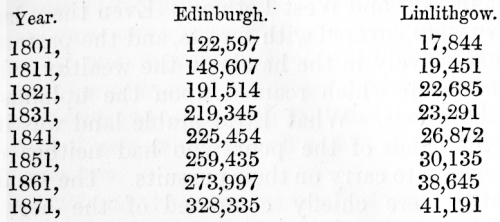
The advance in the county
of Edinburgh has, therefore, in less than three-quarters of a century,
been 205,738, or about 168 per cent.; that of Linlithgow, 23,347, or 131
per cent. The present population of Mid-Lothian is at the rate of 1.3
persons to each acre, and of West Lothian close upon 2. The employments of
the people are variously distributed between trade, commerce',
manufactures, and agriculture.
History of Agriculture.
In common with many
districts south of the Forth, agriculture-was pursued in the counties at a
comparatively early period. It is indeed averred by some writers that this
part of the country produced a considerable amount of grain in the times
of the Romans; as to this, however, we cannot, in the absence of. reliable
information, speak with any degree of certainty. A large proportion of the
land was then undoubtedly covered with forests, and the culture of corn
would generally be confined to fertile patches near the sea-shore, or
along the haughs where the soil was deep.
So early as the 13th
century, the monks cultivated large tracts of land on the south of the
Forth, and were said to be skilful in the management of extensive
orchards. We also have it that they understood something of resting, if
not of fallowing their lands, and the rotation of cropping. For a long
period after the 13th or 14th century, history is silent upon matters
relating to agriculture. It may, consequently, be reasonably assumed that
small progress was made until about the time of the union of Scotland with
England, when the farmers of East Lothian had opportunities of seeing for
themselves the superior practices in agriculture observed in England, some
of which they were not slow in copying. Neighbouring shires soon
afterwards followed their example, but for a period extending to
three-quarters of a century, farming did not make so much headway as could
have been wished, owing not so much to the apathy of agriculturists, as to
the adverse circumstances by which they were too often surrounded.
At the close of the 11th
century, agriculture had made little advancement in Mid and West Lothian.
Even then, large tracts of the country were covered with forests, and the
pastoral pursuit was almost exclusively in the hands of the wealthy, who
owned large flocks of sheep, which roamed upon the uplands and depastured
in the woods. What little arable land was in cultivation was in the hands
of the poor, who had neither capital to expend nor energy to cany on their
pursuits. The small patches they cultivated were chiefly composed of the
best soils in sheltered situations, or the partially alluvial deposits by
the sides of the streams. These soils were scourged by successive
cropping, rendered filthy by the growth of weeds, and reduced to extreme
poverty, owing to the small amount of manure given.
The reign of David I.,
which commenced in 1124, was a new era in agricultural improvement. This
monarch gave a large share of attention to the cultivation of the land, in
which he evinced considerable ability. He founded several agricultural
establishments, both in Mid and West Lothian. His grange farm at
Linlithgow is mentioned as being much abreast of the times. Roused by the
noble example of their monarch, the barons also cultivated farms in
various parts of the country, so that the agriculture of the counties
under notice received an impetus which was at once salutary and lasting in
its effects. David I. also devoted much attention to horticulture, and
mention is made in his charter of Holyrood of his garden under the castle.
For many years after the
termination of this monarch's reign agriculture may be said to have
retrograded rather than progressed. The prevalence of forests was a great
barrier to the extension of husbandry, for, they not only occupied much of
the land, but they also afforded shelter to the warriors and freebooters
who scoured the country at all seasons, and trampled down the crops of the
more peaceful inhabitants. In the early part of the 14th century Edward
III. lessened the extent of forest in Mid-Lothian very materially; and
mills, kilns, and breweries began to be established throughout the county,
thus showing that agriculture was gradually gaining ground and subduing
the asperities of the soil. But even then farming was far from being on a
satisfactory footing. The tillers of the ground still belonged to the
poorer classes of the community, who lacked sufficient capital to carry on
their avocations successfully: they, therefore, performed the duties
devolving upon them reluctantly for others rather than willingly for
themselves. This was chiefly owing to the unsatisfactory tenure upon which
they held their "farms. They not only rented the land from the proprietor
but everything upon it; who, in turn, at the expiration of the tenancy,
claimed everything the farmer possessed. This tenure was called "steelbow,"
which, in a modified form, still lingers in many of the remote districts
of Scotland. In Linlithgow matters were even worse,. for, after the
peaceful reign of Alexander III., the country was plunged into ruin by
foreign invasions and domestic strifes during a period of about seventy
years, when the strong oppressed the weak, and the hardly-won earnings of
the industrious too often fell to the lot of cruel and oppressive
invaders.
The year 1723 may be
regarded as a fresh starting-point in the history of agriculture, when a
society was formed in Edinburgh for the purpose of issuing instructions,
illustrated by example, on the most practical and profitable methods of
land culture. This was called the Society of Improvers, and from the date
of its establishment cultivation in both Edinburgh and Linlithgow began to
advance with rapid strides. Two years later, a sale of manure at
Cuffabouts, near Bo'ness, by one Higgins, realised 1s. per bushel—thus
affording an indication that the teachings of the society were doing good
service. Enterprising farmers now began to spring up on all sides. Sir
James Macgill, and, seventy years later, Sir John Dick of Prestonfield,
carted much manure from Edinburgh, and soon converted the worn-out and
barren soils under their management into fertile fields.
In the year 1728, John,
Earl of Stair, introduced much that was new on his farm in the parish of
Kirkliston, in West Lothian. He began to practise the horse-hoeing system
of husbandry, and commenced to crop the land in rotation. A few years
previous, Lord Haddington had brought clover and sown grasses into the
adjoining county: these the Earl of Stair took advantage of, and began to
grow upon his own farm. He also brought into field culture turnips,
carrots, and cabbages, which had previously been confined to gardens. How
far his turnip-culture extended we have no means of ascertaining, but
since his time, there have been many claimants for the honour of being the
first to cultivate field-turnips on a large scale. This enterprising earl
had a noble imitator in Charles, the first Earl of Hopetoun, who even
excelled the illustrious earl in farm management, but they both died in
the year 1740, before they had seen their plans fully matured or their
efforts appreciated.
The institution of a
Farmer's Club in Ormiston, East Lothian, by Mr Cockburn, the celebrated
agriculturist, about this time also gave a marked impetus to husbandry, as
members began to exchange and extend their ideas, so that not only
themselves but the whole community in the immediate district were
benefited. In Mid-Lothian the good work once begun was not allowed to
slumber, and soon after the middle of the 18th century land was limed,
fences built, grasses and succulents introduced, and improved implements
brought to bear upon the working of the soil. Sir John Dalrymple of
Cousland, the Duke of Buccleuch, and other gentlemen of note, spared no
pains in bringing their system of agriculture to as high a pitch as
possible.
Bearing the date of 1770, a
minister of Dunse, Adam Dickson by name, issued a work, entitled "The
Husbandry of the Ancients," which threw considerable light upon the
agriculture of bygone days. This appeared at a time when men's minds were
ready to grasp at new ideas upon a subject which was receiving a large
share of attention. A few sentences showing the practice of the ancients
may not be here deemed out of place. We cull from Mr Dickson's admirable
little work:—"Varro says that land should rest every other year, or, after
a severe crop, carry one that in a lesser degree exhausts the land.
"Columella says that wheat
requires rich land, and that which carries a crop, and rests, and is well
ploughed alternately.
"Virgil requires that the
fallowed lands, after they have carried a crop, shall be again fallowed.
"And Pliny says that this
direction, given by Virgil, is most proper when the extent of the farm
allows it; but that if the situation of the farm does not allow this, then
wheat may be sown after such crops as meliorate the soil. This kind of
land that was so frequently fallowed was seldom dunged."
Mr Dickson continues in
much the same strain. His book could not but form a useful companion to
rising farmers at the time we speak of, and no doubt it was to a certain
extent appreciated by such of the community as were readers.
In an interesting work
published in 1795, by George Robertson, farmer, Granton, it is stated that
the competition for farms lying around Edinburgh was so great as to reduce
the profits of the husbandman to little more than legal interest on his
capital. The writer thought that it was unfair of the laird or factor to
exact rigorously the rent at the precise term of payment, and maintained
that in order to make it, the tenant was often obliged to sell his produce
at a great disadvantage. He declared that he frequently had occasion to
observe the circumstances attending failure among the farmers, and could
trace them to the injudicious conduct of the landlords.
The capital then employed
in agriculture was L.5 the Scotch acre in the low country, L.2 in the
moorlands, and 5s. on the hills. From two causes chiefly, this amount was
soon afterwards thought to be inadequate: first, because all articles of
stocking became dearer; and secondly, from having everything of a superior
quality to what farmers were formerly satisfied with. One fourth part was
therefore added, and the result found to correspond very nearly with the
capital employed upon a farm near to Edinburgh, which was L.6, 5s. 3d. the
Scotch acre. On the above data, the whole capital employed in Mid-Lothian
farming was calculated at—

The same author throws some
light upon the sheep and horses kept at that time. A small number of
black-faced sheep was bought in from year to year, generally from
Tweeddale, the wool of which was coarse, and the fleece seldom worth a
shilling, while the carcass rarely weighed over 12 lbs. per quarter. On
the lower grounds a better class was kept, chiefly of the Cheviot breed;
in some cases they were crossed with Herefords, in others with Bakewell
species. These gave a fleece worth four times the amount of the
blackfaces, and the weight rose from 12 lbs. to 25 lbs. per quarter. About
5000 horses were used for husbandry; of these one-half were home reared,
the remainder coming from Linlithgow and Lanark. The amount annually paid
for imported horses amounted to something like L.6000. After the year
1784, value in horses ran up considerably. Best sizes, 16 hands and
upwards, which were previously sold at L.18 to L.20, made L.30 to L.35,
and the price of smaller animals rose from L.12 or L.14 to L.18 or L.20.
Mr Robertson asserts that
the condition of the labouring classes was at that time somewhat
ameliorated. Their cottages were more comfortable than formerly, being
larger, better lighted, and warmer. The kailyard, or plantation of
cabbages, in the front was also common, and not a few kept poultry, the
produce of which brought a good price in the Edinburgh market. The
furniture consisted of two beds, a few chairs or stools, table, chest of
drawers, press, &c, and a cuckoo-clock. Oatmeal with kail-brose formed the
principal part of their food.
Another practical writer of
that day added much to the literature of agriculture. We allude to Lord
Kames, who wrote in an easy and interesting style, and published a work
known as the "Gentleman Farmer." In it he discusses at great length the
question of oxen versus horses for beasts of draught and burden,
agriculturally considered, and finally winds up in favour of the former,
making out that in the course of twelve years the difference of expense
between the keep of a horse and an ox is L.74, 4s., or an average of over
L.6 per year.
We now come to what may be
called the era of improvements and inventions in farm implements and
machinery, when grain winnowers superseded the use of through draughts in
thatched barns, or the "gentle breezes on fairy knowes;'" when the flail
gave place to the thrashing machine; and the old-fashioned "rippler of the
ground" made way for the swing-plough; but we must forbear, lest our
lengthening notes be thought tedious.
Suffice it to say, that
within the present century, agriculture in both Mid and West Lothian has
advanced rapidly, in draining; in the deep culture of the soil; in the
extended use of machinery; in the introduction and appliance of steam
power to many of the most laborious offices of the farm; in the use of
extraneous feeding stuffs and artificial manures; in the scientific
knowledge possessed by the leading farmers; in a word, in almost
everything pertaining to the satisfaction of the proprietor, the
prosperity of the farmer, the happiness of the labourer, and the welfare
of the community at large, as meat and bread consumers. Not that during
the past seventy odd years there have been no depressions; great lessons
are seldom taught without a certain amount of sacrifice on some one's
part, and the agricultural panics of the present century have doubtless
driven many a helpless, honest, and struggling farmer to the wall.
Climate.
The climate of the two
counties is materially modified by their geographical position.
Continually bathed on their northern boundary by the waters of the estuary
of the Forth, extremes of heat and cold are for the most part prevented.
The mean temperature of winter is rarely very low: that of summer never
very high. This will be better understood by comparing the climate of
Edinburgh with those of Copenhagen and Moscow—places nearly under the same
parallel:—

In winter, therefore, snow
seldom continues long upon the ground, except in the vicinity of the
mountains, and frosts rarely lock up the soil so as to retard its
cultivation. Sometimes a few nights characterised by more than ordinary
severity damage the turnips in the fields; at other times the shaws retain
their greenness until the returning spring again awakens the plants into
active life. Cold east winds prevail in March and April, and impede
vegetation to a certain extent; and night frosts, even so late as the end
of May or the early part of June, have been known to blacken the
potato-tops and leave their impress upon the young clovers. As a rule,
however, the fields and gardens exhibit a green aspect early in the
season, which shows that vegetation is not much retarded by the
unfavourable influences just mentioned. Garden produce is brought into
Edinburgh market earlier than it can be procured in many parts of England
200 or 300 miles further to the south, and the early strawberries grown in
the immediate neighbourhood are justly held in great repute for their
delicious flavour. Late in the year the agricultural landscape often
presents the varied and beauteous aspect of lingering summer, when many
districts have been robbed of their charms and swept bare by the surly
blasts of chill November. Within one hundred years the climate has been
much improved by the drainage of wet moors and morasses ; and the winds,
which at times sweep over the country, modified by judicious clumps of
trees or thriving belts of plantation. The summer heat is always
sufficient to impart a golden hue to the wheat crops, and enable the
farmer to ingather his cereals without delay or difficulty, but now and
then a disastrous harvest occurs and does much injury to the outstanding
stooks. In 1872 the harvesting of grain was a slow, troublesome, and
expensive process, and considerable losses were experienced by most arable
farmers. The season alluded to was, however, exceptional. As a further
proof of the mildness of a Lothian winter, we may note that early in
January 1874, Mr M'Nab laid before the Botanical Society of Edinburgh no
less than 138 species of flowers in full bloom, culled from the Royal
Botanic Garden on New Year's Day. Of these 35 might, he said, be
considered as winter and spring flowers, while the remaining 103 might be
looked upon as summer or autumn plants still flowering. The rainfall is
inconsiderable throughout the Lothians, but the annual average is much
greater in Mid than East Lothian. The average for nineteen years as shown
at Inveresk is 19.68. As we advance westward the rainfall is greater,
especially in the locality of the hills, where, oftentimes, a shower is
experienced when the weather is beautifully fine in the low country. The
annual mean rainfall in Edinburgh is 26 inches, but in the south and
south-west districts it may be computed at 30 to 40 inches.
Geological Formation and
Soils.
The geological features are
well varied, and thus form an interesting field of research for those who
delight in rock-exploring pastimes. To describe these fully would take a
much larger space than we have at our disposal; nevertheless, as the rocks
are closely associated with the surface soils, and, therefore, have a
direct bearing upon the agriculture, a brief notice of the leading
characteristics may not be deemed inappropriate. An extensive coalfield,
of which Dalkeith forms the centre, pervades a considerable portion of the
Lothians, and has for ages produced a large annual amount of this useful
commodity for fuel. Extending through the whole of the south-east part of
Mid-Lothian are the Lammermuir Hills, which belong to the Silurian
formation, and consist almost entirely of gneissic rocks. The volcanic or
igneous rocks are largely developed in this county, much of the fertility
of the soil being due to the extensive. beds of these rocks which occur in
the geological strata. The hill called Arthur's Seat, near Edinburgh, is
thought to have been the site of an old volcano, and the supposition is
quite borne out by the immediate surroundings. This is now, we believe,
the theory generally accepted by experienced geologists. From Edinburgh
westward, the carboniferous strata prevail extensively, forming the
beautifully undulating country as far as Linlithgow on the western
confines of West Lothian. Near this ancient town there occurs a vast
series of sandstone and shales in frequent alternations. West Lothian is
also rich in igneous rocks, which geologists have divided into three
kinds, viz., volcanic ash or tufa, interspersed among the sandstone or
shales; beds of greenstone; and trap dykes. The latest geological
formation is known as drift, consisting of clay, sand, and gravel mixed
with boulders and scattered over the surface. The drift theory is borne
out by the grooves or markings which are found on the surface of the
underlying rocks. These run from north-west to south-east, and were
doubtless caused by the grating of boulders and. sand frozen in icebergs,
which were drifted from the northwest during the glacial periods. The
fertile soils of the Lothians may, therefore, have been brought, in part
at least, from the cold and barren shores of the Arctic Ocean, where the
Green-lander now yokes his faithful dog to the sledge, or the Esquimaux
passes the dreary winter in his rudely-built snow-hut. It will thus be
seen that the geological map requires to be used with great care, for the
character of a farm cannot be inferred from the rocks upon which it lies.
Notwithstanding this, it may be said generally that the fertile soils of
Mid and West Lothian rest upon a rich geological basis, containing
abundant supplies of coal, limestone, and building-stone. The surface soil
along the coast varies much: sometimes in a limited area all classes, from
bad to best, may be found. Some of the hills are moorish and mossy, others
are covered with a thin clay, which, when well managed, produces crops
abundantly. In the valleys principally, the most fertile subjects are to
be found, while in the various river basins are some deep patches of loam.
The north and mid sections of Edinburgh bear the palm in the quality of
the soil, and have for ages reared a race of farmers and labourers which
will bear favourable comparison with those of most districts in Great
Britain. In the south and south-east the land is to a large extent
pastoral, but for a long period, and especially in the past twenty-five
years, the agriculturist has been encroaching on the "woolly peoples' wide
domain." As already stated, about one-third of the entire county is now
deemed as inaccessible to the plough; and, indeed, persevering capitalists
and enterprising-farmers may possibly yet reduce the proportion of
unreclaimed or mountain land considerably, by driving this implement over
large beds of heath and barren pasture, which at one time were thought
irreclaimable.
The county of West Lothian,
though fairly rich in its agricultural capabilities, has nearly all
varieties of soil. According to proximate calculations, abou 20,000 acres
are clay, either of carse kind or otherwise of fine quality; 22,700 are
clay, on a cold bottom 9500 are loam; 9500 are light gravel and sand;
14,000 are moorland and high rocky ground; 1500 are moss; and the
remainder is occupied by a few patches of peculiar soils, lakes, and
rivers. In Carriden parish the land is light and early, and is capable of
producing good crops. It is scarcely possible to give a general character
to the soils of Abercorn, so rapid and manifold are the changes which it
undergoes. Sandstone, whinstone, limestone, and coal are extensively
wrought, and add in no small degree to the wealth of the district. A
better and more uniform subject prevails in Dalmeny, upon which thrive
good crops of wheat, potatoes, and turnips, as also the luxuriant and
picturesque plantations of the Earl of Rosebery. In the parish of Cramond
there is some good land, in a high state of cultivation. Heavy-cropping
soils are general throughout almost the entire parish of Duddingston. At
the opening of last century it consisted of nothing but an unreclaimed
moor, growing little but scrubby heath and the stunted juniper; now there
are few, if any, foul spots to stain the agricultural picture. Eastward
from the town of Linlithgow, a broad band of strong clayey land overlies
the carboniferous system, and stretches to a considerable distance. It is
fairly productive when well farmed, but somewhat difficult to work, and in
ungenial seasons the crops are rather late. That portion of West Lothian
lying to the south-west of the town of Bathgate has some good soil, but in
the hilly districts it is much intermixed with patches of heath and moor.
In the parish of Torphichen is also some wet moor towards the west, but
the land under the plough is fertile and well cultivated. In this district
the farming is necessarily of a mixed character, being partly pastoral,
partly arable. In the Penicuik district, lying a few miles to the south of
the city of Edinburgh, the surface is chiefly moorland, with moss and
mountain pasture, but much has been reclaimed in twenty-five years. There
is a considerable extent of wood in the locality. Coal and other minerals
are found, but are not worked extensively. The population is somewhat
sparse and scattered. Towards the south-east extremity of Mid-Lothian the
land is hilly and not very favourable for tillage. The upper soil is only
moderately fertile. It rests upon graywacke and clay slate. A considerable
breadth of land in the Gala water district is entirely inaccessible to the
plough, but the hills are covered with a short succulent herbage, well
adapted for sheep. Of late years the moors have been much dried by the
formation of sheep drains or open cuts, particularly those portions where
moss occurred. Large beds of limestone are found in the parish of
Borthwick, and the land in general is of a hilly character. Some of the
soil is thin and moorish, but a great part is well cultivated. Coming back
more into the heart of the country, the surface around Dalkeith is
beautifully undulating, and the soil, though somewhat light and patchy,
rests upon a deep clay, and is highly adapted for the growth of fruit and
forest trees. Around Corstorphine village a black loamy soil generally
prevails, with traces of clay and sand. This district is literally, and
has not inaptly, been termed "the garden of Edinburgh." The meadow ground
in the vicinity is largely composed of decayed vegetables, and yields
abundantly. Crichton parish possesses a fine, rich, deep soil, most of
which is accessible to the plough, and brings forth good crops annually.
The high lands are sheltered by belts of thriving plantation. The Fala and
Soutra districts, in the eastern division of Mid-Lothian, contain some
heath-clad hills covered with a thin gravelly soil, as also some marshy
grounds. Fala-Flow is a large moss, extending to several hundreds of
acres, from which a very large quantity of peats is annually dug. Among
the Pentland and Lammermuir Hills are much moorland and moss, the farms in
the neighbourhood being either wholly pastoral, or more commonly partly
pastoral and partly arable. In these notes upon the soils of Edinburgh and
Linlithgow, we might have given a much' more elaborate and detailed
account of what the farmers in each particular district have to work upon,
but having fixed upon certain localities, embracing as nearly as possible
every class of soil in the counties under consideration in order to
illustrate our remarks, we think it is quite unnecessary to devote more
space to the subject. In a future part of the paper, where the system of
crop rotation pursued by several farmers is described, more details of the
soils and their capabilities are brought under notice. We may, however,
remark that, in general, there are few impediments to the plough, except
where the land rises abruptly into mountain peaks of considerable
altitude. Here and there boulders are found in the soil within reach of
modern cultivation, but in the old reclaimed lands most of these have been
removed, and are doing good service either upon the roads or in the
drains. Very few of the soils are so thin as not to admit of a good furrow
being taken, while they generally are of great depth, particularly where
thorough culture has been practised during several rotations. In many
instances subsoiling has been effectually carried out, thus affording a
safeguard to the crops in wet weather, by allowing the rain to pass off
more readily to the drains; and also being beneficial in dry weather, as a
well-wrought subsoil is a retainer of moisture in the time of drought.
Rotation of Cropping.
The rotation of cropping
varies much in both counties, depend-ing upon the quality of the land,
climate, and so on. Since the production of meat has become of paramount
importance, there is even greater variation in the methods pursued than in
former times when corn and potato growing on a large scale were considered
necessary in order to produce a satisfactory rent-roll. In some of the
best farmed districts, the ordinary six-course shift still prevails,
namely—
1. Oats.
2. Potatoes, with part Beans.
3. Wheat.
4. Turnips.
5. Barley.
6. Hay or Pasture.
This rapid succession of
grain crops is naturally very trying to the land, and in order to keep it
in good order, the potato crop is invariably manured heavily. Many farmers
are now strong in the belief that two years in pasture in the place of one
would be preferable, as there would then be more grass in summer for
stock. As it is, there is very little land devoted to pasturage; hence
both the cattle and sheep stocking of many holdings in summer is reduced
to a minimum quantity, while in winter it has to be considerably increased
on account of consuming straw and the turnip crop. This importation of
stock entails much risk from the introduction of disease, particularly
when pleuro and foot-and-mouth are prevalent. As meat-making, rather than
corn-growing, is now, or at least ought to be, the chief object of the
farmer, it seems only reasonable to suppose that a larger extent in grass
and a less breadth in corn would bring in the most profit. In some parts
the rotation stands thus—
1. Oats.
2. Potatoes and Turnips.
3. Barley or Wheat.
4. Hay.
5. Pasture.
This five-course shift is
very common in some parts of Linlithgow, and is found to answer well where
a part of the stock is reared upon the farm. Of course the breadth of
potatoes grown on such holdings is not large, so that the green crop break
is chiefly devoted to turnips for wintering cattle and sheep. Another
six-course shift is—
1. Oats.
2. Beans.
3. Wheat.
4. Turnips.
5. Barley.
6. Grass.
This is generally observed
where the land is a strong clay, but on those portions where the soil is
fairly free, grass is taken two years, making thus a seven-shift course.
On a few holdings we find the four-course adopted, but this is not
general. Indeed, glancing at the notes we took when making a tour through
the counties, we find no less than six or seven courses which are observed
on different farms, so that a full account of the various rotations, and
the reasons for their adoption given by the farmers who practise them,
would swell out this Report to an undesirable length. We now proceed to
notice each kind of crop in detail, with the mode of preparation, quantity
of seed given, method of harvesting, and other matters connected
therewith.
Grain Crops.
The total area under
cereals of all kinds in 1875 amounted to 38,816 acres in Edinburgh, and
18,154 in Linlithgow. Good crops and fine samples are usually produced,
and the aim of the farmer is generally directed to have the seed put down
soon in the season, for he knows that an early sowing season is often the
precursor of an early harvest, and this sometimes makes a difference
between securing the grain well and only moderately well. Great discussion
has lately taken place as to the desirability of the British farmer
growing a much smaller area of grain than he now does, and increasing the
production of meat as much as possible ; and while this has been done to a
certain extent as regards wheat, we do not know that the Lothian farmer
could, with advantage, reduce his oat or barley crop very materially, as
straw is needed for the winterage of cattle, bedding, &c. But this by the
way. Harvest usually commences in the early districts from the beginning
to the middle of August, being often a fortnight more backward in the hill
country, where the climate is not so favourable, and the soil, as a rule,
is thinner and less fertile. If anything, corn is cut before it is quite
so ripe as it used to be when operated upon by the sickle. Wheat,
particularly, is said to be finer in the sample when taken somewhat early,
but, of course, moderation ought to be exercised in this as in other
matters, for if cut much too soon, the grain becomes shrivelled when dry.
Cutting is now mostly done by the reaping machine, although on very small
farms, and in exceptional cases upon larger, the scythe is still used, and
when the crops are laid or twisted, even the antiquated sickle is yet
occasionally resorted to. Now and then we see small farmers work upon the
reciprocity system, several joining in the purchase of a reaping-machine,
the labourers moving from farm to farm as required. In most places, a few
extra harvest hands can be obtained from other branches of local industry,
and these, with the regular farm labourers, generally succeed in taking
off the crop in two or three weeks. From eight to ten persons are required
for each machine in addition to the driver and the man who puts off the
sheaves. The harvest labourers work about ten hours per day, but sheafing
is much easier work than hand-reaping used to be. A machine will cut about
6 to 8 acres in a day; some a little more, others a little less, according
to weight of crop, whether it is favourable for cutting and the dexterity
of the people employed. Although harvesters in general bewailed the
introduction of reaping-machines which they declared took the bread from
their mouths, vet it cannot be denied, even by those sons of industry,
that they have been of great benefit to the farmer. In former times, when
the corn crops ripened in rapid sequence, or rather perhaps
simultaneously, the utmost difficulty was experienced in getting them cut
before they were so ripe as to lose much grain by shedding. More corn by
far was also injured by exposure to weather, as before the last parcels
were cut and carried, the season was quite advanced, stormy weather
frequently set in, and the wind-up of the harvest was rendered slow,
tedious, and expensive. By the use of machines two to three weeks of
average weather should see the grain all cut; in ten days more it ought to
be carried. It is a noticeable fact that, contemporary with the
introduction of the reaping-machine, the weather during harvest has become
much more fickle and less to be depended upon. Were harvest now, as in
days of yore, to continue eight or nine weeks, the chances of securing the
grain in anything like fair condition would be considerably lessened.
Kemp, Murray, and Nicholson's (Stirling), with Jack & Sons' (Maybole)
machines are most extensively used in the Lothians. In Edinburgh, harvest
hands are somewhat high, owing to a gradual and growing scarcity of
labourers, best men being paid 3s. 9d. to 4s. 3d. per day, with food for a
month or sometimes longer. Women are paid 3s. to 3s. 6d. per day, and the
ordinary farm hands have a month's meat in addition to their regular
wages. In the hill districts, rates are a little lower, as the season is
more advanced before harvest commences, and the demand for extra hands is
consequently not so great. The cereal crop is carted with all despatch
when it is once dry, as the Lothian farmer never believes that his grain
is safe until it is under "thack and rape." Round stacks are usually built
and dressed with as much care as if they had to stay for several years
rather than so many months. The wheat stacks that have to stand over-year
are mostly built upon pillars, to secure them from vermin. Fires are not
very common in the Lothians, but it is a sate plan to insure the crop, as
a spark from a cottage or passing train is sufficient to deprive the
farmer of his whole year's crop.
Wheat—The counties were
more noted for the production of wheat a few years ago than they now are.
Still, with less than one-half of the land cultivated than in Ayr,
Edinburgh has a similar area of this cereal; but Haddington, with 20,000
acres less land under cultivation, has twice the acreage. In Linlithgow
comparatively little ground is sown with wheat - scarcely one-thirtieth of
the land under the plough. The annexed table shows the acreage in
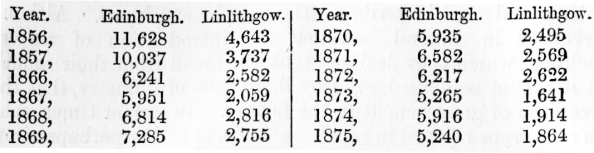
A glance at the above shows
that less than one-half of the area of land is devoted to wheat than was
twenty years ago. This may partly be accounted for by the comparatively
low market price of this commodity with other productions of the farm, the
value of wheat being much affected by the importation from foreign parts.
For example, within the time named, butchers' meat has been doubled, while
value in wheat has remained almost stationary. A very small proportion of
the crop is taken after naked or bare fallow, the area of which is year by
year becoming "small and beautifully less." Wheat is rarely taken after
grass, being almost invariably sown after roots or beans. Farmers
generally contrive to get as much seed in as possible from the middle of
October to the end of December, but sometimes a little is left over till
the spring. Both broadcast and drill sowing are practised. "Where the land
is clean the former method is perhaps preferable, as the roots of the
plants, not being so confined as they are in the drills, tiller better. On
stiff clays, too, the broadcast system is to be recommended, but on fine
free-working soils drilling is preferable, as the crop is more certain,
there being less liability of the plants dying out in winter, owing to
want of firmness in the soil. Another point crops up which is of manifest
importance had we time to dwell upon it—the best width between the drills.
What this should be is by no means decided, nor is it likely to be,
because of the varying circumstances of soil, locality, and climate; yet
we have it on good authority that wide drilling almost compels clean
farming, as the hand and horse hoe have to be kept pretty regularly at
work in order to keep down the weeds. But close-drilling also has its
advocates, and when doctors differ, who can decide? For drilling at
intervals of 8 inches, from 2 to 2½ bushels in autumn to 3 in spring are
about the quantities used, from 1½ to 2 pecks additional being allowed for
broadcasting. Before sowing, the wheat is steeped in a solution of blue
vitriol, at the rate of about 1½ lb. to each quarter of grain, as a remedy
against ball and smut. Many varieties of wheat are grown. Of these we may
mention Benton, Hunter, and Shirreff's King Richard, the latter of which
is an excellent cropper. Chedham and Trump are also cultivated to some
extent. In the red varieties, Square Head has attained to some celebrity,
while Spalding and Browick have their admirers. The estimated average
produce of wheat in Edinburgh is 31 bushels per acre in the best
districts, and 24 to 25 in the higher, although many crops exceed these
figures by 12 or 15 bushels, and some by a great deal more. In Linlithgow,
30 bushels is stated as the average, but from 4½ to 5½ quarters is often
reached.
The usual weight of wheat
may be set down approximately at 60 to 63 lbs. per bushel; on good soils a
little more, on poor thin subjects something less. Weeding of cereals is
not so much attended to in the Lothians as it might be. It is, therefore,
not uncommon at certain times to see the fields yellow with the flowers of
the wild mustard; at others, red with those of the poppy. Wild oats, too,
are a serious source of annoyance in some districts, while thistles spring
up luxuriantly in soils favourable to their growth. Top-dressing of wheat
is practised here and there. When fertilisers thus applied are mixed with
potash and common salt, the straw becomes much stiffer, and thus
root-falling and stem-rotting are, to a certain extent, prevented. In
adverse seasons the larvae of the crane-fly or daddy-long-legs (Tipula
oleracea) occasion much mischief to the roots of the plants; small insects
sometimes attack the stem, while the ear is now and then injured by the
wheat midge.
Barley.—In both Mid and
West Lothian a comparatively large area of barley is grown, being in each
county almost one-eleventh of the breadth under cropping. The acreage
under barley was in—
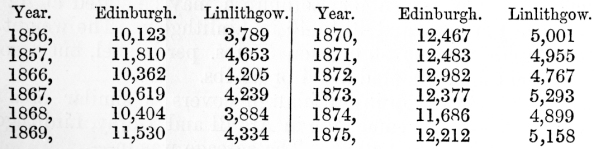
Of late years a slight
increase is noticeable in the extent under cultivation, but not nearly so
much as in some counties. The fluctuations in the statistics effected by
the growth of this cereal in the past twenty years have been very
trifling, although prices have varied considerably. Compared with wheat,
the value of barley now stands relatively high; this is, without doubt,
one reason why the area under the latter is so well maintained. On farms
near the sea fine crops are annually grown, as also on the lighter soils
in the interior of the county. Barley is generally taken after turnips. As
the crop draws its constituents from the soil very quickly, unlike wheat,
which takes them gradually, it is necessary to have the land manurially
rich, for the plant sends out numerous roots which spread laterally
through the soil. "Where the whole of the turnip crop has been drawn,
farm-yard, or artificial manures are substituted, but the barley crop is
rarely as good as it is after the consumption of the turnips upon the
land. The condition of the "bed" in the time of seeding is of primary
importance. The best state of the soil is a friable one, so much so that
when sowing the seed, in the language of the old adage, "the dust should
rise above the harrows." Still there should be, at the same time, a
sufficiency of moisture in order to germinate the grain and give the
plants a start. With these conditions of soil, early sowing answers best,
for it is usually productive of the largest bulk of straw and the heaviest
grain yield. Both broadcast and drill sowing are practised. While there
are undoubtedly great advantages to be derived from the former, which in
some respects suits the habits of the plants very well, the great
difficulty is to secure that uniformity of depth which alone gives, or at
all events gives best, the uniformity in the sample so desirable in the
barley crop. If sown broadcast, about 12 pecks per acre are allowed; if by
drill, 8 to 9 are considered sufficient. On account of its productiveness
and the preference shown to it by maltsters, Chevalier still seems to be
the favourite variety, but on high-lying farms much common barley is also
grown. Annat and Golden Drop also have their patrons, but these
descriptions do not yield so well as Chevalier. Moreover, where the soil
is manurially rich, the latter is least liable to lodge, and when it does
fall it is not at all subject to send out lateral germs or shoots. Full
crops yield 56 to 60 bushels per acre, but this quantity is not often
reached. A fair return for Edinburgh may be stated at 42 to 48 bushels per
acre, and 40 to 46 in Linlithgow. The weight of best samples reaches 56 or
even 57 lbs. per bushel, but a good average may be estimated at 54 or 55
lbs.
Oats.—The oat crop in
Edinburgh covers a similar area to that occupied by the same crop in
Argyll and Moray, Linlithgow having about half the extent. The acreage was
in—
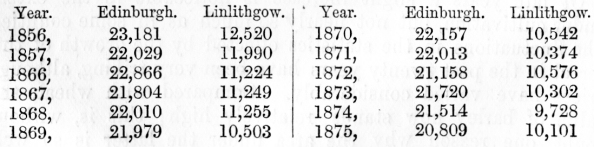
It appears from these
statistics that the land devoted to the oat crop in both counties has
decreased somewhat in twenty years, but has varied very little in the past
ten years. It is almost the invariable practice to take oats after lea,
the exception being here and there a patch of potatoes which are taken
from the lea furrow, or on the high farms a crop of oats taken after
roots. Some farmers plough their land early; others leave it until after
the stubble has been turned over. Early ploughing, to the depth of 6 or 8
inches, generally gives the best results, as the turf is deep enough, and
has sufficient time to decay, and act a fertiliser to the young plants.
The surface, too, becomes flowed by the winter frosts and rains, and a
good seed-bed is ensured. The condition of the soil for the oat plant is a
deep and well-stirred one, the subsoil being free from stagnant moisture.
In habits of growth, oats resemble wheat more than barley, inasmuch as the
roots, or rootlets, push themselves vertically into the soil rather than
laterally near the surface. In the matter of sowing, a part is done with
the drill, but it is not always either convenient or expedient to do so. A
saving of seed is effected, and where hand-hoeing is practised, it is
undoubtedly the best plan. Sown broadcast, about 2½ to 3 bushels of seed
per acre are used; often a great deal more. Indeed, it is a fault that the
Scotch farmers have of scattering far too much oats upon the ground. When
the seed-time is favourable, and the seed good, the mistake of thick
sowing is manifest. Many fields are one-fourth too thickly planted. Pour
bushels sown by hand, and 2 or 3 by the machine, must be considered as
ample. On the early holdings, seeding commences with the advent of March,
but towards the hills it is well on to the end of the month, and now and
then into April before the crop is entirely got in. Two double turns with
the harrows generally suffice to cover the seed, but of late farmers have
shown a preference in finishing with the chain harrow. Several varieties
of oats are grown in both counties. The popular sorts seem to be the
Potato, Sandy, Hopetoun, Longfellow, Tartarian, Gray, and Early Angus. On
deep soils, manurially rich, the Potato yields well, while upon
moderately-conditioned lands the Sandy is a very suitable variety. The
Black Tartarian is a prolific cropper when sown upon a deep rich soil,
often yielding as much as 7 to 9 quarters per acre, weighing 35 to 38 or
even 40 lbs. per bushel. A fairly good crop of Potato oats in Edinburgh
may be stated at 45 to 50 bushels; in Linlithgow, 40 to 45 bushels.
Certainly these figures are often exceeded, while in many cases they are
not reached, so that stating an average yield is at best only a hazardous
conjecture. The weight per bushel varies from 40 to 43 lbs., or about 41
lbs. on the average. No cereals benefit more from top-dressing than oats,
but since the more extensive use of extraneous feeding stuffs for stock,
less top-dressing has been required and given. When found necessary, a
mixture, consisting of l½ cwt. of guano with 1 cwt. of nitrate of soda and
1 cwt. of common salt, has a most salutary effect on the crop,
particularly if applied in showery weather. Moreover, the salt acts, to a
certain extent, as a specific against grub and other insect pests, so that
its virtues for agricultural purposes can hardly be over-estimated.
Beans.—A very small breadth
is annually devoted to beans. In 1866 it was 802 acres in Mid-Lothian, but
by 1875 the area had been reduced to 467 acres. In Linlithgow, for the
same years, the acreage was 1029 and 1026—a very small difference in ten
years. In the latter county the crop is sometimes a very good one, the
returns being ample and satisfactory. A firm consolidated soil is best for
the bean crop, the tilth being such that the plants can send their
rootlets a long way down into it. If lime is not present, it is generally
added, as it is an essential element in the constitution of the bean crop.
Both the drill and broadcast systems of sowing are common, but the former
mostly prevails, and is undoubtedly the best. A width of from 16 to 24
inches between the drills allows of the plants being thoroughly cleaned,
and is therefore considered the most convenient. The bean crop reaches
from 32 to 36 bushels per acre on the average: when these figures are
exceeded, the return is thought good.
Rye and Peas.—Very little
land is occupied by these crops in either county, being confined to a few
acres in small patches. As the produce affects the agriculture in a
trifling degree, it would be a waste of time to enter into details of
quantities and methods of cultivation. We may note, however, that in 1875
there were in both counties 52 acres of rye and 41 of peas in the
aggregate.
Hay and Grass. Within the
past ten years a much larger breadth has been annually devoted to sown
grasses. The acreage was in—
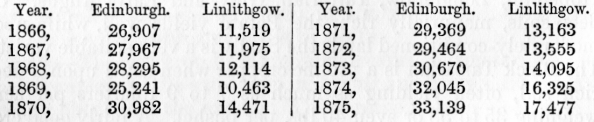
The grass seeds are
generally sown along with the barley crop, which is the last in the
rotation; now and then this plan is deviated from, but seldom. When barley
has been put down early, the grass seeds are sown after it has brairded,
because, if they are put in at the same time, they get too profuse by
harvest time, and cause great difficulty in securing the drying of the
sheaves for the stack. In a favourable season, sowing commences by the
middle of April. The seed is now almost universally deposited by a drill,
16 to 18 feet wide, and covered in either by a very light stroke of the
harrows or by a turn with the roller. The latter plan is mainly adopted,
and is to be recommended, because the nearer small seeds are to the
surface the better. Throughout both counties farmers hold various opinions
as to the quantity of seeds requisite to produce a full and close sole of
grass. Mr Anderson, of Norton Mains, sows 10 lbs. of mixed clovers with 1¼
bushel of ryegrass—one-half home grown, that is British, and one-half
foreign. This quantity is found to answer well upon his farm. Mr Wilson,
Lochend House, Linlithgow, sows 8 to 10 lbs. of mixed clovers with 5 or 6
pecks of perennial ryegrass. Both quantities are often exceeded on other
farms. A good mixture for pasture land is 8 lbs. white clover, 5 or 6 lbs.
of red, 2 lbs. of alsyke, with 6 pecks of mixed ryegrass. A little
cowgrass and trefoil added will be an improvement. For hay, 10 lbs. of red
clover, 4 lbs. of white, 2 lbs. of alsyke, 3 pecks of perennial ryegrass,
and 3 pecks of Italian is a mixture which is found to answer well. Farmers
have discovered that in the matter of seeding with grasses it is a wise
maxim to err on the safe side, and so secure a thickly-set sole or sward.
We made several inquiries as to clover sickness; it is experienced in some
cases, and is undoubtedly owing to want of potash. ["We may here remark
that a friend of ours applies kainit or potash salts where the land was
formerly clover-sick; now he raises splendid crops of clovers which are
never thrown out in the winter months, as they were before potash was
used.] A good dressing would be highly beneficial to many of the soils. In
Edinburgh, about two-thirds of the grasses under rotation are made into
hay or cut green for cattle; the remainder is grazed by stock. In the
neighbourhood of the city, a considerable quantity is annually cut and
consumed in the city byres and stables. A large area is let every year for
the purpose at high rates. This year (1876), clovers and artificial
grasses for cutting made L.19 to L.20 per acre, but in times of scarcity
we have heard of L.30 being reached. In Linlithgow about three-fifths of
the entire crop is made into hay. There is a very small acreage of
permanent meadow-land reserved for this purpose, amounting only to 1300
acres in Edinburgh and 718 in Linlithgow. Towards the end of June, or as
soon as most of the flowers are in bloom, cutting of the grasses for the
hay crop commences. This is now almost entirely done by the mowing
machine, although the scythe is still employed on small holdings or where
the crops are much weather beaten. When seed is not intended to be taken,
early cutting is deemed most desirable, as the farmers are fully alive to
the fact that the hay is more valuable, and the aftercrop heavier. The
best time to harvest clover is a little before the period of full blossom;
if allowed to stand longer the stalks partake too much of the woody fibre;
if taken before, the juices are not properly formed. But the time of
cutting seems to be much better understood than the making of the hay
after it is cut, for although the Lothian farmers are abreast of those in
many other parts of Scotland in the matter of hay-making, nevertheless,
almost all of them allow the grass to lie too long in the swathe. A day or
two is sufficient, with careful management, to get it ready for large
cock, after which it is better to cart it to the stacks at once than to
cole it in the fields, because this system entails great waste. In
hay-making the Scotch farmers might advantageously take a lesson from
their English brethren, who delight in having their hay green, crisp, and
aromatic. To make a good article, it should be done quickly, so that the
juices may all be retained. In order to secure a full aftermath, some
leading farmers are now in the habit of top-dressing with a light
application of nitrate of soda and dissolved bones; others use 2 cwt. of
Peruvian guano. A mixture of Peruvian guano, nitrate, and common salt in
equal proportions, and applied at the rate of 3 to 4 cwt. per acre, has
been tried with good results. In the neighbourhood of Edinburgh, the
foggage, so forced, is sometimes cut for stall feeding, and in a dripping
season the yield is large. The permanent land devoted to the production of
hay has been vastly improved in recent years by draining and surface
dressing with compost, but there are many portions susceptible of still
further improvement. Unless full compensation be made, the scythe is the
greatest robber that comes upon a farm. As a rule, the land which is
grazed the second year carries a fair head of stock, but grazing on a
large scale has not yet drifted in to be one of the branches of farm
management observed by the Lothian occupier.
Any report on grasses
produced in the county of Mid-Lothian would be incomplete without a brief
notice of the sewage farming carried on at Edinburgh, by which as much as
L.45 per acre has been realised from what was originally the poorest of
soil. The extent of these forced meadows is at present about 400 acres,
and it is gradually increasing. The whole is irrigated with the sewage of
Edinburgh, and as it is free of charge, and there is little expense
connected with it, through the elevation whence the fluid manurial
ingredient comes being some 300 feet above, the farming is very
profitable.
At Craigentinny, between
Edinburgh and the sea, are the most extensive meadows in Scotland, being
about 200 acres, all of which have been under regular irrigation with
sewage for upwards of thirty years. A large variety of seeds was put in at
the outset, the principal being Italian rye-grass. Most of the sown
grasses have disappeared long ago, but in their place has gradually sprung
up abundance of natural grasses, which now form a close thick sole. The
produce is sold each year, chiefly to cow-keepers, at L.16 to L.28 per
acre, and one year the price reached L.44. The crop is cut five times in
the season, from the beginning of April to the end of October. The annual
proceeds of the farm, which is in the hands of Mr Christie, the owner,
amount to between L.3000 and L.4000, the expenditure being merely the
wages paid to two men for keeping the ditches in proper order. The gross
produce per acre is estimated at 50 to 70 tons. A little nearer the city
are the Lochend meadows, tenanted by Mr Scott, Duddingston. They have been
laid out on the ditch system, which involves a little more expense, but
still they pay well. In all, they extend to about 80 acres, most of which
is in grass, but on an arable plot of 12 acres, potatoes are sometimes
grown, the land being sown with Italian rye-grass after their removal,
which comes in for cutting before winter. The second crop brings about L.5
per acre. The permanent grass has averaged during nine spring sales L.27,
12s. per acre; prices ranging from L.20 to L.45, according to crop and
demand.
At Dairy, on the west, Mr
Thomson has about 70 acres under sewage irrigation. These meadows have
been in grass for at least half a century, and possess a thick well-set
sward. The sewage has ample natural fall, and involves little expense. The
produce is disposed of in a similar manner to that on the farms already
described.
At Grange, on the south, a
plot consisting of 16 acres gets the drainage of a small section of the
city. Altogether, the sewage irrigation of Edinburgh has been a great
success, the produce being worth at least L.6000 per annum. This is, as
already stated, principally grass, which is mostly consumed by the 2000
dairy cattle estimated to be in the district. Much has been said and
written anent the suitability of sewage grass for dairy cattle, and while
we do not intend here to enter into the pros and cons which have from time
to time been advanced, we may remark that the cow-feeders of Edinburgh
acknowledge it to be a valuable milk-producing commodity, and that they
can get no other feeding stuff to compare with it for the same amount of
cash, notwithstanding the high prices they have to pay per acre.
Green Crops.
Turnips.—About one-tenth of
the cultivated area of Edinburgh and one-fifteenth of Linlithgow are
annually under turnips. This is a much higher percentage than the turnip
area occupies in many counties, but vastly inferior to Aberdeen and some
other important cattle-feeding districts. The extent was in—
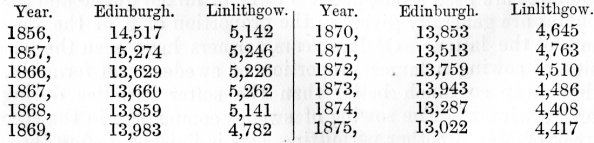
In both Mid and West
Lothian there has been a gradual reduction in the area during the past
twenty years, though not to any appreciable extent. On all the soils where
turnip culture is suitable, it is still considered the mainstay of arable
and mixed farming, providing, as it does, such a large amount of winter
food for stock, and its consumption being so valuable a manurial agency
for corn. Where autumn cultivation is observed, the land is ploughed with
a deep furrow of eight to ten inches as soon as possible in the fall. It
is then allowed to lie till the following spring, when it is well grubbed,
spring ploughing being rarely practised. A few years ago, as many as two
furrows were given in spring, but this mode of culture has been almost
abandoned, inasmuch as it not only entails more labour, but is positively
mischievous in its effects, for the rainfall being moderate, the soil
becomes dry and hard, so that a fine tilth is difficult to obtain, and
there is a lack of moisture to promote the germination of the seed. Two or
three good grubbings generally suffice, the last being generally made in
the direction of the drills. Mr Davidson, Walton, approves of autumn
cultivation, and he rarely ploughs in the spring. Mr Anderson, Norton
Mains, also thinks that autumn ploughing and spring grubbing answer best.
Mr Melvin, Bonnington, ploughs in autumn, taking a deep furrow, and grubs
in spring, obtaining a fine tilth. Mr Inch, Liberton West Mains, has
grubbed regularly in spring for thirty years, going over the land once,
twice, or thrice, as may be found necessary. The practice never fails with
him, as he gets his land into good order and retains all the moisture in
the soil. Another successful agriculturist, Mr Dickson, Saughton Mains,
also prefers spring grubbing, as he gets a finer mould and a better braird
of plants. We have brought forward these examples in order to show the
general esteem in which spring grubbing is held by many of the successful
farmers in the Lothians. Mr Mylne, Niddrie Mains, on the other hand,
advocates spring ploughing for turnips, but he works well up to the plough
with the harrow and crusher, so as to retain the moisture. Drills are
generally made 27 inches in width with a double-mould plough. Where
farm-yard manure is used, it is forked into the stitches, if not
previously applied to the stubble in autumn, and the drills split to cover
it in. From 2 to 3 cwt. of portable manures is also allowed to give the
plants a start at the outset. Where artificial manures are used alone,
about 8 cwts. of mixed guano and phosphates are generally given in the
proportion of 6 of the former to 2 of the latter. Of late years, farmers
have seen the necessity of sowing a larger proportion of swedes than
formerly, as they keep so much better than the softer varieties during a
severe winter. The sowing of swedes commences in the second week of May,
weather permitting, and is finished before the end of the month, the white
and hybrid descriptions being sown immediately after, and the whole crop
being got in, if possible, before midsummer. Occasionally, the turnip
beetle—Haltica nemorum—proves very destructive when the plants are in the
cotyledonous stage, and, as a safeguard, a heavy seeding is given, from 3
to 3½, or even 4 lbs. per acre being the usual quantity sown. Many
farmers, however, consider that 2½ lbs. of fresh home-grown seed is quite
sufficient. And here we may note that selection of seed is, or ought to
be, a very important matter with the grower. Having faith in the adage
that "like begets like," he should satisfy himself, not only that his seed
is descended from a healthy and trustworthy stock, but also that the bulbs
from which it was produced had been carefully selected and transplanted.
Seed grown from a miscellaneous crop of bulbs can never be so good as that
produced from those which have been selected for their shape, size, and
general qualities, because roots of all kinds are liable to deteriorate,
unless much care be exercised in their propagation. The varieties of
swedes grown are Skirving's, East Lothian, and purple-top; of common
turnips, the white globe, greystone, yellow bullock, and Fosterton hybrid.
In singling, the roots are left 10 to 12 inches apart, as a rule, although
we have seen many fields where the plants were much nearer, scarcely
exceeding 6 or 7 inches. Singlers, unless well looked after, are apt to
leave the plants too close together, as few of them can realise the size
of a well-developed turnip when they see it only in its infant stages.
Still, great care is often exercised in the singling, in order that no two
plants may be left in close contact, as the growth of both is then
abnormal. Hand-hoeing and weeding, with stitch-harrowing and grubbing, are
vigorously prosecuted, with the view of keeping down weeds and stirring
the soil, so as to allow the air to permeate it until the plants close in
the drills and entirely preclude further operations. We may mention that a
few farmers have latterly tried the top-dressing of turnips with a mixture
of superphosphate and nitrate of soda applied broadcast immediately after
singling. This is found to have a beneficial effect upon the plants, and
the practice is worthy of being more generally adopted. About 16 to 18
tons of swedes, and 22 to 23 tons of common turnips per acre, may be put
down as a good average return from first-class land, but the average of
both counties on all classes of soil will probably not over-reach 16 to 17
tons. The proper storing of turnips is not so well attended to as it might
be, neither in the Lothians nor in many other districts of Scotland. Too
often they are carted from the fields during the winter as they are
required, and in the event of a snow storm occurring or a hard frost
setting in, there is a great waste experienced in this "hand to mouth"
system. By the latter part of October, or, say up to the middle of
November, the roots should be topped and tailed, and carted to the
homestead, or in some way protected from the winter storms. When carted,
the roots should be free from frost or rime, or their keeping qualities
will be impaired. There are several methods of storing turnips observed.
The old-fashioned plan of putting in longitudinal heaps and thatching with
straw has in many instances been superseded by what we think is a better
method— that of storing in square heaps, having a uniform depth of three
feet. These heaps are finally covered with straw, and the bulbs keep
admirably, the rain running through without doing any harm. Another plan
is to cart the roots to a piece of clean lea, and set them closely
together upon the turf, the tops serving for a protection. Where it is
intended to consume the crop by sheep upon the land during spring-time,
turnips are sometimes put in heaps as most convenient, and covered with
straw and earth; or four rows are thrown into a drill, and a deep furrow
drawn up each side, the soil being laid close to the roots. In consuming
the turnip crop, the farmer has to consider two points—the making of the
straw at home into manure, and the enriching of the land for the future
wheat or barley crop. In order to provide for both these important
matters, four drills are usually drawn off to consume with the straw in
the cattle folds, the remaining four being eaten upon the land by sheep.
This practice leaves the soil in high manurial condition, especially if a
little cake has been allowed with the turnips. Some farmers let their
roots for consumption, the rate per week for aged sheep being 6d. less or
more, according to supply and demand. One penny per day is reckoned a very
good price : if the crop is heavy, it ensures a remunerative return. When
let for cattle, the general rate is 4s. or 5s. per week, or about L.8 to
L.9 per acre. Should the purchaser desire to consume cake along with the
turnips, of course the farmer gets the benefit in the improved manure; for
this cake he gives an equivalent in money at the rate of L.2 to L.3 per
ton. The city dairymen buy a considerable quantity of turnips from the
farmers near Edinburgh, for which they pay heavy prices. Potatoes.—In each
of the counties under consideration the potato crop covers about half the
extent that is allotted to turnips, so that the apportionment of the green
crop, with trifling exceptions, is one-third potatoes, two-thirds turnips.
Edinburgh stands in the eleventh position as regards other counties, while
Linlithgow, owing to its limited area, holds an inferior position. The
breadth was in—
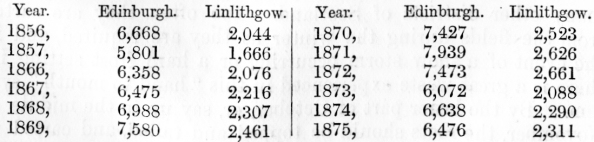
The extent of land under
potatoes remains much the same as it was twenty years ago. The soil and
climate are generally favourable to the growth of this esculent, and a
good yield is the rule. But the crop hardly pays so well as formerly,
owing to the demand for Scotch potatoes not being so keen in the London
markets. Sales are, therefore, scarcely so easy to make, while prices are
less than they were twenty years ago. Potatoes form the second crop in the
rotation, occupying a portion of the oat stubble, which is almost always
manured in the autumn. A few farmers, however, adhere to the drill-manuring
system, inasmuch as they maintain that the crop is larger. Though we are
ready to admit this, yet it cannot be denied that autumn manuring gives
sounder tubers and better quality, while the labour in spring is reduced
to a minimum. Where fall manuring is practised, as soon after harvest as
is convenient, the land apportioned to this crop is divided by furrows
drawn at a distance of 18 feet apart, in order that the manure may be
regularly and evenly laid on. The quantity per acre varies, but it is well
known that it is poor economy to give less than experience has proved
necessary to the production of a full crop. From 20 to 25 tons is reckoned
a good dressing, but even this quantity is, in some cases, much exceeded.
For example, in the present season (1876), we saw a fine thirty-acre field
of potatoes upon the farm of Mr Anderson, Norton Mains, which had been
dressed with 1250 tons of well-made farm-yard manure, or between 42 and 43
tons per acre, allowance being made for hedges and headlands. Besides
this, the crop was dressed with 4 cwt. of guano, at a cost of 10s. per
cwt., one-half being applied at the time of planting, the remainder as a
top-dressing. The potatoes were taken after grass, but the practice is not
general. After the land has been manured in autumn, it is ploughed with a
deep furrow, and where free from weeds little more is needed in the spring
than a few stripes with the grubber and going over two or three times with
the harrow. Sometimes potatoes are grown solely with portable manures,
chiefly guano and dissolved bones; in such cases, 16 to 18 cwts. are
given, at a cost of L.8 or L.9 per acre. After the land has got into a
nice surface tilth, it is thrown into drills about 27 inches wide. The
artificial manures are then applied and the potatoes planted. Ten inches
is a common width between the setts, but a few growers prefer twelve;
others, fourteen for the late descriptions. Dalmahoys and Bed-bogs are the
chief croppers in the early varieties, Regents and Bocks in the late ones.
Recently, Rintoul Dons and Victorias have been tried to some extent, while
the old Orkney red, once so common, has almost entirely been supplanted. A
wide opinion exists as to the best kind of setts to use. Some advocate
those cut from large tubers; others prefer medium-sized potatoes planted
entire, a small slice having previously been cut from the rose-end. Too
many eyes in the seed are guarded against as much as possible, as they
cause the haulms or shaws to be weak and the produce small in size. The
seed tubers are not cut long before they are wanted, inasmuch as the
germinating powers are liable to be either impaired or entirely destroyed,
by this procedure. A few weeks after planting, the drills are harrowed
down to check the first or spring braird of weeds. When the potatoes are
sufficiently through, a good hoeing is given, and between the drills the
grubber and stitch-harrow are used as required. Previous to the final
earthing up, which should always, if possible, be done when the soil is
damp, many top-dress with 3 cwts. of artificial manure sown broadcast,
which acts very beneficially in the formation of tubers. It will thus be
seen that, independently of rent of land, cost of seed, working, and other
incidental expenses, the potato crop is a very expensive one. In-purchased
farmyard manure costs about 8s. 6d. per ton, and before it can be laid on,
generally entails 1s. 6d. more for carriage, thus bringing the price up to
10s. on application. A dressing of 20 tons at 10s., costs L.10; 4 cwt. of
artificial at 10s., L.2 ; and, say 2 cwt. for top-dressing, L.1; making an
aggregate manurial expenditure of L.13. This is only a low estimate, yet a
very high figure. Still, as liberal manuring is essential to heavy
cropping, there is no economy in limiting the supplies. Considerable
losses are sometimes experienced from the crops being attacked by the
malady which thirty years ago first created such wide-spread consternation
throughout the British Islands. A fine crop in bygone times usually
realised L.30 per acre when sold to dealers, but of late the prices have
been much reduced. Ordinary value now rarely exceeds L.20 to L.25 per
acre, sometimes less, so that, taking the risk of the crop and the
expenses attending its culture into consideration, there is not a wide
margin left for profit. An extra crop, however, still occasionally
realises L.30 and upwards. A large proportion of the tubers grown in both
Edinburgh and Linlithgow are sold to dealers who reside in Dunbar. The
crop is lifted solely at the buyer's expense, the farmer furnishing the
horse work only. These dealers carry on an extensive trade, some of them
buying as far as L.20,000 worth in a single season. Lifting commences with
the Dalmahoys about the beginning of July, or sometimes in the latter part
of June. These are sent off to Edinburgh and other towns in baskets, where
they command a good price. A few farmers pit all their later varieties in
preference to selling to dealers, consigning to London or disposing of as
best they can throughout the winter and spring. In October the general
crop is lifted and stored, the whole being finished before Martinmas. The
raising of the tubers entails a heavy expenditure. One practice is to
throw them out with a plough specially constructed; another is to raise by
the digger, but this implement is not yet in general use; while, perhaps,
the most satisfactory method adopted is hand-digging. The potatoes are
stored in pits, thatched with straw, and covered with nine inches to one
foot of soil. From 7 to 8 tons per acre is thought a good crop, but the
prolific varieties occasionally reach 9 tons. The tubers are sorted into
three divisions, the largest size being for the table, the second for
seed, and the smallest for stock or the starch manufactories. Large
quantities of seed are sent to England, the change from the Lothians being
a good one; while the seed required in turn is purchased every year, or
every alternate year at furthest, from Perth, Lanark, and the adjoining
counties, the aim being to obtain them from a later to an earlier and
better district.
Other Green Crops.—In
Mid-Lothian, 657 acres of cabbage and 968 of vetches were grown in 1875.
These form a valuable food for dairy stock, as both crops come in at
seasons when other substances are scarce. Seventeen acres of mangolds and
53 of carrots were also raised. The latter are sometimes used for horses,
but a large portion of them goes to the Edinburgh green market. In the
same year, Linlithgow had 307 acres under vetches, 72 under cabbages, 18
under mangold, and 1 under carrots.
Live Stock.
Cattle.—There are
comparatively few cattle bred in Mid-Lothian, but a larger proportion in
Linlithgow, although breeding is carried on not nearly so extensively as
in many counties of Scotland. In Aberdeen, Berwick, Caithness, Moray, and
Kincardine, for example, one-half of the entire number of cattle collected
by the Board of Trade are under two years of age, while in Edinburgh only
one-fourth, and in Linlithgow one-third, are under two years; and were the
statistics collected at Christmas in place of midsummer, the proportion
would still be much smaller. Breeding is chiefly carried on upon farms
remote from the large towns, and on the upland holdings, where nearly all
kinds of farming are now and then observed by one tenant. Often the calves
from the large dairies are purchased by hill farmers, reared, and sold off
fat. Feeding cattle are generally good crosses bought in at the autumn
fairs, and disposed of during the next summer. The farmers near Edinburgh
have great facilities for the disposal of dairy produce, hence the
dairying interest receives a large amount of attention. The number of
cattle was in—
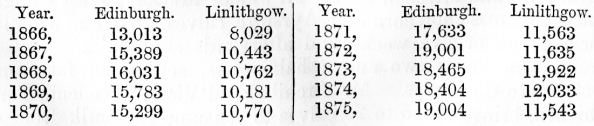
There has been a large
increase in the number of cattle kept within ten years, amounting to
nearly 50 per cent. in Edinburgh, and very little less in Linlithgow. This
has been brought about principally by the low rate at which grain has been
selling, and the improved price of butchers' meat, combining to make the
farmer change his system of management. The reduction in the area of wheat
land has therefore seen a corresponding increase in the head of cattle
kept—a noticeable feature in almost every part of the kingdom.
Breeding and Bearing of
Cattle.—The total number of young cattle in Edinburgh in 1875 was 5412; in
Linlithgow, 3851. These include all cattle under two years old, so that
the number of calves annually reared cannot be large. They are generally
born in spring, although in the vicinity of the dairies there is a fair
proportion dropped in the fall of the year, the cows being destined to
fill the ranks of the cattle which have become dry, and are put up for
feeding. Spring calves get the mother's milk for a month at the
commencement; they are then put upon skim milk, to which is added a little
gruel, or, in some cases, artificial food. Different systems prevail in
the after-management. Some prefer to turn the calves upon the pastures,
giving them skim milk twice a day; others keep them under cover, and allow
them grass or tares. We noticed that where it is the custom to drive milk
to the towns, the calves were in poor condition, the immediate money
return being most in favour. However desirable, therefore, it is in some
respects that dairy farmers should rear their own cattle, this is one
disadvantage of the system, for if the calf-flesh is lost, the animals are
liable to be stunted in after-life. Winter calves get new milk for a month
or six weeks ; they are then put upon skim milk or gruel. In addition to
this, they have sliced turnips as soon as they can eat them, with a little
hay. Cooked food is seldom given, the majority of farmers having a decided
objection to it, but several have great faith in pulped roots. The method
of rearing differs so little from that pursued in other counties that we
have little to add on this point, but, by way of illustration, may give
the practice of two or three farmers in the breeding districts. Mr Meikle,
Seafield, Bathgate, who owns one of the best pure-bred Ayrshire stocks in
Scotland, rears 20 to 30 calves annually, giving them warm milk from the
cow for a month, after which they are run upon the pastures, and are fed
with skim milk and artificial food. Mr James Mackay, West Craigs, raises
20 cross shorthorn and Ayrshire calves, giving new milk for a month or
five weeks, and afterwards skim milk. These crosses he keeps two and a
half years, selling off fat from October to Christmas. Mr Archibald
M'Vicar, Woodend, Torphichen, brings up 15 to 20 calves to consume the
milk from a dairy of 12 to 15 cows. This is principally a hill farm, on
which blackfaced sheep are kept. In the city and adjacent byres some of
the calves are fed off for the butcher with all despatch, and sold as
veal; others, as already stated, are sold to the upland farmers, either to
rear as dairy cattle or to fatten for the shambles.
Cattle Feeding.—The
majority of lowland farmers graze only a few cattle in summer, but in
winter feed many more. The Board of Trade returns afford no information as
to numbers, as the bulk of the feeding cattle are purchased in during
autumn, and sold off before the returns are collected in the following
year. The beasts for fattening consist largely of strong shorthorn crosses
from the southern counties of Scotland and the north of England, with here
and there a sprinkling of Irish. These crosses are two to three years old
when bought in, and are sold off as they become ready during the winter
and spring months, the whole being cleared out by June. It is not uncommon
for the in-buying price to be doubled, while there is generally a
sufficient margin to fully remunerate the feeder. Sometimes good crosses
are kept over-year and finished off by the following Christmas, when they
make heavy weights. This system is, however, far from common. The food
given to fattening animals is turnips, straw, cake, and corn, with or
without a little hay. Roots are not given ad libitum as in some counties,
only a sufficient quantity being allowed to keep the animal in a healthy,
thriving condition. Crushed oats and rye are used in a few instances, so
are refuse potatoes, when the crop is lifted by the owner. Mr Ford,
Hardengreen, one of the best feeders in Mid-Lothian, uses hay, cake, and
crushed grain. These substances he finds to answer well, and his cross-breds
thrive admirably upon such generous fare. He has tried the experiment of
running a few crosses upon rough pastures in the winter, allowing nothing
but what they gather for themselves, and yet they make fair progress. Of
course, they require a little better diet at the finish, but it is well
bestowed. Mr Dickson, Saughton Mains, is also a noted feeder. In addition
to straw and turnips, his cattle are liberally supplied with extraneous
food, and are consequently sent off ripe before they have been long in his
hands. Mr George Davidson, Walton, is one of the most noted feeders in
West Lothian. He purchases either the best Irish or Westmorland cattle in
the fall of the year, when the turnip crop is ready for use. A sufficient
quantity of roots is allowed, to prevent the animals from requiring water,
with a daily allowance of 3 lbs. of linseed cake. In addition to this,
they get a feed of the following mixture once or twice a day:—Crushed
cotton cake, grains, light wheat, beans, oats, light barley, and cut
straw—or hay, when cheap—damped a few hours before use. On this fare they
make good headway, and are quite healthy. Those which are ripe go off to
market by the end of the year, when the stalls they occupy are filled by a
few choice cattle drawn from the ordinary winter stock. The remnants are
sold in spring and early summer, the whole being cleared out by June. The
last consignments in the summer of 1876 realised L.35 each. Last year
(1875), Mr Davidson tried an experiment with some pasture land purposely
left rough in the autumn. He purchased a cheap lot of West Highland stirks
at the Falkirk October Tryst for L.6, 5s. per head. They throve amazingly,
and with a little help in the spring, made considerably over L.20 each.
The courts at Walton are all covered in, Mr Davidson having little faith
in open sheds for feeding purposes. "Loss of heat is loss of meat," he
rightly considers, to say nothing of the superior quality of the manure
which is made under cover. Mr Davidson also grazes a few stirks upon the
pastures, winters them, and feeds off in the following summer. Mr Peter
Wilson, Broomieknowes, who has a mixed farm consisting of arable land and
hill pasture, grazes cattle upon the hill in summer, and finishes them in
the courts upon turnips, straw, and corn, or cake in winter. So long as
straw commands 4d. to 6d. per stone, Mr Wm. W. Anderson, Norton Mains,
Mid-Lothian, thinks it profitable to sell it, and purchase an equivalent
in town manure from Edinburgh or Glasgow. When the straw falls short of
that price, he buys in cattle to consume it along with the turnips. Mr
John Fortune, Inglis-ton feeds cattle in the open courts in summer with
cut grass. This system makes good manure, and brings in a return of about
L.10 per acre.
The dairymen in the
district lying in and around Edinburgh change their cattle as a rule every
year, sometimes oftener. The animals are purchased either on the eve of
calving, or soon after the calves are dropped, and are hard fed and milked
for eight or ten months, when, by a gradual change in the character of the
food, the cows become dry, and are soon good beef. Thus they bring in
sometimes as much, and occasionally more than first cost. In other cases
they lose a little, and this is more common since the great advance in the
price of newly-calved cattle, or those close on profit. In the more remote
dairy localities, cattle are milked for one, two, or three seasons, so
that there is not so much beef produced as where there is more pressure
brought to bear upon the management. Milk being the primary object of the
Edinburgh dairyman, he caters for it in every way, using substances in the
forcing which would soon ruin the constitution of the cow. It is therefore
to his interest to change his stock often, even if a little loss be
experienced. We may here note that of late years large lots of foreign
cows in calf are readily bought by city dairymen, at prices ranging from
L.7 to L.15 each. These, as a rule, milk well, and are less risk to the
owner, owing to their small cost; while, when fat, they frequently make
L.3 to L.5 a-piece over inlaid price. We have said that Ayrshires and
shorthorns sometimes lose a little, so that the dairyman is now drifting
into the stocking which requires less capital, and is more sure of
maintaining or exceeding its original value. Some of the foreign stock
make very nice beef, and are readily picked up by butchers if their age is
not too great.
Dairying.—Of the 19,004
cattle returned by the farmers of Edinburgh, 9614 come under the head of
cows and heifers in milk. Besides these, there are about 1800 to 2000
milch cattle in the town and suburbs of Edinburgh, making a total of
between 11,000 and 12,000 coming under the dairy interest. In Linlithgow,
3541 of the 11,543 may be classed as dairy stock, making a total for the
two counties of about 15,000 head. In Mid-Lothian dairying has increased
much in recent years. In the city of Edinburgh it has fallen off slightly,
but has been fully compensated for by the extra number of stock kept,
specially in the country, to supply the requirements of the town. Previous
to the rinderpest year, the number of dairy cattle in Edinburgh was stated
at 2100 or 2200; but the grievous plague claimed many as its victims, and
the original quantity was never again fully made up. The Cattle Sheds Act,
too, reduced the numbers to some extent. This insured a regular inspection
of the byres, and a report as to whether they were properly constructed,
had good sanitary regulations, and were well kept in general. Many were
condemned, and the country thus came in for a larger share of the town's
business. Had the town's cattle increased with the requirements of the
population in place of falling off, they would now have, doubtless,
numbered close upon 4000. Most of the produce of these cattle is sold as
sweet milk. There are also dairies in the suburbs constructed on much the
same principle as those in the city. In summer the cows are fed upon grass
obtained from the irrigation meadows, together with brewers' grains, bran,
and meal; in winter, they have hay, cut turnips, grains, beanmeal, and
straw. Both feeding and milking take place three times a-day, except when
the cows are being put dry. Besides the foreign cattle already mentioned,
the breed consists of Ayrshires and crosses. It is computed that about
one-half of the milk required in Edinburgh is obtained from the city
dairies; the remainder is driven from the country, or, in some instances,
where far distant, sent by rail. Amongst those who keep shorthorn crosses
for dairying purposes, may be mentioned Mr Stenhouse, South Gyle,
Corstorphine, who has about 60 cows; Mr Thomas Mylne, Niddrie Mains, who
has 50 cows; Mr James Hope, Duddingston, whose byres contain over 70 dairy
cattle; and Mrs Mure, Mid-Kinleith, who has 40, more or less. The 50 cows
at the large dairy of Morningside, Egypt, owned by Mr Begbie, also belong,
with a few exceptions, to the cross breeds. On many of the large dairy
farms pure Ayr-shires are kept. Mr James Fleming, Coates, Penicuik, has,
off and on, 50 of this favourite breed; the Duke of Buccleuch has 20 at
Dalkeith Park; Mr Ainslie, Hillend, has 40 to 50; Mr Walter Kidd, about 50
at Balleny; and Mr Robertson, Harlaw, Currie, has between 30 and 40 of his
own rearing. Mr Meikle, Seafield, keeps pure Ayrshires, his herd, for
dairy purposes, numbering about 40; Mr Mackay, West Craigs, has 20 of the
same breed, and Mr M'Vicar, Woodend, 15 to 20. The three last named stocks
being in Linlithgow, the owners do not send their milk into Edinburgh, but
find an offgate in another way. Mr Meikle has sent his churned milk to
Newcastle for seventeen or eighteen years. The Penicuik and Currie
districts in Mid-Lothian are both well adapted for dairy stock; and when
sweet milk began to be scarce in Edinburgh, during the time of rinderpest,
several farmers commenced driving their milk to the town, and have done so
ever since. The method of feeding varies much according to the kind of
cows kept, the district to which the dairy belongs, and other
circumstances. On a dairy-farm in the Penicuik district, the cows are kept
upon the pastures in summer, and get a feed of draff twice a-day; in
winter they have boiled turnips mixed with feeding meals and draff twice
a-day, raw turnips twice, with hay and straw each once in the day. The
cost of the food is calculated at 12s. per week. Upon another farm, the
cattle get cut vetches and meal in summer, besides liberty upon a good
pasture; and in winter have turnips three times a-day, and hay or straw
twice. Cost of maintenance, exclusive of attendance, 12s. to 13s. in
winter; in summer, 7s. to 7s. 6d. In the parish of Torphichen, Linlithgow,
a farmer who drives milk, feeds on turnips, meal, draff, and hay in
winter, at a cost of 10s. to lis., and estimates the summer-keep at L.7
for twenty weeks. Another farmer in the parish of Linlithgow, who feeds in
much the same way, calculates 11s. to 12s. as a fair average all the year
round. His cows for this, return three to four gallons of milk daily
throughout the season. On a farm in the Cuirie district, the cows are
grazed in summer, and have a feed of cut grass at night; in the winter
they get turnips, draff, meal, cake, and straw. Estimated cost, 14s. per
week. The instances quoted scarcely give a fair criterion of the cost of
keeping a cow, as the owners, having most of the food in their own hands,
do not estimate everything at full price. The city dairies show a much
larger expenditure. At Morningside the cows average about 18s. per head.
Mr Honeyman, Dairy, gives 19s. to 21s. as the probable cost. Mr Mylne,
Niddrie Mains, gives 17s. 6d., and some others estimate L.1. This may be a
little over the mark, but where cows are kept in the stalls all the year,
the expense is undoubtedly heavy. "We received various estimates as to the
quantity of milk an average cow would produce. Some of the best, in the
height of the season, give six gallons daily for a long time, while five
is common. A good average for a dairy, throughout the season, is about
four gallons; this is seldom exceeded, and not often reached; three and
a-half gallons will be about the most correct figure to put down
approximately. We have heard it stated at three gallons, but this, we are
convinced, after making numerous inquiries, is too little. The selling
price is 11d. per gallon, so that a cow which holds out at three and
a-half gallons per day will bring in 24s. l½d. per week. There are,
however, many incidental expenses, not calculated in the returns, which
bring up the cost of keep so near that of amount realised by produce, that
there is a very small balance kept for profit. There is sometimes an
offset in the difference between the buying-in and selling-out price of
cattle, especially where the milk is much forced.
Shorthorns.—There is comparatively little
fancy breeding carried on in either county. The shorthorn mania has
probably not reached this district; if so, it has at least gained very
little ground. Still there are two very nice herds of shorthorns, one at
Dalkeith House, the property of the Duke of Buccleuch, and the other at
Halkerston, the owner being Mr Currie. They are both well descended, and
are carefully managed, fresh strains of blood being introduced from time
to time from herds of repute. The commercial stocks of the counties,
generally, may be classed under the head of Ayrshire and shorthorn
crosses, with a fair proportion of Dutch in the city dairies.
Sheep Farming.
As a sheep-producing
county, Mid-Lothian is the fourteenth in Scotland; while West Lothian
stands very low, two counties only, namely, Clackmannan and Nairn,
returning a smaller number. But as we remarked of cattle, so we may say of
sheep, that if the returns were made earlier in the season, the present
figures would be much exceeded. Many of the turnip sheep upon the lowlands
have been disposed of, and the new stocks are not laid in when the returns
are made. The majority of the sheep accredited to the counties are
therefore breeding flocks. On account of the rise in the price of meat
during recent years and the stagnation in the grain trade, more attention
has been paid to sheep-breeding, rearing and feeding. The number of sheep
was in—
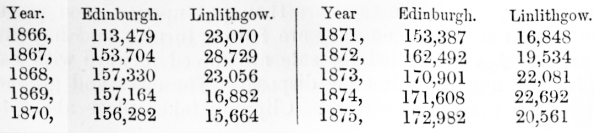
The numbers have increased very much in
Mid-Lothian in ten years, 59,503 more being returned in 1875 than in 1866.
West Lothian has receded in ten years, but has gained ground since 1870,
when only 15,664 were returned. The greatest increase in Edinburgh was in
the year 1867, but the figures have since been steadily becoming larger.
The formation of the Lothian Earn Society, a few years ago, gave an
impetus to breeding, which has had a salutary effect, not only in the
numbers reared, but in the quality of the stock as well. Several breeds
are to be found in the counties. Of course the blackfaces chiefly occupy
the hills ; there are likewise large flocks of Cheviots; while half and
three-parts bred sheep occupy the low grounds. In Mid-Lothian a few
Cotswolds and Shropshires are reared, as well as several notable flocks of
Border Leicesters. Foremost among the owners of blackfaced in this county
are Mr Archibald, Overshiels; Mr Aitken, Listonshiels; Mr Murray,
Eastside; Mr Melrose, West-loch, and Mr Gray, Harperrigg. The Cheviot
breeders are Mrs Moffat, Kinleith; Mr Stevenson, Mount-Lothian; Mr Penman,
Bonally, and Mr Plenderleith, Moorfoot. The Border Leicester breeders are
the Duke of Buccleuch; Earl of Morton; Mr Mel-vin, Bonnington; Mr Ford,
Hardengreen; and Mr Ainslie, Hillend.
Blackfaces.—Although the Cheviot breed is
preferred in some parts, there is still a lingering attachment to the old
blackfaced type in others. This hardy breed has for ages occupied the
hills of Scotland, and great improvement in its appearance has in late
years been effected. The race is extremely hardy, and consequently of
great value upon exposed hills and mountain sheep walks. With slight
variations, the lambing season occurs from the middle of April to the 20th
of May. Twin lambs are exceptional, and as the ewes are excellent milkers,
the progeny soon become strong and vigorous. A certain proportion of the
gimmers fill up the place of the ewes which are drafted off at five or six
years old and sold to English farmers, who take a crop of half-bred lambs
from them, and then sell off fat. The wether lambs are mainly sold in the
Lanark and Sanquhar markets, at prices ranging all the way from 12s. to
24s. per head, to non-breeders, who keep them till three years of age, and
then dispose of them to the southern markets to fatten on turnips. Mr
Archibald has one of the finest flocks of blackfaces to be seen in the
country. The lambs are dropped on the hill farms of Overshiels and
Midcrosswood, where they are weaned early in August. The tups are then put
upon a good pasture until the autumn, when they are fed on turnips and hay
until March. Those intended for sale are forced forward with cake and
beans until the time for disposal. The ewes and gimmers are fed on grass
and turnips. Clipping takes place about the 10th of July, and regular
dipping constitutes a part of the successful management. The cast ewes are
sold into England at six years of age. Tups from this flock realise as far
as L.55; generally making as far as L.13 to L.15 per head on the average
when disposed of at the Lothian Earn Sales. Mr Aitken, Listonshiels, has
had a fine flock of blackfaces for over twenty years. The sheep are
summered on the high parts of the farm and wintered on the lower pastures.
No food is, given except a little hay in case of a snowstorm occurring.
Last year (1875) 40 rams from the flock averaged L.9, 6s. 4½d., the
highest price being L.36. Mr Gray, Harperrigg has had blackfaced sheep
over twenty years. No hand-feeding is practised. The flock numbers 500,
the ewes being kept until five crops of lambs are taken, and are then
replaced by gimmers. Mr Currie has established a nice flock of blackfaced
sheep at Yorkston, in the Gorebridge district. Hay is the only extra food
given, and that only in a snowstorm. Mr Archibald M'Vicar, Woodend,
Linlithgow, keeps 500 to 600 blackfaced ewes, and breeds cross lambs
chiefly by Leicester tups. In most respects the management is similar to
that of many of the Mid-Lothian breeders. Of West Lothian, generally, we
may say, that few blackfaced flocks are kept from which rams are bred for
the Lothian Ram Sales; indeed, a great many farmers breed crosses only for
feeding purposes, except perhaps a few pure-breds to fill the places of
the draft ewes.
Cheviots.—In many parts of Scotland the Cheviot race has supplanted the
blackfaces. This type occupies in part the highland and in part the
lowland country; Cheviots may, therefore be described as an intermediate
race between the small, fell, or hill descriptions and the larger animals
of the plains. They pasture on the hill in summer, and are brought down
into the fields in winter and kept on foggage or old pasture. This breed
is the most hardy of all the whitefaced varieties. The original race,
which cropped the herbage of the Cheviot Hills (whence they derive their
name), are described as having been small in. size, light in bone, and
poor in wool, but having a hardy constitution. Their heads and legs
exhibited, for the most part, a slight tinge of brown. Altogether, the
breed bore little resemblance to the finely proportioned animals which
represent the type of the present day. About 100 years ago the race of
improvement began, and for at least three-quarters of a century the
Cheviot has been gradually encroaching on the domain of the blackface,
from its original home on the Cheviot Hills as far north as John o'Groats,
within a stone's cast of which we have seen a splendid flock of this type
feeding. In the counties under notice this has also been going on to a
certain extent; what the proportions of each breed now are is a question
difficult to answer. The management of Cheviots, with trifling exceptions,
is everywhere much the same. In some eases the hoggets are never weaned;
in others, they are separated from their mothers for a few days only, and
then put back to them. Ewes seldom have lambs until they are two years
old, and are sold off, as in the case of blackfaces, at five or six to
bear a crop of half-breds in England. Shearing of the Cheviot flocks takes
place in July, the weight and quality of the fleece depending much upon
the pasture, thus verifying the old adage which states that "the wool goes
in at the mouth." Mr Stevenson, Mount Lothian, has a flock of 400 Cheviot
ewes. In the summer they feed upon the hill pastures, and in winter have a
few-turnips. Several rams are annually bred and disposed of at the Lothian
Earn Sales, where they always realise good prices. Mr Penman, Bonally,
owns a very old established flock of Cheviots, dating back upwards of
forty years. On the 1st of April the lambing gimmers are taken from the
hill to the'grass parks. After lambing the ewes and their progeny are sent
back to the hills for the summer. Clipping takes place early in July, and
dipping in September and again in January. Ritchie's dip is now generally
preferred. Earns are sold at the annual sales and bring good prices. Mr
Plenderleith has bred Cheviots at Moorfoot for a quarter of a century. The
stock is mostly kept to the hill pastures, a little hay being given when
required. Earns from this fold bring as far as L.20 at they early sales.
Perhaps the best and largest flock of Cheviots in Mid-Lothian belongs to
Mrs Moffat, Easter Kinleith, Currie. About the 1st of March the gimmers in
lamb and the weaker end of the ewes are put on hay and turnips until the
lambing season. This gives them strength, and the dams have a good supply
of milk, while the lambs are healthy and sprightly. Weaning takes place in
July, about 40 or 50 of the best male lambs being kept for rams. The
highest price ever reached was L.78, but L.30, L.40, and L.50 are common
figures. Border
Leicesters.—This celebrated breed of sheep, which is said to have been
introduced into the Border counties by Messrs Cully upwards of a century
ago, has several admirers in the Lothians. Much discussion—and even
dissension—has been provoked of late anent the qualities of the Border
Leicester, but it is not within the pale of this report to enter into the
merits and demerits of the breed; we therefore pass these points over with
the remark, that whatever faults may be adduced, some of the flocks we
have seen not only seem to thrive and do well, but also leave a handsome
profit in the hands of the breeder and rearer. The Border Leicester has
the reputation of producing a larger quantity of mutton and wool than
almost any other breed. The flesh they produce is, however, somewhat
coarse in grain and tallowy in the fat. In the most noted flocks the male
lambs are kept for tups, and disposed of at the annual sales at Edinburgh.
Some of the rams thus dispersed go to improve existing flocks of the same
breed in various parts of the country, while others are used for crossing
Cheviots or blackfaced ewes. The crosses from blackfaces attain a
considerable size by the time they are two years old, and are much
esteemed for their fine quality of flesh. The Cheviot crosses, too,
although a little slower, have fine quality, and arrive at a large size
with longer keep. Where half-bred ewes are kept and crossed with pure-bred
tups, the progeny arrive rapidly at maturity, and produce a large amount
of wool and meat. By way of illustrating the management of the Border
Leicester breed, we may briefly notice the system adopted by the Duke of
Buccleuch at Dalkeith Park. The flock of breeding numbers 140 to 150, and
has been in existence twenty years. The ewes occupy the lighter land in
summer and in winter have a few turnips. The lambing time begins in March.
In winter the ram lambs get a little cake and hay, while the ewe hoggs get
the best of the parks. The flock has achieved many honours in show-yards,
and is held in great repute. Mr Ainslie, Hillend, has a nice fold of
Border Leicesters, and one of half-breds as well. The former numbers about
120. The diet is moderate, as the ewes get too fat when it is liberal. Mr
Ford, Hardengreen, has a standing flock of from five to eight score.
Nothing but grass is given to the ewes in summer, but after the new year
they get a few turnips. The tups get cake and corn, those intended for
sale or the show-yard receiving a more liberal allowance. The rams realise
high prices at the Edinburgh sales; last year (1875), the average for 45
was over L.9. There are several other folds of note in the district, the
management of which we have not space to detail.
Cross Breeds.—As already stated, crosses are
numerous. By these the bulk of the turnip crop not required for cattle is
consumed. The practice is to draw every four alternate stitches, leaving
the other four to be eaten off by sheep. In this way the soil is enriched
for the succeeding white crop, a greater breadth of land getting the
benefit of the sheeps' droppings. Many farmers cart the turnips to a lea
field, and there cut them for the sheep, but a large breadth is still,
however, consumed where they grow. A great many sheep are in this way
annually fed off, being purchased in during the autumn sales and going off
as they are ready for the market. Some of the lots leave as much as 1s.
per week for their keep, but when 7d. to 8d. per week is reached the
grower is commonly satisfied. Many farmers now allow a little cake or corn
along with the roots, which forces the sheep forward, and more money is
commanded in the market. Others feed on turnips, pur et simple, with
perhaps a little hay or straw in case of a hard frost. The numbers of
sheep in both counties will be swelled out in the winter season at least
40 to 50 per cent. by these commercial or flying stocks; in spring they
again sink to their ordinary level.
Horses.
The number of agricultural horses in
Mid-Lothian is small compared with the aggregate in some counties of
similar size. Linlithgow has about one-half the number. The large county
of Aberdeen contains six times as many as the former; twelve times as many
as the latter. The numbers were in—

There has been a decrease in both counties
within the past seven years, but not to any large extent. A few farmers,
we have already noticed, are introducing two years' grass in place of one;
this makes some difference in the number required, and others are going
into steam cultivation, which also to some extent tends to decrease the
quantity required. Of the 4079 returned in Edinburgh, only 705 are
unbroken, so that very few are reared in the county. Linlithgow, with a
total of 2077, contains 559 unbroken animals, as breeding is carried on a
little more extensively. The work horses as a rule are of a good stamp.
Most of them are either pure Clydesdales, or have been largely mixed with
Clydesdale blood. A few farmers in the west of Linlithgow breed excellent
types, the best of the produce bringing as far as L.80 to L.90, and now
and then one over L.100. We may here mention the name of Mr James Mackay,
who is well known in local show-yards as being a successful prize-taker.
The horses he rears always bring high prices. Mr Orr, The Hill, also
breeds some splendid Clydesdales, for which he has taken honours in
Linlithgow and Bathgate. Great care is bestowed in both feeding and
grooming, the diet varying at different periods of the year, according to
the work they have to do. When the spring pressure is on, the farm horses
are fed upon hay, oats, and beans, with now and then a warm mash.
Occasionally, a few potatoes are given, as well as carrots or swedes. The
horsemen, in general, seem to take great pleasure in having the animals
under their care in good condition, while the harness is clean and well
kept. In the towns, particularly in Edinburgh, there are many horses in
addition to those accounted for in the Board of Trade Returns. These
consist of various breeds for drawing drays, cabs, 'buses, and tram-cars,
with a few used for riding and driving by business men and private
families. The number of horses required by the Edinburgh Street Tramway's
Company varies from 470 to 490, according to the traffic. The present rate
of feeding which keeps them in capital condition, is on an average per
diem—
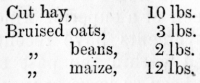
Pigs.
In neither county is pig-breeding or
pig-feeding carried on to any considerable extent. In Edinburgh the number
in 1866 was 9609 ; in 1875, it was 5191, thus showing a decrease of 4418
in nine years. In 1866, Linlithgow contained 3166 ; in 1875, the number
had fallen to 1978, being a decrease of 1188 in nine years. While the
porcine tribe have gone back much of late in point of numbers, great
improvement is noticeable in the quality. This has been effected by the
introduction of boars from other parts, and by the superior attention paid
to the housing and general management. A few pigs are commonly kept upon
every farm to consume the offal from the kitchen and the wash from the
dairy. A little meal is given to finish them, but they are at other times
kept at very little expense. Many cottagers still have the privilege of
keeping a pig, and when once fattened, forms no inconsiderable item in the
year's stock of provisions.
Dogs and Poultry.
Where sheep exist in large numbers, especially
upon the hills, a well-trained dog is invaluable, so that in the south and
southwest parts of the counties several well-bred collies are kept. The
instinct and sagacity of the shepherd's dog have often been commented on.
The old habit of calling the dogs after the name of a river is still in
full force, but whether the shepherds yet believe that this will prevent
the animals from going mad, we cannot say. However, "Tweed," "Yarrow," and
other kindred names seem to be as common as they were before the whistle
of the locomotive was heard in the Scottish valleys.
Poultry are kept on almost every farm to peck
up the "odds and ends." Close to Edinburgh, they are on some farms kept on
a large scale, as there is always good demand for the eggs. Some of the
housewives are therefore able to show a favourable balance sheet, but the
poultry undoubtedly consume much food which never finds its way to the
expenditure side of the cash-book. The varieties are numerous, including
Dorkings, Brahmas, and the old-fashioned game breed. Crosses between the
two former are reckoned the best table birds. A few geese and ducks are
also reared, and here and there fancy birds, as peacocks and guinea fowls,
are to be seen.
Improvement in Twenty-five Years.
Although for more than half a century the
farming practised in the Lothians has been of a superior kind, it must not
be inferred that no improvements have recently been made. The area of land
reclaimed within the past twenty-five years has not, as already stated,
been so large as in some counties, simply because there was less for the
proprietor or the farmer to accomplish. Still, in the hill districts,
whole tracts have been brought under the plough and made to yield
abundantly, which previously produced only a scanty subsistence for sheep.
In the Gala Water district, in Mid-Lothian, almost the whole face of the
country has been changed within the limit of this Report—since the railway
passed through the locality. Half and three-parts bred sheep have
superseded the native breeds in a great measure, and are thus adding much
to the wealth of this part of the country. A large breadth of land in and
around the parish of Currie, has also been improved, particularly the
sheep pastures which have been drained and top-dressed. The plough has
likewise been encroaching on the mountain heath. By draining liming, and
breaking up, Mr Walter Kidd has recently raised the farm of Balleny to a
high state of productiveness, a report of which has already appeared in
the Society's Transactions. Mr Robertson, Harlaw, has drained and limed a
vast extent, the latter costing as much in some cases as L.6 per acre. Mr
Gray, Harper-rigg, has limed a large area of sheep pasture, and also
drained where required. In the Penicuik locality much land now under
cropping was waste fifty years ago, a considerable breadth having been
gone over within twenty-five years. For the most part, the owners provided
the outlay-capital; the tenants performing, and paying interest for money
invested. Mr Fleming, Coates, has brought 150 acres of bog into good
arable land within twenty years. On many farms the area of ploughing land
has been increased: on some extensively, as Coates, Mount Lothian, Walston,
and Mirefield, with several others. A few miles south of Edinburgh, a
large proportion of the soil was in its natural and barren state less than
thirty years ago, and was almost wholly depastured by blackfaced sheep. It
has since been improved by draining, fencing, liming, and breaking up. A
superior class of stocking is kept, the land producing oats, turnips, and
grass abundantly. Lime is plentiful and is liberally applied. In West
Lothian, too, the race of improvement has for some time been going on,
especially in the hill districts. In the parish of Linlithgow, Mr Wilson
has added to his extent of cropping at Lochend by taking out rough fences
and reclaiming waste patches, while the land has been drained and
otherwise improved. Mr George Davidson, Walton, has drained much, and
enriched all his soil by the consumption of cake and the liberal use of
manures. Mr Wilson has effected great improvement at Riccarton, by
draining and top-dressing; and a similar statement may be made anent the
farms of West Craigs, Wood-end, and Hilderstone in the south-west of the
county. Mr Meikle, Seafield, has drained almost all his farm within the
currency of the present lease, the landlord finding the tiles and the
tenant paying for the cutting. In short, on nearly every farm in both
counties, improvements, more or less, have been effected within the past
quarter of a century. The reclamation of land has necessarily been
attended with great expense in fencing. In some instances, dry stone walls
have been built; in others, wire fencing has been substituted. Clumps of
trees have also been planted with good effect, thus affording shelter for
stock and enhancing the beauty of the out-stretching landscape.
Another noticeable improvement is in the
deeper cultivation of the land already under the plough. The farmers, as a
rule, manure with no sparing hand, and of late years, in addition to the
large amount of artificial manures used, an enormous quantity of
extraneous food for stock has also been purchased. The consumption of
feeding cakes and other substances upon pasture is one of the best methods
of enriching the soil, especially cotton cake, which has a higher manurial
value than any other commodity in the market.
The Highland Society, with many Local
Agricultural Societies, have been of great usefulness in the advancement
of agriculture. The annual shows connected with these serve as a healthy
impetus to farmers in the improvement of their stock, and perhaps in no
other branch of husbandry has so much progress been made as in the
breeding and quality of sheep. Much credit is due to the promoters of the
Lothian Earn Sales in this matter, as the annual dispersion of so large a
quantity of well-bred rams must have a wholesome influence upon the breed
in the districts where their several lots are cast. Farmers' Clubs have
also done some service, inasmuch as members are enabled to discuss
questions and interchange ideas, by which the intelligent mind will rarely
fail to profit in some degree.
In both counties, the farm implements in use
are of the first order. Nearly the whole of the grain is threshed out by
steam machines, the chimney-stalk forming a conspicuous landmark on almost
every large holding. There are still on the smaller farms a few machines
driven by horses or water-power, and occasionally the monotonous tap-tap
of the barnman's flail may yet be heard. Mowers, reapers, tedders,
hay-rakes, in fact, all kinds of labour-saving machines, are now in almost
every farmer's possession; while single and drill-ploughs, iron harrows,
seed-drills, and various other improved implements, render the working of
the soil comparatively easy to what it was twenty-five years ago. Even the
hay and manure forks are better constructed and lighter than those
formerly used, and the old ones have been laid aside with the scythe and
sickle of bygone days.
The Farm Labourer.
The position of the farm labourer will bear
favourable comparison with most other parts. On the principal farms there
is a sufficiency of cottage accommodation, which has a beneficial
influence on the character of the labourer both in a social and moral
aspect. Wages generally are high, having advanced very much in
twenty-five, and even in ten years. Notwithstanding these advantages,
there has of late been a growing scarcity of labourers, as inducements to
go to other sorts of work have been strong in this part of the country.
When the rate of wages at the collieries rose so rapidly two or three
years ago, many of the most able hands bade farewell to the plough and
shouldered the pick. Good pay and short hours—the thought of having more
time to themselves—proved to be irresistible temptations, and they
succeeded in attracting the best men from the farms to the great centres
of other local industries. We often heard, when paying the farmers a
visit, the complaint that "good men are now exceedingly scarce." Wages
have gone up fully 50 per cent. in twenty-five years: 40 per cent. in ten
years, and L.10 per annum in five years.
In the neighbourhood of Edinburgh, regular
farm-servants get L.35 or L.36 in money, 6½ bolls of oatmeal, 4 bolls of
potatoes, coals driven, one month's meat in harvest, and a cottage and
garden. Total, about L.52 or L.1 per week. Ordinary labourers receive 16s.
to 20s. per week; women workers 9s., and harvest hands are regulated by
the law of supply and demand.
In the district of Gala Water ploughmen obtain
L.20 in money; 6½ bolls of oatmeal; 1200 yards of potato ground;
dwelling-house ; month's meat in harvest, or L.1, 5s. as equivalent; fuel
at pit price; 24 qrs. barley; cow kept, and sometimes purchased ; and
litter for a pig. Estimate in money, L.52, or just about the same as near
Edinburgh, only more is paid in kind. Ordinary labourers are often scarce,
even at 4s. per day.
A few miles to the west of Edinburgh, ploughmen have L.37 in money ; free
house and garden; 4 bolls of potatoes; 6½ bolls of oatmeal; coals led;
equal in all to L.1 per week. In fact, wages throughout Mid-Lothian for
ploughmen range from L.51 to L.53 per annum, the rate differing little
between the low country and the hill districts.
In West Lothian payments are much the same.
For example, Mr John Wilson, Riccarton, gives his ploughmen L.36 to L.38;
6½ bolls meal; 4 bolls potatoes; house and garden, rent free; coals
driven, or at pit price; and a month's meat in harvest. Total, L.52 to
L.54. Servant women have L.7 to L.9 per half year with food. Happily,
there is no bothy system, the young men being hired by the half year, and
boarded in the farm house.
In the Carriden district, ploughmen get L.35
to L.36 in cash ; 6½ bolls oatmeal, worth say L.7, 10s.; 1000 yards of
potatoes in the drill, value, L.4; free house and garden, L.4; coals
driven, L.1; and a month's meat in harvest, L.1. Total, L.52 to L.53. In
many cases, a pig is kept in addition to the above perquisites, and milk
allowed at a low rate.
With the exception of a little uneasiness now
and then, caused by a desire to leave farm work and obtain employment in
other spheres of industry, the labourers of this district are a contented
and happy race of people. With most of the necessaries of life already
provided for them, they have comparatively little care and anxiety, and
not a few families lay by part of their earnings for the proverbial "rainy
day." The majority take great delight in their homes. The little patch of
garden affords them occupation for their leisure moments, and here and
there are beds of flowers neatly and tastefully arranged. Literature seems
to be in the ascendant, for almost every family has its weekly newspaper.
The children are fairly—some of them well—educated, and many, in riper
years, do good service in the commercial walks of life. Often the labourer
stays upon one farm during the whole of his days, becoming as it were
rooted to the soil, and when old age and infirmity creep on, has the
satisfaction of seeing his place filled by one of his offspring. All in
all, we rarely, if ever, saw a more thriving or contented race of
peasantry, and this causes us to regret that year by year the ranks of the
labouring classes are becoming thinner.
Before leaving this subject, we believe it
will be interesting to state the amount of remuneration given
three-quarters of a century ago. In Cranston, the wages of a ploughman
were L.2, 15s. to L.3, 6s. for the half-year; for a hind, L.5 to L.5, 10s.
for the year, with grass for a cow, and two pecks of meal per week. Extra
labourers (men) received 10d. to 1s. per day in winter, and 1s. 2d. in
summer. In Kirknewton, labouring men got 1s. to 1s. 2d. per day in summer,
and 10d. in winter, and females 6d: wages of maid servants, L.3 per year.
In the parish of Stow, in 1759, hired men received L.3, 4s. per annum;
women, L.2; and extra labourers, 4d. per day, with food, in winter, and
6d. in summer. In 1795, wages for hired men had risen to L.6, 10s. for the
year, and women L.3, 10s.; day labourers receiving 6d. in winter and 8d.
in summer, with victuals, and higher rates in harvest, but even then 1s.
to 1s. 3d. was seldom exceeded.
The wages of the present
day present a wonderful contrast to those of the times alluded to; the
total cost of manual labour upon an arable farm, especially where many
potatoes are grown, being high. On large farms close to Edinburgh, having
only one year's grass in the rotation, the amount per acre is estimated at
38s. to 45s., in some cases as far as 48s. Twenty-five years ago the
outlay in the same localities ranged from 24s. to '28s., or 30s. at most.
Thus it will be seen that working expenses have gone up at least 50 per
cent. on regular crop farms, while in the more remote districts the uprise
may be put down at 25 to 30 per cent.
Miscellaneous Observations.
Size of Farms.—The
subjoined table shows the number of holdings of various sizes in
Mid-Lothian:—
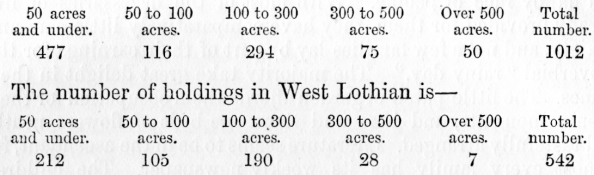
The average extent of farms in Edinburgh is
131 acres; that in Linlithgow, 108 acres. In the former, the number of
occupiers having less than 20 acres is-357 ; in the latter, 145. Ordinary
farms in Mid-Lothian range from 100 to 400 acres, some occupations in the
hill districts being still larger. Six separate holdings range over 1000
acres each, and it is not at all unusual for one farmer to hold several
occupancies. In West Lothian the ordinary size of farms is 80 to 200
acres; a few farmers, however, rent 300 to 500, or even 600 acres where
more than one farm is held. There are only seven farms with an extent
exceeding 500 acres, one of which contains over 1000 acres. For the sake
of comparison, we may state that East Lothian has 200 acres to each
occupier; Berwick, 197; Roxburgh, 146; and Wigtown stands in a similar
position to Linlithgow, having 110 acres. On the whole, the landed
property is well divided, suiting the advanced state of husbandry
practised in the district, but Ave heard a few complaints of farmers
having an excess in hand. Much might be said upon the subject of large
versus small farms, there being arguments in favour of both sides, but it
is not within the province of this paper to attempt to discuss the
question. Within twenty-five years there has been little change in the
extent of the occupations, nor indeed in the names of the occupiers, for
farms not unfrequently go from father to son for several generations. Many
whom we visited were in their second or even third nineteen years' lease,
and this speaks volumes for the good understanding which generally exists
between landlord and tenant. A glance at the picturesque landscape from
some point of vantage ground may suggest the idea that there are too many
hedges, but. this idea is dispelled upon closer examination. Not that
there are no irregular fences and small fields, where in bygone times
zealous farmers had enclosed the most fertile patches without any further
aim; but, as a rule, the fields are large and well laid off. The size
varies from 10 to 20 acres, while parks of 30 or 40 acres are by no means
uncommon. Rent of Land.—-The valued rent of Mid-Lothian in 1674 was
L.191,055 Scots, or L.15,921 sterling; the new valuation for 1876-77 is
L.558,194 (exclusive of railways); valuation of railways (less the portion
situated within burghs) L.112,694. The valued rent of West Lothian in 1674
was L.60,880 Scots, or L.5073 sterling; the new valuation for 1876-77
(exclusive of railways and canals) is L.189,198 ; of railways and canals,
L.47,039. Rents of farms vary much according to quality and capabilities
of the land, and its proximity or otherwise to the city of Edinburgh.
Fields of pasture, let solely as accommodation land, realise as much as
L.6 to L.10 per acre; soil suitable for gardens, L.8 to L.12; while for
ordinary farming purposes in some localities it reaches L.4 or L.5. These
high-rented tracts are, however, not only of first quality, and so
situated that the produce is sold at the highest cost, but they are also
within easy reach of manure. Approximately, the whole of the arable land
in Mid-Lothian may be calculated at 40s. to 55s. per acre, while the hill
pastures may average 10s to 15s. throughout. The rent of the parish of
Newton may be put down at L.3 to L.5, and of the parish of Gogar at L.2 to
L.3 per imperial acre. Three-fourths of a century ago, good pasture or
meadow land in the parish of Dalkeith let at L.3 to L.5 ; whole farms at
L.1 to L.1, 15s. and L.2 ; and gardens at L.3 to L.5, 10s. The rents in
the parish of Cranston at the same period ranged from 5s. to 30s. per
acre, and some as far as L.2. Since then, the figures have been quite
doubled. Taking the whole range of enclosed land seventy-five years back,
it will be quite safe to say that the rents have advanced cent. per
cent—60 per cent. in fifty years, and 25 to 30 per cent. in the past
twenty-five years. After the Crimean War, rents rose rapidly, but the
change since then has not been so marked, although there has still been an
upward tendency, In recent years, the most advance has been in the hill
districts, where improvements in draining, liming, manuring, and other
descriptions of land reclamation have been zealously prosecuted. In
Linlithgow the farms are not rented so heavily as in Edinburgh To begin
with, the soil is not naturally so fruitful, the district is further from
a good market, and the land has not been so highly farmed and so liberally
manured in previous years. It is an old and a true proverb, that "land
never forgets having been thoroughly managed." No fancy or accommodation
prices are given, so that the rents paid may be taken as a commercial
basis of what the land is really worth. Very little over-reaches L.3, per
acre, and an average of L.2 to L.2, 10s. for the best districts, 30s. to
35s. for medium soils, and L.1 to 25s. for the worst land, will not be
wide of the mark. Some hill pastures, considered separately, are even far
below the figures quoted, only being-valued at a few shillings per acre.
The rent of the parish of Up-hall is quite L.2, if not L.2, 2s.,
throughout; in Carriden, rents are 30s. to 40s., and, in extreme cases,
50s., but none above; in the parish of Linlithgow, 32s. for the worst, to
42s. or perhaps 45s. for the best, and in the high-lying parts not more
than 25s. to 35s. The increase in the past twenty-five years may be
calculated at little less than 10s. per acre, being in some cases as low
as 10 per cent. uprise, in others as high as 30. An average of this may be
stated at 20 per cent. With fairly prosperous years, we do not hear that
farmers are overburdened with the price they pay for their land, but a
failure in the turnip crop, disease in potatoes, or a disastrous corn
harvest, like that experienced in 1872, sometimes gives them enough to do
to make ends meet, without any offset as profit.
Fences.—On the high-lying farms stone walls
prevail to a certain extent. These are generally 4 or 5 feet high, being
furnished at the top with a coping. Where blackfaced sheep are kept, high
walls are indispensable, as the woolly mountaineer is gifted with leaping
powers of no common order. The boundary fences adjoining the main roads
are often built with stone and mortar, and, though expensive at the
outset, are efficient and lasting. Upon the hills, of late years, many
sheep fences have-been constructed of wire, and answer very well. Where
these are varnished or painted every two or three years they last a long
time. They are especially convenient on upland pasture, where the erection
of stone walls is attended with much expense and difficulty. Quickset
fences, or hedges composed of hawthorn, however, mostly prevail, and when
neatly trimmed lend a charm to the rural prospect. In grazing fields, if
allowed to grow high, they are valuable for shelter, but are detrimental
to crops unless kept within proper bounds. Here and there, we imagine,
there is too much hedgerow timber, for however much these isolated trees
serve to enhance the beauty of the landscape in an artistic point of view,
it cannot be denied that they impoverish the soil for a considerable
distance by their roots drawing the nourishment from it, shade the crops
from sun and air, destroy to a certain extent field ventilation, and
harbour wood-pigeons, rooks, and other winged pests. Gates are well made,
neatly hung, and on many estates carefully painted year by year.
In a word, there is little to be found fault
with in the character of the fences; generally they are in keeping with
the well-farmed fields they enclose.
Drainage.—At a very early period in the
history of agriculture drainage was in part attended to. Not that it was
attempted upon any large scale, but the wet portions of the arable land
had a few cuts made in them to take off the water. These were filled with
stones, and did a certain amount of good in clearing off the surface
water. Later, wet fields were entirely stone-drained, but the cuts were
not deep enough to be effective. In the majority of cases, the covers were
barely out of the reach of the plough, while the best of the drains were
only 2 to 2½ feet in depth. Their outlet was into a ditch or open course,
which, if not regularly scoured, had an injurious effect in preventing the
water from getting away. By the middle of the present century, quite
three-fourths of the land requiring draining had been gone over in this
way. Even earlier than this, many farms had been efficiently drained with
tiles, but it is mainly within the range of the past twenty or twenty-five
years that thorough drainage has been carried out. In stiff, retentive
clay soils drains had to be laid down pretty closely, and the expense was
something considerable. The cost of cutting alone was from 1s. to 1s. 3d.
or 1s. 6d. per rood of 7 yards. Government money was taken in some cases,
in others the tenants did the cutting and the landlord found the tiles,
while occasionally the work was exclusively performed by the landlord or
tenant alone. During recent years, the drains have been cut to a depth of
3 or 4 feet, and the water run off into a main drain provided with tiles
of larger dimensions. A part of the cutting was done by means of a drain
plough drawn by horses, but by far the greater portion was executed by
extra labourers, engaged at so much per rood. In one way or another the
whole of the two counties has been drained, and a large breadth of land
twice over. Gravelly or sandy subsoils rarely required any expenditure in
this way, but improvement in the soils overlying clay could only result
after perfect drainage, which is rightly considered as the foundation of
successful farming. Since the land has been thoroughly dried, there is a
marked amelioration in the climate, which is now far more healthy and
bracing. Roads.—An
elaborate road system renders access to every part of the counties
comparatively easy. From the city of Edinburgh nine excellent roads
radiate, leading to different towns in the adjoining counties. In
Linlithgow are three principal roads extending throughout the whole length
of the county. All the roads are kept in creditable repair. Broken
whinstone is used for covering, and is found, from its hard nature, to be
very durable. About 2s. 6d. per yard is paid for breakage, and it requires
an expert hand to break 1½ yard per day. Cross roads are also numerous and
well kept. Tolls still exist in this part of the country, and
notwithstanding the extensive railway system and the various canals,
which, combined, take most of the heavy traffic, a large yearly revenue is
collected by the gate-keepers.
Buildings.—Within the past forty years, and
especially in the last twenty-five years, the position of the Lothian
farmer has been considerably elevated in the social scale. Old-fashioned
farmhouses have, in consequence, given way to neat modern dwellings,
combining convenience and comfort with architectural beauty of design. As
regards the old farm-steadings, we may remark that they are not quite so
central as could be desired, but this mainly arises from land having been
added after the building-site had been fixed. Modern farm-steads are
better situated, and contain, for the most part, a commodious barn, with
steam power thrashing machine and grinding mill, a good granary, well
ventilated and roomy stables, and convenient byres, loose-boxes, and
piggeries. These often enclose a square, in the centre of which is a good
paved yard. Uncovered courts for cattle are still common. On almost every
farm comfortable cottages have been erected for the labourers, so that
they are conveniently near their work, and are within easy reach whenever
their services are required. The cottage is invariably furnished with a
good living room, a place to cook, wash, and bake in, with two at least,
and often three, bedrooms. A plot of garden ground is also attached, and
the thrift of the cottager is seen in the fine crops of vegetables which
adorn his kitchen allotment. In fact, an air of quiet comfort everywhere
seems to pervade the working-classes, and in no section of Lothian
agriculture has there been more melioration during the past quarter of a
century than in the condition of these honest tillers of the soil. Before
leaving the subject of buildings, we may notice one point which crops up
in our memory. There are few, if any, covered dunghills. The importance of
having the manure heap protected, as well from the scorching rays of the
sun as from the dripping of the clouds, must be our excuse for noticing
this great omission. Various experiments have been conducted from time to
time, which prove pretty conclusively the superiority of dung made or kept
under cover over that which is allowed to bleach in the sun or be washed
by frequent rains, and this should be sufficient to set the agricultural
mind a-thinking. Every large home-stead ought, in our opinion, to be
furnished with a covered shed for manure—an important but not a very
costly requisite!
Cultivation by Steam.
Steam cultivation is not nearly so much
practised as might naturally be expected where agriculture is so well
understood as it is in Mid and West Lothian. The soil of most of the level
tracts not only admits of, but requires deep cultivation, and the working
of it is a serious strain upon the horses. Indeed, for many of the stiff
soils, light horses are of little use for ploughing; this is doubtless one
reason that the class of animals found on most farms is heavy, and
altogether of a superior order. The fields in general are not badly laid
off for cultivation by steam power, and little impediment is found in the
way of boulders, rock, &c. One great drawback to the general usefulness of
steam tackle is the large amount of capital required, as few farmers,
after the necessary amount has been expended in stocking, have anything to
spare to invest in steam appliances. Costly, and to a certain extent
cumbersome, cultivation by steam appeals to men with large hearts and
well-filled purses, and not to those who have already enough to do.
Companies are, however, doing what individuals cannot accomplish, but, as
we have already stated, farmers are a little slow in taking the important
matter up. Still, we met with several who have employed the tackle
furnished by enterprising companies, and they all speak highly of the
efficiency of the work done by steam power. Mr Watson, Norton Mains, has
often had his land cultivated by this agency. He finds the greatest
benefit from deeply cultivating moderately light soils having a stiff clay
subsoil. After steam culture has once been adopted, the land is much more
easily wrought for many years. Mr John Wilson, Riccarton, also engages a
Steam Company's tackle both in winter and spring, and grows splendid
turnips after it. The benefit to the succeeding wheat crop is marvellous.
This is to be accounted for by the loosening of the soil to a great depth,
for the roots of wheat, taking a vertical direction, have more room for
their healthy development. Several others employ steam at certain seasons,
and we did not hear of one that does not acknowledge its superiority to
horse power. By its aid the hardened "pan" is broken up, and the surface
water is allowed to pass off to the drains gradually, in place of
remaining stagnant at the roots of the plants.
Woods, Nursery Grounds,
Market Gardens, and Orchards.
The county of Mid-Lothian is very nicely and
regularly wooded. The extent under plantation has increased much in
twenty-five years, owing to the general improvement in land; numerous
clumps of trees and belts of plantation having been laid off for shelter.
The total area is 10,320 acres; and in West Lothian, 4719 acres. In both
counties there are some well-wooded policies, which lend a charm to the
landscape, and modify the monotonous appearance of the level portions.
Edinburgh has more land under nursery grounds than any other county in
Scotland. Indeed it contains one-third of the whole extent, the remaining
two-thirds being very unequally divided between twenty-four other
counties, Aberdeen, Ayr, Dumfries, and Forfar having by far the largest
share. Linlithgow has a very small proportion, the area only amounting to
10 acres. As a matter
of course, Edinburgh exceeds all the other counties in market gardens,
there being 775 acres under cultivation. Most of the produce is consumed
in the city of Edinburgh. It consists chiefly of early potatoes, cabbages,
turnips, strawberries, &c, for which there is always a ready offgate. Much
manure is used for forcing, but the crops sometimes realise astonishing
prices. Labour is, however, dear; and a great deal being required, there
is not so much profit, after all incidental expenses are deducted, as a
casual observer might imagine. Linlithgow has 14 acres under market
gardens. In the
extent of land occupied by orchards, Edinburgh stands third, being
exceeded by Perth and Lanark. The entire area devoted to fruit-trees is
returned at 72 acres; but these figures by no means afford a fair
criterion of the fruit actually grown. There is much produced in the
market gardens as wall-fruit, and also upon standard trees and espaliers.
A large quantity of the fruit raised is of fine quality, especially when
the season is favourable for ripening.
We may notice that Haddington also contributes
largely in the matter of fruit and vegetables to the Edinburgh markets.
This has gone on for many years; and now that railways have facilitated
the means of transit, a lucrative trade is pursued. The East Lothian
market gardens occupy 306 acres.
Farming, Past and Present.
It is a pleasant feature in the farming of the
two counties to notice the contrast between the excellent system observed
at the present day and that carried on at the beginning of the nineteenth
century, as handed down to us by history, or through oral tradition; not
that very large tracts of land have been reclaimed in the low-lying
districts within the limits of this report, because, as already stated,
most of the land was previously in cultivation; but great advances have
been made in the general system of cropping and land management. In the
hill districts, many large stretches have been added to the area, and are
now growing turnips and corn abundantly, where, of yore was little save
the heather and the heather-bell. In order to see as much as possible of
the methods of culture now adopted, we made what may be termed two
agricultural tours through the counties, guiding our footsteps into the
best and worst districts, also keeping in view the following features—
cattle-feeding, dairying, hill-farming, and lowland mixed agriculture. It
was the haying season when we paid our visit, and splendid weather;
cereals were just assuming that beautiful golden hue which brings comfort
to the farmer's heart, turnips were covering the drills, and bands of men
and women were busy in the fields. We found the country delightful for a
rustic ramble—here a clump of wood, there a purling rill—here a herd of
pretty Ayrshire cattle, there a flock of mountain blackfaced sheep; while
ever and anon the prospect changed from hill to dale—from cornfield to
potatoes, turnips, or grass, and back to the cornfield again. Our
starting-point was from Edinburgh, and the clock of the old Tron Church
slowly struck eight on a lovely morning as we took our departure from
"Auld Reekie." Keeping the main road in a westerly direction, we duly
arrived at the village of Corstorphine. The land in this locality is
moderately level, the soil consisting mostly of a rich black loam,
interspersed with patches of sand and clay. Much of the ground is laid out
in well-cultivated gardens, which supply fruit and vegetables for the
Edinburgh market. The country is nicely wooded, and contains many fine
residences. The fields are carefully managed, and bear fine crops in
rotation. Diverging a little to the south, we saw the generous farming
practised by Mr Russell, Saughton Hall Mains, and that of his neighbour,
Mr Dickson, who has long been a successful grower of turnips. Like many
others in the locality, Mr Dickson ploughs in the fall, and grubs in the
spring, as he finds this procedure to answer well for turnip culture. At
Corstorphine Bank, Mr Sanderson farms about 400 acres well. He keeps six
pairs of horses, and works his land with slight variations, on the
ordinary shift. Mr Jack, North Gyle, has 300 to 400 acres, which appear to
be in fine order; but as he was from home at the time of our visit, we did
not succeed in obtaining any particulars of management. Proceeding onward
in the direction of Linlithgow, our hap was to light upon Mr William W.
Anderson, Norton Mains, who farms 400 acres. The soils upon this farm are
various, some being heavy, and others friable, upon a stiff clay. He
approves of subsoiling, whether heavy or light; and is a staunch supporter
of deep culture. He keeps four pairs of horses ; and in addition, adopts
steam cultivation to a certain extent, which he finds of great benefit,
especially the grubbing. His rotation is—1st, grass; 2d, oats; 3d,
potatoes; 4th, wheat; 5th, turnips, sown with artificial manure, and eaten
off with sheep where the land is strong; and 6th, barley. Most of the
produce is sold off the land, and an equivalent in farm-yard manure
purchased from the dairies of Edinburgh and Glasgow. Occasionally, a field
is kept in grass three or four years. This season, 1876, Mr Anderson has
thirty acres of potatoes growing in a field broken from the lea-furrow,
which had previously been grazed four years, when the enormous quantity of
145 tons of cake, principally cotton, had been consumed upon it! The
fertilisers applied for the potato crop have been elsewhere alluded to in
this report. A large dressing of farm-yard manure is allowed, in order
that the land may be able to bear the two white crops which occur in the
rotation. The rent of this farm is now about L.2, 15s. per acre, the
advance being 10s. within a few years. Mr John Fortune has 345 acres at
Ingliston. His straw is all made into manure. With this exception, he
farms much in the same way as Mr Anderson. The wheat grown at Ingliston is
the Square-head, a prolific variety; and the crops, at the time of our
visit, looked promising. Within the past five years, labourers' wages have
gone up fully L.10 per year in this locality. Ploughmen now receive an
equivalent to L1 per week. The whole parish of Kirkliston, a little
further westward, is slightly elevated, and the soil varies from a rich
black mould to a strong clay. There are also some small sandy tracts and
parcels of light earth. The land was all limed one hundred years ago, and
is still generously farmed, and produces good crops. It was in this parish
that Lord Stair first introduced cabbage culture in the open fields. Rents
are from 30s. to 45s. per acre, and some fertile patches bring a little
more. Passing on to Ecclesmachan, the land is somewhat level and the soil
good, being capable of growing in abundance all sorts of grain. At
Three-Mile Town, Mr James Fleming farms about 200 acres in good style. He
combines a commercial pursuit with agriculture, having a business in
Glasgow. At Water-stone, in this parish, Mr John Cochrane occupies 230
acres under the Earl of Hopetoun. He is just entering upon a second 19
years' lease. The land is principally a stiff clay, and three pairs of
horses are necessary to work it properly. He adopts the five or six course
shift as circumstances admit, the rotation being—1st, oats; 2d, turnips
and potatoes; 3d, wheat and barley; and the remainder in grass. Keeping a
little further to the south, we enter the parish of Uphall. The soil in
many parts consists of a rich workable clay upon till; in the low grounds
it changes into a fine dark loam of first quality. With the exception of
210 acres occupied by natural pasture, and 180 by plantations, the whole
of the parish is under the plough. Most of the land belongs to the Earl of
Buchan. So recently as 1768 a large area was under, or divided by runrig.
The agricultural state was then low, for the miscellaneous stampede of
live stock in the autumn made sad havoc in the outstanding crops. There
was then little fallow and a very small amount of artificial grass. The
rent of the best enclosed land was at that time 30s. per acre; good
enclosed, 25s., and the worst, exclusive of moorland, 8s. or 9s. In 1860,
the average rent of the parish was L.1, 16s.; now it is about two guineas.
The soil is mostly well cultivated. Mrs Flint occupies nearly 200 acres at
Crossgreen, under the Earl of Buchan.
The Flints have been farmers in the parish for
300 years, and the present holding has been in their hands for thirty-one
years. The soil being stiff, the following rotation is adopted:—1st, oats
; 2d, beans, potatoes, and turnips; 3d, wheat or barley; 4th, hay; and
5th, grass. The extra manure is bought from a neighbouring-dairy, and
cattle are kept in winter to consume the straw. Potatoes are always
liberally manured, about 40 tons of dung being-applied with a little
artificial to give the plants a start. Regents and Dalmahoys are the
varieties usually grown. The land has been mostly drained within the
current lease, at the commencement of which 10s per acre was added to the
rent. Retracing our steps to Three-Mile Town, and keeping to the north, we
enter the parish of Abercorn. Here the scenery is strikingly picturesque,
the seaboard being richly wooded, the fields highly cultivated, and in a
fine state of fertility. The castellated mansion of the Earl of Hopetoun
enjoys a commanding prospect, having on one side the blue sea, and on the
other green fields, with the Pentland Hills in the background. The soil in
this quarter is variable, but fertile. The substratum is still more
changeable, consisting of patches of till, gravel, sand, limestone, and
sandstone. So early as the 17th century, wheat was grown, rents being paid
in considerable part by this commodity. What draining was required was
mainly accomplished before the close of the 18th century, and a large
extent of land planted and ornamented with clumps and belts of trees. The
fields were also enclosed by stone walls and hedges. The Abercorn estate
has long been famous in the annals of Linlithgow. It formerly belonged to
the Grahams. Sir John Graham, who owned it in the 13th century, fell near
Falkirk, in the war against Edward I. of England, on the 22d of July,
1298. But we must leave the memory of such scenes of strife and discord,
and pass on to notice the high-class farming carried out in these more
peaceful days. Entering the parish of Carriden, we find the surface of the
county more unequal, the high lands culminating in the Irongarth or
Glour-o'er-em Hills, which attain an altitude of 519 feet, yet are all
enclosed and arable. Part of the soil is light and dry and part stiff and
tilly, but the whole produces good crops of different kinds. At Walton, Mr
George Davidson, who acts as factor for Admiral Sir James Hope, Carriden
House, has 600 acres in his own hand. Different rotations are adopted to
suit the character of the soil, but the most approved on the stiff clay
is—1st, oats ; 2d, beans ; 3d, wheat; 4th, turnips; 5th, barley; and 6th,
grass. Where the land is lighter, the following shift is observed:—1st,
oats; 2d, turnips; 3d, barley; 4th, grass (hay, pasture, or both); and
5th, pasture. Beans and turnips are invariably grown on the heavy soils;
potatoes and turnips on the lighter. Sometimes a very stiff field is bare
fallowed, but this rarely occurs. He commonly gives his potato land a deep
furrow in the autumn, manuring partially on the, stubble and partially in
the drills in spring. It is grubbed next season, and works admirably. Mr
Davidson finds that spring-manuring invariably gives the heaviest crops,
but the autumn-dressed land produces the best quality of tubers, and the
writer's experience is that they are not so liable to disease. Walker's
Be-gents form the bulk of the crop, but a few Victorias are grown. The
selling price is L.20 upon the ground. The land was thoroughly drained by
the present tenant twenty years ago, the drains being laid down 2½ to 4
feet deep, according to requirements. In cutting, a heavy drain plough by
Alexander was used, twenty horses being employed to draw it. Afterwards,
the cuts were cleared and the tiles laid. He, however, gave up this system
in wet weather, as the trampling of so many horses poached the land so
much that it was difficult to work and get into tid for a long time after.
Throughout the whole of this parish, the crops yield tolerably well and
produce a nice sample. Wheat reaches 32 to 36 bushels; barley, 40 to 42;
oats, 40 ; and beans, 32 to 36 bushels per imperial acre. Potatoes weigh 6
to 8 tons per acre; swede turnips, 24, and common varieties, 18 to 20
tons. Nineteen years' leases prevail, almost without exception. After the
Crimean War, a few prosperous seasons and a general uprise in produce
caused land to be in great demand, so that rents ran up considerably, in
many cases as far as 10s. to 12s. per acre. Recently, there has been
little change, but the tendency is still to an advancement. Current rents
are 34s. to 40s. per acre—in exceptional cases 50s.; but we do not hear
that the latter figure is ever exceeded.
Taking the road again, we soon arrive at the
old-fashioned town of Linlithgow. The land in the parish is somewhat
hilly, but on the level tracts the soil is deep, fertile, and
well-cultivated. Mr Wilson holds 200 acres of light soil at Lochend. He is
just completing his second nineteen years' lease, and as his dairying
interest is increasing, he is grazing more than formerly, some of the
fields being three, four, or five years in grass. The farm has been much
improved during the currency of the past lease, double fences having been
uprooted, trees hewn down, drains cut and laid, and fields enlarged. A
portion is cropped thus:—1st, potatoes from lea; 2d, wheat; 3d, oats; 4th,
turnips; and 5th, barley, with grass seeds. The land is then left in
pasture three to five years, according to quality and other circumstances.
Twenty cross-bred cattle are kept for the dairy, the milk being all
churned. The soil is rather free for wheat, but the sample is fine, and
the crop sometimes reaches 5 qrs. per acre. The common rotation in the
neighbourhood is—1st, oats; 2d, potatoes; 3d, wheat; 4th, turnips; and 5th
barley, sown with grass seeds, which are mown or grazed the year
following. Be-passing the town of Linlithgow, and holding on to a
south-easterly course, we arrive at the farms of Parkly and Ric-carton,
measuring together 360 acres. They are in the occupation of Mr John
Wilson, and consist partly of arable land and partly of hill pasture. He
has a nineteen years' lease, and has held his occupation a quarter of a
century. The Earl of Selkirk is the proprietor. The rotation of cropping
observed is—1st, oats; 2d, potatoes and turnips; 3d, barley or wheat; 4th,
grass, partially mown; and 5th grass, wholly depastured. A good sample of
wheat is grown, either of the white or Hunter's variety. The potato crop
extends to 8 or 10 acres, and consists chiefly of Walker's early, the
turnip crop being about equally divided between swedes and the common
descriptions. The land is rented at 25s. to 38s. per acre in the
neighbourhood, and has gone up 20 per cent. in as many years, but this is
less than in some adjoining localities. Steam has been tried by Mr Wilson,
and he approves of it vastly. The tackle employed is in the hands of a
company. At Broomieknowes, Mr Peter Wilson holds 100 acres of arable land
and 150 of pasture from the same landlord. He buys in 5 or 6 score of
Cheviot ewes each autumn, and clears them out after taking one crop of
lambs. In the summer season he grazes a few cattle upon the upland
pasture, and feeds them off in the following winter. At Hill-house, Mr
Andrew West occupies 200 acres also belonging to the Earl of Selkirk. This
is chiefly an arable farm, with a small extent of hill pasture, and his
method of management does not differ materially from Mr Wilson's. Mr E. V.
Harper, Bridge-end holds 400 acres from Captain Stewart, and farms on the
four-shift course, as per agreement, viz., 1st, oats; 2d, green crop; 3d,
white crop of some description; and 4th, grass. The soil is good but
variable. Very little permanent stock is kept, Mr Harper buying in and
selling out as he thinks desirable, so that his herds and flocks are, in
the strict acceptance of the terra, "flying" ones. The farm is nicely
undulating, well watered, but perhaps too well wooded, as the plantations
are a harbour for the wood-pigeon, which is an intolerable nuisance in
this part, destroying turnips, clover, corn, and beans with impunity. The
strict preservation of game, and its usual concomitant, the destruction of
magpies, hawks, and the like, have been the means of increasing the number
of wood-pigeons considerably of late years.
In this neighbourhood, a ridge of strong clay
extends from east to west for a considerable distance. The farms situated
upon it are mostly owned by the Earl of Hopetoun, and the occupiers,
having lived long upon their several holdings, are not heavily rented.
From 30s. for the worst, to 42s. per acre for the best, are about the
usual rates. At Gateside, Mr William Robert-son farms 282 acres, the soil
being stiff and suitable for beans. His rotation is—1st, oats; 2d,
turnips, potatoes, and beans, with a little in naked fallow; 3d, wheat or
barley, sown down with grass-seeds, and one or two years in grass, as the
case may be. Sometimes wheat is taken after fallow, at others barley. The
fields are of large size—18 to 20 acres—and well laid out. The high land
is occasionally kept in pasture for several years, and sheep run upon it.
Cross-bred cattle are fed in winter to consume the straw and turnips;
these often leave a handsome balance for their keep when sold off fat.
Wood-pigeons and rabbits are much complained of. When we visited the farm,
a stack of wheat was just being threshed, which was exceedingly deficient
in kernel, owing to the destructiveness of the former. Mr John Robertson
keeps a dairy of 25 to 30 Ayrshire and cross-bred cattle at Ochiltree
Castle. The farm extends to 350 acres, and is the property of the Earl of
Rosebery. He always drives the milk churned into Edinburgh three times per
week in the summer, and once in the winter. At Wester Ochiltree, Mr David
Flint holds 250 acres from the same proprietor. He also has a nice herd of
dairy cattle, and drives his milk into Edinburgh.
Making now a zig-zag course in a
south-westerly direction, we enter the parish of Torphichen, the surface
of which rises in Cairn Maple to 1498 feet, being the highest point in
West Lothian. The land is generally fertile, if we except a small tract of
wet moor towards the extreme west. In the south-west it is likewise of a
moorish nature, but of better quality. Some years ago, belts of trees were
planted with good effect, as they not only beautify the scenery, but
afford good shelter for stock. There is a nice lake in the parish covering
an area of 22 acres. Perhaps one of the best farms is that occupied by Mr
James Gardner, Hilderstone. It extends to 228 acres, and is all under the
plough. The fourth or sixth shift is adopted, i.e.., 1st, oats; 2d,
potatoes or turnips; 3d, barley ; and from one to three years in grass.
Ten or 12 cross cattle are kept for dairy purposes, and the milk driven
into Bathgate. About 30 cattle are also annually fattened on cake, straw,
and turnips, thus leaving a good heap of manure for spring dressing.
Clydesdale horses of the first stamp are reared, and long prices have
lately been obtained for the surplus animals, reaching from L.70 to over
L.100. No sheep are kept in summer, but two or three score of hoggets are
wintered and sold off in the spring. In twenty years, Mr Gardner's rent
has gone up L.60,—28s. per acre being the present rate of payment. Land in
the vicinity varies from 20s. to 30s. Much has been drained and otherwise
improved within the time named, both upon this farm and many others in the
locality. The hedges, too, are far better kept than they were even a very
few years ago. In the extreme south-west of Linlithgow is the farm of
Woodend, occupied by Mr Archibald M'Vicar. This holding extends to about
800 acres, and is principally hill-land, one-half of which is in permanent
pasture. On the other section are grown—1st, oats; 2d, turnips and
potatoes; 3d, white crop of some kind; 4th, hay; and pasture two years.
Woodend is essentially a mixed farm. 500 to 600 blackfaced ewes are kept
for breeding purposes. These are crossed with Leicester rams, and the
progeny are always finished by the end of August. From 40 to 50 north
Highland cattle are kept two summers, one-half being disposed of from
October to November in each year to the butcher, and others bought in to
fill their places. 13 pure Ayrshire cows constitute the dairy stocking, a
bull of the same breed being used. 15 or 16 calves are reared upon the
skim milk, butter being made from the cream. Passing several small farms
on our way, we arrive at West Craigs, which is 300 acres in extent. Some
of the land is hilly, and the rotation observed by the tenant (Mr James
Mackay) is—1st, oats; 2d, turnips and potatoes; 3d, oats or barley, sown
down with grass seeds; and three years in grass. For the soil and climate,
this seems to be a suitable shift. About 42 bushels of oats and 50 bushels
of barley per acre are considered fair returns. Some of the land is grazed
as long as ten years. Cattle are fed in winter with straw and turnips, and
cake is plentifully used for fattening. About 200 Leicester-Cheviot
crosses are purchased in the autumn, clipped and sold off fat when the
turnips have been consumed. Twenty Ayrshire cattle are kept, and their
offspring reared and disposed of when ready for market.
Fancying we had seen enough of the mixed
hill-farming in this district to enable us to give a faithful report of
the agriculture as practised at the present day, we made good our way
towards the east, passing through a charmingly diversified country, which
is evidently cultivated with great care. Our next halt was at Seafield,
made famous of late years by the honours won by the farmer, Mr John Meikle,
in the pure Ayrshire cattle classes. He has a splendid array of silver
medals, which his stock have taken at the Highland Society's and other
shows. The farm consists of about 400 acres, and is held under a lease of
nineteen years, from John Pender, Esq., M.P. The rotation is—1st, oats;
2d, potatoes and turnips ; 3d, oats; 4th, hay; 5th and 6th, pasture. The
quality of the soil here varies quickly. On one side of the main road
leading east and west the land lets at L.1 to L.2 per acre; on the other,
it only realises 15s. On Mr Meikle's farm, good oats can be grown weighing
up to 44 or 46 lbs. per bushel, while the yield sometimes reaches 50
bushels per acre. The turnips raised are large and of good quality. The
varieties are chiefly yellow Aberdeens and hybrids. The tenant has
succeeded on two different occasions in taking the medal offered for the
best turnips in West Lothian, A short walk from this point brought us to
Livingston Station, where we took train for Edinburgh, well pleased with
what we had seen in a somewhat circuitous ramble. The line of railway
passes through a nicely farmed country from Livingston eastwards, but the
soil is extremely variable, and the rotations differ on almost every
holding. The land is well wooded, but while the belts of plantation afford
good shelter for stock, they also in some degree impede the progress of
the plough, and prevent ventilation in the fields.
Our second outing did not extend beyond the
county of Mid-Lothian, and, as in the former one, our attention was
chiefly directed to the quality of the soil and the prevailing systems of
cropping, with the addition of a few stray notes on other subjects thrown
in ad libitum; so, in the second tour we mainly confined our attention to
sheep farming and dairy management. As the particulars of several flocks
and herds will be found under their respective heads in the body of the
report, the notes are not so full here as they otherwise would have been.
Taking the train to Currie, we alight in a delightful country, where the
utile, and the dulce are beautifully combined. The soil of the lower
grounds is rich and under high culture, but the uplands are moorish. The
rental of one or two farms has increased 700 per cent. in 150 years. Mr
Walter Kidd, Balleny, has 50 Ayrshire cattle for dairy purposes. He has
also been a wonderful land reclaimer, and his oats and turnips grown upon
portions of the farm originally worth no more rent than 1s. per acre were
simply excellent. At a little distance is the farm of Mrs Moffat, Kinleith,
where a standing flock of 600 splendid Cheviots is kept. Proceeding along
a mountainous route we arrive at Listonshiels, at the head of the water of
Cock-burn. Here Mr Aitken has one of the best blackfaced flocks in
Scotland, and has long been a successful honour-taker. Mr Gray, Harper-rigg
has also a good flock of this breed. Crossing an elevated tract of
country—the high range of the Pentlands—we come to Penicuik. The parish
bearing this name is extensive, being 11 or 12 miles in length by 6 in
breadth. There is a variety of soils, consisting of clay, gravel, sand,
and moss, with all their combinations, and the agriculture is as varied as
the soil. Sheep farming, dairying, and cropping are carried on in all
their moods and tenses, and to give a complete account of every branch
would be to describe the methods on the generality of the holdings. There
is not much wheat grown, but oats and turnips, with here and there a field
of barley, seem to thrive well. Of the whole parish, about 8400 acres are
in tillage, 1000 under wood, and the remaining 11,600 in mountain pasture
or waste. During recent years a large area of once waste land has been
reclaimed, and now produces good crops, but the climate is only of a
second-rate character in the higher reaches. At Mount-Lothian, a little to
the south-east of Penicuik, Mr Stevenson has 300 or 400 Cheviot ewes. His
land is part in moor, part in permanent grass, and the remainder arable.
At Coates, a little to the northwest of Penicuik village, Mr James Fleming
has a dairy of Ayrshire cattle numbering 70. Other dairies in the locality
are those of Mr Macdonald, Spittal; Mr Noble, Howgate; and Mr Pate,
Cross-house. Rents vary considerably. Some of the best land, capable of
growing turnips, grass, and oats well, realises as far as L.2 per acre and
upwards, while the worst is rented at only a few shillings. On our return
journey we passed through the parish of Lasswade to Dalkeith. Lasswade
contains some moorish, bleak, and unsheltered land in the south, but
consists mainly of a fertile plain, well sheltered with timber. A large
breadth of land has been reclaimed in twenty-five years; other extensive
plots have been limed and dried by the cutting of open drains. In the
locality are some nice gardens, producing strawberries and potherbs for
the neighbouring markets. Three-fourths of a century ago there were as
many as fifty Small's ploughs in the parish, and the march of improvement
has never been suffered to lag. Cattle feeding, sheep farming, crop
raising, and market gardening are all carried on in an industrious spirit.
A few of the rents are very high, being as far as L, 3 to L.4 for choice
fields, and double for vegetable ground. At Hillend, Mr Ainslie has a fine
flock of Leicester's, which have already been noticed. In the parish of
Dalkeith the surface is beautifully undulating. The rent of the land is
high, particularly that occupied by gardens. At the close of the last
century, farms let at L.1 to L.1, 15s. and L.2 per acre, meadow land at
L.3 to L.5, and gardens as far as L.5, 10s. Since then rents have gone up
in common with other districts, the soil being fruitful, and there being a
ready sale for the produce of both gardens and fields. Almost
seven-eighths of the land belongs to the Duke of Buccleuch. His Grace has
a nice herd of shorthorns at Dalkeith Park, which have recently risen into
repute. His Leicester's also have acquired fame in sale-rings and
show-yards. A
pleasant walk in the cool of the day brought us once more to Edinburgh. We
were highly delighted with our rambles, as we had had ocular demonstration
of what can be done in a country possessed of a fairly productive soil and
good agricultural capabilities in general, when peopled with a persevering
class of tenantry. We visited several other farms in the neighbourhood of
Edinburgh, as well as in the east and south-east of Mid-Lothian, but we
need not enter into the particulars of management, as they differ little
from those on many farms already described.
Other Sources of Industry.
Before drawing our report on the agriculture
of Edinburgh and Linlithgow to a close, we may just briefly refer to other
sources of industry which give employment to no inconsiderable part of the
population. Mines and
Quarries.—The counties are both rich in minerals. Coal has been wrought in
some localities for a long period. In the parish of Lasswade, Mid-Lothian,
collieries had been opened about the beginning of the 17th century, and
history informs us that in the county of Linlithgow several mines were
worked as early as the reign of Alexander III. About forty years ago, the
annual average amount of coal produced in West Lothian was 44,000 tons,
but within twenty years after, it had vastly increased, and now is far
beyond that limit. It may here be stated that the coal-fields of Scotland
are divided into an eastern and a western district. In 1866, the former,
which includes Edinburgh and Linlithgow, contained 254 collieries and
21,200 miners, being an average of about 83 workmen to each colliery. The
total amount of coal raised was 6,100,000 tons, or an average of 287 tons
to each miner. The quantity of coal annually raised in the valley of the
Esk a few years ago was said to yield a royalty of L.12,000 to the
proprietors of the mines. In this locality are 15 collieries, the coal-bed
being 15 miles by 8 in extent. A large portion of the produce is shipped
coastwise at Musselburgh. Coal is extensively wrought at Vogrie, in the
parish of Borthwick, and yields a large annual revenue. The aggregate
quantity shipped from Leith and Granton during 1875 was in—
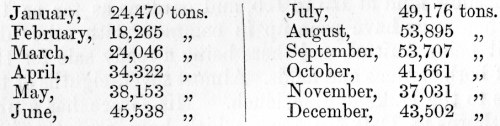
These figures give a total of 463,766 tons, or
a little more than one-thirtieth part of the whole amount raised in both
the eastern and western districts of Scotland. Coal mines may be said to
have gone up in value 30 per cent. in ten years, and 40 to 50 in twenty or
twenty-five years. The mining population are mostly well-behaved and
industrious, but like too many of the class to which they belong, are
somewhat improvident in their habits. When wages were at their height
three years ago, and from 8s. to 10s. or even 12s. per day could be made,
very few saved any portion of their earnings; consequently, little, if any
money is laid by in ordinary times, and a period of depression is too
often marked by privation and suffering. In 185?, wages were about 2s. 6d.
per day; in 1862, 5s.; and in 1872, 10s., so that ten years saw them
doubled; twenty years, quadrupled. Bates at present, however, are not much
in advance of what they were in 1862; indeed, in many cases 5s. per day is
not reached; and as we write, the prospects are not of the brightest.
Limestone is pretty widely diffused throughout
both counties. It is particularly abundant in all the coal districts. From
the earliest days of agriculture, large quantities of lime have been
burned in Hemperston, Middleton, Vogrie, and Arniston. At Crichton-Dean,
Cranston kilns, 24,000 bolls were a few years ago annually sold, the kilns
at Cousland producing 16,000 bolls. The most abundant strata are at
Grilmerton, in the parish of Liberton. In Abercorn parish, Linlithgow, the
value of raw produce, including coal, whinstone, and limestone, was, in
1843, estimated at L.22,700. Since the more general use of artificial
manure and extraneous feeding stuffs, lime as a land fertiliser has not
been so extensively used; but it is the opinion of many agriculturists
that much of the soil in both Edinburgh and Linlithgow would be benefited
by a good dose.
Sandstone is abundant, and the quarries add much to the wealth of the
country. One at Hailes yields a slaty stone which is easily worked, and
very suitable for pavements. Another at Redhall, a few years ago, brought
in a rental of L.11,000. From a quarry at Craigleith most of the beautiful
and durable stone of which the New Town of Edinburgh is built was
obtained. At
Clermiston, and other places, inexhaustible quarries of trap or blue
whinstone are worked. This is very valuable, not only for building
purposes but also for road-making, being exceedingly hard and lasting.
Ironstone, too, is largely developed in some
parts. The working of a band in Whitburn, Linlithgow, some twenty-five to
thirty years ago, provided a large means of local industry, and resulted
in changing the aspect of a bleak, lonely, and barren moor into a scene of
activity. This band yields from 27 to 30 per cent. of pig iron, and has
proved a profitable working. Iron is still wrought in several parts, and
adds much to the proprietors' revenue. Ironworks have advanced quite 25 to
30 per cent. in twenty years. In 1875, the quantity of pig iron exported
from Leith and Granton was 160,161 tons.
Firebricks are rather extensively made in some
localities, and besides supplying a large home demand, quantities are
occasionally shipped to other parts.
Manufactures.—Neither Edinburgh nor Linlithgow
occupies a very important position with regard to manufactures. Linen is
made at Edinburgh, Leith, and Musselburgh, but not to any great extent.
About 4000 hands are employed in the paper manufacture, which is chiefly
carried on at Colinton, Penicuik, Currie, Lasswade, Balerno, Auchendinny,
and some other places on the rivers Leith and Esk. A silk mill was erected
on the hanks of the Union Canal, a little to the west of Edinburgh, in the
year 1835, but the speculation did not turn out so successfully as the
promoters expected. In the town of Bathgate, about 600 to 800 hands are
employed in the paraffin works of Messrs Meldrum. Printing and publishing
are carried on in Edinburgh perhaps to a larger extent than in any other
town in the United Kingdom, London excepted.
Fishing.—A small portion of the population
residing along the banks of the Forth still obtain their livelihood,
either wholly or in part, from the sea, but the fisheries are by no means
extensive when compared with those of some districts along the eastern
seaboard of Scotland. Cured fish are exported to Germany, Holland, Russia,
and other countries.
Shipping Interests.—These are well represented by the seaport towns dotted
along the estuary of the Forth, particularly by Leith, which has a foreign
and colonial trade with Russia, Holland, Denmark, Sweden, Germany, East
and West Indies, America, China, and Australia, besides a considerable
coasting trade. In 1692 the shipping comprised 29 vessels, of 1702 tons in
the aggregate; in 1855, 168 sailing vessels, of 19,067 tons, and 25
steam-vessels, of 6327 tons. In 1859 the customs revenue amounted to
L.572,872. The total value of exports in 1859 was L.872,973. Since then
both the export and import trade have increased. The chief exports are
coal, iron, firebrick, and paraffin; the imports, grain, tallow, timber,
and live stock. In 1875 the principal imports of grain were:—wheat,
2,248,589 cwt.; barley, 652,930 cwt.; oats, 363,117 cwt.; rye, 69,465
cwt.; beans, 167,669 cwt.; pease, 116,467 cwt.; Indian corn, 351,345 cwt.;
and flour, 254,005 sacks.
The seaport of Borrowstounness, or Bo'ness,
enjoys a little trade. About the end of the 17th century it ranked next to
the port of Leith. The number of vessels which entered the port in 1870
was 390, representing a burthen of 41,851 tons, and the clearances 1420,
or 157,577 tons. Coal is the chief article of export.
Shipbuilding is carried on at Leith pretty
extensively, and the yards have turned out some very fine steamers and
sailing vessels. |



