|
By John Yeats, Esq. of
Kincorth, Advocate, Aberdeen.
[Premium, The Gold Medal.]
The estate of Kincorth, on
which the improvements embraced in this report have been executed, forms a
part of the eastern extremity of the Grampians. It lies in the parish of
Nigg, Kincardineshire, and is from two to three miles distant from the
market-cross of Aberdeen.
On acquiring the property
in September 1842, the reporter resolved to attempt its improvement.
Obstacles, by many deemed almost insuperable, abounded; but Aberdeen,
where hundreds of men were unemployed, was near, and wages were low; and
thus a more favourable time for the attempt was not likely to occur.
The property consists of
fertile haugh land, extending along the south side of the river Dee, and a
steep bank of old arable land rising from it. This bank of land is
succeeded by a hill, lying about 250 feet above the level of the river,
both fronting the north. It also consists of an almost level valley or
plain, stretching along the bottom of the hill to the west; and on the
south there stands another hill, now planted, the elevation of which is
some 350 feet above the level of the sea.
The operations on the plain
and the hill first mentioned are now reported upon.
The reporter found the
plain in a state of nature. It was altogether useless, producing only
heath and whins, amongst which, in many parts, a blade of grass could
scarcely be detected. After a fall of rain, it could be traversed neither
by man nor by beast, without risk. On its surface, where not covered with
large fixed stones (whinstones,) which all around met the eye, presenting
the appearance of one entire mass of rock, were a few inches of loam or
peaty earth; and below, a blue sandy clay, which, at a depth of from 3 to
4 feet, was found to change into sand. It contains about 44 acres, and, as
need not be stated, was worth nothing while in this dreary state.
In the winter of 1842, and
the spring of the year following, the reporter caused the whole of it to
be hand-trenched. The depth of the operation was 16 inches; the
surface-sod was taken off, (not more than 6 inches deep) reversed, and
laid flat, and equally divided in the bottom of the trench, while the
remainder of the soil and subsoil was put upon the top of the sod, and
properly levelled on the surface. Whatever stones two men with picks and
levers could move, were raised; and the numerous larger masses of rock
were bored, and blasted with gunpowder.
The contracts for trenching
averaged L.7, 7s. 6d. an acre; boring and blasting the large stones cost
3½d. a foot for inch bores, and 5d. for larger bores, exclusive of
gunpowder; the average, including gunpowder, being about L.6 an acre.
Stones being superabundant,
it was desirable, as regarded both economy and use, to employ as many as
possible in the several operations on the property; and accordingly, and
at the same time to dry the ground the more effectually, the drains were
made 5 feet deep and 27 inches wide, with an eye 9 inches square in the
bottom, and filled above with small stones, till within 18 inches of the
surface of the ground. The expense was 3½d. a yard, or L.4 an acre.
Substantial stone dykes,
dividing the ground into ten fields, were next erected. These are 4½ feet
high, and are built in regular courses over covered drains, level with the
bottom of the trench which is filled to the surface with small stones. The
expense, including the cutting of the foundation and removing stones, was
10d. a yard. The fields are small, averaging 4 acres—the reporter having
been desirous as well to use as many stones in the dykes as was compatible
with neatness, as to divide his property into farms comprehending from 40
to 70 acres. Such, in a town locality, are found to be more advantageous
than farms of greater extent.
Early in the spring of 1843
these fields were ready for the plough; and, after having been for a time
exposed to the action of the air and frost, and abundantly manured with
Aberdeen police dung and lime, (30 cubic yards of the one, and 8½ bolls—51
bushels, of the other, being given to the acre,) they were sown with oats.
The crop was sold upon the ground, at prices averaging L.9 an acre. Five
of the fields were sown with grass, and from the other five fields a
second crop of oats (sown out with grass) was taken, which was also sold
upon the ground for about the same price. The grass was luxuriant, and was
sold for L.6 an acre. The subsequent crops have been very heavy. The
ground presents the appearance of having long been successfully
cultivated. It is a sandy blue clay, open soil, slightly mixed with peat
moss.
The reporter has
incorporated this improved ground with the adjoining old land, and it is
let (excluding the old land from the calculation) at rents which average
fully 40s. an acre. Every field is well watered.
The results attending the
improvement of this ground are as follows:—
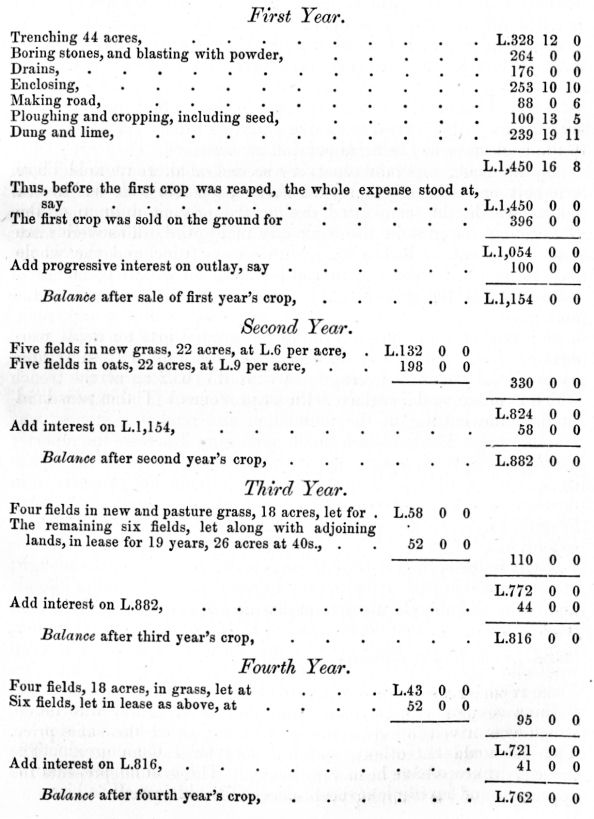
Having proceeded with the
improvement of the plain before referred to, so as to be satisfied with
the results, the reporter directed his attention to the improvement of the
hill, which has been described as rising about 250 feet above the level of
the river Dee. It lies a little to the westward of the plain, and contains
66 acres of ground, which, like the plain, was thought by many would prove
incapable of being improved for profit or use. The rocky barren
worthlessness of the one describes that of the other; in all respects both
were similar. And suffice it to say, that in the years 1844, 1845, 1846,
the hill was operated upon as the plain had been, although at somewhat
greater expense, labour having risen in value. The crops and rents have
yielded the same satisfactory results.
This hill was divided into
eighteen fields. These are enclosed with dykes built in regular courses,
and in other respects similar to the enclosures of the fields previously
described. They are abundantly watered; and between every second or
alternate field there is a belt or enclosure, to secure shelter, (50 feet
wide within the dykes,) which will be planted during the present autumn or
the next spring. For the reasons already mentioned, all the fields are
small in extent. Most of them have been twice, and the whole once, cropped
with oats. The soil is yellow loam, and open.
To promote the proper
management of his new land, and complete his arrangements, the reporter
has added it to the adjoining farms; so that these farms now comprehend
nearly an equal proportion of old and new land. The leases are for 19
years; and the new land yields an average yearly rent of L.2 an acre.
The expense and results of
the improvement of this new land are the following:—
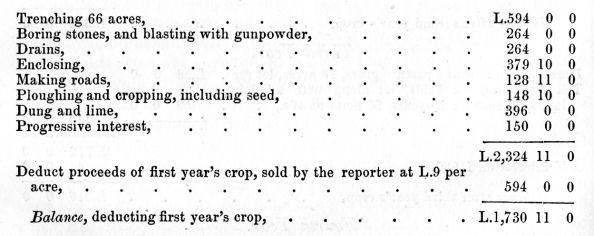
The reporter was desirous
to provide good roads, without which no improvements can be rendered
really useful. And, in forming these, he contrived to get rid of many
hundred cart-loads of stones, which he could not otherwise, without
considerable unproductive expense, dispose of—as he had in drains, in
dykes, in houses, and in making up and levelling several fields of his old
as well as his new land consumed as many of his heavy antagonists as
could, with advantage, be used. Accordingly his property is now
intersected by roads of a solidity which the lapse of many years will not
materially affect. They are founded with stones compactly laid together to
a depth of from 6 to 8 inches, over which abundance of "metal" is
deposited.
He has erected four
complete farm-steadings, which the tenants possess on dead inventory,
besides altering and improving other buildings on his property.
In conclusion, the reporter
may humbly state his belief that the improvements which he has effected
will not be without their use. To himself they will prove remunerative;
and to the environs of Aberdeen, the substitution of verdure for bleakness
will afford some additional beauty.
The reporter's improvements
were all designed and carried most satisfactorily into execution by Mr
James Mennie, land-surveyor in Aberdeen. |



